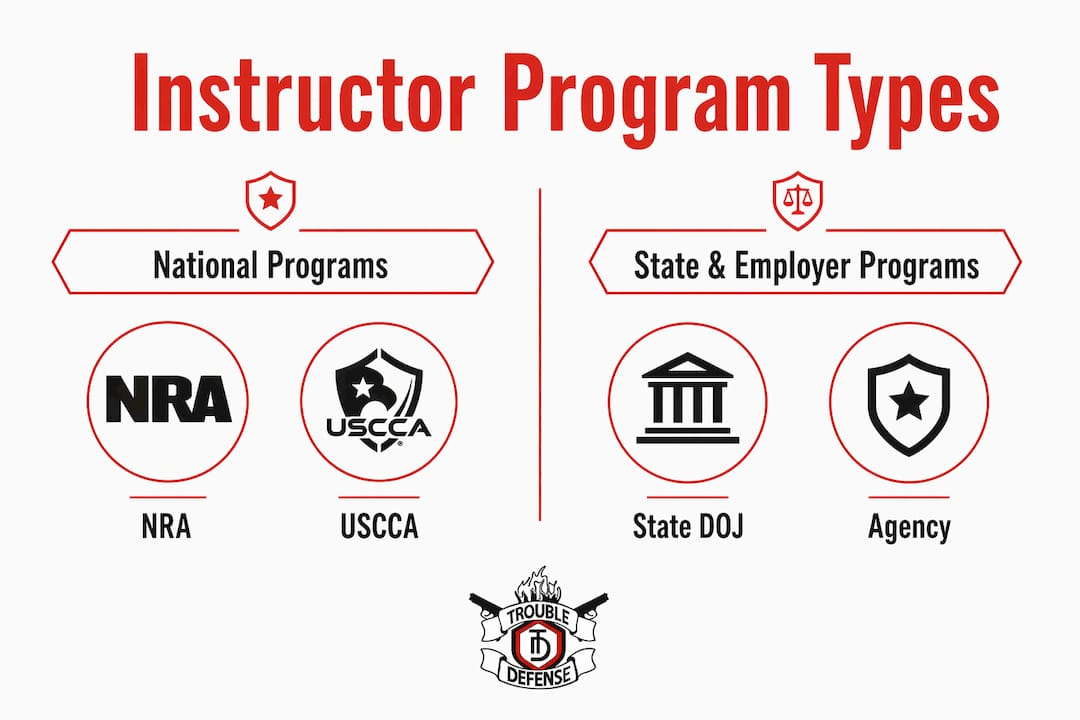
You can become a certified firearms instructor by completing one of three main paths: a national association program (NRA or USCCA), a state or DOJ-certified instructor program, or an employer and agency training course. The right path depends entirely on what you plan to teach and where.
Two fastest starting points:
- State/DOJ-certified instructor route — required if you want to teach permit-authorized classes in states like California, Minnesota, or Massachusetts
- NRA or USCCA instructor program — the most portable civilian credential for running public gun safety courses across multiple states
Before you spend a dollar on tuition, do two things: confirm your state’s specific instructor approval rules, and take an honest look at your current shooting proficiency. Many programs screen candidates before the course even starts.
Table of Contents
- What are the main certified firearms instructor programs?
- What does an instructor course actually cover?
- Who qualifies for instructor courses?
- How much does certification cost, and how long does it take?
- How do state rules differ, and how do you verify yours?
- What insurance and liability considerations matter for instructors?
- How do you choose the right program before you enroll?
- What separates a strong instructor candidate from the rest?
- Common challenges during certification and how to handle them
- How to prepare and apply to an instructor program
- Where does certification lead? Career paths and income potential
- What shooting skill level do you need before applying?
- Key Takeaways
- Why the “just get certified” mindset misses the point
- Trouble Defense supports aspiring instructors in the DMV
- Useful sources
- FAQ
What are the main certified firearms instructor programs?
Four program categories cover nearly every instructor path in the United States. Each grants a different credential and serves a different professional goal.
NRA Instructor Program
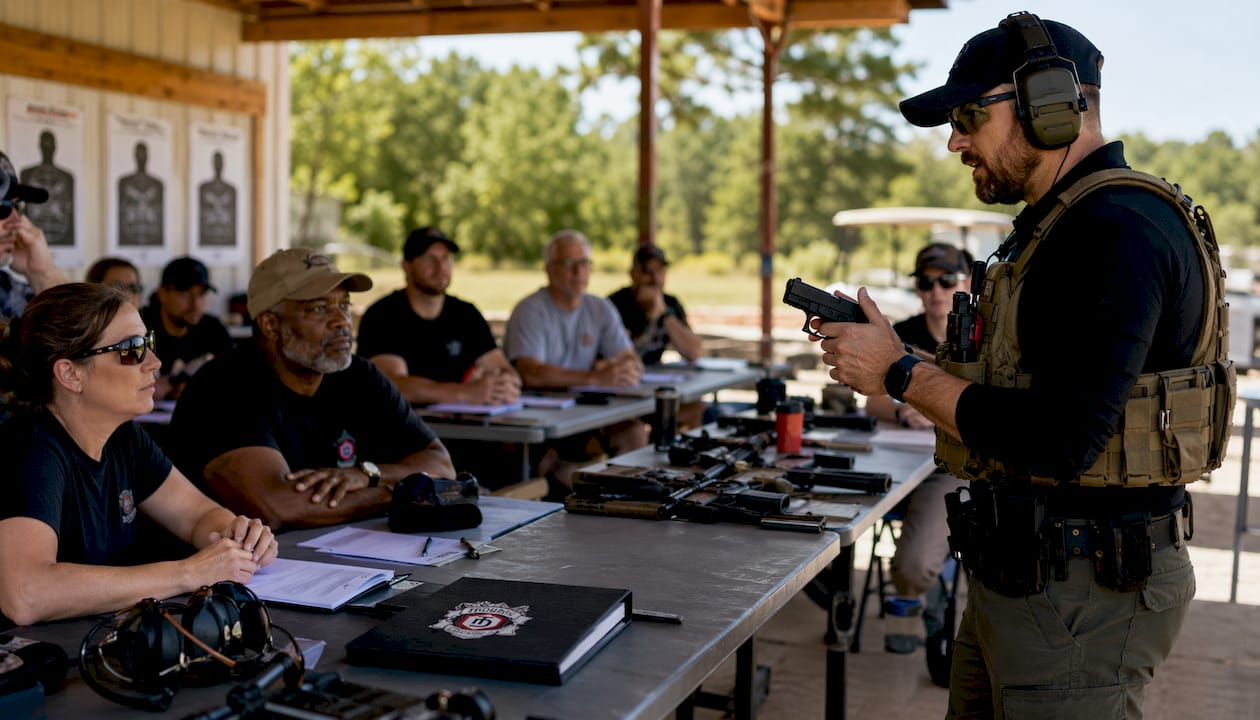
The NRA offers discipline-specific instructor ratings across pistol, rifle, shotgun, personal protection, and more. The NRA instructor process follows a three-step sequence: complete the relevant Basic course, attend Basic Instructor Training (BIT), then finish the discipline-specific instructor course. Activation fees apply after completion, and the credential renews every two years. NRA instructor ratings are widely recognized across states for civilian courses, though they don’t automatically satisfy every state’s permit-class requirement.
USCCA Certified Instructor
USCCA uses a blended format: roughly 6–8 hours of online eLearning followed by two days of classroom and live-fire instruction. Candidates must purchase an Instructor Toolkit as part of the program. USCCA’s curriculum leans heavily on concealed carry and self-defense law, which suits instructors whose students are primarily permit seekers.
State/DOJ-Certified Instructor Programs
States like California, Minnesota, and Massachusetts maintain their own instructor approval lists. California’s DOJ Certified Instructor program authorizes instructors to issue Firearm Safety Certificates. Minnesota’s Firearms Carry Permit Instructor Certification requires state-specific approval before you can legally teach permit classes there. If your goal is to run state-authorized permit courses, this path isn’t optional.
Employer and Agency Programs
Law enforcement, military, and private security organizations often run their own instructor pipelines. These programs can run 40 or more hours and focus on professional-use scenarios, force continuum, and agency-specific protocols. They’re not portable to civilian teaching contexts, but they’re the gold standard for professional settings.
What does an instructor course actually cover?
Instructor training goes well beyond shooting well. The curriculum is split between classroom knowledge and live-fire application, and both halves are tested.
| Component | Typical Content | Assessment Method |
|---|---|---|
| Firearm safety fundamentals | Four rules, safe handling, storage | Written exam |
| Range management | Line commands, safety officer duties, emergency protocols | Practical evaluation |
| Legal and use-of-force overview | State law basics, liability concepts | Written exam |
| Lesson planning and pedagogy | Adult learning principles, session structure | Teach-back exercise |
| Live-fire qualification | Accuracy and proficiency drills | Scored range qualification |
| Teach-back sessions | Candidate teaches a module to peers | Instructor evaluation |
NRA instructor exams commonly require a high score to pass, and teach-back exercises are graded on clarity, safety management, and student engagement, not just content accuracy. The range qualification isn’t a formality either. Failing to meet the required shooting score can disqualify a candidate regardless of how well they performed in the classroom.
Common curriculum elements across most programs:
- Firearm safety rules and safe storage practices
- Range setup, line management, and emergency response
- Lesson planning and adult learning techniques
- Legal overview: use of force, instructor liability, state-specific rules
- Practical teach-back sessions with peer and evaluator feedback
- Live-fire qualification drills with documented scoring
Who qualifies for instructor courses?
Most programs share a core set of eligibility requirements, though the specifics vary by organization and state.
Standard eligibility items:
- Minimum age of 21 (some programs accept 18 with restrictions)
- Legal right to possess firearms under federal and state law
- No disqualifying criminal history
- U.S. citizenship or lawful permanent resident status for some programs (ITAR-related restrictions can bar non-U.S. persons from certain specialized courses)
- NRA membership is required for NRA instructor activation
Pre-course proficiency expectations are where many candidates get surprised. Programs like the NRA’s require demonstrated shooting skill before instructor instruction begins. Showing up to an instructor course without solid fundamentals is the most common reason candidates struggle or fail. If your groupings aren’t consistent at 7–15 yards, spend time on the range before you apply.
Some state programs also require candidates to be affiliated with or employed by an approved organization before they can teach permit classes. Confirm that requirement before you enroll anywhere.
How much does certification cost, and how long does it take?
Costs vary enough that a single number would mislead you. Here’s a realistic breakdown:
- NRA instructor courses: Tuition typically runs a few hundred dollars per discipline, plus activation fees that differ for members versus non-members, and renewal fees every two years
- USCCA instructor program: Course tuition plus a required Instructor Toolkit purchase; total first-year costs can reach several hundred dollars
- State DOJ programs: Fees vary by state; some charge application or certification fees on top of any required training course
- Agency/professional programs: Often employer-funded; individual cost varies widely
Timeline expectations:
- NRA: The three-step sequence (Basic course → BIT → Instructor course) can be completed in a few weekends, though scheduling gaps between steps often stretch the process to one to three months
- USCCA: Online modules plus a two-day in-person session means most candidates finish within a month of enrolling
- State programs: Application processing and approval can add weeks or months beyond course completion
- Renewal: NRA credentials renew every two years; state programs often require annual renewal or ongoing affiliation with an approved organization
Pro Tip: Budget for more than just tuition. Range fees, ammunition, toolkit purchases, and activation fees are real costs that catch first-time candidates off guard. Get the full cost breakdown from any program before you commit.
How do state rules differ, and how do you verify yours?
State-level variation is the single biggest source of confusion for aspiring instructors. A national association credential does not automatically qualify you to teach state-authorized permit classes.
Several state permit programs maintain their own approved organization lists and require instructor affiliation with one of those organizations to legally offer permit-authorized training. California’s DOJ publishes its own instructor certification process. Minnesota’s Bureau of Criminal Apprehension maintains a separate instructor certification program tied directly to state statute. Massachusetts runs its own Firearms Safety Instructors Certification Program.
Steps to verify your state’s requirements:
- Visit your state police or Attorney General’s website and search for “firearms instructor certification” or “permit instructor requirements”
- Check the state DOJ or Department of Public Safety training pages for approved organization lists
- Review the official permit program page to see whether instructor affiliation is required
- Contact the issuing agency directly if the published rules are ambiguous
Pro Tip: Before advertising permit classes, verify that BOTH you as an individual AND the organization you’re affiliated with appear on your state’s approved list. Being a certified instructor with an unapproved organization can make your permit classes legally invalid for students.
What insurance and liability considerations matter for instructors?
Teaching firearms carries real liability exposure. Most range owners and program administrators will tell you that insurance isn’t optional.
Coverage types to consider:
- General liability insurance: Covers bodily injury and property damage claims arising from your classes
- Professional liability insurance: Covers claims that your instruction was negligent or inadequate
- Range liability: Confirm whether the range you use carries its own coverage and whether it extends to guest instructors or requires you to carry your own
Best practices for risk management:
- Use written waivers for every student, reviewed by an attorney familiar with your state’s laws
- Keep detailed records: attendance, qualification scores, equipment used, and any incidents
- Maintain a written incident response plan before you ever run a class
- Confirm your coverage limits annually, especially if your student volume grows
Pro Tip: Check whether your national association (NRA, USCCA) offers member instructor liability coverage as part of your credential. Some do, and it can be a cost-effective starting point, though it may not replace a standalone policy for high-volume instructors.
Understanding your exposure early also means knowing when to consult a professional. Resources like firearm charges defense support exist for instructors navigating legal questions that go beyond standard liability coverage.
How do you choose the right program before you enroll?
Picking the wrong program wastes months and money. Run through this checklist before you commit.
Decision checklist:
- What is your primary teaching goal? (Permit classes, civilian safety courses, agency training)
- Does your state accept this credential for the type of courses you want to teach?
- Is the course format compatible with your schedule? (Single weekend vs. multi-day vs. blended online)
- Do you have confirmed range access for qualification and future teaching?
- Does the program include or require specific insurance coverage?
- Will the credential be recognized if you teach in neighboring states?
Questions to ask any program before enrolling:
- What is the maximum class size for the instructor course?
- What are the exact qualification standards for the range component?
- What post-certification support does the program offer?
- What is the instructor-to-candidate ratio during teach-backs?
- What is included in the toolkit or materials fee, and what is the total cost?
Red flags to watch for:
- Vague or unpublished qualification standards
- No documented renewal or recertification process
- No affiliated range or range partner listed
- Instructors who can’t explain what the state acceptance process looks like
Industry advisors consistently recommend matching your program to your end goal rather than defaulting to the most well-known name. A USCCA credential is excellent for concealed carry instruction; it may not satisfy a state that requires its own DOJ-certified instructor approval.
What separates a strong instructor candidate from the rest?
Marksmanship gets you in the door. Teaching ability determines whether you succeed. Experienced NRA Training Counselors consistently note that the most successful candidates demonstrate clear lesson planning, safe line management, and effective teach-backs, not just tight groupings.
Attributes that matter beyond shooting skill:
- Clear verbal communication under range conditions (noise, stress, distraction)
- Patience with students who learn at different speeds
- Organizational discipline: lesson plans, documentation, equipment checks
- Situational awareness to manage a firing line safely while also teaching
Practical teaching techniques used by veteran instructors:
- Chunk lessons into short segments with a clear objective for each
- Use dry-fire demonstrations before live-fire to reduce anxiety and errors
- Give corrective feedback privately when possible; praise publicly
- Run a safety briefing at the start of every session, even with experienced students
- Debrief after every teach-back with specific, constructive notes
The candidates who struggle in instructor courses are almost never the ones with the worst shooting. They’re the ones who freeze when asked to explain a concept clearly, or who can’t manage a line of six students safely while also delivering instruction.
Common challenges during certification and how to handle them
Failing the pre-course qualification. This is more common than programs advertise. If you haven’t shot consistently in months, your scores may not meet the entry threshold. The fix is straightforward: build baseline shooting skills before you apply, not after you’ve paid tuition.
Teach-back anxiety. Standing in front of peers and evaluators to deliver a lesson is uncomfortable for most first-time instructor candidates. Practice at home with a mirror or a small group before the course. The evaluators aren’t looking for perfection; they’re looking for safety awareness and clear communication.
Scheduling conflicts between course steps. The NRA’s multi-step sequence requires completing courses in order, and scheduling gaps between a BIT and the discipline-specific instructor course can stretch timelines significantly. Map out all three steps before you register for the first one.
State approval confusion. Completing a national program and then discovering your state requires a separate approval process is a frustrating and avoidable delay. Verify state rules before you enroll, not after you graduate.
How to prepare and apply to an instructor program
Getting your application right the first time saves weeks of back-and-forth.
Documentation to gather early:
- Government-issued photo ID
- Proof of U.S. citizenship or lawful permanent resident status (where required)
- Current NRA membership card (for NRA programs)
- Any prior training certificates or course completion records
- Range access confirmation or affiliated range documentation
Application process steps:
- Identify the specific credential you need based on your state and teaching goals
- Confirm eligibility requirements directly with the issuing organization
- Register for any prerequisite courses (Basic course, BIT) before the instructor course
- Complete the online application or registration form and pay any required fees
- Schedule your range qualification session and confirm ammunition requirements
- Submit all documentation and follow up on activation or approval status after course completion
The step-by-step instructor guide from Trouble Defense covers DMV-specific pathways in detail, including Virginia, Maryland, and DC requirements, for candidates navigating the local permit landscape.
Where does certification lead? Career paths and income potential
A firearms instructor credential opens more doors than most candidates expect.
Common employment and teaching settings:
- Private firearms training academies and shooting ranges
- Gun shops offering safety and permit courses
- Community colleges and continuing education programs
- Corporate and workplace active-shooter preparedness training
- Law enforcement and security contractor training programs
- Independent instruction (self-employed, teaching your own courses)
Income varies widely by setting, geography, and specialization. Independent instructors in high-demand metro areas can charge premium rates for private lessons and small-group courses. Instructors affiliated with ranges or academies typically earn per-class fees or hourly rates. Security and law enforcement training contracts often pay the highest rates but require specialized credentials and agency relationships.
Specialization accelerates earning potential. Instructors who add credentials in areas like adaptive training, women’s self-defense, or active-shooter response can reach student populations that most generalist instructors don’t serve. Trouble Defense’s adaptive firearms training program for blind and low-vision individuals is one example of how specialization builds both reputation and demand.
What shooting skill level do you need before applying?
Most programs don’t publish a precise minimum score for pre-course qualification, but the expectation is clear: you should be a competent, consistent shooter before you try to teach others.
Practically, that means:
- Reliable accuracy at 7, 10, and 15 yards with a handgun (or the relevant firearm for your discipline)
- Consistent application of the four safety rules under observation
- Smooth, safe handling during loading, unloading, and malfunction clearing
- Comfort on a live-fire range without coaching
If you’re not there yet, structured shooting lessons focused on fundamentals will close the gap faster than unstructured range time. Dry-fire practice at home, combined with regular live-fire sessions, is the most efficient preparation method most experienced instructors recommend.
Key Takeaways
Becoming a certified firearms instructor requires choosing the right program for your state and teaching goals, meeting pre-course proficiency standards, and maintaining your credential through renewal cycles.
| Point | Details |
|---|---|
| Choose the right path first | Match your program (NRA, USCCA, state DOJ) to your specific teaching goal before enrolling. |
| Verify state rules early | Some states require separate DOJ or state police approval beyond any national credential. |
| Meet proficiency standards | NRA exams commonly require a 90% score on the written test, and range qualification failures can block entry regardless of tuition paid. |
| Budget for total costs | First-year costs include tuition, toolkit purchases, activation fees, and range fees, often totaling several hundred dollars. |
| Trouble Defense for DMV candidates | Trouble Defense offers mentor-led prep, CCW instructor support, and local range partnerships for aspiring instructors in Virginia, Maryland, and DC. |
Why the “just get certified” mindset misses the point
Most guides treat instructor certification as a finish line. It isn’t. The credential is a starting point, and what you do with it in the first year determines whether you build a real teaching career or let the renewal lapse unused.
The instructors who build lasting reputations share one trait: they treat every class as a live test of their communication skills, not just their shooting knowledge. A student who leaves your course confused about the four safety rules is a liability, regardless of what your certificate says. That’s why programs like the NRA’s require teach-backs and scored range qualifications rather than just a written test. The evaluation is designed to surface exactly that gap between knowing and teaching.
There’s also a practical reality that most certification guides skip: your first few classes will be harder than the instructor course itself. Managing a mixed-skill group on a live-fire line, answering questions you didn’t anticipate, and keeping the pace moving without cutting corners on safety, that’s where the real learning happens. The candidates who succeed are the ones who seek mentorship after certification, not just before it.
For aspiring instructors in the DMV, the combination of state-specific permit rules across Virginia, Maryland, and DC makes local mentorship especially valuable. Getting certified is step one. Knowing how to navigate three different state permit frameworks while running a safe, professional class is what actually builds a career.
Trouble Defense supports aspiring instructors in the DMV
Veteran-owned and based in Fairfax, VA, Trouble Defense is the practical next step for instructor candidates in Virginia, Maryland, and Washington, DC who need more than a course catalog. The difference here is hands-on mentorship from certified NRA instructors who know the local permit landscape across all three jurisdictions.
Relevant services for instructor candidates include mentor-led preparation sessions, range access partnerships, Virginia CCW and Maryland Wear and Carry instruction, DC concealed carry training, adaptive firearms training, women’s firearms training, and private coaching for candidates preparing for qualification. Whether you need to sharpen your shooting fundamentals before a pre-course qualification or want guidance on which CCW permit class structure fits your teaching goals, Trouble Defense has the local experience to point you in the right direction. Browse the full firearm safety training guide or contact Trouble Defense directly to schedule a prep session or private lesson.
Useful sources
Use these primary sources to verify program rules, state acceptance, and renewal requirements before enrolling in any instructor course.
- NRA Instructor Program: firearmtraining.nra.org/become-an-instructor — official program overview, discipline list, and activation steps
- California DOJ Certified Instructor: oag.ca.gov/firearms/fscinfo — FSC instructor certification requirements and renewal rules
- Minnesota BCA Instructor Certification: dps.mn.gov — state-specific permit instructor approval process
- Massachusetts Firearms Safety Instructors Certification: mass.gov — state program details and approved instructor list
- USCCA Instructor Program: third-party trainer pages and USCCA’s own site for current toolkit costs and course format
- Minnesota Statute 624.714: revisor.mn.gov — the statutory basis for Minnesota’s permit instructor requirements
When reviewing any official page, confirm: which organizations are on the approved list, what the renewal cycle requires, and whether individual instructor affiliation is mandatory for permit-authorized courses.
FAQ
How hard is it to become a firearms instructor?
The difficulty depends on your starting point. Candidates with solid shooting fundamentals and teaching experience typically find the process manageable, but programs like the NRA’s require a 90% score on the written exam and a passed range qualification, so underprepared candidates do fail.
How much does it cost to become a firearms instructor?
First-year costs vary by program but commonly reach several hundred dollars when you add tuition, required toolkit purchases, activation fees, and range fees. Budget for the full picture, not just the advertised course price.
Do I need state approval beyond a national certification?
Often, yes. States like California, Minnesota, and Massachusetts require separate state-level instructor approval to teach permit-authorized classes, regardless of your NRA or USCCA credential. Always verify your state’s rules before advertising permit courses.
How do I become a certified firearms instructor in a specific state like Pennsylvania?
Pennsylvania and most states require you to hold a recognized instructor credential (NRA is widely accepted) and may require affiliation with an approved organization for permit classes. Check your state police or Attorney General’s website for the current approved list and any additional state-specific steps.
Can Trouble Defense help me prepare for an instructor certification course?
Yes. Trouble Defense offers mentor-led prep sessions, private coaching, and range access in the DMV area, specifically for candidates in Virginia, Maryland, and DC who are working toward instructor certification. Contact Trouble Defense to discuss your goals and schedule a preparation session.