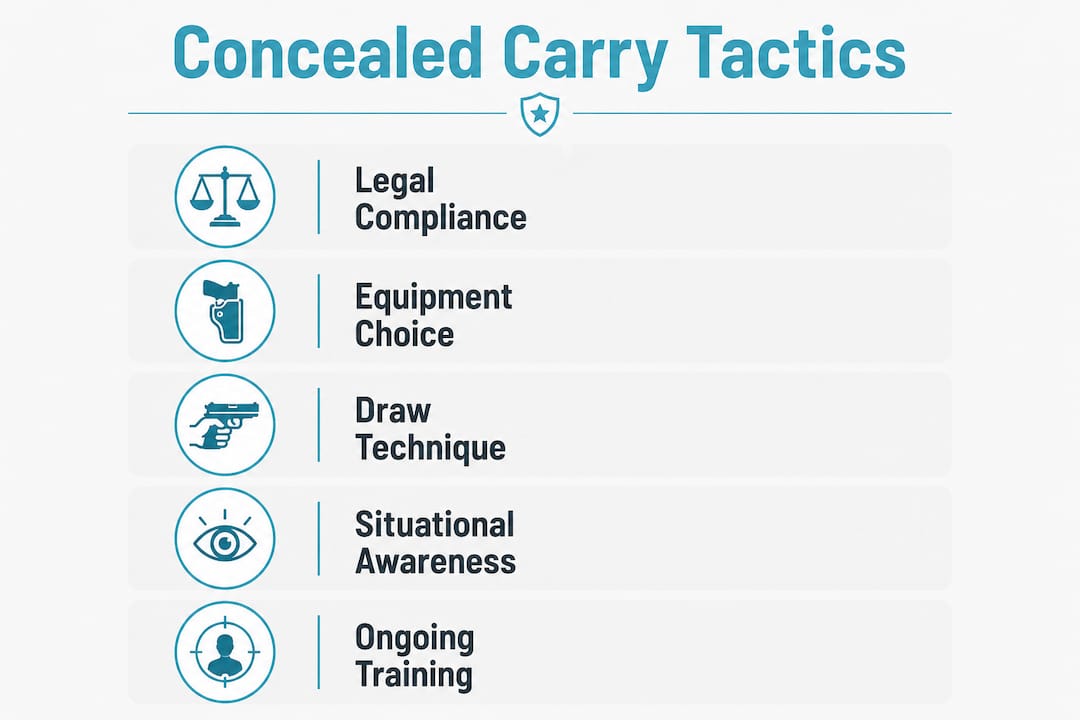
Concealed carry tactics are defined as the coordinated system of legal awareness, gear selection, draw skill, and situational discipline that transforms a permit into genuine self-defense capability. Carrying a firearm without this system is like holding a medical license without ever treating a patient. The complete tactical system combines the right pistol, a quality holster, defensive ammunition, legal knowledge, and consistent training. Troubledefense, a veteran-owned firearms training academy in Fairfax, VA, builds this system into every student from day one. Understanding what concealed carry tactics actually require is the first step toward carrying responsibly and effectively.
What is concealed carry tactics as a complete system?
Concealed carry tactics refer to every decision and skill a carrier applies before, during, and after a potential threat. The term covers far more than the mechanics of drawing a gun. It includes how you select and position your equipment, how you read your environment, how you respond under stress, and how you train to make all of that automatic.
The permit itself is legal permission, not a skill set. A CCW permit authorizes you to carry. It does not teach you when to draw, how to draw safely, or how to avoid a confrontation in the first place. That gap between license and capability is where tactics live, and closing it requires deliberate, structured practice.
Stress and adrenaline cause people to revert to trained behavior. Untrained carriers frequently fail under real engagement conditions because their bodies default to whatever they have practiced most. If you have practiced nothing, your body has nothing to default to. That is the core argument for treating concealed carry as a system rather than a single decision.
What are the essential equipment choices in concealed carry tactics?
Equipment is the physical foundation of every concealed carry technique. The wrong gear creates printing problems, slow draws, and safety failures. The right gear disappears under your clothing and performs consistently under pressure.
Choosing the right firearm and holster
Your holster is not an accessory. It is a safety device. A quality holster must cover the trigger guard completely, provide consistent retention, and deliver the same draw stroke every single time. Holsters that shift, collapse, or expose the trigger guard are responsible for a significant share of negligent discharges. The firearm and holster must be matched specifically. A universal holster built for “most compact pistols” is not a tactical choice.
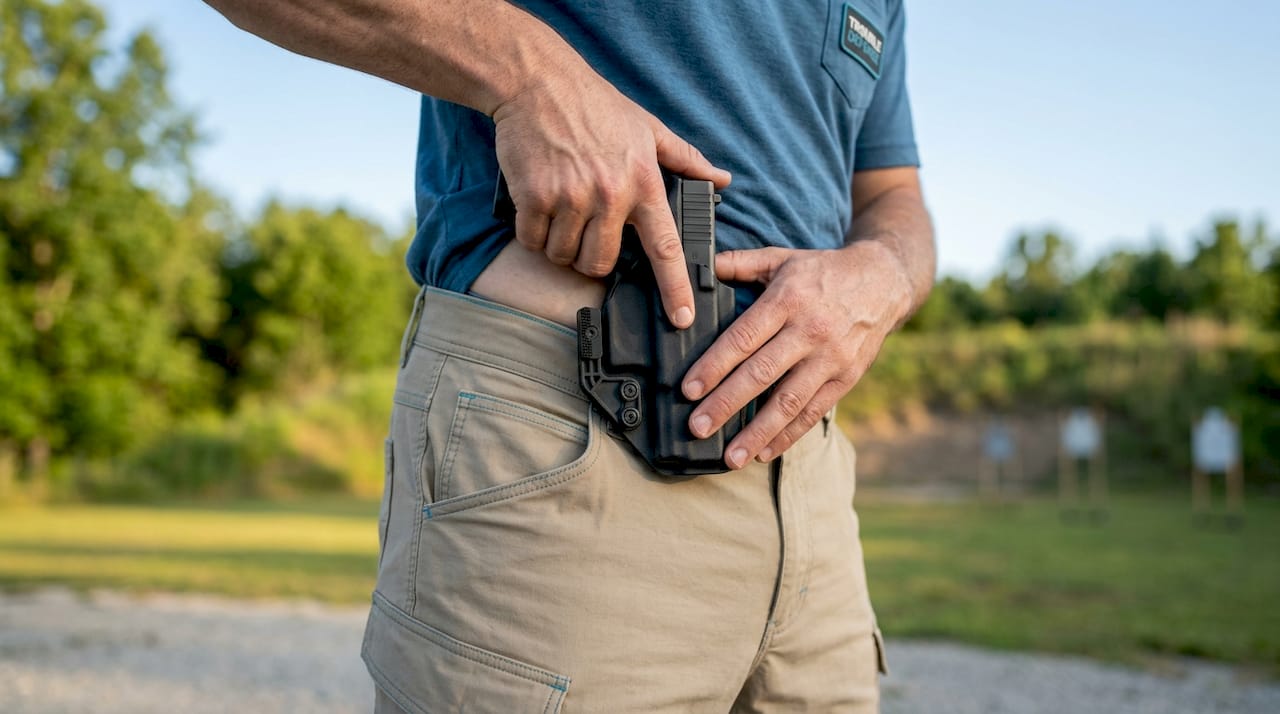
The four primary carry positions each carry tradeoffs:
| Carry Position | Concealment | Draw Speed | Comfort |
|---|---|---|---|
| IWB (inside waistband) | High | Moderate | Moderate |
| OWB (outside waistband) | Low to moderate | Fast | High |
| AIWB (appendix inside waistband) | High | Fast | Requires practice |
| Pocket carry | High for small pistols | Slow | High |
AIWB has become the preferred position for many defensive pistol instructors because it combines strong concealment with a fast, natural draw stroke. Pocket carry works well as a backup or for very small firearms but limits draw speed significantly.
Clothing, belts, and ammunition
Effective concealment depends on clothing and equipment working together. Darker colors, looser shirts, and longer hems reduce printing. A reinforced gun belt is non-negotiable. Standard dress belts flex and sag under the weight of a holstered firearm, which shifts your draw position unpredictably.
Ammunition selection is equally specific. Carry quality defensive hollow point rounds designed for terminal performance in real-world conditions. Full metal jacket range ammunition is for practice only. The difference in terminal performance between FMJ and quality hollow points is substantial in a defensive scenario.
Pro Tip: Dress around your gun, not the other way around. Buy two or three shirts in slightly larger sizes and test your full draw stroke in front of a mirror before carrying in public.
How do safe and effective draw techniques define concealed carry tactics?
Drawing from concealment is a complex motor skill that requires thousands of repetitions before it becomes reliable under stress. Most carriers dramatically underestimate how much practice a consistent draw actually demands.
The standard four-count draw stroke breaks down as follows:
- Establish grip. Drive your strong hand to the firearm while it is still holstered. Your grip must be complete before the gun clears leather. A partial grip means a grip adjustment mid-draw, which costs time and introduces error.
- Clear the garment. Use your support hand or a sweeping motion to move clothing out of the draw path. The technique varies by carry position and clothing type. AIWB carriers typically use a shirt-sweep with the support hand. Strong-side IWB carriers often use a rearward shirt-pull.
- Rotate the muzzle. As the firearm clears the holster, rotate the muzzle toward the threat. At this point, you can fire from retention if the threat is extremely close.
- Extend to target. Drive the firearm forward to a two-handed grip and full extension. Your sights align as the gun reaches the target.
Common draw mistakes to eliminate
The fishing-pole extension is one of the most common errors. It occurs when the carrier raises the gun upward before pushing it forward, adding a full second to draw time. Grip-fix stutters happen when the initial grip is incomplete and the carrier stops mid-draw to adjust. Both errors disappear with structured repetition.
Dry-fire practice at home is the most efficient way to build draw skill. The protocol requires a physical and visual chamber check to confirm the firearm is unloaded, removal of all live ammunition from the room, and use of snap caps to protect the firing pin. Thousands of dry-fire repetitions cost nothing and build the muscle memory that live-fire cannot replicate at the same volume.
Pro Tip: Record your dry-fire sessions on your phone. Watching the footage reveals grip errors and garment-clearing problems you cannot feel in the moment.
Why is situational awareness the most important concealed carry tactic?
Situational awareness is the most vital skill a concealed carrier develops because it is the only tactic that prevents a confrontation entirely. Every other skill on this list assumes a threat has already materialized. Awareness stops threats before they reach that point.
The Cooper Color Code system provides a practical mental framework:
- White: Unaware and unprepared. Dangerous for a carrier.
- Yellow: Relaxed alertness. Aware of your surroundings without fixating on any single threat. This is the baseline state for every concealed carrier in public.
- Orange: A specific person or situation has drawn your attention as a potential threat. You are mentally preparing a response.
- Red: A threat is confirmed and you are prepared to act.
Maintaining Condition Yellow means scanning entry and exit points when you enter a building, noticing who is near you and how they are behaving, and positioning yourself with your back to a wall when possible. None of this is paranoia. It is the same awareness a trained security professional applies every day.
Recognizing pre-attack indicators gives you time to act before a situation escalates. Behavioral signals include target glancing (repeatedly looking at your valuables or weapon), interview behavior (a stranger asking unusual questions to gauge your awareness), and blading (turning the body sideways to conceal a weapon or prepare to strike).
“The goal of situational awareness is not to find threats everywhere. It is to see them early enough that avoidance and de-escalation remain options.” This principle defines the tactical mindset every responsible carrier should carry alongside their firearm.
Drawing a firearm is the last resort after all lesser options are exhausted. Awareness shortens your OODA loop (Observe, Orient, Decide, Act), which increases the likelihood of resolving a situation without ever touching your firearm.
What other tactical skills support effective concealed carry?
A complete set of concealed carry strategies extends beyond drawing and awareness. Equipment failures happen. Injuries happen. Preparedness for both separates a trained carrier from someone who simply owns a gun.
Malfunction clearance under pressure
Malfunction clearance sequences like Tap-Rack-Bang address the most common pistol stoppages. Tap the magazine to seat it, rack the slide to eject a failed round and chamber a fresh one, and reassess. Practitioners train these sequences to completion in 2 to 8 seconds under stress. That timing benchmark matters because a stoppage in a defensive scenario will not wait for you to think through the steps.
Medical preparedness and trauma gear
Trauma control training is a non-negotiable component of responsible carry. A tourniquet in your bag is useless without the muscle memory to apply it correctly under stress. Stop the Bleed courses teach the skills in a few hours. Carrying a compact individual first aid kit (IFAK) with a tourniquet, pressure bandage, and chest seal addresses the injuries most likely to occur in a defensive encounter.
Reholstering and equipment maintenance
Reholstering is the highest-risk moment in the entire carry cycle. Most negligent discharges happen during reholstering, not during the draw. The rule is simple: reholster slowly, deliberately, and with visual confirmation that the holster mouth is clear. There is no tactical reason to reholster quickly. The threat is over.
Regular equipment checks round out the preparedness picture. Inspect your holster for wear and retention changes monthly. Rotate your carry ammunition annually. Verify your firearm’s function with a chamber check every time you holster up for the day.
Key takeaways
Concealed carry tactics form a complete system where legal knowledge, proper gear, draw skill, situational awareness, and medical preparedness work together to make carrying both safe and effective.
| Point | Details |
|---|---|
| Tactics are a system | Legal compliance, gear, draw skill, and awareness must all work together. |
| Holster quality is non-negotiable | Trigger guard coverage and consistent retention prevent negligent discharges. |
| Draw skill requires repetition | Thousands of dry-fire reps build the muscle memory that performs under stress. |
| Awareness prevents most threats | Condition Yellow and pre-attack recognition allow avoidance before drawing. |
| Medical prep completes the picture | Carrying and training with a tourniquet addresses injuries a firearm cannot prevent. |
What I’ve learned from watching carriers train
I have worked with hundreds of students at Troubledefense, from complete beginners to veterans with decades of trigger time. The pattern I see most consistently is this: people invest in the firearm and almost nothing else. They buy a quality pistol, a cheap holster, and consider themselves prepared. Then they come to a class and discover their draw takes four seconds and their situational awareness stops at the parking lot.
The permit creates a false sense of completion. You passed a test. You got a card. That feels like an endpoint when it is actually a starting line. The carriers who develop genuine capability treat their defensive pistol training as an ongoing practice, not a one-time certification.
The other thing I push back on constantly is the idea that carrying is primarily about the gun. The firearm is the last tool you reach for. The first tools are your eyes, your positioning, your awareness, and your willingness to leave a situation before it escalates. I have seen students who could draw in under a second but could not tell me who was standing behind them when they walked into the room. That is not a trained carrier. That is someone with a fast hand and a dangerous blind spot.
Carry every day or not at all. Consistency builds the habits that make carrying safe. Intermittent carry means intermittent awareness, intermittent gear familiarity, and intermittent competence. None of those are acceptable when the stakes are this high.
— Dee
Train with Troubledefense and build real carry skills
Knowing the theory is the starting point. Troubledefense turns that knowledge into tested, repeatable skill through hands-on instruction led by certified NRA instructors in Fairfax, VA. Courses cover draw techniques, shooting under time pressure, malfunction drills, and the situational awareness frameworks that keep you out of danger in the first place. Whether you are picking up a firearm for the first time or refining skills you have carried for years, the right class accelerates your development faster than solo practice ever will. Check the training calendar for upcoming concealed carry and self-defense firearm courses serving Virginia, Maryland, and DC.
FAQ
What is the definition of concealed carry tactics?
Concealed carry tactics are the combined methods of legal compliance, gear selection, draw technique, situational awareness, and emergency preparedness that make carrying a concealed firearm safe and effective. They represent a complete system, not a single skill.
How many draw repetitions does it take to build reliable muscle memory?
Building a stress-proof draw stroke requires thousands of repetitions, most of which should come from dry-fire practice at home using strict safety protocols. Live-fire sessions reinforce the pattern but cannot replace the volume dry-fire provides.
Is situational awareness more important than draw speed?
Situational awareness is the more critical skill because it enables avoidance and de-escalation before a firearm is ever needed. Draw speed matters only when awareness has already failed to prevent a confrontation.
What is the safest way to reholster a concealed carry firearm?
Reholster slowly, deliberately, and with visual confirmation that the holster mouth is clear of clothing or obstructions. Rushing reholstering is the leading cause of negligent discharges among concealed carriers.
Do I need medical training as a concealed carrier?
Trauma control training, including tourniquet application through programs like Stop the Bleed, is a core component of responsible carry. Carrying trauma gear without the training to use it under stress provides no real benefit.

I really appreciate how the post emphasizes situational awareness over just draw speed. It’s something that’s often overlooked until you’re actually in a high-pressure situation, and it makes a huge difference in overall safety. Pairing that awareness with consistent practice seems like the real key to becoming a competent carrier.
I really appreciated how you framed concealed carry as a complete system rather than just carrying a firearm. Highlighting the importance of situational awareness alongside regular practice really reinforces how much preparation goes into being a responsible carrier. It’s a helpful reminder that safety and skill-building go hand in hand.
The emphasis on situational awareness being more important than pure draw speed is a point that often gets overlooked. I also appreciated the inclusion of medical preparedness and safe reholstering—those skills don’t get as much attention, but they can be just as important as carrying the firearm itself. Training the full system rather than focusing on one skill seems like the right approach.