Here’s a scene we hear all the time from students. They did everything right: took the class, got the permit, bought a good handgun. Then we ask how often they actually carry it — and there’s a pause. “Well… it depends. It’s in the safe most of the time, honestly.”
If that sounds familiar, this post is for you. A firearm protects you in exactly one place: within your reach, at the moment you need it. Everywhere else — the safe, the nightstand, the glove box back home — it’s just something you own. Understanding why you should carry every day starts with one honest fact: you are your own first line of protection. Not the police. Not your alarm system. You.
When Seconds Count, Help Is Minutes Away
This isn’t a criticism of law enforcement — it’s arithmetic. Government crime data has consistently shown that police response times are measured in minutes, even for priority calls, and that’s in places with strong departments. Rural and suburban response can take considerably longer. None of that is the officer’s fault. They have to receive the call, get dispatched, drive to you, and figure out what’s happening when they arrive.
A violent encounter runs on a different clock. Most are decided in seconds — long before anyone you’ve called can get to you. Officers themselves will tell you: they usually arrive in time to document what happened, render aid, and start an investigation. Preventing the harm in the first place is a job that, like it or not, falls to the person standing there when it starts.
That person is you. The question is whether you’ve given yourself the tools — and the training — to be ready for that role.
Owning a Gun Is Not the Same as Having It With You
Plenty of people own a firearm the way they own a fire extinguisher still in its box in the garage: technically prepared, practically not. The difference between owning and carrying is the difference between a plan and a hope.
Think about where trouble actually happens. Not in your living room at 7 p.m. while you’re watching the news with the safe ten feet away. It happens in parking lots, at gas pumps, on walks, in transitional spaces where you’re alone, distracted, or loading groceries with your hands full. Criminals don’t schedule appointments, and they don’t pick the moments when you’re best prepared. They pick the moments when you’re not.
Carrying every day closes that gap. It means the tool is in the same place, in the same holster, in the same condition, every time — so if the worst moment of your life ever arrives, you don’t have to improvise. You just have to act on the preparation you’ve already made.
The Real Reasons People Leave It Home
Almost nobody leaves their gun behind because they stopped believing in carrying. They leave it behind for small, ordinary reasons — and each one has a practical fix.
“It’s uncomfortable.” This is the number one reason, and it’s almost always an equipment problem, not a you problem. A cheap holster and a floppy dress belt will make any gun feel like a brick taped to your hip by noon.
“I’m only running a quick errand.” Quick errands are when life happens — the gas station stop, the ATM, the parking lot after dark. “Quick” describes your plan, not your risk.
“My neighborhood is safe.” Most people are victimized in or near places they consider safe, precisely because that’s where they spend their time with their guard down. And you don’t control who passes through your safe neighborhood.
“My clothes don’t work with it.” Fitted clothing, summer outfits, and dress codes are real constraints — especially for women, who get handed the worst holster advice in the industry. But they’re solvable constraints.
“It’s a hassle.” Holstering up feels like one more step in a busy morning. Like any habit, it feels effortful right up until it doesn’t.
Practical Fixes That Make Everyday Carry Stick
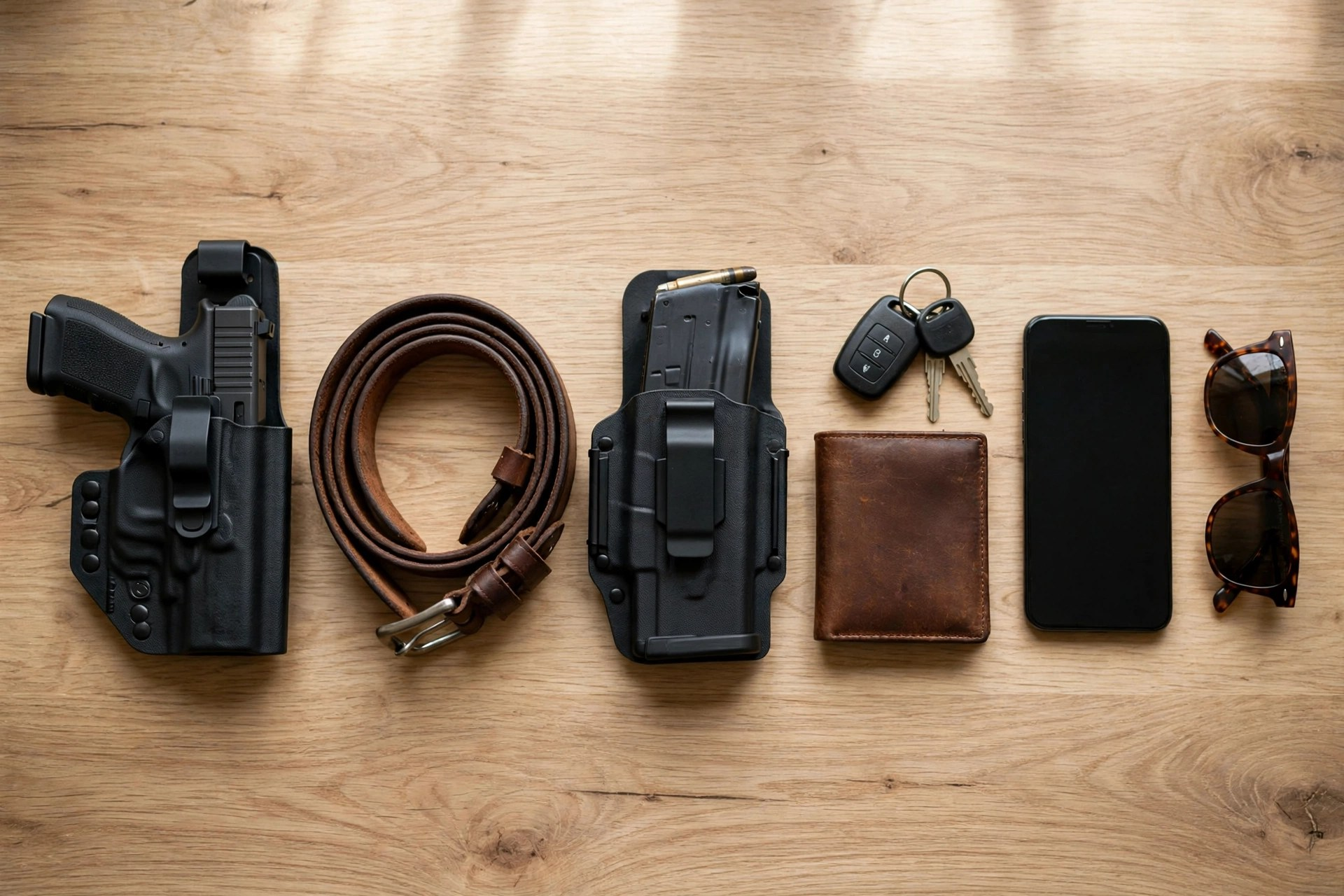
Fix the rig first. A rigid holster made for your exact gun — Kydex is the standard for a reason — plus a real gun belt designed to carry weight will solve most comfort complaints overnight. If carrying hurts, don’t carry less. Change the equipment.
Carry a gun you’ll actually carry. A smaller, lighter handgun on your belt beats the full-size one in your safe, every single day. There’s no prize for owning the “best” gun you never bring. If your current setup keeps losing the morning argument, a compact carry setup you forget you’re wearing is the upgrade that matters.
Dress around the gun, a little. An untucked layer, a slightly longer cover garment, a different carry position — small wardrobe adjustments solve most printing and comfort issues. Appendix, strong-side, and other positions all work; the right one is the one that’s safe, concealed, and comfortable enough that you’ll do it daily.
Make it part of the routine. Keys, wallet, phone — gun. Lay your carry setup out with the rest of your daily essentials and put it on the same way you put on your shoes. When holstering up is just “getting dressed,” the hassle argument disappears.
Know before you go. Part of carrying daily is knowing where you can’t. Schools, courthouses, polling places while polls are open (our state just got a reminder of that one), posted private property — check before you walk in, not after. Our Virginia self-defense laws guide covers the places and rules that matter most.
The Responsibility Side of Carrying Every Day
Carrying daily is a commitment, and it comes with obligations that matter just as much as the carry itself.
Know the law cold. Where you can carry, when force is legally justified, what to do in the aftermath — these aren’t optional extras. They’re the difference between a lawful defender and a defendant. If it’s been a while since your class, a refresher is money well spent.
Don’t drink while carrying. In Virginia, consuming alcohol while carrying a concealed handgun is a crime, and carrying under the influence is worse. If the evening involves drinks, the gun stays home, locked up. Non-negotiable.
Train and practice on a schedule. Skills fade. Drawing from concealment, shooting accurately under a little pressure, clearing a malfunction — these are perishable abilities. Regular range time keeps your first line of protection from being mostly theoretical.
Store it right when it’s off your body. The moment the gun comes off, it goes secured — a quick-access safe at home, never loose in a drawer. And since July 1, 2026, Virginia law (§ 18.2-308.7:2) makes leaving a handgun in an unattended vehicle a misdemeanor unless it’s out of plain view and in a locked, hard-sided container. A lockbox cabled to the vehicle is cheap insurance. For more on safe storage, Project ChildSafe offers free, practical guidance and safety resources for gun owners.
A Gun in the Safe Protects No One — but an Untrained Carrier Is Its Own Problem
Let’s be honest in both directions.
A gun left in the safe protects no one. That’s the argument for carrying, and it’s a strong one.
But carrying a firearm you haven’t trained with is its own kind of risk — to you and to everyone around you. A defensive shooting is one of the highest-stress events a person can face. Under that stress, you will not rise to the occasion; you will fall to the level of your training. If your training is “I shot a box of ammo the week I bought it,” that’s the level you’re falling to.
Real protection isn’t the gun. It’s the layered habits around it: awareness of your surroundings, avoiding trouble when you can, de-escalating when words will work, knowing the law, and — only when there’s no other choice — the skill to use the tool you’ve carried faithfully. The firearm is the last line, not the only one. Training is what turns a carried gun from a talisman into an actual first line of protection.
Frequently Asked Questions
Is it legal to carry every day in Virginia? Yes — with a valid Concealed Handgun Permit, you can carry concealed daily anywhere Virginia law allows. If you don’t have your permit yet, our Virginia concealed carry class covers the in-person training requirement and the law, start to finish. Not in Virginia? Our DMV concealed carry training serves DC and Maryland students too.
What if my workplace doesn’t allow carrying? Then the gun doesn’t go inside — full stop — and your employer’s policy isn’t worth your job or a trespassing charge. What you can do is prepare properly for the commute: secure the firearm in your vehicle in a locked, hard-sided container, out of plain view, as Virginia law now requires for unattended vehicles.
What if I can only comfortably carry a small gun? Carry the small gun. The best carry gun is the one that’s actually on you. Just train with it — smaller guns are snappier and demand more practice to shoot well, which is an argument for more range time, not for leaving it home.
How do I build the daily habit? Same gear, same place, every day. Set your holster, belt, and carry gun with your keys and wallet the night before. Most students tell us that after two or three weeks, leaving home without it feels like forgetting your phone.
Make Your First Line Real
You already decided your family’s safety was worth protecting the day you bought a firearm and got your permit. Carrying it — consistently, comfortably, and competently — is simply finishing that decision.
Trouble Defense is a veteran-owned Northern Virginia training company, teaching since 2012. If your carry habit needs better fundamentals behind it — drawing from concealment, shooting accurately, understanding the law — that’s exactly what we teach. Start with our Virginia concealed carry class if you need the permit — and if your daily life crosses state lines like most Northern Virginians’, our DMV concealed carry training covers carrying legally across DC, Maryland, and Virginia. Then find a session on the training calendar to sharpen the skills you already have.
Because when seconds count, the first line of protection is the one you brought with you.
Disclaimer: Firearm laws change, and this article is for general information only — not legal advice. Always verify current requirements with the Virginia State Police or a qualified attorney.