Women choose firearms for personal safety primarily for protection, empowerment, and peace of mind — and that choice pays off most when it’s backed by real training and responsible storage.
Here’s what drives that decision for most women:
- Protection and deterrence: A firearm levels the physical playing field when other options fall short.
- Empowerment and confidence: Owning and training with a firearm shifts the feeling of vulnerability into capability.
- Closing the protection gap: Police response times, remote locations, and living alone all create situations where self-reliance matters.
- Training-led competence: Women who train report higher safety efficacy and more comfort thinking through personal safety scenarios.
This article covers the main motivations, the evidence behind them, how training works (including women-only classes), responsible ownership basics, equipment fit, pros and cons, and how to get started in the DMV area.
Table of Contents
- Why women choose firearms for safety: the core motivations
- How does training turn uncertainty into real confidence?
- What responsible ownership actually looks like
- What should you actually look for in a firearm?
- Firearms vs. non-lethal options: an honest tradeoff
- How to get started: a practical path from curious to trained
- What the research and experienced trainers show
- Key Takeaways
- What a trainer would tell you before you decide
- Trouble Defense: women’s firearm training in the DMV
- Useful sources
- FAQ
Why women choose firearms for safety: the core motivations
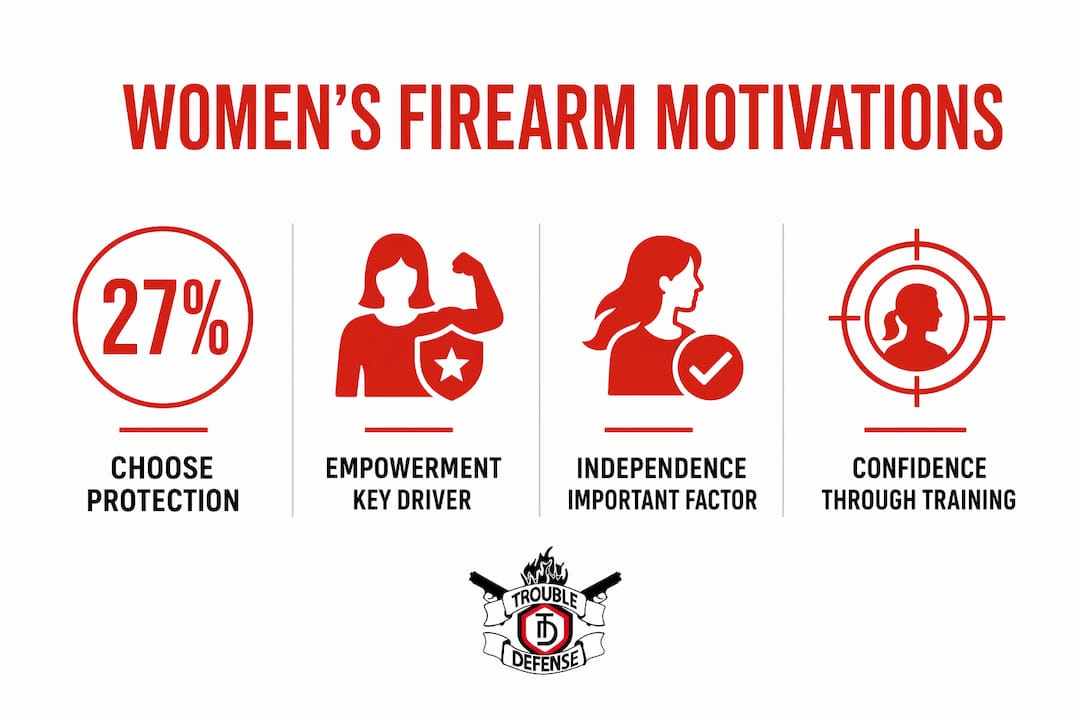
The reasons women report choosing firearms for personal safety are specific and consistent across surveys. Protection tops the list by a wide margin. About 27% of women gun owners cite protection as their only reason for ownership, compared to 8% of men — meaning women are far more likely to own a firearm for a single, clear purpose rather than for sport, hunting, or collection.
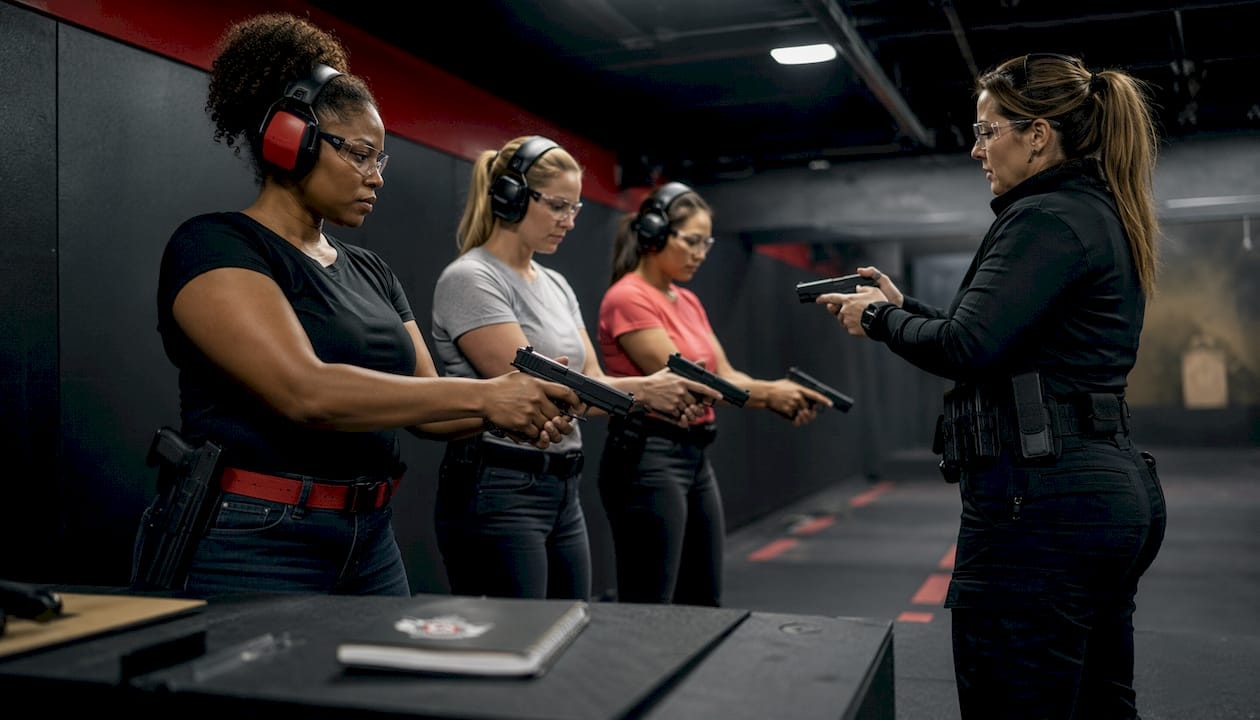
A 2023 nationally representative survey found that approximately 79% of firearm owners overall cited protection as a reason for ownership, and that protection-motivated ownership is increasingly associated with new owner profiles, including women and racial minorities. Women’s ownership has also risen significantly: Female firearm ownership in the U.S. has risen over recent decades, increasing significantly from much lower rates in 1980.
The motivations break down into a few distinct categories:
- Personal protection and deterrence: The most common driver. A firearm creates a credible deterrent and a last-resort defense option.
- Empowerment after victimization: Research consistently shows that women who have experienced interpersonal violence are more likely to consider or pursue firearm ownership. Prior victimization predicts women’s plans to obtain a firearm across multiple studies.
- Physical disparity: A firearm neutralizes size and strength differences in a way that most other tools cannot.
- Protecting family and property: Particularly relevant for women who live alone, in rural areas, or who are primary caregivers.
- Independence and self-reliance: Not relying solely on external systems — police, neighbors, or others — for personal safety.
Stat to know: About 79% of gun owners cite protection as a reason for ownership. Among women who own for protection specifically, that sense of safety is tied directly to training and preparation.
How does training turn uncertainty into real confidence?
Fear of firearms is common among women who have never handled one. Training is what converts that fear into competence. Women who complete structured firearm courses report higher safety efficacy, spend more time on safety planning, and feel more comfortable thinking through personal safety scenarios than women who don’t own or train. That’s not anecdotal — a peer-reviewed study found that women with interpersonal victimization experiences who owned firearms showed measurably higher safety efficacy and used more complementary safety measures than non-owners.
What good training actually delivers:
- Safe handling: Loading, unloading, clearing malfunctions, and muzzle discipline become automatic.
- Scenario practice: Realistic drills build decision-making speed under stress.
- Storage and transport: Knowing how to store and carry legally and safely is part of the curriculum, not an afterthought.
- Confidence that sticks: Skill-based confidence is durable. It doesn’t fade the way a purchase alone never provides.
Why women-only classes work better for many learners
Women-only classes aren’t a niche accommodation — they’re a genuinely more effective learning environment for many women. Industry reporting and instructor interviews consistently highlight tailored pacing, emotional safety, and technique adjustments as key benefits. Grip adjustments for smaller hands, holster placement for women’s clothing, and recoil management for different hand strength are all addressed more directly when the class is designed around women’s needs from the start.
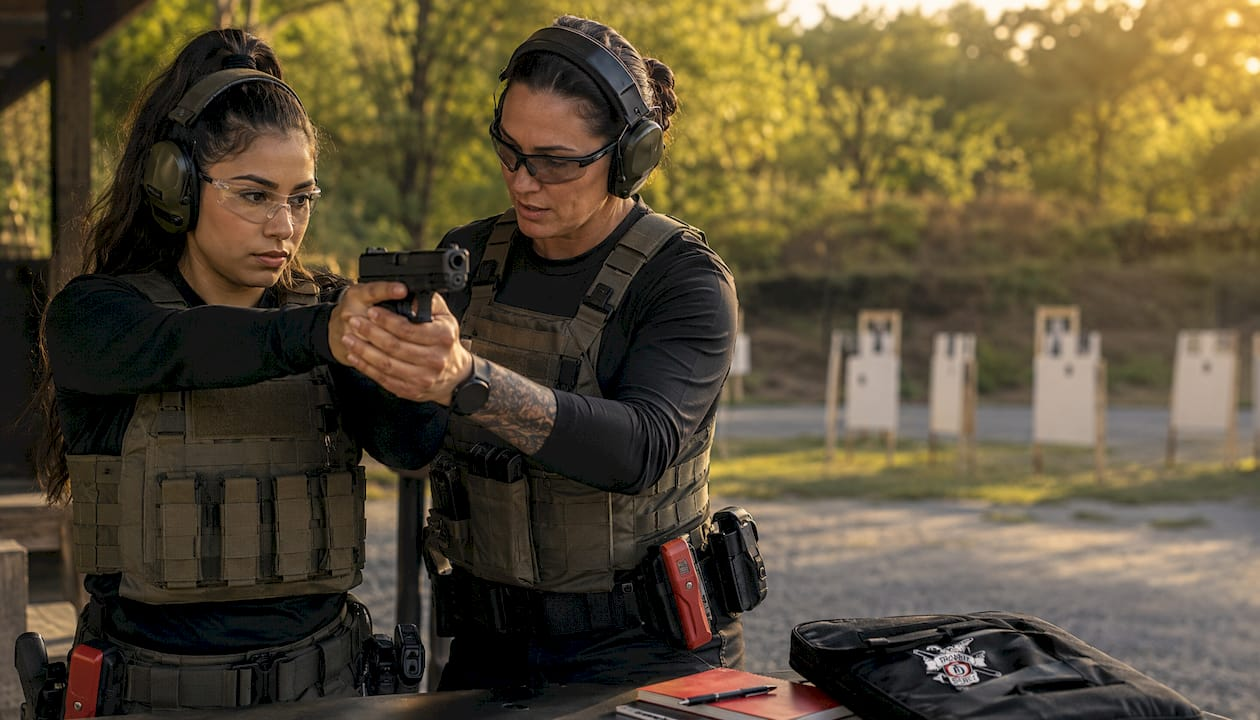
Representation also matters. Female students often perform better and retain more information when they see themselves in their instructors. A woman teaching the class isn’t just a symbolic choice — it changes the dynamic in ways that show up in skill retention and comfort asking questions.
Pro Tip: When evaluating a class, ask specifically whether the instructor holds NRA certification or a state-recognized CCW instructor credential, and whether they have experience teaching women beginners. A good instructor welcomes that question. You can explore women’s firearm training options in the DMV that are built around exactly these principles.
What responsible ownership actually looks like
Owning a firearm for safety creates responsibilities that are non-negotiable. Safe storage, legal compliance, and regular maintenance aren’t optional extras — they’re the difference between a firearm that protects and one that creates new risks.
Safe storage
- Use a quick-access biometric or combination safe for home defense firearms.
- Store ammunition separately from the firearm when the gun isn’t in active use.
- Trigger locks add a secondary layer of protection, especially in households with children or visitors.
- Never leave a loaded firearm unsecured, even briefly.
Handling and maintenance
Clean and inspect your firearm regularly. A neglected firearm is less reliable, and reliability is the whole point. Learn to field-strip and clean your specific model as part of your initial training.
U.S. legal basics (overview only)
Self-defense laws vary significantly by state. Concepts like “stand your ground,” “castle doctrine,” and “duty to retreat” mean different things in Virginia, Maryland, and DC — and the rules for carrying a concealed firearm are different in each jurisdiction. A CCW permit class covers the legal framework for your state and is the right place to get jurisdiction-specific guidance.
Stat to know: Firearm carriage laws and permit requirements differ in every U.S. state. What’s legal in Virginia may require additional steps in Maryland or DC. Always verify current rules with your state’s attorney general office or a qualified attorney before carrying.
Pro Tip: Don’t rely on general internet searches for self-defense law. Take a state-specific CCW or permit class, and if you have specific legal questions, consult a licensed attorney in your state. Trouble Defense offers Virginia CCW classes and Maryland Wear and Carry training that cover the legal landscape for each jurisdiction.
This article is general information, not legal advice. Confirm current laws with your state’s primary source or a qualified attorney for your specific situation.
What should you actually look for in a firearm?
Fit beats brand every time. A firearm that doesn’t fit your hand, that you can’t manage the recoil on, or that you can’t draw cleanly from a holster isn’t a defensive tool — it’s a liability. Experts consistently emphasize trying multiple models before purchasing rather than defaulting to whatever a salesperson recommends.
Key fit factors to evaluate:
- Grip size: Your finger should reach the trigger comfortably without shifting your grip. Many compact pistols fit smaller hands better than full-size models.
- Recoil management: Higher-caliber rounds hit harder. A firearm you can shoot accurately and comfortably is more useful than one you flinch from.
- Sight picture: You need to see the sights clearly and consistently. Adjustable or fiber-optic sights help many new shooters.
- Holster compatibility: Your carry method (inside the waistband, purse, shoulder) determines which holster works, and holster fit is model-specific.
- Weight and concealability: A lighter firearm is easier to carry daily but may have more felt recoil.
Compact pistols in 9mm are a common starting point for women new to defensive carry — manageable recoil, widely available ammunition, and a broad selection of holster options. But the right choice is the one that fits you, not the one that’s most popular.
Pro Tip: Before buying, rent several models at a range and shoot at least 50 rounds through each. Many intro classes let you try multiple firearms during live-fire exercises. A tactical range bag makes it easier to organize your gear during those sessions.
Firearms vs. non-lethal options: an honest tradeoff
A firearm is not the right choice for every woman in every situation. Here’s a clear-eyed look at both sides.
Pros of choosing a firearm
- Credible deterrent that doesn’t require physical strength to be effective
- Defensive capability at distance, not just in close contact
- Increased confidence and safety planning behavior among trained owners
- Independence from external protection systems
Cons and real risks
- Accidental injury risk, especially without proper training and storage
- Legal consequences if used incorrectly or carried without proper permits
- Escalation risk: a firearm can turn a confrontation more dangerous
- Ongoing maintenance, storage costs, and training time required
- Emotional and psychological weight of owning a lethal tool
Non-lethal alternatives worth considering
Personal safety is a broader concept than any single tool. Non-lethal options include pepper spray, personal alarms, and training in situational awareness and escape strategies. These may be preferable for women who live in jurisdictions with restrictive carry laws, who aren’t ready for the responsibility of firearm ownership, or who want layered protection.
| Factor | Firearm | Non-lethal options |
|---|---|---|
| Training required | Significant and ongoing | Moderate |
| Legal complexity | High (varies by state/permit) | Low to moderate |
| Defensive range | Close and distance | Primarily close range |
| Storage responsibility | High (safe, locked) | Low |
| Escalation risk | Higher | Lower |
| Confidence impact | High (when trained) | Moderate |
How to get started: a practical path from curious to trained
Getting started doesn’t require buying a firearm first. In fact, training before purchasing is the smarter sequence.
Step-by-step checklist
- Take an intro firearms safety class — no prior experience needed, no gun required.
- Attend a women’s-specific course to learn in a tailored environment.
- Complete live-fire range sessions to build comfort and accuracy with different models.
- Enroll in a CCW/permit class for your state (Virginia, Maryland, or DC each have different requirements).
- Purchase a firearm after you’ve tried multiple models and know what fits.
- Buy a quality safe before bringing the firearm home.
- Build a regular practice plan — monthly range time at minimum.
Typical costs and timelines
Intro safety classes often run $50–$150. State CCW or permit courses typically range from $100–$300 depending on the state and provider. The permit process itself varies: Virginia’s process is relatively straightforward, while Maryland’s Wear and Carry permit requires a more involved application and training hours. DC’s process is among the most detailed in the region. Budget 4–12 weeks from starting classes to having a permit in hand, depending on your state.
If you’re not ready to own a firearm yet, these immediate steps still improve your safety:
- Audit your home for entry points and lighting.
- Keep a charged phone accessible at night.
- Take a situational awareness or personal safety course.
- Consider a personal alarm for daily carry.
You can also explore online firearm safety classes as a low-barrier first step before committing to in-person training.
What the research and experienced trainers show
The evidence on women and firearms for personal safety points in a consistent direction: ownership combined with training produces measurable gains in safety confidence and planning behavior. Women who own firearms report higher safety efficacy and use more complementary safety measures than non-owners with similar victimization histories.
Women-only training programs show strong outcomes in enrollment, retention, and skill development. Tailored instruction that addresses women’s specific physical and emotional needs produces better results than co-ed classes where women’s questions may go unasked.
Trouble Defense offers a range of programs directly relevant to women considering firearm ownership:
- Women’s firearm training in Fairfax, VA, with women-focused curriculum and NRA-certified instructors
- Virginia CCW classes covering state law, safe handling, and live-fire qualification
- Maryland Wear and Carry training for MD permit applicants
- DC concealed carry training for the region’s most complex permit process
- Adaptive firearms training for blind and low-vision students
With over 300 five-star Google reviews and thousands of students trained since 2012, Trouble Defense has built its reputation on exactly the kind of personalized, confidence-building instruction that women new to firearms need most.
Pro Tip: When evaluating any instructor or program, ask for their NRA certification number or state CCW instructor credential. A credentialed instructor can show you proof. If they can’t, keep looking.
Key Takeaways
Women who choose firearms for personal safety, and pair that choice with structured training and responsible storage, consistently report higher confidence and safety efficacy than those who don’t train.
| Point | Details |
|---|---|
| Protection drives ownership | About 27% of women gun owners cite protection as their only reason, vs. 8% of men. |
| Training builds real confidence | Trained women report higher safety efficacy and more active safety planning behaviors. |
| Women-only classes outperform | Tailored pacing, grip adjustments, and representation improve skill retention for women. |
| Legal rules vary by state | Virginia, Maryland, and DC each have distinct CCW and carry laws — take a state-specific class. |
| Trouble Defense serves the DMV | Women’s classes, Virginia CCW, Maryland Wear and Carry, and DC training are all available locally. |
| Protection is the primary reason for ownership | About 79% of firearm owners cite protection as a reason for ownership. |
What a trainer would tell you before you decide
Most women who walk into a first firearms class arrive with some version of the same concern: “I’m not sure this is for me.” That’s not a reason to leave. That’s exactly the right place to start.
The decision to own a firearm for personal safety isn’t one you have to make before you walk through the door. What you do need to decide is whether you want to understand your options — and a good intro class gives you that without pressure. Skill builds incrementally. Confidence follows skill. The women who feel most capable six months in are almost always the ones who started with the most questions, not the fewest.
Take a women’s intro class before you buy anything. Shoot several different firearms. Ask every question you have. The instructor’s job is to answer them.
Trouble Defense: women’s firearm training in the DMV
For women in Virginia, Maryland, and Washington, DC who are ready to take a concrete next step, Trouble Defense offers the most direct path from curious to confident.

The programs are built for women at every starting point — complete beginners, women returning after a gap, and those preparing for their first CCW permit. NRA-certified instructors lead every class. Women-only sessions provide the tailored environment where most women learn fastest. Scheduling is accessible, and the veteran-owned team has been doing this since 2012.
Relevant programs include women’s firearm training, Virginia CCW classes, Maryland Wear and Carry, DC concealed carry training, and adaptive training for students with disabilities. If you have questions before booking, the firearm training FAQ covers the most common ones in detail.
Check the training calendar and reserve your spot in an upcoming class.
Useful sources
- Pew Research Center: How male and female gun owners in the U.S. compare
- Injury Prevention: Firearm ownership for protection in the USA, 2023
- Liebert Publishing: Safety efficacy among women with victimization experiences
- Legal Reader: Gun ownership by gender, 2026
- Guns.com: Why women-only classes are still needed
- NRA Women: Why every woman should attend a women-only shooting event
- Pew Research Center: Key facts about Americans and guns
- PPSS Group: The personal safety of women
- PMC: Associations between perceived threats and firearm behaviors among U.S. adults
FAQ
Why do women choose firearms for personal safety?
Women most often choose firearms for protection, empowerment, and independence. About 27% of women gun owners cite protection as their only reason for ownership, a rate more than three times higher than among men. Additionally, about 79% of all firearm owners cite protection as a primary motivator.
Are women who carry guns safer?
Women who own firearms and receive proper training report higher safety efficacy and engage in more active safety planning than non-owners with similar backgrounds. Training is the key variable — ownership alone, without instruction, does not produce the same outcomes.
What gun should a woman get for protection?
Fit matters more than brand or model. Compact 9mm pistols are a common starting point because of manageable recoil and wide holster availability, but the best choice is the one that fits your hand and that you can shoot accurately. Rent and try several models at a range before purchasing.
Why is safety so important to women when it comes to firearms?
Women are more likely than men to own a firearm for a single, protection-focused reason, which means the stakes of mishandling are higher and the motivation to train correctly is stronger. Safe storage, legal compliance, and regular practice are what make a firearm a genuine safety tool rather than a risk.
Where can women in the DMV find firearms training?
Trouble Defense offers women’s firearm training, Virginia CCW classes, Maryland Wear and Carry courses, and DC concealed carry training from its Fairfax, VA location. Classes are led by NRA-certified instructors and include women-only sessions designed for beginners.