
A pistol caliber carbine is a strong home defense choice for owners who commit to real training and a secure, practiced access plan. It gives you a longer sight radius, lighter recoil, and easier control in tight hallways than a handgun, but that advantage only holds if your ammunition choice limits overpenetration and your household has a rehearsed plan for safely reaching a secured firearm.
TL;DR:
- The choice of a pistol caliber carbine requires familiar controls, reliable ammunition, and a size that fits your household’s layout and safe storage plan.
- Shorter barrels improve maneuverability indoors, but longer barrels increase velocity and may affect overpenetration risks.
- Confirm your specific defensive rounds reliably cycle, group accurately, and behave predictably in your carbine’s barrel length before trusting them for home defense.
- Proper safe storage involves quick-access safes that are securely mounted, with regular practice and a household plan clear to all authorized users.
- Hands-on training, both self-practiced and with a professional, is essential to develop fast, stress-resilient skills for deploying the carbine effectively in real scenarios.
Table of Contents
- Why a Pistol Caliber Carbine Can Outperform Other Options Indoors
- What to Look for in a Home Defense PCC
- How Shooting Pistol Rounds From a Carbine Changes Their Behavior
- Secure Storage and Quick-Access Planning
- Training and Practice Before You Rely on a PCC
- Quick Preparation Checklist for Your Home Defense PCC
- Trainer’s Perspective: Who Actually Benefits From a PCC at Home
- How Trouble Defense Can Help You Prepare
- FAQ
- Sources
Why a Pistol Caliber Carbine Can Outperform Other Options Indoors
A carbine chambered in a pistol round gives you two hands on a stock, a longer sight radius, and far less recoil than a shotgun loaded with buckshot. That combination makes a real difference when you’re moving through a hallway at 2 a.m. with your heart rate elevated and adrenaline working against your fine motor skills.
The low recoil of pistol calibers like 9mm means faster, more controlled follow-up shots if you need them. You’re not fighting the gun between rounds the way you would with a 12-gauge, and you’re not trying to keep a short-sight-radius pistol steady with one eye squinting in the dark. The stock and forend also give you two points of contact, which steadies your aim more than a handgun’s single-hand or two-hand grip ever can.
None of that erases the tradeoffs. A carbine is longer than a pistol, which means it takes an extra second or two to bring to bear in a cramped closet or stairwell, and it needs more room in a safe. Certain defensive loads can still overpenetrate drywall at carbine velocities, which matters enormously if other people sleep under your roof. And a long gun stored for quick access still has to answer the same question a handgun does: who else lives in your home, and how do they factor into your plan?
Here’s how the three common home defense tools stack up indoors:
- Pistol caliber carbine: longer sight radius and two-handed control, light recoil, but added length can slow movement in very tight spaces.
- Handgun: fastest to maneuver in a small room, but harder to shoot accurately under stress due to a short sight radius and one-handed recoil management.
- Shotgun: significant stopping power at close range, but heavier felt recoil slows follow-up shots and pattern spread raises its own penetration questions.
For a lot of households, the carbine splits the difference: more control than a handgun, less punishing recoil than a shotgun. The right pick still depends on your home’s layout, who lives there, and how much time you’re willing to put into practice.
What to Look for in a Home Defense PCC
Choosing a carbine for home defense is less about chasing the newest release and more about picking controls and a configuration you can run without thinking. Familiarity beats novelty every time stress is involved.
Start with the controls. A safety lever, magazine release, and charging handle that sit where your muscle memory already expects them will save you precious seconds. If you already carry or train with a particular handgun platform, a carbine that mirrors those controls reduces the mental load during a high-stress encounter.
Barrel and overall length matter more indoors than most new owners expect. A shorter barrel length makes a carbine easier to swing through doorways and tight turns, while a longer barrel can add velocity at the cost of maneuverability. Your stock or brace choice affects both your ability to aim quickly and how compactly the gun stores in a safe. A folding or collapsible stock can shave inches off your storage footprint without sacrificing a solid cheek weld when it counts.
A red dot optic is close to standard on a modern defensive PCC, and for good reason: it speeds up target acquisition in low light far better than iron sights alone. Mount it at a height that co-witnesses with your irons as a backup.
A few more priorities worth locking in before you consider the carbine ready:
- A weapon light with a bright, narrow beam for target identification in the dark.
- A sling for retention and control if you need to open a door or move a family member.
- Reliability with your chosen defensive ammunition, confirmed through your own range testing, not the manufacturer’s marketing copy.
Independent testing of pistol caliber carbines has found that operating system, weight, and control layout matter as much as caliber when it comes to household suitability, and that a technically excellent carbine can still be a poor fit if its controls or optic feel unfamiliar under stress.
Pro Tip: Run your home defense PCC with the same light, optic, and sling setup every time you train, so your hands know the gun blind before you ever need it in the dark.
How Shooting Pistol Rounds From a Carbine Changes Their Behavior
A pistol round fired from a 16-inch carbine barrel doesn’t behave exactly like it does from a 4-inch pistol barrel. The longer barrel typically increases velocity, which can change how a hollow point expands or fragments on impact. That shift matters because a load tuned to perform well from a handgun may behave differently, sometimes less predictably, once it’s burning more powder in a longer barrel.
This is why verifying your specific load in your specific carbine isn’t optional. You want to confirm three things before you trust any defensive round for home use:
- The round cycles reliably through your carbine’s action without hiccups.
- It groups accurately at realistic in-home distances.
- It performs as intended on terminal ballistics testing or from a manufacturer’s published data for carbine-length barrels specifically.
Penetration is the other half of this equation. Indoors, a round that overpenetrates one wall can travel through two or three more, which is a serious concern in any home with family members or neighbors nearby. General guidance here leans toward avoiding the highest-velocity defensive loads in favor of rounds designed to expand and slow down rather than punch straight through.
It helps to keep expectations grounded. Research based on the National Crime Victimization Survey has estimated that defensive firearm uses are infrequent relative to the overall volume of crime in the United States, a reminder that a carbine is one layer of preparedness, not a guarantee, and shouldn’t replace sound storage habits or situational awareness.
Secure Storage and Quick-Access Planning
The baseline, according to the DOJ’s safe firearm storage guidance, is straightforward: unload firearms when they’re not in use, store them in a locked safe or case, and keep ammunition secured separately. A CDC analysis of storage behaviors across eight states in 2021 and 2022 found wide variation in practices, with a substantial portion of respondents who kept a loaded firearm reported that at least one loaded gun was stored unlocked in some participating states. That gap between guidance and practice is exactly where a household plan needs to do its work.
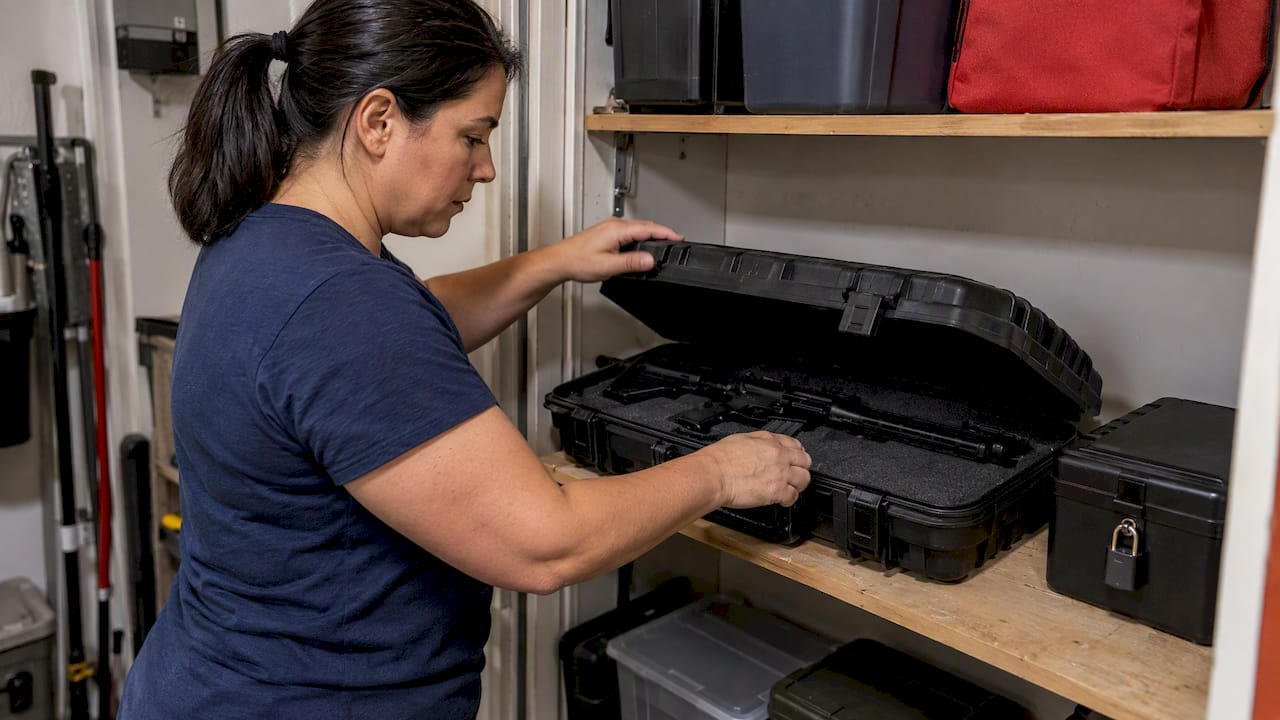
If your goal is quick access to a loaded carbine, layer your security rather than trading it away entirely. A biometric safe with audit logging, mounted and bolted so it can’t be carried off, gives you speed without leaving a loaded gun sitting in a nightstand drawer. Separating ammunition storage from the firearm itself adds a step for an unauthorized person while barely slowing down someone who’s trained on the routine.
A simple household plan looks like this:
- Designate authorized users and make sure everyone in that group knows the safe’s code or biometric enrollment.
- Walk the access route from bedroom to safe in the dark, more than once, so it’s automatic under stress.
- Practice unlocking drills with an unloaded firearm until opening the safe takes seconds, not fumbling minutes.
- Inspect and maintain the safe’s battery, lock mechanism, and mounting hardware on a set schedule.
Choosing a gun safe built for your household means weighing speed against theft resistance. A lighter, faster-access safe is more convenient but easier to defeat; a heavier, bolted unit slows down an intruder but costs more and takes longer to install correctly. Review your plan every few months, especially after any change in who lives in your home.
Pro Tip: Practice your safe’s unlock sequence with the lights off at least once a month. Muscle memory in the dark is different from muscle memory under a bright bathroom light.
Training and Practice Before You Rely on a PCC
Owning the right hardware solves maybe half the problem. The skills that actually keep a household safe come from repetition: drawing from secure storage to a ready position, clearing a malfunction without panicking, identifying a target in low light before you ever touch the trigger, and knowing when de-escalation is the better call than engagement.
A workable practice plan is short and frequent rather than long and occasional. Fifteen minutes a week beats a single four-hour session every few months, and you should progressively add stressors, dim lighting, time pressure, a simulated need to move, once the fundamentals are solid.
This is also where most owners hit a ceiling they can’t safely push past alone without professional pistol training. A trained instructor can run scenario-based drills, correct your grip and stance in real time, and coach you on a household-specific access plan in ways a YouTube video simply can’t replicate.
Skills worth prioritizing in a structured class:
- Storage-to-deployment drills that mirror your actual safe and home layout.
- Malfunction clearing practiced until it’s automatic, not something you think through.
- Low-light manipulation of your light, optic, and controls together.
- Target identification and de-escalation judgment, not just marksmanship.
We are a veteran-owned firearms training provider offering instruction with certified NRA instructors and recognized by many positive reviews from students in the DMV area.
Quick Preparation Checklist for Your Home Defense PCC
Before you consider a carbine “ready,” run through a short inspection covering the gun, your household plan, and your own skills.
Hardware to verify:
- Weapon light holds a charge and mounts securely.
- Optic zero is confirmed and batteries are fresh.
- Sling is attached and adjusted for your build.
- Safe or lockbox is mounted, functional, and accessible to authorized users only.
Household readiness to confirm:
- A written access plan exists and every authorized adult has read it.
- Access routes have been walked and practiced in low light.
- Ammunition storage location is known to every authorized user.
Set a quarterly reminder to function-test the carbine, audit your storage setup against current household needs, and run a short training session so the skills don’t fade.
Trainer’s Perspective: Who Actually Benefits From a PCC at Home
The owners who get the most out of a pistol caliber carbine are the ones who treat it as a system, not a purchase: trained, practiced, and paired with a household plan everyone understands. The most common mistake isn’t picking the wrong gun. It’s buying one, skipping the storage discipline, grabbing whatever ammunition looked good online, and assuming the hardware will cover for the lack of practice. A biometric safe or a red dot sight doesn’t replace drills. If your household’s layout, occupants, or storage setup raises questions you can’t answer confidently, that’s worth working through with a professional rather than guessing.
— Dee Parker
How Trouble Defense Can Help You Prepare

Owning the right carbine is only part of a workable home defense plan. We built our training around the gap most owners face: knowing the hardware but never having practiced the parts that actually matter under stress. Our private sessions cover safe storage-to-deployment drills, low-light manipulation of your light and optic, and malfunction clearing until it’s automatic, tailored to your own home layout rather than a generic range scenario.
We also run concealed carry and defensive-readiness classes across Virginia, Maryland, and DC for owners who want a broader foundation, along with adaptive and women’s firearm training for households with specific needs. If you’re ready to turn a stored carbine into a practiced, confident plan, book a session through our private firearm training in Fairfax page, or explore our DMV concealed carry training package to build your skills further.
- Private firearm training for one-on-one, household-specific PCC drills.
- Defensive scenario training covering low-light and malfunction practice.
- Women’s and adaptive firearm training options designed for varying household needs.
FAQ
Are pistol-caliber carbines good for home defense?
Yes, for owners who train with them. A PCC offers lighter recoil and a longer sight radius than a handgun, which helps with accuracy and control indoors, but it still requires a secure, practiced access plan to be effective.
What are the best pistol-caliber carbines for home defense?
The right carbine is less about a specific model and more about controls you already know, reliable function with your chosen defensive load, and a size that fits your storage plan. Independent testing of PCC designs shows operating system, weight, and control layout matter as much as caliber for everyday household suitability.
Are pistol-caliber carbines legal?
In most of the United States, pistol caliber carbines are legal to own and use for home defense, subject to the same federal and state purchase requirements as other rifles. Rules on barrel length, magazine capacity, and specific configurations vary by state, so confirm current regulations for your own location before buying or modifying one.
What is the best caliber handgun for home self-defense?
There’s no single best caliber, as several popular pistol calibers have documented records in defensive use. The right choice depends on recoil management, shot placement, and how well you shoot that specific round. Verifying your chosen defensive load’s function and performance in your own firearm matters more than chasing a caliber reputation.
Sources
- Firearm Storage Behaviors — Behavioral Risk Factor Surveillance System, Eight States, 2021–2022 | MMWR
- Testing the Best Pistol Caliber Carbines | Outdoor Life