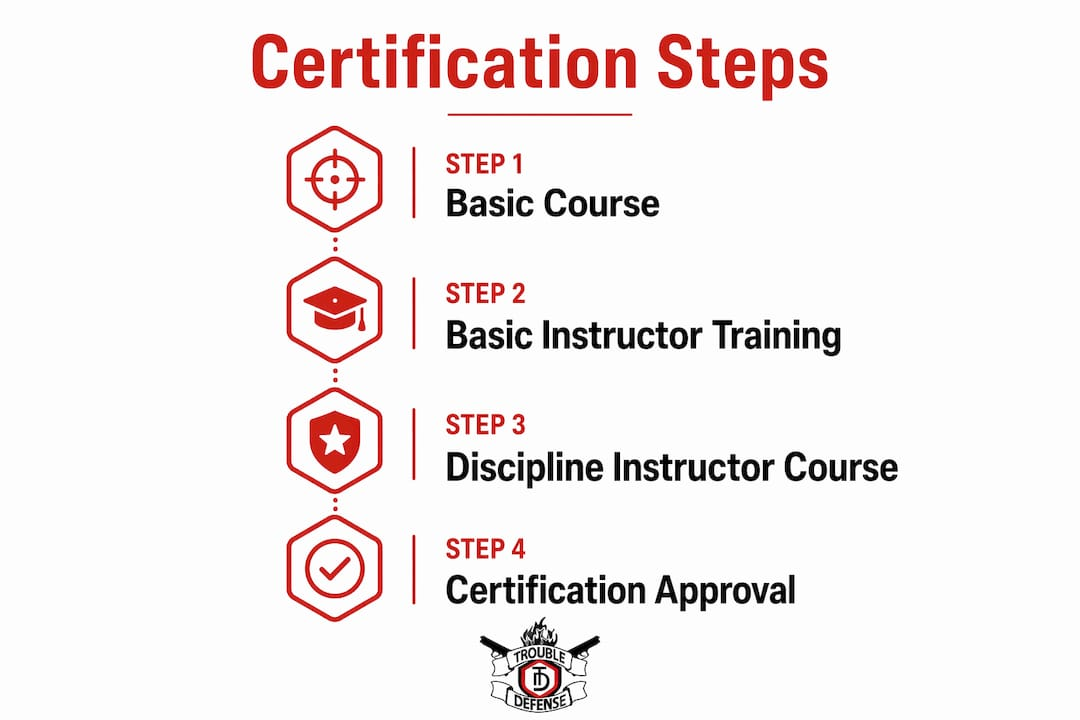
Becoming an NRA instructor comes down to three required steps: complete the basic course in your chosen discipline, finish Basic Instructor Training (BIT), and pass the discipline-specific instructor course taught by an NRA Training Counselor. Once your Training Counselor endorses you, you activate your rating in the NRA Instructor portal and pay the credentialing fee. That’s the whole path.
Before you register for anything, run through this checklist:
- Basic course first. If you haven’t already taken the NRA Basic Course in your discipline (pistol, rifle, shotgun, etc.), that comes before everything else.
- BIT timing. BIT is valid for two years for adding additional ratings. Take it close enough to your instructor course that it doesn’t expire before you finish.
- Pre-course qualification. This is the single most common gating failure. You must demonstrate safe gun handling, recite NRA safety rules, and meet minimum shooting scores before the instructor-specific instruction even begins.
- Credential activation. After the course, log into the NRA Instructor portal, submit your application, and pay the credentialing fee to make your rating official.
Most candidates typically complete the process in about a month or two from first enrollment to active credential, assuming you’re already a competent shooter and don’t need to repeat the basic course.
Table of Contents
- What does an NRA instructor credential actually authorize you to do?
- What NRA instructor course types are available?
- How do you go from zero to certified NRA instructor?
- Are there specialized NRA schools for law enforcement?
- What are your ongoing responsibilities as a certified instructor?
- What does the financial picture look like for NRA instructors?
- How do you host an official NRA course?
- Key Takeaways
- What most instructor guides won’t tell you about the TC relationship
- Trouble Defense can help you get there faster
- Useful sources and next steps
- FAQ
What does an NRA instructor credential actually authorize you to do?
An NRA-certified instructor is the only person authorized to teach official NRA Basic Courses in their rated discipline and to purchase official NRA training materials. That’s the core of what the credential unlocks.
The credential structure has four levels worth knowing:
- Apprentice Instructor: a provisional rating for candidates who need more development; can assist but cannot lead courses independently.
- Assistant Instructor: can co-teach under a Certified Instructor but doesn’t hold a full independent rating.
- Certified Instructor: the standard credential; can teach NRA Basic Courses independently in rated disciplines.
- Training Counselor (TC): the highest civilian level; authorized to train and certify new instructors.
What the credential does not do: it doesn’t guarantee employment, doesn’t make you a law enforcement trainer, and doesn’t cover disciplines outside your rated courses. A pistol instructor can’t teach the NRA Basic Rifle Shooting course without a separate rifle rating.
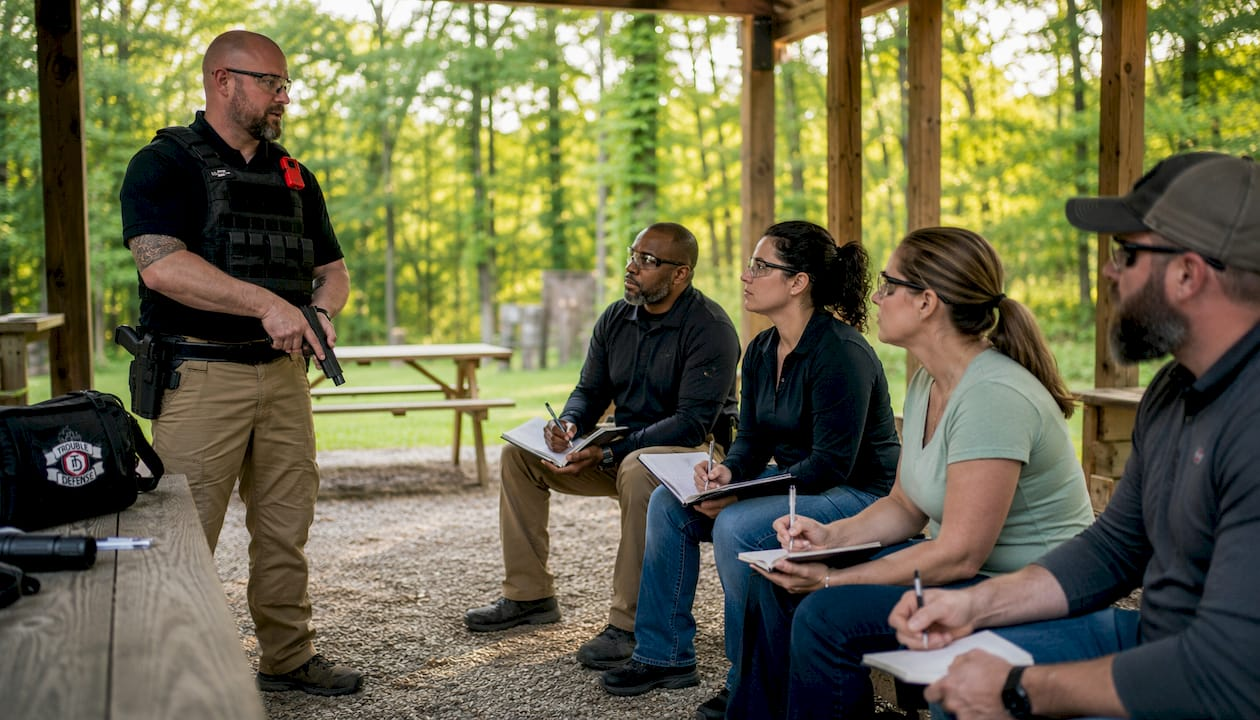
The NRA instructor program emphasizes teaching methodology and safety systems, not just marksmanship. You’ll learn how to run a classroom, manage range safety, and deliver standardized lesson plans. Plenty of excellent shooters have struggled in instructor courses because they underestimated how much the teaching side matters.
What NRA instructor course types are available?
The NRA offers instructor ratings across a range of disciplines. Here’s a quick reference for the most common ones:
| Discipline | Best For | Typical Length | Pre-Course Qualification Notes |
|---|---|---|---|
| Pistol | CCW instructors, self-defense trainers | 2 days | 9-inch target |
| Rifle | Hunters, youth coaches, range staff | 2 days | 4.5-inch circle |
| Shotgun | Hunters, sport shooters | 2 days | Pattern and handling demo |
| Personal Protection in the Home (PPItH) | Home defense instructors | 2 days | Requires certified pistol rating first |
| Personal Protection Outside the Home (PPOtH) | CCW and self-defense instructors | 2 days | Requires PPItH instructor rating first |
| Range Safety Officer (RSO) | Range staff, event coordinators | 1 day | No shooting qualification required |
| Home Firearm Safety | New-owner educators | 1 day | Basic handling demonstration |
| Youth Programs | 4-H coaches, scout leaders | Varies | Discipline-specific |
A few things to note on sequencing: PPItH requires a certified pistol instructor rating first, and PPOtH requires PPItH. Don’t try to skip ahead. The RSO course is a popular starting point for range employees because it has no shooting qualification requirement and can be completed in a single day.
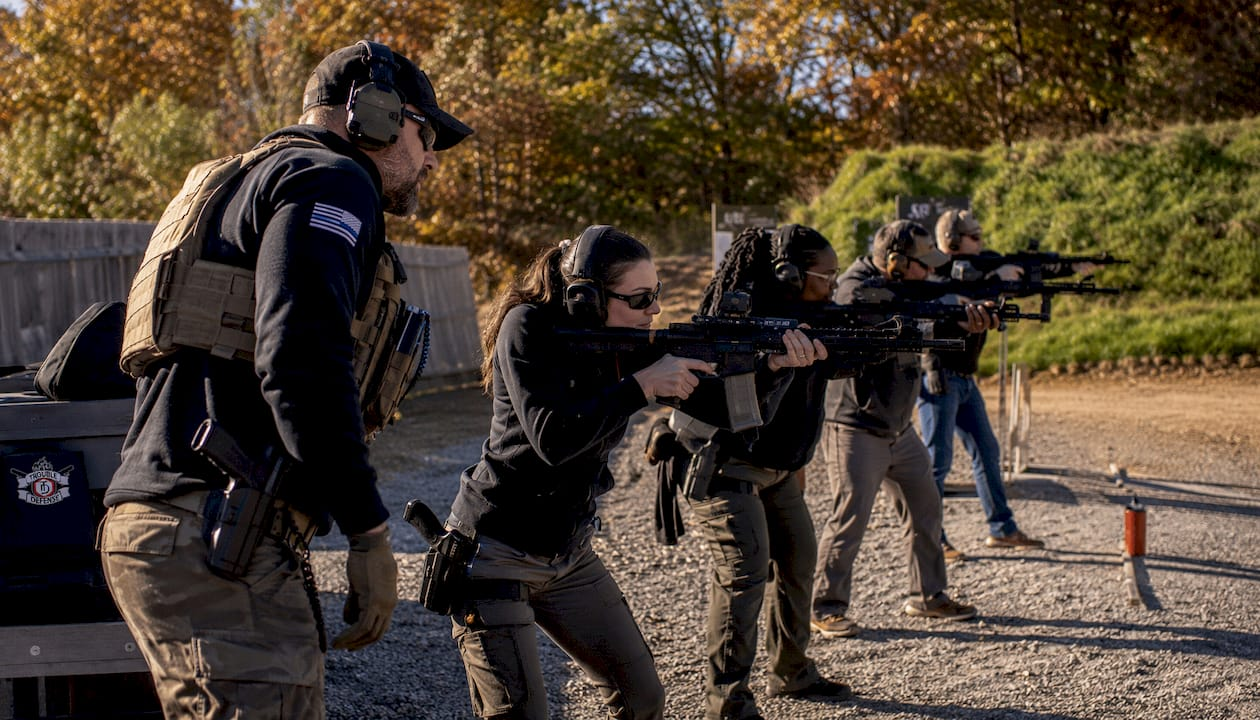
Pro Tip: Contact your Training Counselor before you register and ask exactly what pre-course qualification targets and scores apply to your discipline. Standards vary, and showing up with the wrong prep is a fast way to fail the first morning.
How do you go from zero to certified NRA instructor?
Here’s the step-by-step process, in order:
-
Complete the NRA Basic Course in your discipline. Previous shooting experience doesn’t substitute for this. The basic course teaches you the exact content you’ll later be delivering to students. If you’ve never taken it, you don’t yet know what you’re supposed to teach.
-
Complete Basic Instructor Training (BIT). BIT covers NRA training methodology, policies, and how to run a course. It’s common to all instructor disciplines and can sometimes be delivered concurrently with your discipline instructor course. Verify with your TC whether BIT is included in your scheduled class or whether you need to take it separately beforehand.
-
Attend the discipline instructor course. This is where pre-course qualification happens first. You’ll demonstrate safe gun handling, recite the NRA’s three fundamental safety rules, and shoot to minimum score standards. Pass that, and you move into the instructor-specific content: role-play teaching segments, team teaching exercises, and written assessments. Your Training Counselor evaluates everything and submits a recommendation.
-
Receive your TC’s recommendation. The TC can recommend you at the Apprentice, Assistant, or Certified level based on their assessment of your knowledge, skills, and attitude. All three factors count. A candidate who shoots well but handles feedback poorly can walk away with an Apprentice rating instead of Certified.
-
Activate your rating in the NRA Instructor portal. Log in, submit your application, and pay the credentialing fee. Your rating isn’t live until this step is complete.
Costs to expect:
- Basic course fee: varies by provider, typically $75–$150
- BIT fee: typically included in the instructor course or an additional fee if taken separately.
- Discipline instructor course fee varies depending on Training Counselor and location.
- NRA credentialing fee varies by membership status, with members typically paying discounted rates.
Pro Tip: Practice your pre-course qualification scores at least two weeks before the course, not the night before. Dry-fire drills and live-fire sessions at your target distance will do more for your confidence than any amount of reading.
Are there specialized NRA schools for law enforcement?
Yes, and they’re a different animal entirely. NRA Law Enforcement Instructor Development Schools are designed for public and private law enforcement, military, and security personnel. The curriculum is more tactical, the contact hours are longer, and the evaluation standards are more demanding than civilian instructor courses.
Key differences from the civilian track:
- Longer contact hours. LE schools run multiple days with scenario-based evaluation built into the schedule.
- Tactical curriculum. Content covers use-of-force context, duty-weapon handling, and agency-level training standardization.
- Three-year certification cycle. NRA LE instructor certifications are valid for three years from issuance, not the two-year civilian window.
- Recertification requires continuing education. Recertification commonly requires proof of at least 24 hours of continuing education completed during the expiring certification period.
- Certification is not automatic. Completing the school doesn’t automatically certify you. A separate application is required after the course.
Agencies often enroll officers in NRA LE Instructor Development Schools specifically to standardize training across their department and gain official lesson-plan approvals. The benefit isn’t just individual certification — it’s building a defensible, documented training program at the agency level.
Law enforcement candidates should expect a significantly more rigorous evaluation environment, with scenario-based assessments layered on top of the standard knowledge and skills testing.
What are your ongoing responsibilities as a certified instructor?
Certification is the beginning, not the finish line. Running an official NRA course means you’re responsible for a specific set of materials and logistics:
- Approved lesson plans and Trainer’s Guide. These are available only to active NRA instructors with a valid Instructor ID. You can’t teach the course without them.
- Student packets. Each student needs official NRA course materials. You purchase these through the NRA Program Materials Center using your active credentials.
- Range equipment. Targets, safety equipment, and any required firearms must be arranged before the course date.
- Liability insurance. Independent instructors should carry their own liability coverage. Range employees may be covered under their employer’s policy, but verify this before you teach your first class.
- Recertification. Civilian NRA instructor ratings require periodic renewal. Stay current on NRA continuing education requirements and watch your credential expiration date.
Pro Tip: Proper firearm storage guidance is a natural add-on topic for any basic course. Students who ask about storing demonstration firearms between classes will appreciate a concrete answer.
What does the financial picture look like for NRA instructors?
Honest answer: NRA certification doesn’t come with a paycheck. Most instructors work as independent contractors or employees of ranges and academies. Income depends on how well you market yourself, how often you run classes, and what the local market will bear.
Here’s a realistic cost summary for getting started:
| Cost Item | Typical Range |
|---|---|
| Basic course (student) | $75–$150 |
| BIT (if separate) | $50–$100 |
| Discipline instructor course | $150–$300 |
| NRA credentialing fee (member) | Lower two-year rate |
| NRA credentialing fee (non-member) | Higher two-year rate |
| Range rental for first class | $100–$300 |
| Targets and supplies | $30–$75 |
| Liability insurance (annual) | $150–$400 |
The credentialing fee itself varies based on NRA membership status and the number of ratings you’re adding. NRA members pay a discounted rate; non-members pay more for the same two-year credential window. Joining the NRA before you apply often saves money on the net cost.
On the income side, a pistol instructor running two group classes per month at $100 per student with eight students per class is generating meaningful supplemental income. Scale that with Virginia CCW classes, Maryland Wear and Carry prep, or DC concealed carry training, and the numbers grow. The instructors who build sustainable revenue treat their certification as a business, not a hobby.
Pro Tip: Price your first few classes slightly below market to fill seats and collect reviews. A full class at $85 per student beats an empty class at $120 every time, and the social proof compounds.
How do you host an official NRA course?
Hosting a course means more than booking a range. Here’s what the process actually involves:
Before the course:
- Confirm minimum class-size expectations with your Training Counselor. Most instructor courses have candidate limits; basic courses have their own minimums.
- Verify range suitability: safe backstop, adequate distance for the discipline, and a classroom or covered space for the didactic portion.
- Coordinate with your TC on BIT delivery, whether it’s included in the scheduled day or needs to be completed separately.
- Confirm all required equipment: targets, firearms (if you’re supplying them), safety gear, and printed student materials.
Running the course:
- Conduct a range safety briefing before any live fire.
- Deliver the didactic content using approved NRA lesson plans.
- Supervise all range exercises and document any safety incidents.
- Complete all student assessments and record scores.
After the course:
- Submit the course roster to NRA within the required reporting window.
- Help candidates understand how to activate their credentials in the NRA portal.
- Retain copies of all paperwork. NRA audits do happen, and documentation protects everyone.
Key Takeaways
Becoming a certified NRA instructor requires completing three sequential steps, meeting pre-course qualification standards, and activating your credential through the NRA portal before you can legally teach official NRA courses.
| Point | Details |
|---|---|
| Three required steps | Complete the basic course, BIT, and the discipline instructor course in that order. |
| Pre-course qualification | Shooting scores and safe-handling demos must be passed before instructor content begins. |
| BIT validity window | BIT is valid for two years; time it so it doesn’t expire before you finish your instructor course. |
| Credential activation | Ratings aren’t live until you log into the NRA portal and pay the credentialing fee. |
| Trouble Defense | Trouble Defense offers pre-course coaching, discipline prep, and hosted courses for DMV-area candidates. |
What most instructor guides won’t tell you about the TC relationship
The pre-course qualification gets all the attention in most guides, and yes, you need to be able to shoot. But the part that actually trips up competent candidates is the Training Counselor’s evaluation of attitude.
Training Counselors have discretionary authority to recommend candidates at the Apprentice, Assistant, or Certified level based on knowledge, skills, and attitude. That last factor is subjective, and it matters more than most candidates expect. A shooter who corrects the TC, dismisses feedback, or shows impatience with slower students during role-play exercises can walk out with a lower rating than their marksmanship deserved.
The candidates who do best treat the instructor course as a people-management assessment, not a shooting test. They ask questions, take notes, and demonstrate that they can run a safe, welcoming classroom for students who know far less than they do. That’s the actual job.
The other overlooked piece: public speaking. Most candidates spend weeks on the range and zero time practicing their five-minute lesson segments. Film yourself delivering a brief safety briefing. Watch it back. The awkward pauses and filler words you hear on video are exactly what the TC will notice during role-play. Fix them before the course, not during it.
Trouble Defense can help you get there faster
Getting certified is one thing. Showing up prepared enough to earn a Certified rating on the first attempt is another. Trouble Defense, a veteran-owned training academy based in Fairfax, VA, works directly with instructor candidates across the DMV area to close that gap.
Whether you need to complete your discipline basic course, sharpen your pre-course qualification scores, or find a range-hosted instructor course in Northern Virginia, Trouble Defense has the infrastructure and the certified instructors to support you. The team also offers Virginia CCW classes, Maryland Wear and Carry and HQL prep, DC concealed carry training, and adaptive firearms training for students with disabilities — giving newly certified instructors a ready-made curriculum model to follow.
If you’re serious about becoming a firearms instructor in the DMV area, reach out to Trouble Defense to discuss private pre-course coaching, discipline prep sessions, or course hosting. You can also explore firearm safety training fundamentals to make sure your foundational knowledge is solid before you walk into your instructor course.
Useful sources and next steps
Use these official and local resources to register, prepare, and host NRA courses:
Official NRA resources:
- NRA Firearm Training home — course catalog, instructor portal, and program materials
- Become An Instructor — official three-step path, eligibility, and portal registration
- NRA Law Enforcement Division — LE Instructor Development Schools and certification pages
- NRA LE Instructor Certification — three-year certification and recertification requirements
- NRA Training home — find a course, find a Training Counselor, and access the instructor portal
Trouble Defense resources:
- How to become a firearms instructor — local step-by-step guide for DMV candidates
- Firearm training in Virginia — in-person prep courses and scheduling
- CCW permit class guide — for candidates planning to teach concealed carry courses
- Firearms instructor near me in Fairfax, VA — local instructor services and availability
| Point | Details |
|---|---|
| NRA portal | Activate and manage your instructor rating at nrainstructors.org. |
| LE certification page | Three-year certification and 24-hour CE recertification rules are at le.nra.org. |
| Local prep | Trouble Defense offers discipline prep and hosted courses for DMV-area candidates. |
| CCW teaching track | Candidates planning to teach CCW should complete the pistol instructor rating first. |
FAQ
What is an NRA instructor?
An NRA instructor is a certified educator authorized to teach official NRA Basic Courses in one or more rated disciplines and to purchase official NRA training materials. Certification is issued at the Apprentice, Assistant, or Certified level based on a Training Counselor’s evaluation.
How long does it take to become an NRA instructor?
Most candidates complete the process in four to eight weeks, assuming they’re already competent shooters and don’t need to repeat the basic course. The main variable is scheduling availability for the BIT and discipline instructor course.
Do NRA instructors get paid?
NRA certification itself doesn’t come with a salary. Most instructors work as independent contractors or range employees, and income depends on class frequency, local demand, and how well the instructor markets their courses.
How much does it cost to become a firearms instructor?
Total out-of-pocket costs typically run in the several hundreds of dollars when you add up the basic course, BIT, discipline instructor course, NRA credentialing fee, and startup supplies for your first class. NRA members pay lower credentialing fees than non-members.
What is the pre-course qualification, and can you fail it?
Yes, you can fail it. Pre-course qualification requires demonstrating safe gun handling, reciting NRA safety rules, and meeting minimum shooting scores specific to your discipline. Failing this portion stops your progression in the course until the standard is met.