De-escalation means using calm words, steady tone, and nonthreatening body language to lower the intensity of a tense or potentially violent situation, without force. The single most important move when tempers flare: stay calm yourself, quickly check the environment for danger, and open with an empathic statement instead of a command. The CISA action framework, Recognize, Assess, De-escalate, Report, gives a repeatable structure, and real-world training data shows it works when practiced, not just read.
TL;DR:
- Effective de-escalation relies on staying calm, using empathy, and maintaining safe physical distance to prevent escalation and build rapport quickly.
- Recognizing warning signs like clenched fists or erratic movement, assessing environment safety, and having a clear exit plan are crucial before engaging.
- Training that includes scenario-based practice and real-time feedback significantly reduces use-of-force incidents and injuries, but isolated sessions are less effective without organizational support.
- Practicing scripted responses, breathing exercises, and role-playing with others enhances the ability to apply de-escalation techniques under stress.
- Documenting observable facts and behaviors after an incident is essential for legal, ethical, and organizational purposes, especially when safety is at risk.
Table of Contents
- Practical De-Escalation Techniques You Can Use Right Now
- The Recognize, Assess, De-escalate, Report Framework
- How to Master Active Listening and Calming Language
- Reading Body Language: Posture, Space, and Warning Signs
- When De-Escalation Isn’t the Right Call
- What the Research Actually Shows About Training
- Quick Scripts and Two-Minute Drills to Practice Alone
- The Psychology Behind Why These Techniques Work
- Common Triggers That Turn a Conversation Into a Conflict
- Legal and Ethical Lines to Keep in Mind
- Documenting and Following Up After an Incident
- Where to Learn More
- Why Practice Beats Perfect Scripts
- Bring De-Escalation Training to Your Team or Family
- Sources
- FAQ
Practical De-Escalation Techniques You Can Use Right Now
Most people freeze up in a heated moment because they’re reacting instead of following a plan. The techniques below come from crisis negotiation and workplace safety research, and they work in that order for a reason: each one buys a little more calm before you move to the next.
- Lead with empathy, not argument. Say something like, “I can see this is really frustrating for you,” before you try to correct facts or defend a position. Validating the emotion doesn’t mean agreeing with the accusation. It just tells the other person you’re listening.
- Slow your voice down and drop the pitch. A fast, high voice reads as anxious or confrontational. A slower, lower, steady voice signals control, and people unconsciously mirror it.
- Give the other person room. Standing too close, especially squared off face to face, reads as a challenge. An angled stance with a few extra feet of space feels far less threatening.
- Use active listening tools deliberately. Paraphrase what you heard (“So you’re saying the delay cost you a full day”), label the emotion (“That sounds like it made you furious”), and ask open questions (“What would help right now?”) instead of yes/no ones.
- Offer choices instead of orders. “Would you rather step outside or sit down for a minute?” preserves a person’s sense of control far better than “Calm down” or “You need to leave.”
- Let silence do some work. A pause after someone vents gives them room to hear themselves and often drops the emotional temperature without you saying a word.
- Keep an exit line ready. “I need to step away for a moment, I’ll be right back” is a legitimate, safe way to reset a conversation that’s climbing instead of settling.
Here’s how that looks in practice. A customer is yelling about a billing error. Instead of explaining the policy first, you say, “That’s incredibly frustrating, and I want to fix it.” You slow down, ask, “Can you walk me through what happened?” and let them talk without interrupting. Nine times out of ten, the volume drops before you’ve solved anything, because the person finally feels heard.
Pro Tip: Practice the empathy line out loud before you need it. Under stress, most people default to whatever phrase is already in muscle memory, so rehearsing a handful of calm openers matters more than memorizing a long script.
The Recognize, Assess, De-escalate, Report Framework
CISA’s guidance breaks a volatile encounter into four decision points, and walking through them in order keeps you from skipping straight to action before you’ve actually sized up the situation.
- Recognize: Watch for a change from someone’s baseline, raised volume, clenched fists, rapid movement, refusal to make eye contact, or pacing. The shift matters more than any single behavior.
- Assess: Quickly scan your environment for exits, objects that could be weapons, and how many people are involved. Check your own state too. Are you calm enough to engage, or do you need backup first?
- De-escalate: Move deliberately, speak in short, clear sentences, keep watching body language as you talk, and set gentle limits (“I want to help, but I need you to lower your voice so we can talk”).
- Report: Once the situation is stable, or if you had to disengage, write down or tell a supervisor exactly what happened. Stick to observable facts, times, and words used, not guesses about motive.
The CISA De-Escalation Action Guide puts particular weight on that last point: reporting should describe what you saw and heard, not conjecture about why someone acted that way. That distinction protects everyone involved and gives an organization accurate data instead of assumptions dressed up as facts.
How to Master Active Listening and Calming Language
Active listening isn’t a soft skill you either have or don’t. It’s a set of specific, learnable moves, and crisis negotiators train on them the same way athletes drill footwork.
- Paraphrasing: Repeat the core of what someone said in your own words. “So the part that really got you is that nobody called you back.”
- Emotional labeling: Name the feeling you’re picking up on. “It sounds like you’re feeling disrespected.” Getting the label wrong is fine. Correcting you actually pull a person deeper into the conversation.
- Mirroring: Repeat the last few words someone used, in a curious tone. It invites them to keep explaining rather than escalating.
- Minimal encouragers: Small verbal nudges like “I hear you” or “go on” keep someone talking instead of shouting.
- Open-ended questions: “What happened right before this started?” gets far more useful information than “Are you okay?”
These tools work because they build rapport fast and often surface the actual “hook,” the specific grievance driving the anger, which negotiation research points to as the real trigger behind most escalating encounters. Once you find that hook, you can address it directly instead of arguing around it.
Pro Tip: Practice paraphrasing with a friend for five minutes a day using ordinary complaints, a bad commute, a rude email. Timing is the hard part. Most beginners try to insert a paraphrase before the other person finishes, which comes across as interrupting rather than listening.
Reading Body Language: Posture, Space, and Warning Signs
Words carry maybe half the message in a tense conversation. The rest is posture, hands, and distance, and getting those wrong can undo a perfectly good verbal approach.
Keep your hands visible and at a relaxed height, never crossed or in your pockets. Face someone at a slight angle rather than head on, and keep a few extra feet of space if you sense any agitation. Watch for these warning signs that someone’s escalating:
- Clenched jaw or fists
- Pacing or shifting weight rapidly
- Standing too close, or “looming” over you or others
- Loud, rapid speech or sudden silence after yelling
- Pointing, finger jabbing, or invading your space
Do: keep an open stance, nod to show you’re tracking, and match your movements to theirs slowly.
Don’t: point, cross your arms, turn your back, or make sudden movements that could be read as aggressive.
When De-Escalation Isn’t the Right Call
Not every situation is safe to talk through, and pretending otherwise puts you at real risk. Certain signs mean it’s time to disengage immediately rather than keep trying to talk someone down.
- A weapon is shown or referenced. Do not attempt further verbal engagement. Move to safety and call 911.
- Someone makes a direct, specific threat of violence. Treat it as real, remove yourself, and get help.
- The situation escalates faster than your words can match it. If your calm tone and space aren’t slowing things down within a minute or two, stop trying and leave.
- You feel physically blocked or cornered. Prioritize finding an exit over finishing the conversation.
Have an exit phrase ready, something like “I’m stepping away now,” said clearly and without turning your back abruptly. Once you’re safe, note the facts: what was said, what time it happened, who else witnessed it. Report those facts plainly. Avoid guessing at someone’s motives or background, since profiling based on appearance rather than actual behavior is both unfair and unreliable.
What the Research Actually Shows About Training
The evidence on de-escalation training is more specific than most people assume, and it points to a clear takeaway: training helps, but the format matters.
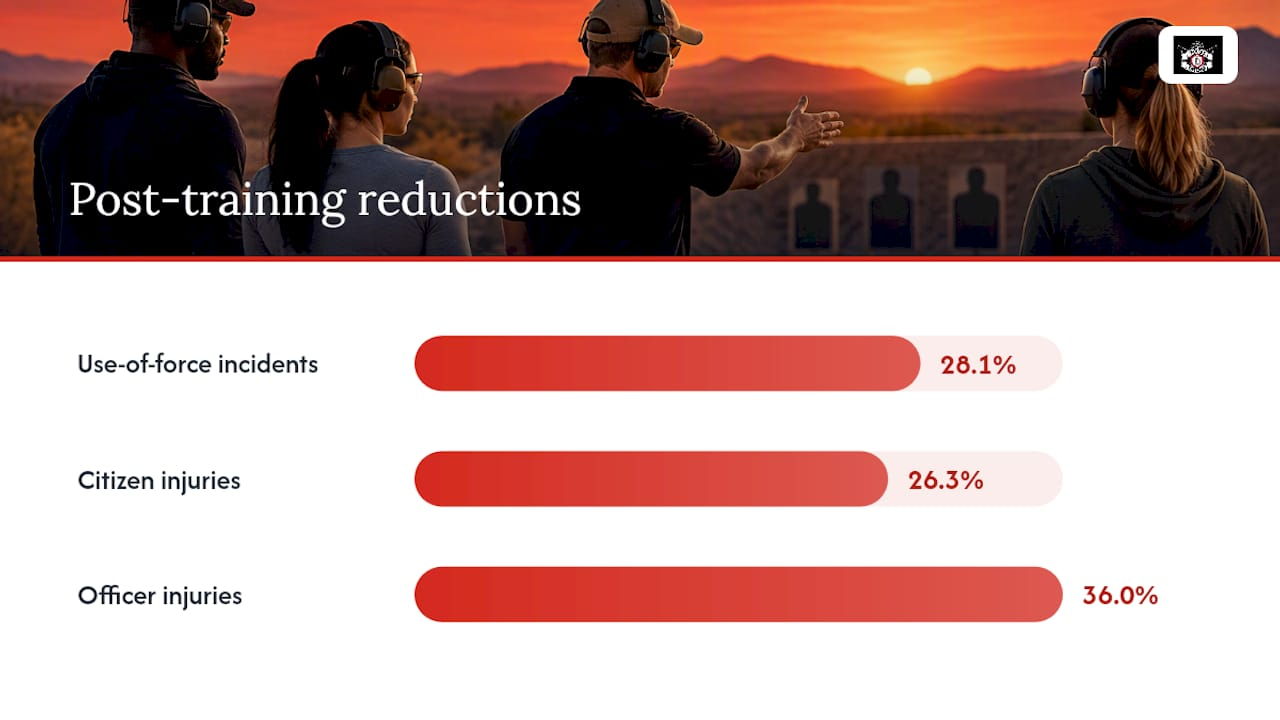
A controlled evaluation of ICAT de-escalation training in Louisville found statistically significant drops after officers completed the program: use-of-force incidents fell 28.1%, citizen injuries fell 26.3%, and officer injuries fell 36.0%.
By the numbers: Post-training data from the Louisville evaluation showed a significant drop in use-of-force incidents, citizen injuries, and officer injuries, demonstrating the effectiveness of the program.
That’s a strong signal for structured, scenario-based training specifically, not for de-escalation advice in general. A systematic review of workplace violence interventions in healthcare settings backs that nuance up: standalone training sessions running two to eight hours reliably boost staff confidence, but reducing actual violence rates usually takes a multicomponent program, meaning training paired with policy changes and environmental adjustments, not training alone.
A few things worth demanding from any program you’re considering:
- Scenario-based or simulation practice, not just a lecture and a handout
- Realistic role-play with feedback, since simulation-based formats consistently outperform lecture-only sessions on skill retention
- Organizational follow-through, since gains from individual training tend to fade without supervisor reinforcement and clear policy support
Quick Scripts and Two-Minute Drills to Practice Alone
You don’t need a classroom to start building this skill. A few minutes a day with the right script rewires your default response under stress.
- Customer conflict: “I hear you, and I want to make this right. Can you walk me through exactly what happened?”
- Family tension: “I can tell you’re really upset. I’m not going anywhere, let’s figure this out together.”
- Public distress (a stranger escalating near you): “Hey, I’m here, you’re not in trouble. Let’s just talk for a second.”
- Workplace disagreement: “I want to understand your side before we decide anything. What’s the part that’s bothering you most?”
- Self-regulation drill (two minutes): Breathe in for four counts, hold for four, exhale for six, repeat six times. This is the “de-escalate yourself first” step that negotiators treat as decisive, not optional.
Run these scripts with a partner who plays an escalating role, and swap roles afterward. Adjust wording for accessibility, plain, short sentences work better for anyone processing under stress, and be mindful that eye contact norms and personal space expectations vary across cultures.
Pro Tip: Record yourself saying your go-to calming phrase once. Most people are shocked at how fast or clipped they sound when they think they’re being calm.
The Psychology Behind Why These Techniques Work
De-escalation isn’t a trick. It leans on two well-documented psychological levers: empathy and rapport.
When someone feels genuinely heard, their nervous system starts to downshift out of fight-or-flight, which is why validating a feeling before addressing the facts works better than the reverse order. Rapport does something similar over a slightly longer arc. Once a person sees you as an ally rather than an obstacle, they become far more willing to accept limits or compromises from you.
The less obvious part, and the part most beginners get wrong, is timing. Knowing when to talk, when to go quiet, and when to offer a choice matters as much as knowing the right words. Novices tend to over-talk, filling every pause with reassurance or explanation, which can read as arguing rather than listening and actually reignite the tension it was meant to calm.
Common Triggers That Turn a Conversation Into a Conflict
Most escalations trace back to a small set of recurring triggers, and recognizing them early gives you a head start on defusing them.
Feeling disrespected or dismissed tops the list, followed closely by a sense of losing control over a situation. Long waits, unmet expectations, and being interrupted repeatedly also push people toward escalation fast. In workplace and public settings specifically, feeling unheard by someone in a position of authority is a frequent flashpoint, especially when the person believes a decision has already been made without their input. Financial stress, fatigue, and prior unresolved grievances all lower a person’s baseline tolerance, meaning a small spark can trigger an outsized reaction that has little to do with the immediate issue.
Legal and Ethical Lines to Keep in Mind
De-escalation carries real ethical weight, and it’s worth being deliberate about a few boundaries.
Report only what you observed, actions, words, and behaviors, never assumptions about someone’s intent, background, or character. Profiling based on appearance rather than behavior is both unreliable and unfair, and it undermines the accuracy of any report you file. If you work in a role where use of force is a legal possibility, such as security or law enforcement, de-escalation is generally treated as the preferred first step before force, not an optional courtesy, though the exact legal standard depends on your jurisdiction and role. When in doubt about your authority or legal exposure in a specific incident, consult your organization’s policy or legal counsel rather than relying on general guidance.
Documenting and Following Up After an Incident
What you do in the minutes after a tense encounter matters almost as much as what you did during it.
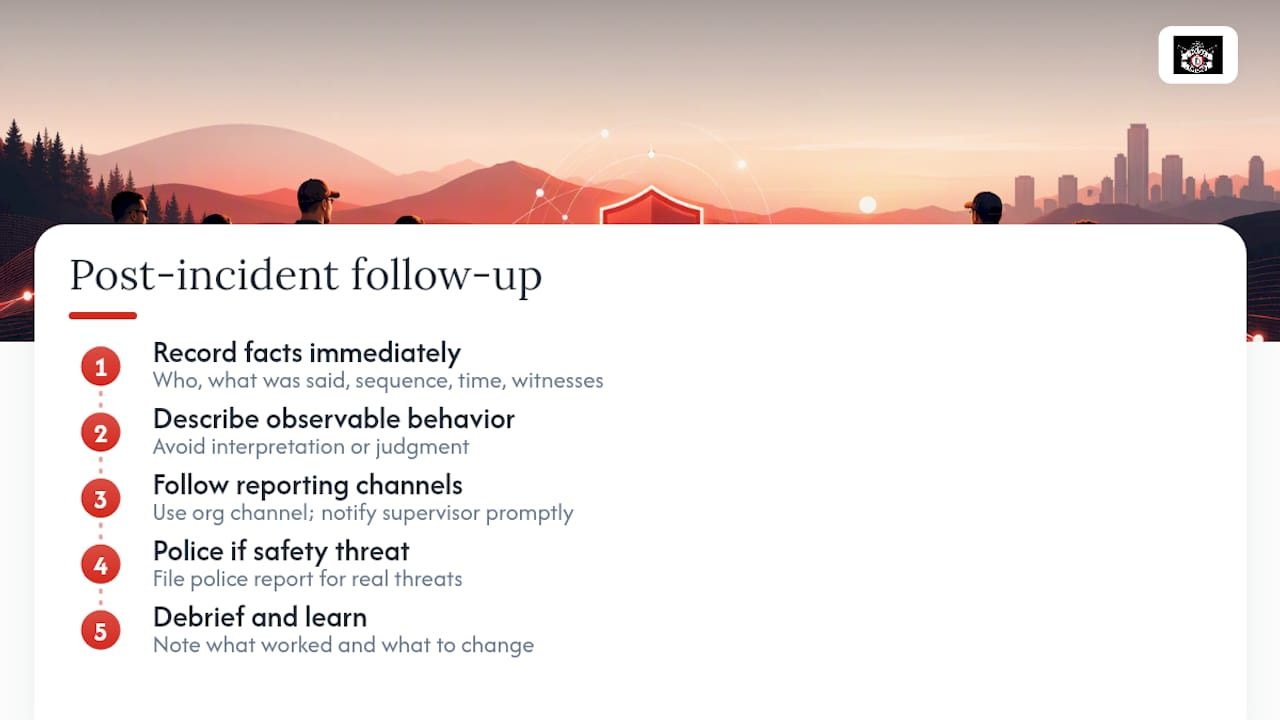
Write down the facts while they’re fresh: what was said, the sequence of events, who was present, and the time it occurred. Stick to observable behavior rather than interpretation. If the incident happened at work, follow your organization’s reporting channel and notify a supervisor promptly rather than letting it go unrecorded. For anything involving a real safety threat, a police report matters too. Afterward, take a few minutes to debrief on what worked and what you’d do differently. That habit, more than any single technique, is what turns a stressful one-off into a repeatable skill.
Where to Learn More
A handful of sources are worth bookmarking if you want to go deeper than any single article can cover.
- The CISA De-Escalation Action Guide for the full Recognize, Assess, De-escalate, Report framework and printable checklists
- The ICAT Louisville evaluation for a data-backed look at how structured training changes real outcomes
- The systematic review of workplace de-escalation interventions for how training format affects confidence versus actual violence rates
- Trouble Defense’s de-escalation training page for local, in-person classes covering these skills hands-on
Why Practice Beats Perfect Scripts
Scripts are a starting point, not the finish line. The real skill is de-escalating yourself first, steady breathing, relaxed shoulders, a controlled tone, before you ever open your mouth to the other person. Reading about paraphrasing or emotional labeling won’t build the instinct. Repetition does.
In-person guided practice, where an instructor can stop you mid-scenario and point out that your hands are clenched or your pace is too fast, builds retention that reading never will. That’s the gap between knowing the theory and actually using it when your heart rate spikes. Trouble Defense weaves de-escalation into its broader safety and firearms training because the same self-regulation and situational awareness skills that keep a firearm interaction safe also keep a heated conversation from turning into something worse.
— Dee Parker
Bring De-Escalation Training to Your Team or Family
Reading about these techniques gets you partway there. Actually rehearsing them, under realistic pressure, with someone correcting your posture and timing in real time, is what makes them stick when you need them most. A veteran-owned training academy in Fairfax, Virginia offers de-escalation and workplace violence prevention programs built around the same simulation-based approach the research points to as most effective, including hands-on scenarios, certified instruction, and a supportive environment rather than a lecture hall.
Whether you’re a business owner preparing your staff, a parent who wants practical skills for your family, or a security professional sharpening your response under pressure, Trouble Defense’s de-escalation training programs are built to fit your situation, and they pair well with active shooter preparedness training for organizations that want a fuller safety plan. Certified NRA instructors lead every session, and classes are structured for complete beginners and experienced professionals alike. Reach out to book a class or ask about workplace programs, and get hands-on practice instead of just another slide deck.
Sources
- De-Escalation Action Guide (CISA)
- Effectiveness of interventions to de-escalate workplace violence against nurses in healthcare settings
FAQ
What Are the 5 Steps of De-Escalation?
Most frameworks describe four core steps rather than five: Recognize the warning signs, Assess the situation and your own safety, De-escalate using calm communication and space, and Report the facts afterward. This Recognize, Assess, De-escalate, Report model comes directly from CISA’s guidance and applies across workplace, public, and personal settings.
Is There a Hyphen in “De-Escalate”?
Yes, “de-escalate” and “de-escalation” are typically written with a hyphen, since “de” attached directly to “escalate” without one can look awkward and harder to read. Both hyphenated and unhyphenated spellings appear in print, but the hyphenated form is the more common and widely accepted style.
What Is De-Escalation in Healthcare?
In healthcare, de-escalation refers to communication techniques nurses and staff use to calm agitated patients or visitors without physical restraint or force. Research shows training programs that combine staff training with policy and environmental changes are more effective at reducing actual violence than training alone.
What Are Three De-Escalation Techniques?
Three of the most effective techniques are leading with empathic, validating language instead of arguing facts, using active listening tools like paraphrasing and emotional labeling to build rapport, and offering controlled choices instead of commands to preserve someone’s sense of control. Keeping a calm, slow voice and respecting personal space support all three.
Does Trouble Defense Offer De-Escalation Training?
Yes, Trouble Defense offers in-person de-escalation and workplace violence prevention training in the Fairfax, Virginia area, serving Virginia, Maryland, and the DC region. Pricing for these programs is available directly on the de-escalation training page.