Defensive shooting scenarios are practical exercises that replicate high-stress self-defense situations to sharpen firearm handling, tactical decision-making, and safety under pressure. Unlike static range shooting, these drills force you to think, move, and react the way you would in a real encounter. The gap between punching paper at a range and responding to a home invasion is enormous, and scenario-based training closes that gap by introducing unpredictable variables that demand critical thinking, not just mechanical skill. Trouble Defense, a veteran-owned training academy in Fairfax, VA, builds its curriculum around exactly these kinds of real-world defensive shooting scenarios examples to prepare students across Virginia, Maryland, and Washington DC.
1. The Failure Drill: shot sequencing under pressure
The Failure Drill, also called the Mozambique Drill, is one of the most widely taught defensive shooting scenarios examples in professional armed defense training. The drill requires two shots to the torso followed by one precise shot to the head, executed in rapid sequence. This sequence exists because body armor, adrenaline, or drugs can prevent a threat from stopping after center-mass hits. The head shot is the escalation decision, and making it correctly under stress is the entire point.
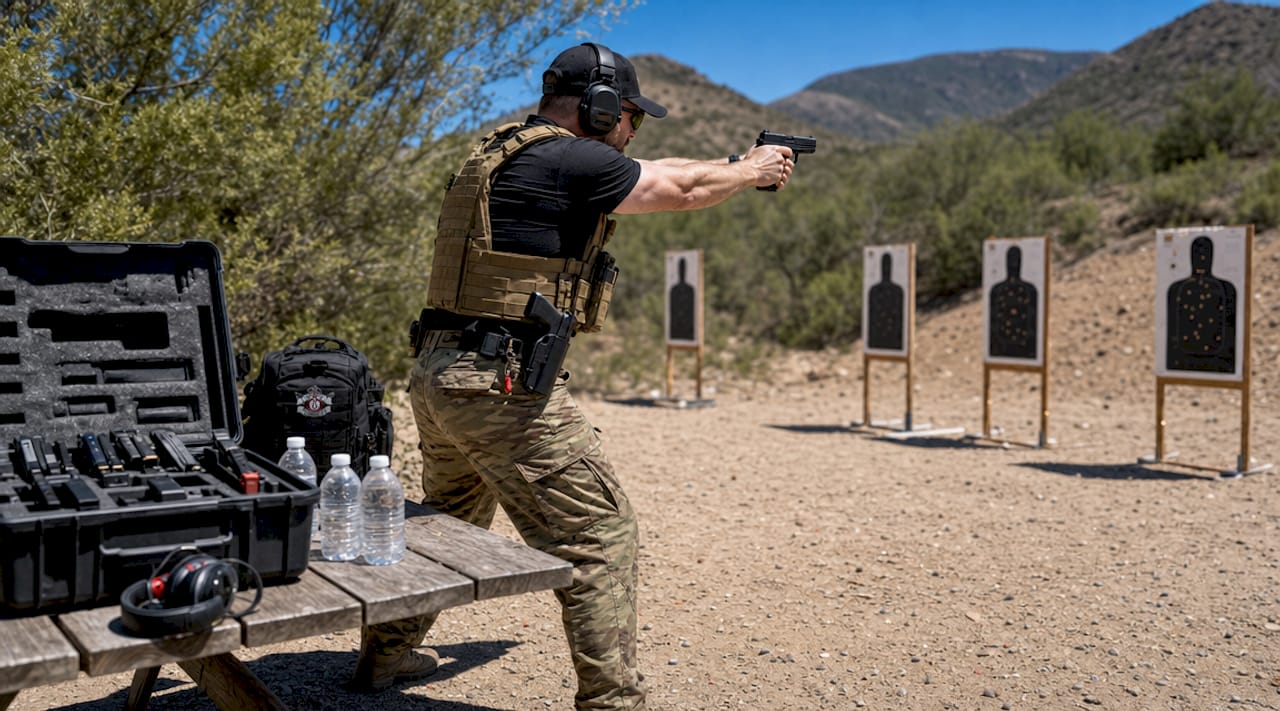
What makes this drill genuinely valuable is the discipline it demands. You cannot rush the third shot. The transition from the torso to the head requires a deliberate sight picture, and that pause under pressure is where most shooters fail in training. Practicing this sequence repeatedly builds the neural pathway for controlled escalation rather than panic firing.
Here is how to structure a Failure Drill session:
- Start at 7 yards with a standard silhouette target.
- Draw from the holster and fire two controlled shots to the center mass zone.
- Pause, assess, then deliver one precise shot to the head box.
- Time yourself. A competent defensive shooter completes the sequence in under 3 seconds at 7 yards.
- Gradually introduce movement, low-light conditions, or a second target to increase difficulty.
Pro Tip: Use dry-fire practice to rehearse the Failure Drill at home. The transition from torso to head is a fine motor skill, and dry fire builds that precision without burning ammunition.
2. Dos Atracadores: engaging multiple threats with movement
Dos Atracadores, Spanish for “Two Robbers,” is a multi-target drill designed by Mike Boyle that directly addresses one of the most common real-world defensive shooting situations: facing more than one attacker. The drill places two targets at different distances, requiring the shooter to engage both while incorporating lateral movement to cover and executing a mandatory reload. A superior pistol rating is achieved at 12 seconds or less. That benchmark matters because it forces you to balance speed and accuracy rather than sacrificing one for the other.
The movement component is what separates this drill from simple double-target practice. Standing still while engaging two threats is a liability. Moving to cover while reloading and re-engaging trains the body to do several things simultaneously, which is exactly what a real encounter demands.
Key elements of the Dos Atracadores drill:
- Target placement: One target at close range (3 to 5 yards), one at a longer distance (7 to 10 yards).
- Engagement order: Shoot the closer threat first, then transition to the farther target.
- Movement: Step laterally to a designated cover position during or after the initial engagement.
- Mandatory reload: Execute a reload before completing the drill to simulate real-world ammunition management.
- Time standard: Timed performance at 12 seconds or under reflects superior tactical execution.
This drill is a staple in Trouble Defense’s practical shooting scenarios curriculum because it mirrors the chaos of real encounters far better than single-target drills ever could.
3. Low-light defensive shooting: weapon lights and target identification
Low-light engagement training is a non-negotiable element of effective home defense teaching, because the most common timeframe for home intrusions is nighttime. Most defensive shootings happen in conditions where ambient light is poor, and your ability to identify a target before firing is both a legal and a moral obligation. Shooting the wrong person in the dark is not a training failure. It is a catastrophe.
Weapon-mounted lights (WMLs) solve the core problem of maintaining a two-handed grip while illuminating a target. Without a weapon-mounted light, shooters in testing struggled to identify no-shoot targets at just 7 yards in low-light conditions. That statistic should end the debate about whether a WML is a luxury or a necessity for home defense.
Effective low-light training covers several techniques:
- Weapon-mounted light activation: Learn your light’s pressure pad or switch so activation is instinctive, not fumbled.
- FBI flashlight hold: Extend the handheld light away from your body to draw fire away from your center mass. Useful when a WML is not available.
- Modified cigar hold: Hold the flashlight between your index and middle fingers, allowing a two-handed grip on the firearm while still directing light.
- Light discipline: Use short bursts of light rather than constant illumination to avoid giving away your position.
- Stress inoculation: Training under simulated stress builds the neural pathways needed for calm decision-making when your heart rate spikes in a real encounter.
Pro Tip: Run your low-light drills in your actual home at least once. The layout you know in daylight feels completely different at 2 a.m. with an elevated heart rate.
4. Home defense tactics: barricade vs. room clearing
The single most important tactical decision in a home defense scenario is whether to barricade or move. Experts consistently advise that civilians should barricade in a safe room rather than clear the home, because untrained room clearing dramatically increases the risk of accidental discharge and friendly fire. Room clearing is a team skill. Law enforcement and military units train for it constantly, with multiple people covering angles simultaneously. A single civilian doing it alone is at a severe disadvantage.
The standard safe room setup is the master bedroom: solid-core door with a quality lock, a charged phone to call 911, and your firearm ready. Your job is to create distance, call for help, and only engage if the threat comes through that door. This approach is legally and tactically sound.
| Approach | Recommended for civilians | Risk level | When it applies |
|---|---|---|---|
| Barricade in safe room | Yes | Low | Threat is in another part of the home |
| Room clearing | No (without training) | High | Not recommended for untrained individuals |
| Rescue movement | Situational | Medium to high | Retrieving a family member from another room |
The one exception to barricading is a rescue mission. If your child is in another bedroom, you move. But that movement should be deliberate, using walls and doorframes for cover, minimizing your exposure at every threshold. Trouble Defense covers these exact movement tactics in its home defense training courses for Virginia, Maryland, and DC residents.
5. Post-incident management: legal and psychological realities
What you do in the 60 seconds after a defensive shooting determines much of what happens in the months that follow. Proper post-event protocol includes securing the scene, calling 911 immediately, holstering your firearm before police arrive, and then waiting. That sequence is not instinctive. It requires prior knowledge and rehearsal.
The legal dimension is where many otherwise justified shooters create problems for themselves. Detailed statements made under acute stress can contradict your account once adrenaline fades, and those contradictions become ammunition for prosecutors. The correct approach is to identify yourself to law enforcement, confirm you called 911, point out evidence and witnesses, and then state clearly that you want to speak with an attorney before giving a full statement.
Follow this sequence after a defensive shooting:
- Confirm the threat is stopped and the environment is secure.
- Call 911. State your location, describe what happened in one sentence, and request medical assistance.
- Holster your firearm before police arrive. Officers responding to a shooting call will draw on anyone holding a weapon.
- When officers arrive, keep your hands visible and follow instructions without argument.
- Provide your name and basic facts. Then invoke your right to an attorney before any detailed questioning.
The psychological aftermath is real and should be anticipated. Post-incident management encompasses legal, tactical, and psychological dimensions, and understanding all three before an incident improves outcomes significantly. Trouble Defense integrates this context into its advanced training programs so students are not blindsided by the aftermath of a justified shooting.
Key takeaways
Effective defensive shooting training requires scenario-based drills that combine tactical movement, stress inoculation, legal awareness, and target identification to prepare you for real encounters.
| Point | Details |
|---|---|
| Failure Drill fundamentals | Two torso shots followed by one head shot trains controlled escalation under pressure. |
| Multi-target movement | Dos Atracadores builds speed, accuracy, and reload discipline against multiple threats. |
| Low-light necessity | Weapon-mounted lights are required for safe target identification in nighttime home defense. |
| Barricade over clearing | Civilians should hold a safe room position rather than attempt solo room clearing. |
| Post-incident protocol | Call 911, holster before police arrive, and consult an attorney before making detailed statements. |
Why realistic scenarios changed how I teach
I have watched students shoot tight groups at 10 yards on a static range and then completely fall apart the first time I add a moving target, a time limit, and a verbal command to stop shooting. That collapse is not a character flaw. It is what happens when training does not match reality. The body does not know how to perform skills it has only practiced in calm, predictable conditions.
The common misconception I see most often is that accuracy on a square range translates to competence in a real encounter. It does not. Marksmanship skills are the foundation, but decision-making under stress is the structure built on top of that foundation. A shooter who hesitates because they have never practiced a threat-assessment decision in training is more dangerous to themselves and others than a shooter with average accuracy who has drilled realistic scenarios hundreds of times.
What I find works is progressive stress loading. Start with the Failure Drill in dry fire. Add a timer. Add movement. Add a second target. Add a low-light condition. Each layer forces the brain to adapt, and that adaptation is what builds genuine readiness. The students at Trouble Defense who train this way consistently report that their confidence in real-world situations, including understanding their legal obligations and post-incident responsibilities, is qualitatively different from what they felt after basic range training.
Legal and psychological readiness is not a bonus module. It belongs in every defensive shooting curriculum from day one. If you carry a firearm in Virginia, Maryland, or DC and you have not rehearsed what you will say to a 911 operator or a responding officer, your training is incomplete.
— Dee Parker
Train with Trouble Defense for real-world readiness
Trouble Defense offers scenario-based firearm training across Virginia, Maryland, and Washington DC, taught by certified NRA instructors and veterans who have applied these skills in real environments. Courses cover home defense tactics, low-light shooting, Virginia CCW classes, Maryland Wear and Carry permits, DC concealed carry training, and advanced defensive drills including the Failure Drill and multi-target engagements. Trouble Defense also offers women’s firearm training, adaptive programs for individuals with disabilities, and youth firearm safety education. With over 300 five-star Google reviews, the training is built for every level. Check the upcoming training calendar and register for the class that fits your goals.
FAQ
What is the Failure Drill in defensive shooting?
The Failure Drill requires two shots to the torso followed by one shot to the head, training shooters to escalate precisely when center-mass hits fail to stop a threat. It is one of the most widely practiced defensive shooting scenarios examples in professional armed defense training.
Why is low-light training important for home defense?
Most home intrusions occur at night, and without proper low-light training, shooters cannot reliably identify targets before firing. Weapon-mounted lights significantly improve target identification and accuracy in dark conditions.
Should civilians clear their home during a break-in?
Experts advise against it. Barricading in a safe room is safer for untrained civilians, and room clearing should only be attempted to rescue a family member in immediate danger.
What should you do immediately after a defensive shooting?
Secure the scene, call 911, holster your firearm before police arrive, and request an attorney before making any detailed statements to law enforcement.
How do timed drills like Dos Atracadores improve defensive skills?
Timed multi-target drills force shooters to balance speed and accuracy under pressure, simulating the decision-making demands of real encounters. A superior rating in Dos Atracadores is achieved at 12 seconds or less.