What Is De-Escalation Training and Why Is It Important in the Workplace?
Conflict can happen in almost any workplace.
An upset customer may become increasingly angry. Two employees may have a disagreement that begins affecting the rest of the workplace. A patient, visitor, student, tenant, or member of the public may become frustrated and confrontational.
The question is: Will your employees know what to do when a difficult conversation starts becoming a safety concern?
That is where de-escalation training can make a difference.
De-escalation training gives employees practical communication and awareness skills they can use to recognize rising tension, respond professionally, establish boundaries, and make better decisions during difficult encounters. These de-escalation techniques for employees can help reduce tension, improve communication, and support a safer work environment.
For businesses and organizations throughout Virginia, Maryland, and Washington, DC, workplace de-escalation training can also become an important part of a broader workplace violence prevention and employee safety strategy. When organizations invest in workplace conflict de-escalation, they help employees respond more effectively to emotionally charged interactions before they become crises.
What Is De-Escalation Training?
De-escalation training teaches people how to recognize and respond to behaviors that may indicate an interaction is becoming more serious.
The goal is not to “win” an argument.
The goal is to help employees communicate effectively, maintain awareness of their surroundings, reduce unnecessary tension, and recognize when a situation can no longer be safely handled through conversation alone. In many workplaces, verbal de-escalation training helps employees build the confidence to respond calmly and professionally under pressure.
Employees may learn how to:
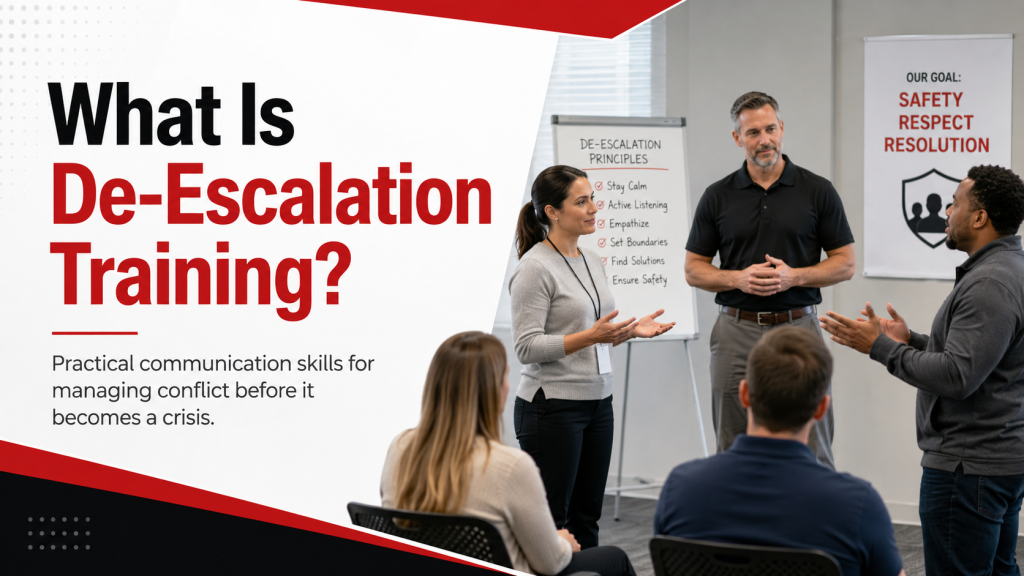
- Recognize early warning signs of escalating behavior
- Control their own emotional response
- Use a calm and professional tone
- Practice active listening
- Avoid language that may unintentionally increase tension
- Establish clear and professional boundaries
- Maintain appropriate personal space
- Remain aware of exits and available assistance
- Recognize when verbal communication is no longer working
- Disengage and seek additional help when necessary
These de-escalation techniques for employees can be useful in industries where staff regularly interact with customers, patients, students, residents, visitors, clients, or members of the public. Strong workplace conflict de-escalation skills are especially valuable for public-facing teams that may encounter frustration, confusion, or aggressive behavior on the job.
Why Is Workplace De-Escalation Training Important?
Many employees are expected to deal with angry or emotionally charged individuals without ever receiving formal training on how to respond.
They may know company policy, but knowing a policy is different from having practiced what to say when someone is yelling, making threats, refusing to cooperate, or becoming increasingly agitated.
Without training, employees may react based on instinct.
Some people argue back. Others become defensive. Some freeze. Others continue attempting to reason with someone even after the interaction has become unsafe.
This is one reason so many employers ask, why is de-escalation training important? The answer is simple: it helps employees respond with more control, more awareness, and more professionalism. De-escalation training provides employees with a framework they can use when emotions are running high, and verbal de-escalation training gives them practical tools to use in real conversations.
1. Employees Learn to Recognize Warning Signs Earlier
Conflict rarely goes from completely calm to dangerous without some type of change in behavior.
There may be changes in:
- Tone of voice
- Volume
- Body language
- Personal space
- Agitation
- Threatening statements
- Repetitive or fixated behavior
- Willingness to follow reasonable instructions
Recognizing these changes early can give employees more time to evaluate what is happening and determine an appropriate response.
Early recognition matters because the best opportunity to manage a conflict may occur before the person reaches their highest level of frustration. This is another key answer to the question, why is de-escalation training important. Employees who can recognize warning signs earlier are often better prepared to apply de-escalation techniques for employees before the situation intensifies.
2. Employees Learn That Their Own Response Matters
An employee cannot completely control another person’s behavior.
They can, however, control many aspects of their own response.
Their tone, words, body language, facial expressions, positioning, and willingness to listen can influence how an interaction develops.
For example, arguing with an already frustrated customer may increase tension.
Interrupting repeatedly can make someone feel ignored.
Crowding an agitated individual or using unnecessarily aggressive language can also make the situation worse.
De-escalation training helps employees become more aware of how their own communication may affect the encounter. This is why verbal de-escalation training is so valuable. It gives employees practical, repeatable communication skills that support effective workplace conflict de-escalation and reduce the chance of making the situation worse.
3. Active Listening Can Help Reduce Frustration
Sometimes people become even more frustrated because they believe nobody is listening to them.
Active listening does not mean agreeing with inappropriate behavior, accepting abuse, or promising something that cannot be delivered.
It means identifying the actual concern.
Instead of immediately arguing about who’s right, an employee may first determine what happened and what the person is trying to accomplish.
A professional response might be:
“I understand that you’re frustrated. Tell me what happened so I can understand the situation.”
That small change in communication can help move the conversation away from confrontation and toward problem solving. This is one of the most effective de-escalation techniques for employees, and it is a core part of quality verbal de-escalation training.
4. De-Escalation Training Helps Employees Set Boundaries
Being calm does not mean allowing someone to behave however they want.
Professional boundaries are an important part of de-escalation.
Employees should understand how to clearly communicate what they can do, what they cannot do, and what behavior is unacceptable.
An employee may need to explain available options while remaining firm about workplace rules.
This becomes particularly important for employees working in customer service, healthcare, hospitality, education, property management, retail, government, security, and other public-facing positions. In these environments, strong workplace conflict de-escalation skills and clear boundaries can help employees maintain professionalism while still protecting safety.
5. Employees Learn When to Stop Talking
One of the most important lessons in de-escalation training is that not every situation can be verbally de-escalated.
There is no magic phrase that guarantees an angry or aggressive person will become calm.
Employees must understand their personal safety limitations.
There may come a point when continuing the conversation is no longer appropriate.
Depending on the circumstances and organizational procedures, employees may need to:
- End the interaction
- Create distance
- Move to a safer location
- Request help from a supervisor
- Contact security
- Activate an emergency procedure
- Contact law enforcement
Successful de-escalation training should never teach employees that they are required to remain in a dangerous situation simply because they are trying to calm someone down. A good verbal de-escalation training program also teaches when talking is no longer enough and when a safety-focused response is necessary. That is a major reason why de-escalation training is important in the workplace.
6. Scenario-Based Training Makes the Lesson More Realistic
Reading a policy manual is different from responding to an angry person standing in front of you.
Scenario-based de-escalation training gives participants an opportunity to think through realistic workplace situations before they encounter them in real life.
A hotel may experience different conflicts than a school.
A healthcare facility may face different challenges than a retail business.
A government office may have different procedures than a church or nonprofit organization.
That is why customized training can be especially valuable.
Training scenarios can be designed around the situations employees are most likely to encounter in their actual workplace. This helps teams practice de-escalation techniques for employees in realistic settings and build more confidence in handling workplace conflict de-escalation situations.
7. De-Escalation Can Support a Larger Workplace Safety Program
De-escalation training should not exist by itself.
Organizations should consider how conflict management fits into their larger approach to employee safety and workplace violence prevention.
Employees should understand the difference between:
A difficult interaction that may still be manageable through communication
and
A developing safety threat that requires employees to disengage and follow emergency procedures.
Training employees to recognize that transition can be just as important as teaching them what to say. This is another strong answer to the question, why is de-escalation training important. It helps employees understand when to use communication, when to apply de-escalation techniques for employees, and when to shift from workplace conflict de-escalation to emergency response.
Final Thoughts
If your organization has ever asked why is de-escalation training important, the answer lies in preparation, communication, and safety. De-escalation training helps employees stay calm, communicate more effectively, recognize escalating behavior earlier, and make better decisions during difficult encounters.
Whether your team needs verbal de-escalation training, practical de-escalation techniques for employees, or a broader approach to workplace conflict de-escalation, the right training can help create a safer and more confident workplace.
Who Should Receive De-Escalation Training?
De-escalation training may benefit many different organizations and professions, including:
- Customer service teams
- Supervisors and managers
- Government employees
- Healthcare workers
- Assisted-living employees
- Teachers and school personnel
- Hospitality and hotel staff
- Retail employees
- Property management teams
- Security personnel
- Churches and nonprofit organizations
- Youth organizations
- Volunteers
- Employees working in public-facing or high-conflict environments
Organizations do not have to wait until a serious incident occurs before providing training.
Preparing employees beforehand allows teams to discuss expectations, communication strategies, organizational procedures, and personal safety before they are dealing with a real crisis.
De-Escalation Training in Virginia, Maryland and Washington, DC
Trouble Defense LLC provides instructor-led conflict de-escalation training for businesses, government organizations, nonprofits, schools, churches, healthcare organizations, hospitality teams, and other workplaces.
Programs can be customized around your organization, employee responsibilities, workplace environment, policies, and the situations your employees are most likely to encounter.
Training options may include on-site instruction, virtual training, group exercises, workplace examples, scenario-based discussions, and customized safety training.
Programs can also be combined with workplace violence prevention or active shooter preparedness training when organizations want a more comprehensive approach to employee safety.
Prepare Your Employees Before Conflict Becomes a Crisis
Employees should not have to figure out how to handle an aggressive or emotionally charged situation for the first time while it is happening.
Practical de-escalation training can help employees recognize concerning behavior earlier, communicate more professionally, maintain better situational awareness, establish boundaries, and understand when it is time to disengage and seek assistance.
Trouble Defense LLC provides de-escalation training in Virginia, Maryland and Washington, DC, with customized programs available for businesses and organizations.
Ready to prepare your team?
Learn more about Trouble Defense De-Escalation Training or request a customized training quote for your organization.
Students leave with a consistent draw stroke, a properly fitted holster setup, and the reholstering habits that prevent negligent discharges. For those working toward a permit, Trouble Defense’s CCW permit class integrates holster fundamentals into the full certification curriculum for Virginia, Maryland, and DC. Check the training calendar for upcoming class dates and availability.
Further reading and sources
- How To Conceal A Gun Comfortably And Safely — PHLster
- Eclipse Holsters — Homepage
- How to safely reholster your handgun — NRA Family
- More Than Just A Gun Bucket: How to Choose A Good Holster — Shooting Illustrated
- Picking a CCW holster — Athlon Outdoors
- 11 carry holster mistakes that make concealment miserable — The Avid Outdoorsman
- How to choose a concealed carry holster — GunTransfers
- Benefits of using a gun belt for concealed carry — Blade-Tech
This article is general information for educational purposes. Concealed carry laws vary by state. Confirm current permit requirements and legal obligations with your state’s licensing authority or a qualified attorney before carrying.
FAQ
Frequently Asked Questions About De-Escalation Training
What is de-escalation training?
De-escalation training teaches people how to recognize rising tension, communicate calmly, set professional boundaries, and respond appropriately to angry, frustrated, aggressive, or emotionally charged individuals.
Who should take de-escalation training?
De-escalation training can benefit employees, supervisors, managers, customer service teams, healthcare workers, educators, security personnel, hospitality staff, property managers, government employees, nonprofit organizations, and other public-facing professionals.
What skills are taught in de-escalation training?
Training may include active listening, verbal communication, recognizing warning signs, maintaining personal space, controlling tone and body language, setting boundaries, situational awareness, and knowing when to disengage or seek assistance.
Does de-escalation training prevent workplace violence?
De-escalation training cannot guarantee that violence will never occur, but it can help employees recognize concerning behavior earlier, reduce unnecessary conflict, and make better decisions when a situation begins to escalate.
Is de-escalation training only for security employees?
No. De-escalation skills can be valuable for almost any employee who regularly interacts with customers, patients, students, residents, visitors, coworkers, or members of the public.
Can every aggressive person be verbally de-escalated?
No. Not every situation can be resolved through communication. Employees should also learn when to stop engaging, create distance, seek help, contact security, or follow emergency procedures.
How long does de-escalation training take?
Training length can vary depending on the organization and its needs. Programs may range from approximately 60–90 minutes to several hours, half-day sessions, or customized training programs.
Can de-escalation training be customized for our workplace?
Yes. Customized training can address the situations employees are most likely to encounter in their specific workplace, such as angry customers, employee disputes, disruptive visitors, aggressive behavior, or other workplace safety concerns.
Can de-escalation training include scenarios?
Yes. Scenario-based exercises can help participants practice communication, decision-making, boundary setting, and situational awareness in realistic workplace situations.
Does Trouble Defense provide de-escalation training for businesses?
Yes. Trouble Defense LLC provides de-escalation and workplace safety training for businesses, organizations, nonprofits, government agencies, and other groups in Virginia, Maryland, Washington, DC, and approved travel locations.
Can de-escalation training be combined with workplace violence or active shooter training?
Yes. De-escalation training can be part of a larger workplace safety program that includes workplace violence prevention, situational awareness, emergency response, and active shooter preparedness.
How often should employees receive de-escalation training?
Organizations may benefit from including de-escalation training in new-hire orientation and providing periodic refresher training, especially for employees in public-facing or higher-conflict positions.