There is no single “best” concealed carry position. Most carriers start by testing inside the waistband (IWB) or outside the waistband (OWB) carry, then experiment with appendix, pocket, or ankle carry based on wardrobe and daily activity. Whatever you choose, use a holster with a covered trigger guard and practice drawing under an instructor’s eye before trusting it in public.
TL;DR:
- Most carriers start with IWB or OWB carry and experiment with appendix, pocket, or ankle positions based on personal wardrobe and activity.
- On-body carry offers faster, more reliable access, while off-body carry is more comfortable but carries risks of loss or theft.
- Safe holster features include a covered trigger guard and secure retention, with re-holstering skills being crucial for safety.
- The best carry position depends on body type, clothing, firearm size, and daily routine, requiring real-world testing and adjustments.
- Hands-on coaching from a certified instructor ensures a safe and effective draw, ride height, and carry setup tailored to individual needs.
Table of Contents
- On-body vs. off-body carry: why the distinction matters
- Top concealed carry positions compared
- How to choose the best carry position for your daily life
- What training standards and documented incidents teach us about holster safety
- An honest look at how carriers actually find their fit
- Get hands-on coaching to lock in your carry setup
- Sources
- FAQ
On-body vs. off-body carry: why the distinction matters
Every concealed carry decision starts with one fork in the road: on-body or off-body. On-body carry means the firearm rides directly against your waist, chest, thigh, or ankle, held by a holster that stays attached to you. Off-body carry, like a purse, sling bag, or fanny pack, keeps the gun separate from your body but inside something you’re holding or wearing.
The trade-off is straightforward. On-body positions generally offer a faster, more reliable draw because the gun is always in the same spot relative to your hands. Off-body carry can be more comfortable and easier to conceal in certain outfits, but it introduces a real risk: if someone grabs the bag, or you set it down and walk away, you’ve lost the weapon and control of it.
Whichever category you choose, the holster itself does more for your safety than the position does. A practitioner overview of holster positions consistently points back to two features that matter most:
- A covered trigger guard that keeps clothing, fingers, or drawstrings away from the trigger.
- Retention that holds the gun securely without requiring your finger anywhere near the trigger to release it.
Training standards echo the same priority. New York State’s minimum concealed-carry training standards require classroom instruction that specifically addresses holster considerations and safe re-holstering, treating holster design as a core safety skill rather than an afterthought.
Top concealed carry positions compared
Here’s how the mainstream positions stack up on concealment, comfort, and accessibility, based on how holster makers and instructors typically evaluate them.
- Inside the waistband (IWB): This is the default recommendation for most first-time carriers. The holster tucks between your pants and your body at roughly the 3 to 5 o’clock position, which keeps the gun close and easy to conceal under an untucked shirt. A holster wedge or claw attachment helps push the grip inward, reducing the printing (visible outline) that shows through clothing when you sit or bend. It fits well in a car seat and works for most body types, which is why it’s often the starting point before anyone tries appendix or OWB.
- Appendix (AIWB): Worn in front of the hip, roughly between 12 and 2 o’clock, appendix carry gives you a fast, natural draw because your hands meet the gun right where they’d naturally fall. The trade-off is comfort: sitting, bending, and driving can press the muzzle into soft tissue or, for some carriers, raise concerns about muzzle direction near the femoral artery and spine during a fall. A wedge or claw again helps here, tilting the grip toward the body. Appendix tends to suit slimmer builds and carriers who prioritize speed over all-day comfort.
- Outside the waistband (OWB) / strong-side hip: Worn at 3 to 4 o’clock outside the pants, OWB is often the most comfortable option and allows a fast, straightforward draw with minimal adjustment. The catch is concealment: it needs a cover garment, like an untucked shirt or jacket, so it works better in cooler weather or looser clothing than it does under a fitted t-shirt in summer.
- Pocket carry: Pocket carry works only with small, purpose-built pocket pistols in a holster designed to break up the gun’s outline and keep the pocket’s fabric away from the trigger. Retention is limited, the draw is slower than IWB or OWB, and deep or tight pockets can make the gun difficult to access quickly. It’s a reasonable backup or low-profile option, not a primary carry method for most people.
- Ankle carry: Concealment is excellent under pants, which makes ankle carry popular for backup guns or situations where waistband carry isn’t practical. Access is poor while seated, driving, or standing, since it usually requires bending down and lifting a pant leg, so most instructors treat it as a secondary position rather than a primary one.
- Small-of-back and cross-draw: Small-of-back carry, at the 6 o’clock position, is one of the least recommended options among instructors, largely because it slows the draw, is nearly impossible to access while seated, and raises the risk of spinal injury if you fall on the holster. Cross-draw, worn on the opposite hip from your dominant hand, has similar drawbacks: it points the muzzle across your own body during the draw and can be more easily grabbed by someone standing in front of you. Both have narrow, situational uses, like carrying while seated in a vehicle for extended periods, but they aren’t a first choice for daily carry.
- Purse, bra, and shoulder carry: These off-body and near-body options work well for wardrobes that don’t accommodate a waistband holster, but they come with the added risk of separation from the firearm if a bag is snatched or set down. A dedicated, holstered compartment that fully covers the trigger guard is essential, since a bag without one lets keys, pens, or a phone charger shift against the trigger.
Pro Tip: Whatever position you land on, dry-fire practice at home (unloaded, no ammunition in the room) builds the muscle memory to draw smoothly before you ever test a position on the range.
How to choose the best carry position for your daily life
Picking a position is less about following trends and more about running your own short experiment.
- Start with your body type and profile: a slimmer build often favors appendix or IWB, while a fuller waistline may find OWB or a slightly higher ride height more comfortable.
- Match the position to your wardrobe: fitted clothing points toward IWB or pocket carry, while looser layers open the door to OWB.
- Consider your firearm’s size: a compact or subcompact pistol conceals more easily in appendix or pocket positions than a full-size duty gun.
- Think about your daily posture: a job that involves long hours of sitting or driving changes how a position feels compared to one spent standing or walking.
- Choose a holster with a covered trigger guard and solid retention before worrying about ride height or cant.
Once you’ve picked a starting point, wear the full outfit you’d normally wear and carry (unloaded, if you’re still testing) for short periods during a normal day. Check for printing in a mirror, note any discomfort when you sit in a car seat or at a desk, and adjust the holster’s ride height or cant a notch at a time until printing and pain both settle down.
Pro Tip: A small adjustment, like raising the ride height half an inch or adding a few degrees of forward cant, often solves a printing or comfort problem faster than switching positions entirely.
Stop and consult an instructor if you notice ongoing pain, printing that won’t resolve no matter what you adjust, or any moment where the muzzle direction during a draw or re-holster makes you uneasy. Our guide on choosing a carry position based on body type and lifestyle walks through this decision in more detail.
What training standards and documented incidents teach us about holster safety
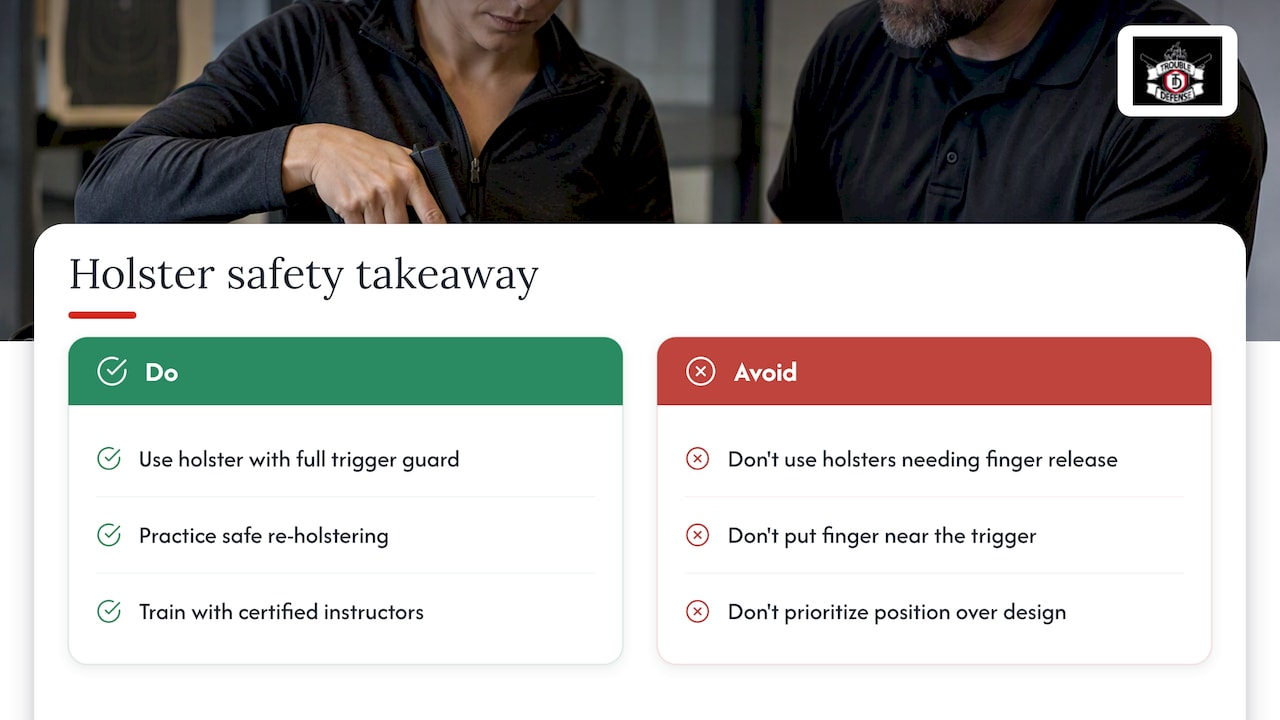
Position matters, but holster design and trigger discipline matter more. New York State’s minimum training standards require classroom hours on holster considerations and safe re-holstering, reflecting a broader consensus that re-holstering, not drawing, is where many negligent discharges happen.
Documentation from FLETC’s holster study found that certain retention holsters, particularly those requiring an index finger near the trigger to release the weapon, contributed to negligent discharges during training. Some ranges have since banned those retention styles outright.
A secure holster with a fully covered trigger guard reduces risk regardless of which position you carry in. Retention methods that put a finger near the trigger during the draw are a documented liability, not a design quirk.
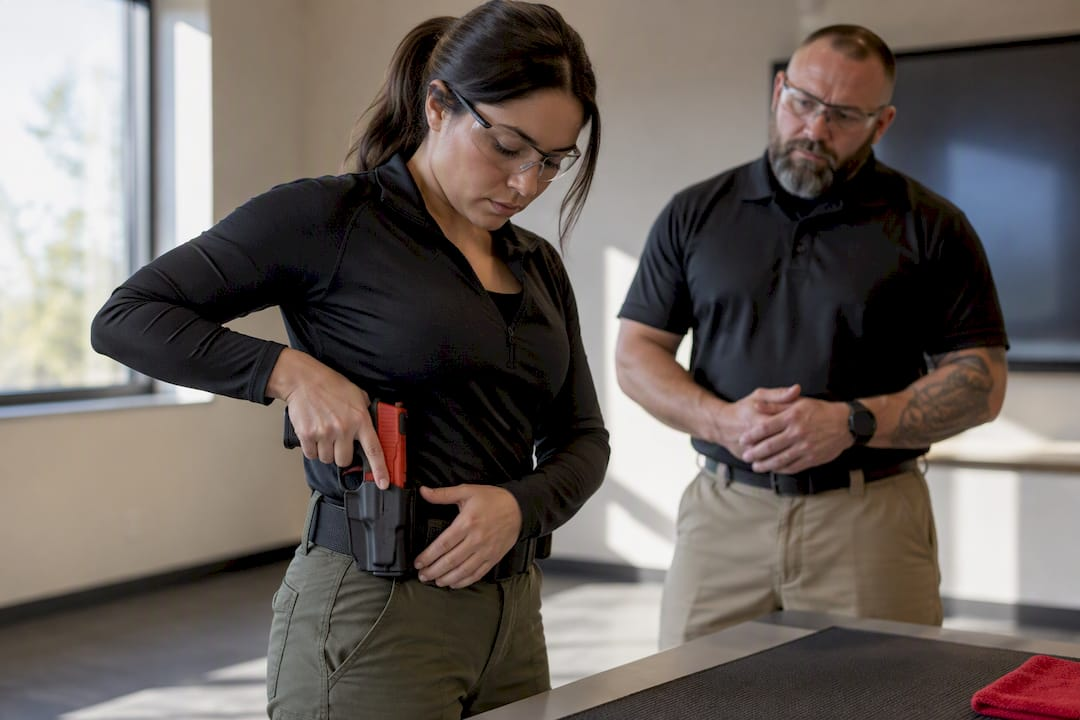
A veteran-owned training academy offers hands-on holster-draw sessions led by certified instructors, so students can work through these exact safety checks with a coach watching, not just reading about them.
An honest look at how carriers actually find their fit
Most people don’t find the right position by reading a comparison chart. They find it by wearing one position for a week or two during their real routine, logging where it prints, where it pinches, and how it feels getting in and out of a car, then adjusting one variable at a time. Dry-fire practice at home builds the draw stroke; live-fire draw coaching with an instructor is what confirms it actually works under pressure.
Women’s carry and adaptive carry (including wheelchair users) often need a different starting position entirely, since waistband access and holster angle change with body position. Our purse carry safety guide for women covers off-body options in more depth. Keep notes. They make your next instructor consultation faster and more useful.
— Dee Parker
Get hands-on coaching to lock in your carry setup
Reading about holster positions only gets you so far. The fastest way to know if your ride height, cant, and draw are actually safe is to run them past a certified instructor who can watch your hands, not just your outline in a mirror. Trouble Defense runs a dedicated holster draw training class built around exactly this kind of live coaching, alongside private firearm training sessions if you’d rather work one-on-one. If you’re still working toward your permit, our DMV Concealed Carry Training Package covers the certification and the fundamentals in one sitting. Reach out to book a session and get real feedback on your setup before you ever need to rely on it.
Sources
New York’s DCJS minimum training standards detail classroom and re-holstering requirements. The FLETC holster study documents retention-related incidents. Safariland’s position breakdown and Tungsten Creek Tactical’s holster type guide add practical context on holster selection.
- Minimum Standards for New York State Concealed Carry Firearm Safety Training (DCJS)
- FLETC holster study and related training incident documentation
- Breaking down concealed carry holster positions — Safariland Inside
FAQ
What position should I conceal carry?
There’s no universal answer: most carriers start with IWB or OWB, then test appendix, pocket, or ankle carry based on their build, wardrobe, and daily activities. Whatever you choose, prioritize a holster with a covered trigger guard and solid retention over the position itself.
What does “Mexican carry” mean?
“Mexican carry” refers to carrying a firearm tucked into the waistband without any holster at all. Instructors strongly discourage it because nothing covers the trigger guard, which leaves the gun vulnerable to snagging on clothing or shifting against the trigger.
What is the best concealed carry position for sitting?
IWB carry at the 3 to 5 o’clock position generally holds up best for long periods of sitting or driving, since it doesn’t dig into the hip or thigh the way appendix or ankle carry can. Testing ride height and cant while seated in your actual car seat is the fastest way to confirm it works for you.
What are the different positions for holsters in concealed carry?
The mainstream options include inside the waistband (IWB), appendix (AIWB), outside the waistband (OWB), pocket, ankle, small-of-back, cross-draw, and purse or bra carry. Each balances concealment, comfort, and draw speed differently, which is why testing one at a time matters more than picking from a list.