Yes, one-handed shooting is a necessary defensive skill, and you can train it to reliable competency with the right grip, stance, and progressive drills. The priorities are a crush grip with pinky emphasis, a stable stance, a smooth trigger press, and repeated practice that moves from dry-fire to graded live-fire. If you want faster progress, pair that practice with professional, hands-on instruction.
TL;DR:
- Proper grip with pinky emphasis and a stable stance improve one-handed shooting accuracy and control, especially during recoil management.
- Dry-fire practice focusing on grip, trigger control, and follow-through significantly enhances skill retention and shot precision at longer distances.
- Using equipment such as appropriately sized grips, taller sights, and lighter recoil calibers can reduce errors and make one-handed shooting easier.
- Training both hands and understanding cross-dominance increase overall confidence and effectiveness, especially under injury or limited support conditions.
- In-person instruction with measurable standards accelerates skill development and helps correct common shooting errors more effectively than solo practice.
Table of Contents
- Grip and stance: the foundation of one-handed stability
- Getting a usable sight picture and pressing the trigger with one hand
- Managing recoil and following through after the shot
- Training both hands: strong-hand, weak-hand, and cross-dominance
- Drills and standards that measure real progress
- Gear that makes one-handed shooting easier
- Fixing the most common one-handed shooting errors
- Why in-person instruction speeds up one-handed skill
- A trainer’s take on one-handed shooting
- Train one-handed shooting with a certified instructor
- FAQ
- Sources
Grip and stance: the foundation of one-handed stability
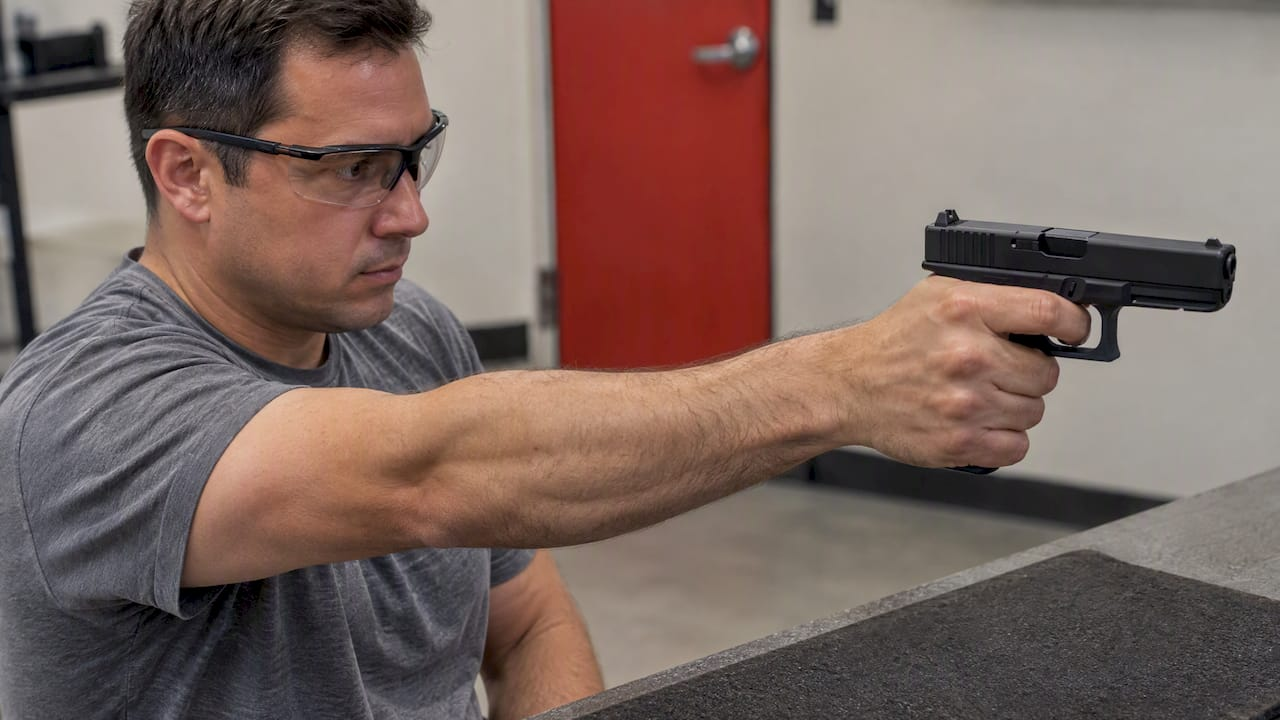
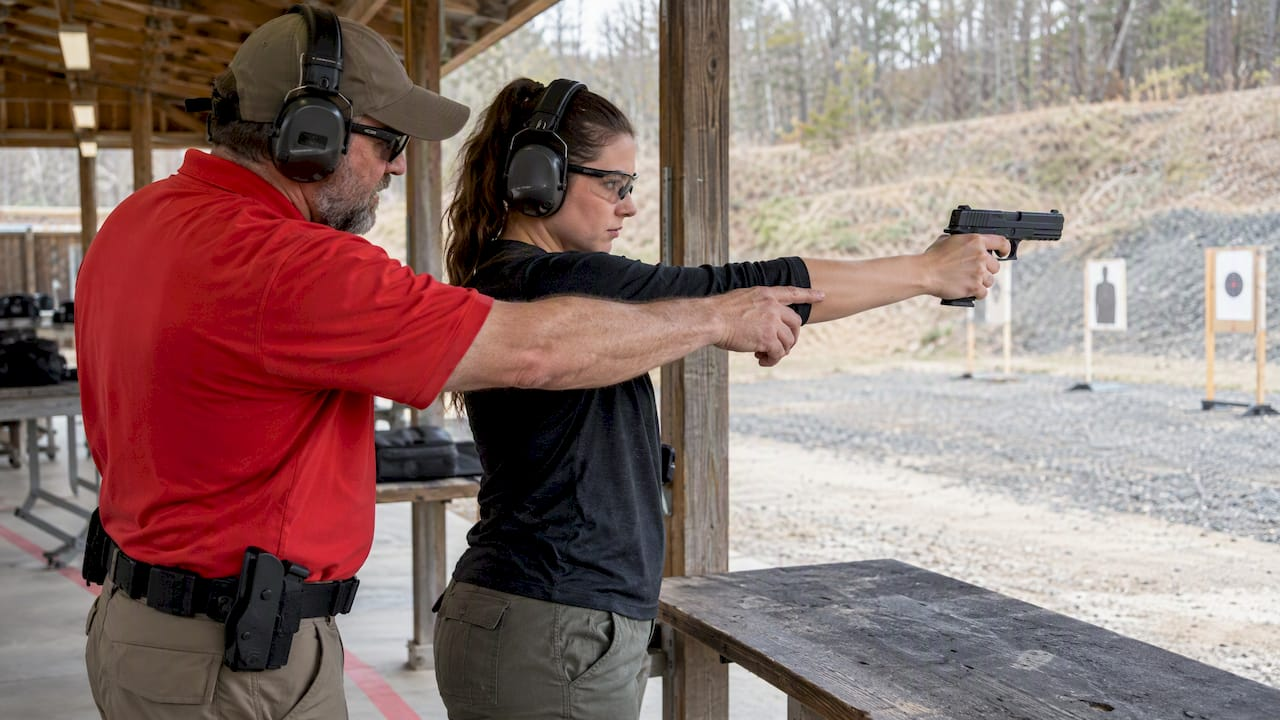
A pistol held with one hand moves more, and your grip has to compensate. Instructor guidance consistently points to gripping as tightly as possible while tensing the shoulder and arm, which limits how much the gun shifts during slide reciprocation. The pinky finger matters more than people expect: wrapping it firmly under the grip adds leverage that a loose pinky simply cannot provide, a detail emphasized in one-handed training drills published by the NRA’s Shooting Illustrated with a focus on pinky pressure.
Elbow position changes things too. A straight, locked elbow can transmit more vibration up the arm, while a slightly bent elbow tends to absorb some of that movement, a pattern shown by laboratory research on handgun aiming and tremor which found reduced tremor amplitude with bent elbows. Stance matters just as much as arm position.
- Strong-side-forward stance: angle your body about 45 degrees from the target, which gives the recoiling arm a natural path to travel.
- Square stance: face the target directly, useful when you need to scan a wider field quickly.
- Weight distribution: keep your weight forward over the balls of your feet rather than rocked back on your heels.
- Non-shooting hand: during certain one-hand drills, training templates call for placing the non-shooting hand in a fist under the chin to protect the throat, a safety detail found in standard reduced-light course materials.
Keep your trigger finger off the trigger until your sights are on target, and always know what is behind your backstop before you press. One-handed drills change your muzzle direction more than two-handed shooting does, so range officers tend to watch these drills closely.
Pro Tip: Practice your crush grip dry, for 30 seconds at a time, before you ever load a magazine. Your hand will fatigue fast, and that fatigue teaches you what a real crush grip feels like.
Getting a usable sight picture and pressing the trigger with one hand
With one hand, your sights wobble more, and chasing a perfectly still sight picture wastes time you do not have in a defensive encounter. Instead, settle the sights into an acceptable wobble zone centered on the target and press the trigger as that zone stays close to center.
- Aiming pause: give yourself a brief, deliberate beat to confirm sight alignment before the first shot of a string.
- Trigger press: a slow, steady increase in pressure beats a jerky pull, and it prevents the gun from dipping in anticipation of recoil.
- Follow-through: keep pressing through the shot rather than slapping the trigger and releasing early.
- Sights versus optics: iron sights demand a clear front sight focus, while a mini reflex optic lets you focus on the target and the dot simultaneously, which some shooters find faster one-handed.
Grip strength correlates with precision. Research measuring pistol movement with a kinematic sensor found a moderate correlation between handgrip strength and shooting precision, with the effect more pronounced at longer distances. That means grip training pays off even before you touch a trigger.
Managing recoil and following through after the shot
Recoil management one-handed comes down to where you put the force. A pinky-heavy grip redirects some of the muzzle’s upward flip into your hand rather than letting the barrel climb freely, and tensing your shoulder and upper arm gives the recoil somewhere to go besides your wrist.
- Engage the shoulder: lock your shoulder and upper arm so the recoil travels through a braced structure, not a loose joint.
- Resist wrist-only control: a wrist that absorbs recoil alone tends to break grip consistency shot to shot.
- Reset and re-acquire: hold the trigger rearward through recoil, let the sights settle, then release only to the reset point before the next press.
- Equipment shifts: a lighter-recoiling caliber or a slightly heavier pistol can noticeably improve controllability for shooters who struggle with one-handed flip.
Follow-through is not a formality. It is the half-second where you confirm your sights returned to target and decide whether another shot is needed.
Training both hands: strong-hand, weak-hand, and cross-dominance
Most people assume they will always have two working hands in a fight. That assumption fails often enough that weak-hand training deserves real time, not an afterthought at the end of a range session.
- Crawl: start weak-hand-only drills slow and static, focused purely on grip, sight alignment, and trigger press with no time pressure.
- Walk: add a timer and basic par times once your weak-hand groups tighten up at close range.
- Run: introduce transition drills, moving the gun from strong hand to weak hand under time, often after simulating an injury to the primary hand.
- Screen for cross-dominance: if your dominant eye and dominant hand do not match, test which eye naturally takes over when both eyes are open, since that eye should guide your sight picture.
Military occupational therapy programs have applied a similar crawl-walk-run model for crossed-dominance training, screening soldiers and building non-dominant-hand competence through progressively harder simulated and live-fire tasks. Practicing both hands regularly builds confidence that carries over into every other part of your shooting, because you stop treating your support hand as a backup plan you hope never to need.
Drills and standards that measure real progress
Vague practice produces vague results. Structured drills with round counts, distances, and par times tell you exactly where you stand.
- Dry-fire first: practice your draw, sight alignment, and trigger press with an unloaded firearm before adding live rounds, then add dry reload transfers between hands.
- Scaled live-fire stages: a published one-handed drill cycles through 3, 5, 7, and 10 round strings at short distances with 5-second par times, drawn from a standard strong-hand-only training format in Shooting Illustrated’s skills check.
- Reduced-light formats: formal course sheets include staged one-hand sequences such as 3 and 5 round strings at 3 yards, covering both strong and weak hand, built into a documented 30-round reduced-light course.
- Duty-style timed draws: some standard courses require a one-handed draw and two rounds fired from 7 yards within a 10-second window, followed by a scan of the surroundings, a format reflected in published duty-course materials.
A common pass threshold is to score sufficiently well, a scoring benchmark used in published one-handed drill standards before a shooter increases difficulty by stepping back in distance or tightening par time. Log your scores every session. If you clear the threshold twice in a row, add a yard or shave a half second off your par time. If you miss it twice, stay at the current distance and work the fundamentals again before moving on. You can see how this kind of staged drill structure fits into a broader defensive shooting drill program if you want a fuller framework.
Gear that makes one-handed shooting easier
Technique matters most, but the right equipment removes friction.
- Grip size and texture: a grip that fits your hand without needing to be choked up or down lets your pinky do its job; aggressive texture or stippling helps maintain purchase as your hand sweats or tires.
- Beavertail or grip safety fit: make sure the beavertail seats properly in your hand one-handed, not just when a second hand is stabilizing the grip.
- Sights: taller iron sights are easier to pick up fast one-handed, while a mini reflex optic can speed up target acquisition for shooters who train with it regularly.
- Holster and draw: practice your one-handed draw from your actual carry position, since appendix and strong-side holsters draw differently one-handed, especially if your other arm is compromised.
Fixing the most common one-handed shooting errors
Most one-handed misses trace back to a handful of root causes.
- Shots land high: usually anticipation or pushing up into the recoil before the shot breaks; fix it with dry-fire reps focused purely on trigger press.
- Shots drift left or right: often grip torque or wrist rotation during the press; check your sight alignment and relax excess tension in your wrist.
- Flinching: isolate the trigger press in dry-fire, slow your tempo deliberately, and rebuild speed only after the flinch disappears.
- Persistent problems: if the same error shows up session after session, that is the point to book time with an instructor rather than keep burning ammunition on the same mistake.
Pro Tip: Film your draw and first shot from the side during dry-fire. Most one-handed flaws are easier to see on video than to feel in the moment.
Why in-person instruction speeds up one-handed skill
Solo practice builds habits, but it cannot always catch the habits that are wrong. A training academy offers private lessons, CCW practical modules, and adaptive classes that include one-handed skill work. A session gives you tailored drills, immediate correction on grip and trigger errors, and supervised range safety you cannot replicate alone. When evaluating any instructor, look for structured drills with measurable standards, not just open range time with vague feedback.
A trainer’s take on one-handed shooting
One-handed shooting is not your primary plan. It is the skill you reach for when your other hand is injured, occupied, or pinned, and treating it as a rare contingency rather than routine practice is the biggest mistake I see. Skill fades without upkeep, so build it into regular practice, not a once-a-year experiment.
— Dee Parker
Train one-handed shooting with a certified instructor
Reading about grip and stance only gets you so far. Trouble Defense offers private firearm training built around your specific goals, including one-handed draw, trigger, and reload work with live correction from a certified instructor.
- Private lessons: one-on-one coaching that targets your specific one-handed weaknesses.
- CCW practical modules: permit classes that include range time and practical shooting skills.
- Adaptive training: programs built for students with disabilities, including blind and low-vision shooters.
The academy structures every lesson around personalized, judgment-free instruction. For readers outside the immediate DMV area who want structured home practice between sessions, this self-defense training resource covers dry-fire habit-building you can do anywhere. When you are ready for live-fire coaching, book a private lesson and bring eye and ear protection, a cleared firearm, and any ammunition your instructor requests.
FAQ
Can you realistically shoot a gun with one hand?
Yes, one-handed shooting is a trainable, realistic skill rather than a rare emergency trick. Published training courses build formal one-hand drills into their curriculum, including staged live-fire sequences at 3 yards, which shows it is treated as a core competency, not an afterthought.
Which pistol is best for one-handed shooting?
There is no single best pistol, but a gun with a grip that fits your hand without needing adjustment, a comfortable texture, and manageable recoil will help the most one-handed. A lighter-recoiling caliber or a taller sight setup can also make one-handed control noticeably easier.
How do you shoot accurately with one hand?
Accuracy one-handed comes from a crush grip emphasizing the pinky, a settled sight picture, and a slow, steady trigger press rather than a jerk. Grip strength itself correlates with better precision, particularly at longer distances, according to kinematic sensor research.
What is the proper stance for one-handed shooting?
A strong-side-forward stance angled roughly 45 degrees from the target gives your arm a natural path to absorb recoil, while a square stance works better for scanning a wider area. Keep your weight forward over the balls of your feet rather than rocked onto your heels.
What causes tremor and shakiness when shooting one-handed?
Shooting with a single arm removes the bilateral support that normally stabilizes the firearm, and research on handgun aiming found that bilateral limb support reduces tremor amplitude compared to single-arm shooting. The same research found that a slightly bent elbow also reduced tremor compared to a locked, straight arm.
Sources
- Skills Check: Strength Through Strong Hand Only | An Official Journal Of The NRA
- SEMI-AUTOMATIC DAY COURSE (SADC) COURSE #10 – REDUCED LIGHT INSTRUCTOR CALL SHEET
- Physiological tremor in handgun aiming and shooting tasks (dissertation)