Mandatory gun training is a structured curriculum designed to teach safe firearm handling, legal obligations, and operational skills required for responsible gun ownership. Understanding what mandatory gun training covers before you enroll saves time, reduces test anxiety, and puts you ahead of the majority of first-time participants who show up unprepared. Whether you are pursuing a Virginia CCW class, a Maryland HQL certification, or a DC concealed carry permit, the core subjects follow a recognizable pattern across states. The details vary, but the foundation does not.
What mandatory gun training covers: core subjects
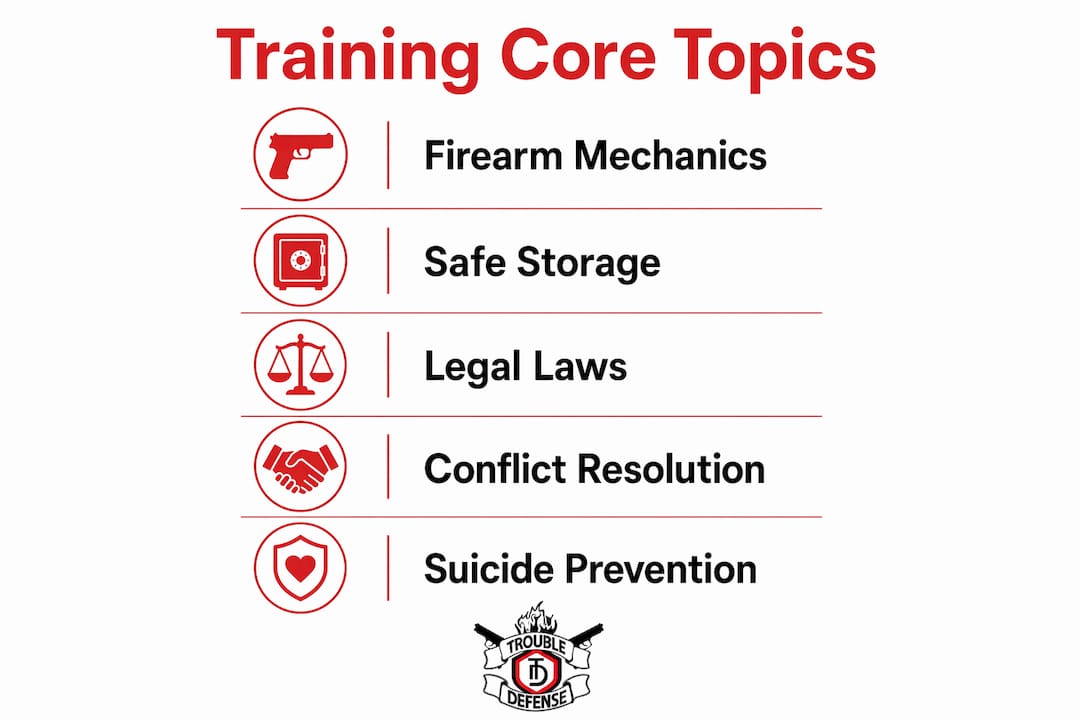
Required gun safety training addresses six foundational areas regardless of which state issues your certification. These subjects appear in programs from Maryland to Massachusetts to California because they reflect the minimum knowledge every gun owner needs before handling a firearm outside a controlled range environment.
The six core areas are:
- Firearm mechanics and operation. You learn how a firearm functions, how to load and unload safely, and how to identify malfunctions. This is not optional background knowledge. It is the baseline for every other skill in the course.
- Safe storage practices. Mandatory firearms instruction covers locked storage, trigger locks, and keeping ammunition separate from firearms. This directly reduces household accidents and unauthorized access by children.
- State and federal laws. Gun training course requirements always include transportation rules, prohibited locations, and use-of-force statutes. Instructors cover what “justifiable self-defense” means in your specific state, not just in theory.
- Conflict resolution and de-escalation. Most curricula include scenario-based instruction on avoiding confrontation before drawing a firearm. Massachusetts updated its curriculum in April 2026 to include disengagement tactics alongside live-fire requirements. That shift reflects a national trend toward behavioral training, not just mechanical skills.
- Suicide prevention and harm reduction. This topic surprises many first-time students, but it is now standard. Mandatory curricula in states like Maryland explicitly include suicide prevention as a required module.
- Live-fire proficiency. Where legally required, you must demonstrate safe handling and accurate shooting on a range. Live-fire training is increasingly becoming a mandatory standard across multiple states, not just an optional add-on.
Pro Tip: Review your state’s specific approved course list before registering. Not every course that advertises compliance is actually state-approved. Confirm directly with your state police or licensing authority.
How do training requirements vary by state?
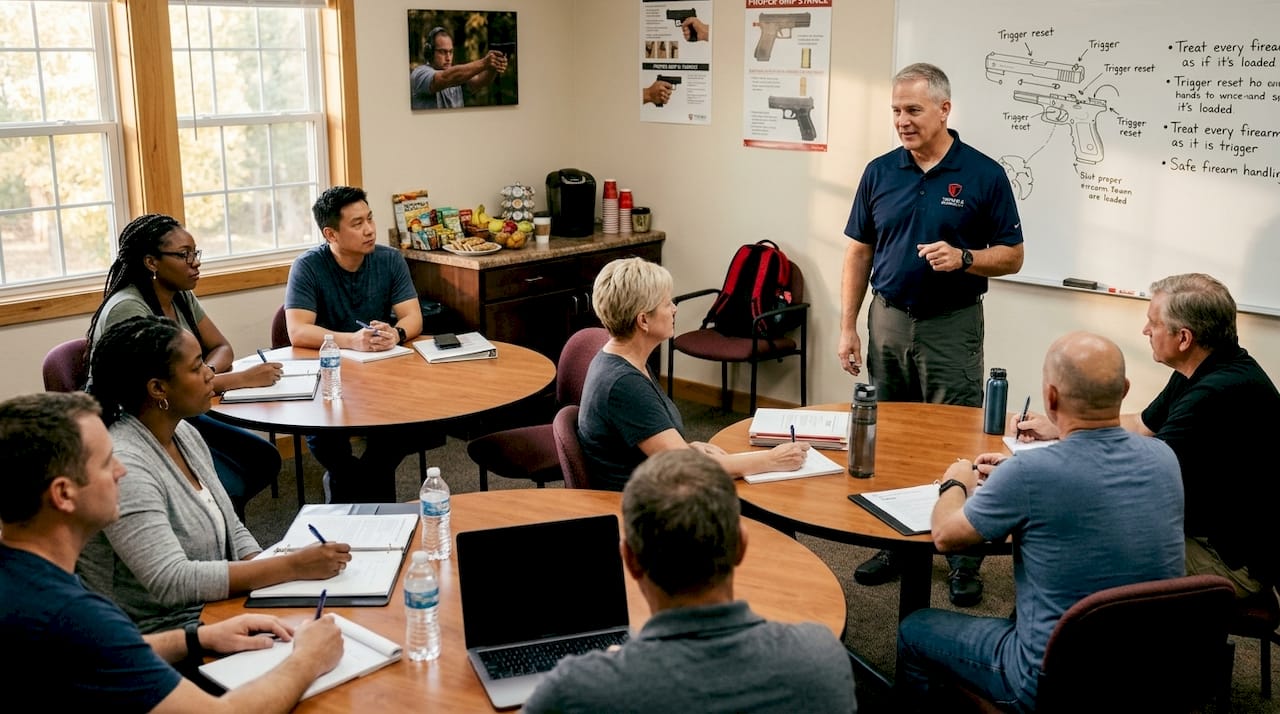
The length, format, and testing standards for mandatory firearm courses differ significantly by state. The table below compares four states with distinct approaches to gun training requirements.
| State | Training length | Live-fire required | Passing standard |
|---|---|---|---|
| Maryland | 4 hours in-person | Yes (HQL applicants) | Completion plus live-fire qualification |
| Massachusetts | Varies by course | Yes (as of April 2026) | Written exam plus participation |
| Colorado | 4 or 12 hours | Yes | 90% pass score on formal exam |
| California | ~30 minutes (exam only) | No (currently) | Pass 30-question FSC exam |
Maryland’s HQL program requires a state police approved firearms safety course with live-fire qualification. The Maryland HQL curriculum emphasizes safe handling skills and legal knowledge over prior shooting experience. Completing the course does not mean you are a skilled shooter. It means you have demonstrated the minimum competency the state requires.
Colorado raised the bar significantly in 2026. New legislation requires a permit and training for semi-automatic rifles and shotguns starting August 1, 2026. Depending on whether you have prior hunter education, you complete either a 4-hour or 12-hour course. The 90% passing threshold is one of the strictest in the country and reflects a deliberate push toward higher standards.
California takes the opposite approach. The Firearm Safety Certificate exam costs $25, takes roughly 30 minutes, and covers basic safety, laws, and storage. There is no live-fire component currently required. The certificate remains valid for 5 years. This model prioritizes accessibility over depth, which is a legitimate policy choice but leaves significant skill gaps for new owners.
Massachusetts sits in the middle and is evolving fast. As of April 2026, live-fire is statutorily required alongside a written exam. However, administrative delays caused a two-week gap where certificates could not be issued due to online portal problems. That kind of regulatory gap is real and can affect your timeline. Always check current processing status before scheduling your course.
How to prepare for mandatory gun training and testing
Preparation separates students who pass on the first attempt from those who need to repeat the process. Follow these steps to walk in ready.
- Obtain your state’s official study materials. Every state publishes a handbook or study guide tied to its specific exam. California’s FSC prep materials are available through the Department of Justice. Maryland’s course content is outlined by the Maryland State Police. Start there, not with generic online quizzes.
- Study for 30 to 60 minutes before your exam. Candidates who study 30 to 60 minutes perform better than those relying solely on in-class instruction. Test questions include both direct recall and scenario application. You need to know the law and be able to apply it to a situation.
- Understand the live-fire component before you arrive. If your state requires live-fire qualification, practice at a range beforehand. Know how to load, unload, and clear a malfunction before your instructor demonstrates it. Arriving with zero range experience is not a disqualifier, but it slows you down and increases stress.
- Gather your documentation in advance. Most states require a valid government-issued ID, proof of eligibility, and sometimes a completed application form. Maryland HQL applicants submit through the Maryland State Police portal. Confirm what you need before the day of class.
- Select a certified instructor or approved course. Instructor quality directly impacts what you retain and how you behave after certification. Look for NRA-certified instructors or state-approved providers. Trouble Defense operates with certified NRA instructors and holds over 300 five-star Google reviews in the DMV area.
- Avoid common first-timer mistakes. Showing up late, forgetting documentation, and assuming the course is easy are the three most common errors. Review beginner firearm tips before your first class to set the right expectations.
Pro Tip: If you are pursuing a Maryland Wear and Carry permit or a Virginia CCW, the training requirements differ from a basic purchase permit. Confirm which credential you need before enrolling in any course.
Common misconceptions about required gun safety training
Several persistent myths cause students to arrive unprepared or choose the wrong course entirely. Here is what the evidence actually shows.
- “My shooting experience exempts me from training.” It does not. Certification requires state-approved in-person hours regardless of prior experience. Exemptions exist but are narrow and specific, typically limited to active law enforcement or military personnel in certain states. Always confirm grandfathering policies with your state authority before assuming you qualify.
- “A purchase permit and a carry license are the same thing.” They are not. A purchase permit or HQL allows you to buy a firearm. A carry license allows you to carry it concealed in public. The training requirements, fees, and renewal timelines differ significantly between the two.
- “Permitless carry states don’t require any training.” In states that allow permitless carry, formal training remains highly recommended to clarify legal boundaries and support multi-state carry reciprocity. Carrying without understanding use-of-force law is a legal liability, not a freedom.
- “Mandatory training is just about shooting accurately.” The primary goal of mandatory training is foundational knowledge and safe handling rather than marksmanship. Most states test your knowledge of laws, storage, and safety protocols far more rigorously than they test your shot groupings.
- “Regulatory delays won’t affect me.” They can. Massachusetts experienced a two-week certificate issuance gap in April 2026 due to portal problems. If you have a deadline tied to a purchase or employment requirement, build buffer time into your schedule.
Key takeaways
Mandatory gun training covers firearm mechanics, safe storage, state and federal laws, conflict resolution, suicide prevention, and live-fire proficiency where required by law.
| Point | Details |
|---|---|
| Core curriculum is consistent | All mandatory programs cover mechanics, storage, laws, conflict resolution, and harm reduction. |
| State requirements vary widely | Colorado requires 90% exam scores; California uses a 30-minute written test with no live-fire. |
| Preparation improves pass rates | Studying 30 to 60 minutes before your exam significantly improves first-attempt success. |
| Experience does not replace certification | Prior shooting experience rarely qualifies as an exemption from state-approved training hours. |
| Instructor quality matters | Certified NRA instructors and state-approved providers produce better safety outcomes post-certification. |
Why I think most people underestimate what good training actually does
I have worked with hundreds of students across the DMV region, from complete beginners who have never touched a firearm to veterans who have carried for decades. The pattern I see most often is not lack of skill. It is lack of legal clarity. Students who come in confident about their shooting ability are frequently the ones who struggle most with the use-of-force scenarios and the state law sections.
The curriculum exists for a reason. Firearm mechanics and storage are teachable in an afternoon. Legal judgment under stress is not. The best training programs spend as much time on when not to draw as they do on how to draw. That balance is what separates a certified gun owner from a genuinely prepared one.
My strongest advice is to treat the minimum requirement as a floor, not a ceiling. Complete your HQL or CCW course, then keep learning. Take a self-defense training course, practice on a range regularly, and revisit the legal updates in your state every year. Laws change. Colorado’s 2026 legislation and Massachusetts’ April 2026 curriculum update are proof that the regulatory environment is not static.
The students who leave my classes most confident are not the ones who came in with the most experience. They are the ones who came in with the most curiosity and the willingness to be corrected. That mindset is worth more than any prior range time.
— Dee Parker
Get certified with Trouble Defense in Virginia, Maryland, and DC
Trouble Defense offers firearm training courses across Virginia, Maryland, and Washington DC for every experience level and background.
Whether you need a Maryland Wear and Carry permit or a Virginia CCW class, Trouble Defense’s certified NRA instructors guide you through every required topic, including live-fire qualification, use-of-force law, and safe storage. Programs include women’s firearm training, adaptive firearms training for individuals with disabilities, and youth firearm safety education. Browse the full training calendar to find a class that fits your schedule. With over 300 five-star Google reviews, Trouble Defense is the DMV region’s trusted name for licensing support and practical firearm education. Contact Trouble Defense today to enroll or ask questions about which course matches your certification goal.
FAQ
What topics does mandatory gun training always include?
Mandatory gun training consistently covers firearm mechanics, safe storage, state and federal laws, conflict resolution, and suicide prevention. Live-fire components are required in states like Maryland and Massachusetts but not currently in California.
Does prior shooting experience waive training requirements?
No. Most states require state-approved in-person training hours regardless of prior experience. Exemptions are narrow and typically limited to active law enforcement or military personnel in specific states.
How long does mandatory gun training take?
Training length varies by state. Maryland requires a 4-hour in-person class, Colorado requires 4 or 12 hours depending on prior hunter education, and California’s Firearm Safety Certificate exam takes approximately 30 minutes.
What is the difference between a purchase permit and a carry license?
A purchase permit or HQL allows you to buy a firearm legally. A carry license, such as a Virginia CCW or Maryland Wear and Carry permit, allows you to carry a firearm concealed in public. Each requires separate training and application processes.
How do I find a state-approved gun training course?
Check your state police website for a list of approved providers and certified instructors. In the DMV region, Trouble Defense offers state-approved courses for Virginia, Maryland, and DC licensing requirements.


