
No, there is no automatic nationwide concealed carry reciprocity today: your right to carry across state lines still depends on each state’s own laws and agreements. Watch H.R.38 in the 119th Congress, the Constitutional Concealed Carry Reciprocity Act, which would change that if passed. Until then, verify every state’s official guidance before you travel, and remember that Washington, D.C. does not recognize out of state permits in practice.
TL;DR:
- Reciprocity laws currently vary widely, so travelers must verify each state’s official guidance before carrying across borders, especially for nonresident permits.
- H.R.38 would establish a federal recognition framework, allowing valid permits from one state to be honored nationwide, but it would not override local restrictions on sensitive places or private property.
- Recognition of out-of-state permits is not guaranteed in places like Washington, D.C., which requires nonresidents to obtain a local license regardless of other states’ permits.
- Misunderstanding permit types and carry methods remains common, as reciprocity agreements do not automatically extend to open carry, vehicle carry, or different firearm types.
- If enacted, the bill would simplify mobility but require permit holders to continue checking specific restrictions and carry conditions in each jurisdiction.
Table of Contents
- Where H.R.38 stands in Congress right now
- What reciprocity actually means and where it stops
- How Virginia, D.C., and other states actually handle it today
- Step-by-step checklist to confirm reciprocity and reduce travel risk
- What happens if you get stopped while carrying
- Tracking the bill and making your voice heard
- How Trouble Defense helps you prepare for multi-state carry
- Non-resident and enhanced permits add another layer
- Permitted weapons and carry methods are not standardized
- How reciprocity law got to where it is today
- What happens legally if you get it wrong
- International visitors face a different, stricter standard
- National parks, federal land, and tribal land have their own rules
- What passage would really mean for everyday carriers
- Get training and permit guidance before your next trip
- Sources
- FAQ
Where H.R.38 stands in Congress right now
H.R.38, the Constitutional Concealed Carry Reciprocity Act of 2025, is the bill most permit holders are watching, and as of October 2025 it had cleared a meaningful early hurdle. The House Judiciary Committee reported the bill, as amended, and placed it on the Union Calendar, which is a formal step toward a floor vote but not a guarantee of one. Bills reach the Union Calendar regularly and then stall for months or years, so this placement signals momentum, not passage.
The core of the bill works like a federal recognition rule. A person carrying a valid government-issued photo ID along with a valid concealed carry permit from their home state, or who is otherwise entitled to carry concealed under their home state’s laws, would be allowed to carry a concealed handgun in any other state that permits concealed carry, subject to that state’s restrictions on where firearms can be carried. In plain terms, it would treat a state-issued carry permit something like a driver’s license: valid everywhere, even though the issuing rules differ state by state.
Beyond the recognition rule itself, H.R.38 carries several provisions that matter more to lawyers and prosecutors than to the average traveler, but that would still reshape how reciprocity disputes get resolved in court:
- Prima facie evidence rule: a valid permit or photo ID from the home state would serve as presumptive proof of a lawful right to carry, shifting the practical burden in a dispute.
- Civil remedies: the bill includes a private right of action, letting a permit holder who is wrongly arrested or prosecuted under a nonrecognizing state’s law sue for damages.
- Fee-shifting language: a prevailing plaintiff could recover attorney’s fees, which lowers the financial risk of challenging a wrongful arrest or charge.
- Preserved state authority: states would keep the power to restrict where guns can be carried (sensitive places, private property) even though they could no longer refuse to recognize an out of state permit outright.
That last point is the one most people misunderstand. H.R.38 would not erase state gun laws. It would force recognition of the permit itself while leaving local carveouts largely intact.
What reciprocity actually means and where it stops
Reciprocity is not a single national right to carry. It is a patchwork of state-to-state agreements, and in some cases unilateral decisions, about whether one state’s permit is honored within another state’s borders. Even if H.R.38 becomes law, “reciprocity” would still mean recognition of your permit, not a blank check to carry anywhere you want once you cross a border.
States retain real authority to carve out exceptions, and those exceptions apply regardless of what a federal recognition statute says about the permit itself:
- Government buildings and courthouses are almost universally off-limits to concealed carry, permit or no permit.
- Schools and school zones carry their own restrictions, often layered with both state and federal law.
- Private property owners can prohibit firearms on their premises, and trespassing after notice can turn a lawful carry into a crime.
- State-specific rules on bars, polling places, or public transit vary widely and are not preempted by a reciprocity statute.
18 U.S.C. § 926C, the federal statute allowing qualified retired law enforcement officers to carry concealed firearms across state lines, is a useful preview of how this balance plays out. That statute creates a narrow federal carve-in for a specific group while explicitly preserving state and local authority to restrict possession on government property and private property. H.R.38 follows a similar structure: federal recognition of the permit, paired with continued state control over where carrying is allowed.
How Virginia, D.C., and other states actually handle it today
The current system is a genuine patchwork, and nowhere is that clearer than comparing Virginia’s approach to the District of Columbia’s.
Virginia recognizes concealed handgun permits from a long list of other states, but the Virginia State Police reciprocity guidance puts the responsibility squarely on the traveler: the state explains which permits it recognizes, but it also makes clear that whether your Virginia permit is honored elsewhere is a separate question you have to answer yourself before you leave the state. Virginia also issues nonresident concealed handgun permits specifically so out of state residents can carry in Virginia, again noting that the permit’s value elsewhere depends entirely on whether the destination state chooses to recognize it.
Washington, D.C. sits at the opposite end of the spectrum. D.C. does not treat out of state permits as valid substitutes for its own license. The Metropolitan Police Department’s application instructions make clear that nonresidents who want to carry in the District must apply for a D.C. Concealed Carry Pistol License on the same terms as residents, including D.C.-specific training requirements. A Virginia or Maryland permit, however valid at home, does not carry over the district line. Travelers heading into D.C. who want to understand the process should look at the steps for applying for a D.C. concealed carry license well before a trip, not after arriving.
A few practical patterns are worth knowing:
- Reciprocity agreements are not permanent: a state can and sometimes does cancel recognition of another state’s permits with little public notice.
- Some states only recognize permits held by their own residents, which can surprise nonresident permit holders who assumed broader coverage.
- Training and issuance standards differ enough that a permit considered “shall issue” in one state might reflect a very different vetting process than a neighboring state’s.
The bottom line is that no map or app should replace checking the issuing agency’s own current guidance.
Step-by-step checklist to confirm reciprocity and reduce travel risk
Before any trip where you plan to carry, work through the same short process every time:
- Check the destination state’s official source. Go directly to that state’s police agency, attorney general, or firearms licensing division website rather than a third-party map.
- Call if anything is unclear. A five-minute phone call to the licensing agency can resolve ambiguity that a web page cannot.
- Save the proof. Screenshot the official page, note the date you checked it, and keep the citation in case guidance changes before your return trip.
- Confirm transport and storage rules. Carrying in a vehicle, storing a firearm at a layover, and carrying on foot can all be governed by different rules within the same state.
- Identify sensitive-place restrictions. Courthouses, schools, bars, and certain government buildings are commonly off-limits regardless of permit validity.
- Have a fallback plan. If you cannot confirm recognition, plan to store the firearm securely and unloaded, or leave it at home.
Third-party reciprocity maps are convenient, but they are frequently out of date, and relying on one instead of an official source is one of the most common mistakes permit holders make. Treat them as a starting point for research, never as the final word.
Pro Tip: Keep a small travel folder with your photo ID, your permit, printed copies of the destination state’s official guidance, and the phone number for a firearms attorney, so you are not searching for information roadside if you get stopped.
What happens if you get stopped while carrying
Even a fully lawful permit does not eliminate the possibility of a tense roadside encounter, and understanding why helps you stay calm if it happens. Officer safety law and permit legality are two separate questions. DOJ materials addressing search and frisk law make clear that officers may frisk a person during a lawful traffic stop for safety reasons, citing the line of precedent running through Terry, Mimms, Adams, and Long, even when that person is legally carrying a firearm. Legal possession of a firearm does not remove an officer’s authority to check for weapons during a stop when safety concerns justify it.
One in a reasonable number of traffic stops escalates into some kind of search or frisk when a firearm is disclosed or discovered, according to DOJ’s own briefing on stop-and-frisk law, which underscores why calm, predictable conduct matters as much as the permit itself.
If H.R.38 passes, its evidentiary provisions would likely change what happens after a stop, not during it. A valid permit treated as prima facie evidence of a lawful right to carry would make it harder for a prosecutor to pursue charges based solely on nonrecognition, and the bill’s private right of action would give wrongly charged permit holders a path to recover damages and legal fees. None of that removes the officer’s authority to frisk for safety in the moment.
Practical conduct during any stop:
- Disclose that you are carrying if your state requires it, and do so calmly and early in the interaction.
- Keep your hands visible and movements slow and announced.
- Present your permit and ID when asked, without reaching toward the firearm.
- Contact an attorney afterward if you believe you were treated unlawfully, and document the encounter while it is fresh.
Tracking the bill and making your voice heard
If you want to follow H.R.38 rather than wait for news coverage to catch up, Congress.gov’s bill page is the authoritative source. It shows the full bill text, every committee action, vote records, and calendar placement in real time, and it is the same source legislative staff use.
A few markers help you interpret what you see there:
- “Reported by committee” means the bill cleared its committee review, often with amendments, and is eligible for floor scheduling.
- “Placed on the Union Calendar” means the bill is queued for a potential House floor vote, though timing is never guaranteed.
- Companion bills in the Senate can move on a separate track and sometimes stall even when a House version advances.
If you want to contact your representative, keep it short: identify yourself as a constituent, name the bill (H.R.38, 119th Congress), state your position in one sentence, and ask for a response on how they intend to vote. Realistic expectations matter here. Similar reciprocity bills have been introduced in prior sessions of Congress without reaching a final vote, so committee movement is meaningful progress, not a finish line.
How Trouble Defense helps you prepare for multi-state carry
Reciprocity questions do not replace the need for solid training, and that is where Trouble Defense fits into this picture. Trouble Defense is a veteran-owned firearms training academy led by certified NRA instructors, built around the idea that students should leave not just certified, but genuinely confident handling a firearm.
For travelers juggling multiple states’ requirements, that foundation matters. Proper training and documentation are part of what makes a permit defensible if reciprocity questions come up on the road. Trouble Defense offers a Multi-State CCW Reciprocity Package designed to help residents prepare training and paperwork for multiple states, alongside its core Virginia, Maryland, and D.C. concealed carry classes. If you are not sure which permit combination makes sense for your travel patterns, reaching out before you book a class is worth the ten-minute conversation.
Non-resident and enhanced permits add another layer
Not all permits are created equal, and reciprocity rules often treat them differently. A standard resident permit, a nonresident permit, and an “enhanced” permit that requires extra training can all produce different outcomes in the same destination state.
Virginia’s own nonresident concealed handgun permit exists precisely because an out of state resident’s home permit may not be honored everywhere, so Virginia offers its own credential as a workaround. Some states that otherwise accept a neighboring state’s standard permit decline to recognize that same state’s nonresident version, reasoning that it was never meant for use back home. Enhanced or “utility” permits, which usually require live-fire qualification beyond the baseline course, sometimes unlock recognition in states that reject a basic permit outright, but there is no uniform rule across state lines.
The practical lesson is the same one that applies everywhere in this topic: do not assume your specific permit type is covered just because your state’s basic permit is mentioned on a reciprocity list. Confirm which category of permit the destination state actually recognizes, because the list of states and the list of permit types that qualify are not always the same thing.
Permitted weapons and carry methods are not standardized
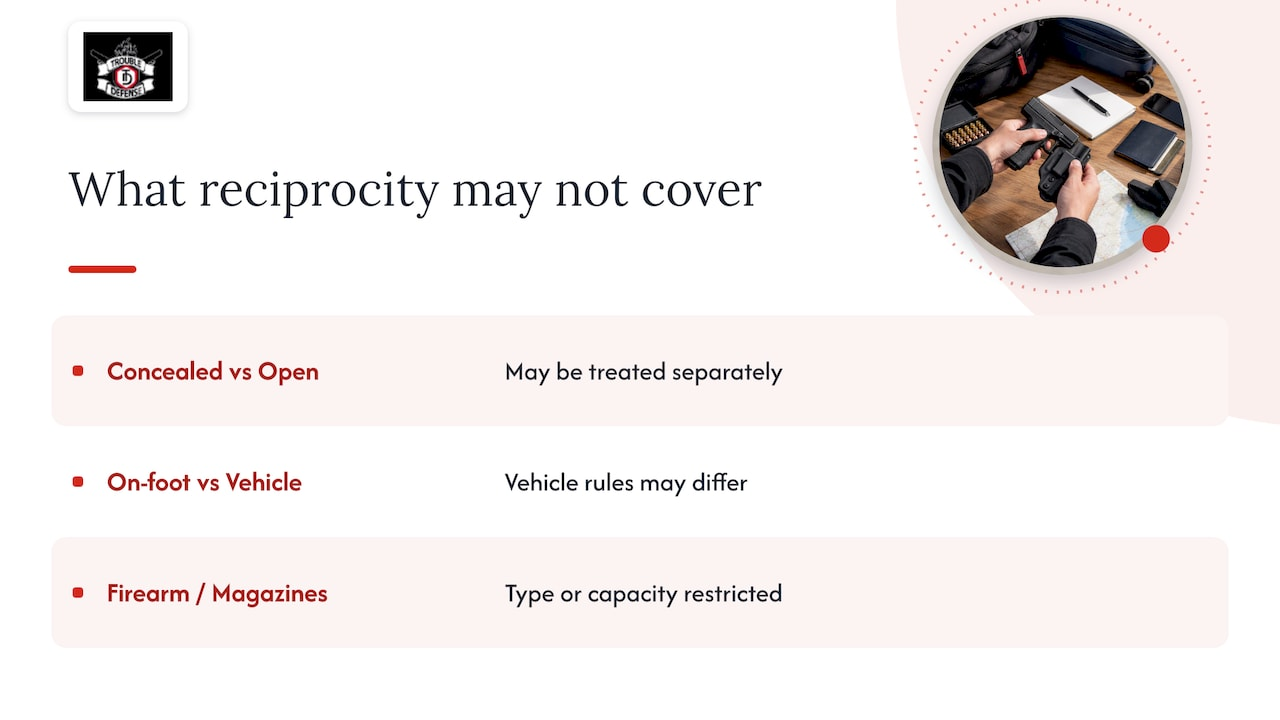
Reciprocity agreements typically govern the validity of the permit itself, not the specific firearm or carry method you use, and that distinction trips people up. A state that recognizes your permit for concealed carry of a handgun does not automatically extend that recognition to open carry, to carrying in a vehicle versus on foot, or to carrying a different type of firearm.
Some states draw sharp lines between concealed and open carry, treating them as separate legal questions even for the same permit holder. Others restrict magazine capacity or firearm type regardless of what your home state allows, meaning a magazine that is perfectly legal where you live could be a prohibited item once you cross a border. Vehicle carry rules also vary: a state might permit concealed carry on foot under reciprocity while applying a different, sometimes stricter, standard to carrying in a car.
None of this is addressed by H.R.38’s core recognition language, which focuses on the validity of the permit rather than harmonizing carry methods or weapon restrictions. That means even full federal reciprocity would leave this patchwork of carry-method rules in place, and checking them separately from permit recognition will likely remain necessary.
How reciprocity law got to where it is today
Concealed carry reciprocity as a concept grew out of a decades-long shift from restrictive “may issue” permitting toward “shall issue” standards in most states, a trend that accelerated after the Supreme Court’s Bruen decision pushed licensing regimes toward more objective, less discretionary criteria. That shift created the practical problem reciprocity law is trying to solve: as more states made permits easier to obtain, the gaps between states’ recognition of each other’s permits became more visible to ordinary travelers, not just gun rights advocates.
Congress has considered various versions of a national reciprocity bill across multiple sessions, with H.R.38 appearing in earlier Congresses before the current 119th Congress version. None of the earlier versions passed both chambers. In the meantime, states built their own overlapping web of bilateral and unilateral recognition agreements, which is why a Virginia resident might find their permit honored in a dozen neighboring states but rejected outright in Washington, D.C. or a handful of other jurisdictions. Federal statutes like 18 U.S.C. § 926C, covering retired law enforcement officers, show that Congress has been willing to legislate narrow carry-across-state-lines rights before, just never a broad civilian version until now.
What happens legally if you get it wrong
Carrying in a state that does not recognize your permit is not a technicality. In states that treat unlicensed concealed carry as a criminal offense, being caught without a recognized permit can result in weapons charges, confiscation of the firearm, and in some jurisdictions, an arrest even if you have a valid permit from your home state.
The consequences escalate depending on the state and the circumstances. Some jurisdictions charge unlawful carry as a misdemeanor for a first offense involving an otherwise law-abiding permit holder, while others treat it as a felony, particularly if the stop involves other complicating factors. A DOJ letter addressing Pennsylvania nonresident carry refusals illustrates how seriously the federal government has taken even administrative barriers to lawful carry, raising constitutional concerns about blanket refusals to process applications, let alone outright criminal charges against someone who reasonably believed their permit was valid.
If H.R.38 passes, its prima facie evidence provision and private right of action would give permit holders wrongly charged under a nonrecognizing state’s law a real path to contest the charge and potentially recover damages and attorney’s fees. Until then, the safest assumption is that a state’s refusal to recognize your permit carries the same practical risk as carrying with no permit at all in that state, regardless of your intentions or your home state’s rules.
International visitors face a different, stricter standard
Reciprocity as discussed here applies to permits issued by U.S. states, and it has no bearing on international visitors. A concealed carry permit or firearms license issued by a foreign country has no legal standing in the United States, and reciprocity agreements between states do not extend any recognition to foreign credentials.
International travelers who want to carry a firearm in the United States generally cannot do so on the strength of a home-country permit. Acquiring a firearm, let alone a concealed carry permit, as a foreign visitor involves a separate and more restrictive set of federal requirements than anything discussed in H.R.38 or existing state reciprocity rules. Tourists interested in firearms during a U.S. visit are far better served by supervised range experiences, which let visitors shoot under instructor supervision without navigating permit law at all. That is a meaningfully different activity from concealed carry, and conflating the two is one of the more common misunderstandings among visitors researching this topic.
National parks, federal land, and tribal land have their own rules
Reciprocity between states does not automatically extend onto federal property, and that gap catches travelers who assume a recognized state permit covers everywhere within that state’s borders.
National parks generally allow visitors to carry firearms in accordance with the laws of the state in which the park is located, which means your state-recognized permit typically carries over onto park land within that state. However, federal buildings within those parks, such as visitor centers and ranger stations, remain off-limits regardless of permit status, mirroring the government-building carveouts that exist everywhere else.
Tribal lands operate under a separate layer of jurisdiction entirely. Tribal governments can set their own firearms regulations independent of the surrounding state’s reciprocity agreements, meaning a permit honored throughout a state may not be honored on tribal land within that same state’s borders. Checking directly with the relevant tribal government before carrying on tribal land is the only reliable way to confirm the rule that actually applies there.
What passage would really mean for everyday carriers
If H.R.38 becomes law, the biggest practical change is mobility: a permit holder would no longer have to research recognition state by state before every trip. That is a genuine improvement over the current patchwork, but it would not eliminate the research entirely.
Sensitive-place restrictions, private property rules, and differences in carry method would all survive a federal recognition statute, because the bill preserves state authority over where and how carrying happens, not just whether the permit itself is valid. Professional training remains the one constant regardless of what Congress does, since knowing how to handle a firearm safely and legally does not change based on which state recognizes your permit. The bottom line from the opening still holds: check official guidance before you travel, and treat federal reciprocity, if it arrives, as a floor rather than a ceiling for your own preparation.
— Dee Parker
Get training and permit guidance before your next trip
Understanding reciprocity law is only half the job: showing up prepared with the right training and documentation is the other half, and that is where Trouble Defense can help DMV-area carriers directly. Our DMV Concealed Carry Training Package and Multi-State CCW Reciprocity Package are built around the exact patchwork described above, helping Virginia, Maryland, and D.C. residents prepare the training records and documentation that matter when you travel.

Whether you need a Virginia CCW class, a Maryland Wear and Carry course, or D.C.-specific training, certified NRA instructors teach in a supportive, judgment-free environment for beginners and experienced carriers alike. Contact Trouble Defense to book a class or ask about the Multi-State CCW Reciprocity Package before your next trip across state lines.
Sources
Keep these sources saved so you can check them directly instead of relying on secondhand summaries:
- Congress
- Reciprocity and Recognition — Virginia State Police
- Instructions for submitting a Concealed Carry Pistol License application — Metropolitan Police Department (MPD)
- DOJ materials on search/frisk and traffic-stop safety (filed briefs)
This article is general information, not a substitute for advice from a qualified lawyer. Consult a qualified legal professional about your own circumstances before acting on anything here.
FAQ
Can I carry concealed in all 50 states right now?
No. There is no federal law today requiring every state to recognize every other state’s concealed carry permit, which is exactly what H.R.38 proposes to change. Recognition currently depends on each state’s own agreements and rules, so you need to verify coverage state by state before you travel.
What states offer reciprocity for concealed carry?
Reciprocity varies by state and changes over time, since states can add or cancel recognition agreements with little advance notice. The only reliable way to know is checking the issuing or destination state’s official police or attorney general website, such as the Virginia State Police reciprocity page, rather than relying on a third-party map.
Can I carry a gun in my car in all 50 states?
No, vehicle carry rules are not uniform even within states that otherwise recognize your permit, and some states apply different standards to carrying in a vehicle versus on foot. Always confirm transport-specific rules for your destination state separately from general permit recognition before you drive across state lines.
Does Washington, D.C. recognize out-of-state concealed carry permits?
No, D.C. does not recognize permits from other states. Nonresidents who want to carry in the District must apply for a D.C. Concealed Carry Pistol License and meet D.C.’s own training requirements, as outlined in MPD’s application instructions.
What would H.R.38 change if it passes?
H.R.38 would require states that allow concealed carry to recognize valid permits or carry rights from other states, treating a home-state permit something like a driver’s license. States would keep authority over sensitive places and private property restrictions, so research into local carveouts would still matter even after passage.


