DC CCW training is a mandatory, state-regulated program requiring 16 hours of certified firearm instruction and 2 hours of qualified range time before you can legally carry a concealed weapon in Washington, DC. The formal term for the credential you earn is a Concealed Pistol License, or CPL, issued by the Metropolitan Police Department. DC enforces a shall-issue policy, meaning MPD must approve any qualified applicant who meets every requirement. Skip a step, use an uncertified instructor, or carry without a valid DC CPL, and you face a felony punishable by up to 5 years in prison and a $5,000 fine for a first offense.
What DC CCW training requires before you start
DC’s concealed carry permit process has two legally distinct tracks running in parallel: firearm registration and CCW certification. Most applicants do not realize these are separate. You must complete both before MPD will process your carry license application.
Eligibility basics you must meet first:
- Be at least 21 years old
- Be a DC resident or a qualified non-resident with a compelling need
- Have no felony convictions or disqualifying misdemeanors
- Have no history of involuntary psychiatric commitment
- Pass a federal and local background check
Firearm registration is not the same as your carry license. Registration is legally distinct from concealed carry licensing, and MPD requires it before your CPL application moves forward. Each firearm must be registered separately. The registration process requires fingerprinting, photographs, a written test on DC firearm laws, and proof of completed safety training. Budget 4–8 weeks for MPD to process your registration before you can even submit your carry license application.
DC also does not recognize concealed carry permits or firearm registrations from any other state. Out-of-state permits hold no legal weight in DC. That means your Virginia or Maryland carry permit is irrelevant the moment you cross into the District. You need a DC-issued CPL, period.
Pro Tip: Start your firearm registration at the same time you enroll in your training course. The parallel timelines save weeks and prevent the most common application delay.
What does the mandatory DC CCW training course cover?
The mandatory training course consists of 16 hours of classroom instruction plus 2 hours of live-fire range training, all delivered by an MPD-certified instructor. This is not a weekend refresher. The curriculum is structured to build both legal knowledge and practical skill before you ever apply for your CPL.
The 16-hour classroom portion covers these core subjects:
- Firearm safety rules — the four fundamental rules, safe storage, and handling protocols
- Firearm operation and mechanics — how your specific firearm functions, field stripping, and malfunction clearing
- Marksmanship fundamentals — stance, grip, sight alignment, trigger control, and follow-through
- DC and federal firearm laws — what you can carry, where you can carry, and what constitutes a lawful use of force
- Self-defense law — the legal standard for justified use of deadly force in DC, including duty to retreat considerations
- Safe storage and transport — requirements for storing and transporting firearms in DC and the surrounding DMV area
The 2-hour range session is not just practice. Range training includes qualification tests where you must demonstrate safe handling and accurate shooting at defined distances. Instructors evaluate your marksmanship and your ability to apply safety protocols under realistic conditions. Failing the qualification means you cannot receive your training certificate.
Pro Tip: Arrive at your range session having already dry-fired your specific firearm at home. Familiarity with your trigger pull and reset dramatically improves first-attempt qualification scores.
Courses combine classroom instruction on safety and laws with practical range time for marksmanship and handling evaluation. The balance matters because MPD reviews both components when validating your training certificate. An incomplete range session invalidates the entire course record.

How to find MPD-certified CCW training instructors and classes in DC
Only MPD-certified instructors can legally deliver the training required for your DC CPL application. Using an uncertified provider means your certificate is worthless, and your application will be denied.
How to verify and select a qualified instructor:
- Visit the official MPD certified instructor list on the Metropolitan Police Department website. This is the only authoritative source.
- Confirm the instructor’s certification is current before you pay any fees. Certifications can lapse.
- Ask whether the course includes both the full 16-hour classroom block and the 2-hour live-fire range session. Some providers advertise partial courses.
- Verify that the course covers DC-specific law, not just generic firearm safety content. Generic NRA courses alone do not satisfy DC’s requirements.
- Ask for a sample training certificate to confirm it meets MPD’s formatting and documentation standards.
Trouble Defense serves the DC metro area and offers DC-approved concealed carry training that meets MPD’s full curriculum requirements. The academy’s NRA-certified instructors bring both military and law enforcement backgrounds to the classroom, which matters when you are learning the legal boundaries of self-defense in a jurisdiction as strict as DC.
Firearms safety courses must be delivered by MPD-certified instructors approved under District law. No exceptions exist for online-only formats. DC requires in-person range qualification, so any provider offering a fully remote DC CPL course is not compliant.
How to complete your DC CCW training and apply for your permit
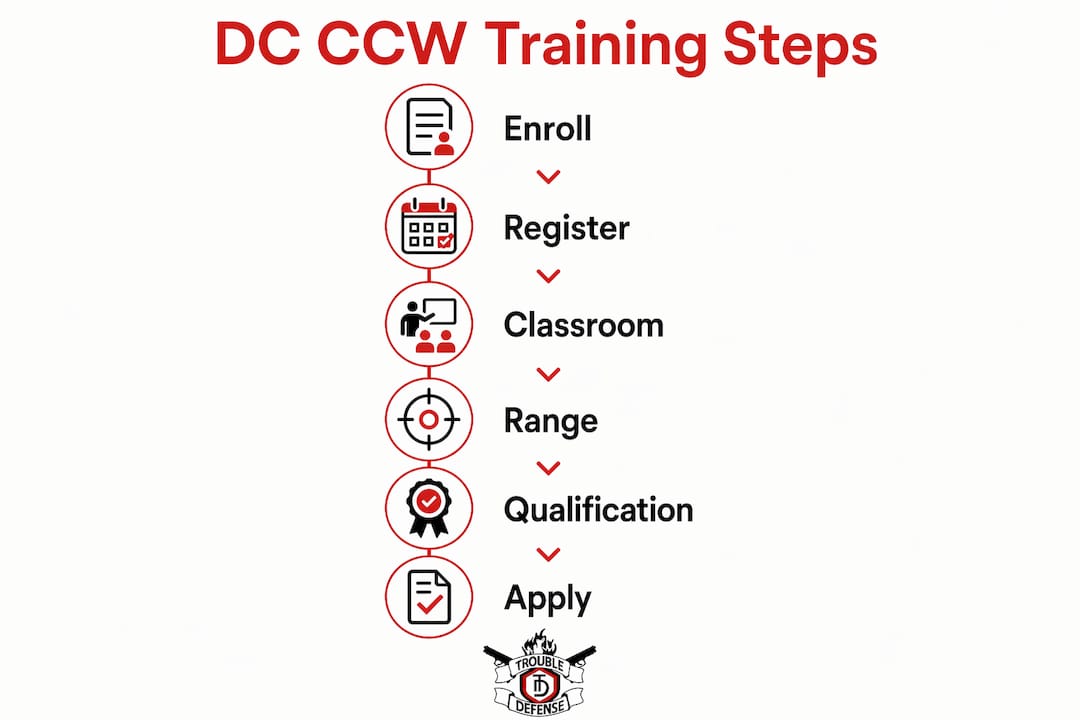
The full process from enrollment to permit in hand follows a clear sequence. Knowing the order prevents the most common delays.
| Step | Action | Timeline |
|---|---|---|
| 1. Enroll in training | Register with an MPD-certified instructor for the full 18-hour course | 1–2 weeks to find and schedule |
| 2. Complete classroom instruction | Attend all 16 hours of required classroom curriculum | Typically 2 days |
| 3. Pass range qualification | Complete 2-hour live-fire session and pass the qualification test | Same day as range session |
| 4. Register your firearm | Submit fingerprints, photos, written test, and safety course proof to MPD | 4–8 weeks processing |
| 5. Submit CPL application | File your carry license application with MPD portal, including training certificate | After registration approval |
| 6. Await CPL decision | MPD reviews your full application package | Varies; plan for several weeks |
Firearm registration typically takes 4–8 weeks before a carry license application can proceed. That timeline is outside your control once you submit. What you can control is the quality of your paperwork.
Pro Tip: Make certified copies of every document you submit to MPD. Keep a dated log of every submission, confirmation number, and correspondence. If your application stalls, this record is your fastest path to resolution.
Applicants face administrative delays or denials when training certificates or registration paperwork are incomplete or improperly documented. MPD’s portal instructions are specific. Follow them exactly, not approximately.
What are common mistakes in DC CCW training and licensing?
Most application failures trace back to a short list of avoidable errors. Knowing them in advance puts you ahead of the majority of applicants.
The most frequent mistakes:
- Using an uncertified instructor. Any course not delivered by an MPD-certified instructor produces an invalid certificate. Verify certification before you pay.
- Assuming out-of-state training counts. DC requires 100% DC-specific compliance. Virginia CCW training, Maryland Wear and Carry courses, and generic NRA certifications do not satisfy DC’s requirements on their own.
- Submitting incomplete documentation. Missing a photograph, an unsigned form, or an improperly formatted training certificate triggers automatic delays.
- Carrying before your CPL arrives. Your training certificate is not a carry permit. Carrying a concealed firearm in DC without a valid CPL is a criminal offense, regardless of your application status.
- Ignoring post-permit compliance. Your CPL has an expiration date. Renewal requires additional training. Carrying on an expired permit carries the same legal risk as carrying without one.
If your situation involves prior legal history, a complex residency status, or a denial, consult a DC firearms attorney before reapplying. Legal experts strongly recommend meticulous compliance with paperwork and MPD portal instructions to avoid setbacks. An attorney can identify the specific deficiency and correct it before you resubmit.
For applicants who want to understand firearm safety training fundamentals before enrolling, reviewing the full scope of what quality instruction covers helps you evaluate any program you consider.
Key Takeaways
DC CCW training requires completing a 16-hour certified classroom course, a 2-hour live-fire range qualification, and separate firearm registration with MPD before your Concealed Pistol License application can proceed.
| Point | Details |
|---|---|
| Training is mandatory and structured | DC requires 16 hours of classroom instruction plus 2 hours of MPD-certified range qualification. |
| Registration runs parallel to training | Firearm registration with MPD takes 4–8 weeks and must be completed before your CPL application proceeds. |
| Out-of-state permits do not apply | DC does not recognize any other state’s carry permit or firearm registration. |
| Documentation errors cause most denials | Incomplete or improperly formatted paperwork is the leading cause of application delays and rejections. |
| Post-permit compliance is required | Your CPL expires and requires renewal training; carrying on an expired permit is a criminal offense. |
DC’s concealed carry rules reward the prepared, not the impatient
The applicants I see struggle most with DC’s process are not the ones who lack skill. They are the ones who underestimate the paperwork. DC’s transition from a may-issue to a shall-issue policy made the permit more accessible in theory. In practice, the documentation requirements became the real barrier.
The 16-hour classroom requirement is genuinely useful, not bureaucratic padding. DC’s self-defense law has specific nuances around duty to retreat and the standard for justified force that differ from Virginia and Maryland. Applicants who treat the classroom as a box to check often leave without understanding where the legal line actually sits. That gap creates real risk after they receive their CPL.
My strongest recommendation is to treat your training certificate and registration paperwork with the same care you would give a legal contract. Date every document. Keep originals and copies in separate locations. Log every interaction with MPD. The applicants who sail through the process are almost always the ones who built a clean paper trail from day one.
Continuous education matters after you receive your CPL, too. A concealed carry training program that builds on your initial certification keeps your skills current and your legal knowledge updated as DC regulations evolve. The law does not stay static, and neither should your training.
— Dee Parker
Trouble Defense offers DC metro CCW training and legal readiness
Trouble Defense LLC is a veteran-owned firearms training academy serving Washington, DC, Virginia, Maryland, and the broader DMV area. The academy’s NRA-certified instructors deliver the full 18-hour DC-compliant curriculum, including classroom instruction on DC and federal law and live-fire range qualification.
Trouble Defense has earned over 300 five-star Google reviews by building a training environment where beginners and experienced shooters both leave confident and certified. Programs include women’s firearms training, adaptive training for individuals with disabilities, and courses for veterans sharpening tactical skills. If you have questions about your specific situation, the team at Trouble Defense provides direct guidance on DC’s requirements and connects you with the right course for your needs. Visit Trouble Defense to review DC-approved course options and schedule your training.
FAQ
What is the minimum training required for a DC concealed carry permit?
DC requires 16 hours of classroom instruction and 2 hours of live-fire range training, all completed with an MPD-certified instructor, before you can apply for a Concealed Pistol License.
Does my Virginia or Maryland CCW permit work in DC?
No. DC does not recognize concealed carry permits or firearm registrations from any other state, including Virginia and Maryland. You must obtain a DC-issued CPL to carry legally in the District.
How long does the DC CCW application process take?
Firearm registration with MPD typically takes 4–8 weeks. After registration is approved, your CPL application processing adds additional time, so plan for the full process to take several months.
Can I take my DC CCW training course online?
No. DC requires in-person range qualification as part of the mandatory training. Any provider offering a fully online DC CPL course does not meet MPD’s requirements.
What happens if I carry in DC without a valid CPL?
Carrying a concealed weapon in DC without a valid, locally issued CPL is a felony. A first offense carries a penalty of up to 5 years in prison and a $5,000 fine.