A qualifying Virginia CHP class must deliver three things: in-person instruction covering Virginia concealed-carry law, firearm safety, and use of force; a supervised live-fire or instructor-verified competency demonstration; and a signed certificate you can hand to the circuit court clerk. That requirement comes directly from Virginia Code §18.2-308.02, which governs resident concealed handgun permits.
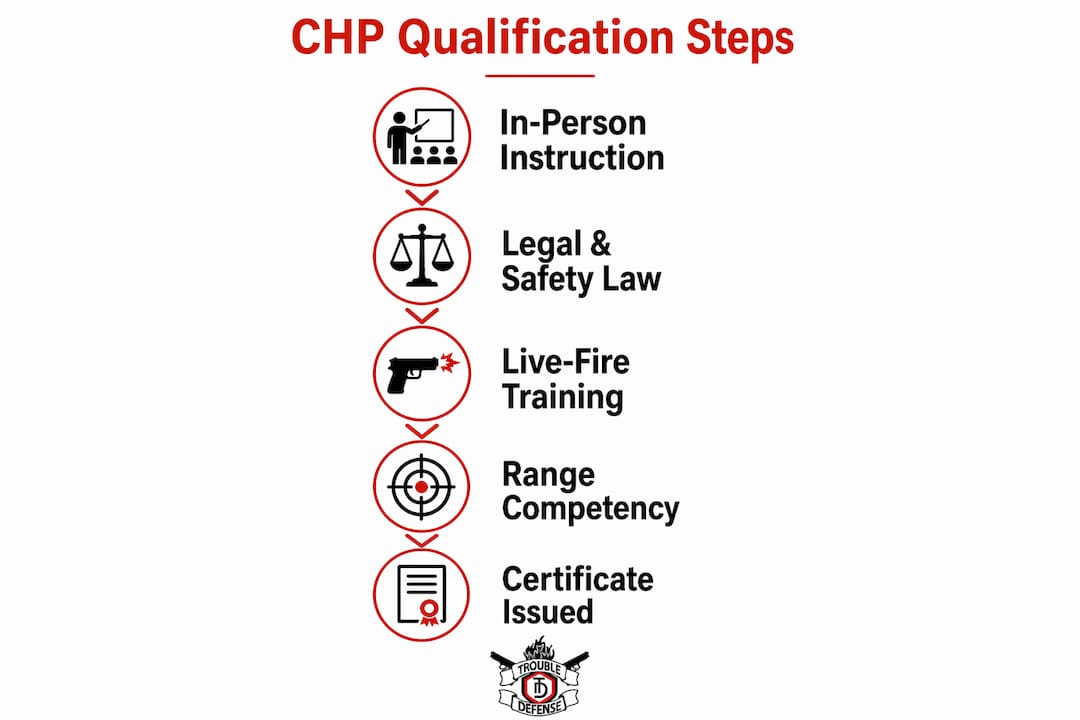
Trouble Defense LLC, a veteran-owned firearms training academy based in Fairfax, VA, offers a Virginia concealed carry course taught by NRA-certified instructors that meets this standard. With over 300 five-star Google reviews and more than a decade serving the DMV area, it’s one of the most trusted local options for CHP training in Virginia.
Leave class with these three items or your application will stall:
- Signed competency certificate listing the course name, date, and your name
- Instructor’s name and certification ID (NRA, DCJS, or USCCA number) printed on the certificate
- Guidance on submission — which circuit court to file with, what copies to bring, and the current filing fee
Pro Tip: Ask your instructor before class day whether the certificate will include their NRA or DCJS certification number. A certificate missing that field is the single most common reason clerks send applications back.
Table of Contents
- What does a qualifying Virginia CHP class cover?
- Class logistics: duration, cost, and what to bring
- Who can attend and what eligibility looks like
- How live-fire qualification works and what gets documented
- What to submit with your Virginia CHP application
- How to pick a Virginia CHP course that actually prepares you
- What to expect from enrollment through getting your certificate
- Trouble Defense LLC: a local provider built for Virginia CHP students
- Key Takeaways
- Why in-person training is worth more than the paperwork
- Trouble Defense is ready when you are
- Useful sources
- FAQ
What does a qualifying Virginia CHP class cover?
Virginia law is flexible about what counts as proof of competency. §18.2-308.02 accepts NRA or USCCA courses, hunter education, law enforcement or military training, organized competition, or an instructor affidavit. In practice, most applicants complete a structured classroom-plus-range course. Here’s what a solid Virginia handgun permit class covers:
Classroom topics
- Virginia concealed-carry law and permit requirements under §18.2-308.02
- Justifiable force and use-of-force standards (when you can legally draw)
- Safe storage, transportation, and handling of handguns
- Situational awareness, conflict avoidance, and crisis de-escalation
- Reciprocity basics and where your Virginia CHP is recognized
Practical and range skills
- Safe loading, unloading, and chamber checks
- Proper grip, stance, and trigger control
- Drawing from a holster and re-holstering safely
- Supervised live-fire qualification drills with accuracy and manipulation checks
Instructor credentials matter. Look for an NRA-certified or DCJS-recognized instructor whose certification ID will appear on your certificate. Courses typically run several hours total, combining the classroom session with range time in a single day or across two sessions.
Pro Tip: A course that skips live-fire and offers only a written test may still technically satisfy the statute in some cases, but Fairfax Circuit Court and many other localities require in-person competency certification for applications filed after December 31, 2020. Don’t risk a rejection — choose a course with live-fire.
Class logistics: duration, cost, and what to bring
Schedule and duration
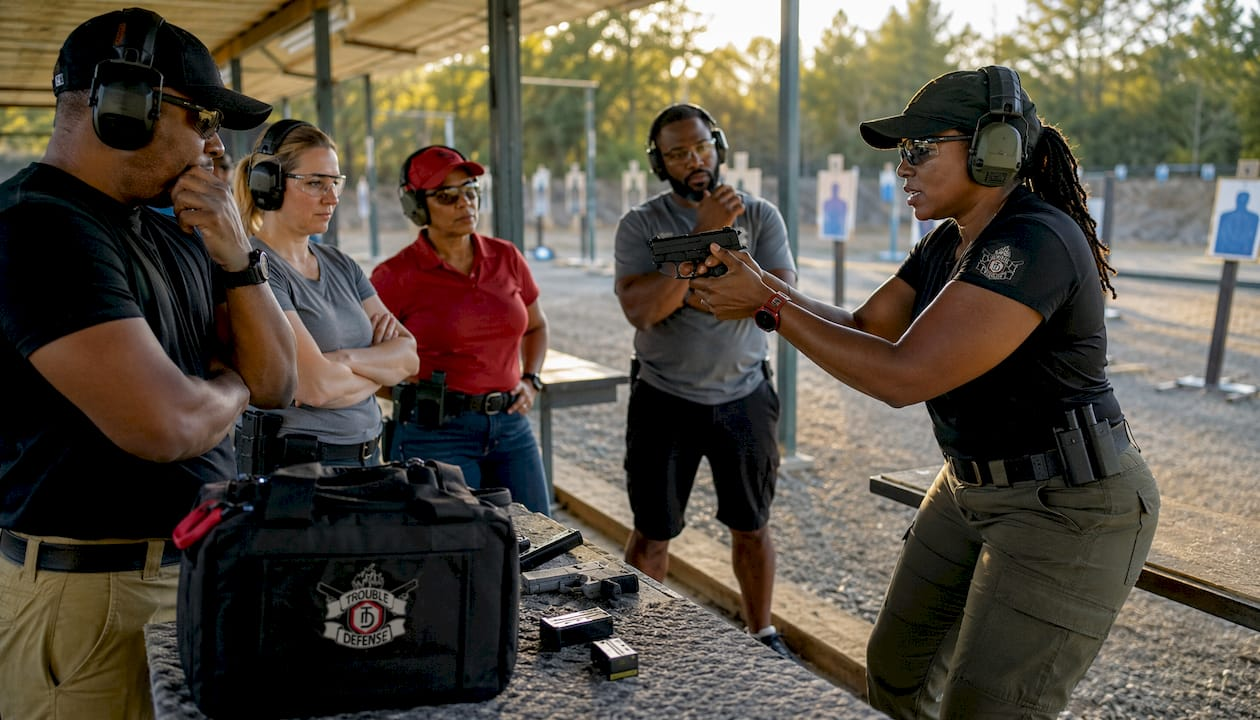
Most Virginia CHP classes run as a single-day intensive, typically 4–8 hours. Some providers split the classroom session and range day across two separate dates. Weekend classes are common and often fill quickly, so book at least two to three weeks out.
Class size matters more during live-fire than in the classroom. Small groups allow for real-time feedback on grip, stance, and safe muzzle control during live-fire sessions. Larger classes during range sessions increase wait time and reduce the quality of individual coaching.
Costs and fees
Expect to budget for several line items:
- Course fee: covers instruction, range time, and basic targets
- Ammunition: typically 50 rounds minimum; confirm the round count with your provider before class
- Eye and ear protection: required on the range; some providers rent gear if you don’t own it
- Rental firearm: available at many ranges if you don’t have your own handgun
- Court filing fee: total application costs typically run around $50, combining the state fee and a small court processing fee, though this varies by locality
One important note: your competency certificate does not expire under Virginia law. If you complete the course today and apply two years from now, the certificate is still valid.
What to bring on class day
- Government-issued photo ID (driver’s license, passport, or military ID)
- Your handgun, cleaned and in working order
- At least the course’s required round count (ask in advance)
- Eye protection and ear protection (electronic muffs are a plus)
- Any prior training certificates (military DD-214, competition records, prior courses)
- Comfortable, weather-appropriate clothing and closed-toe shoes
Who can attend and what eligibility looks like
Virginia’s resident CHP is available to applicants who are 21 or older, can legally possess a firearm under state and federal law, and reside or are domiciled in Virginia. Active-duty military stationed outside the state may apply in the county or city of their domicile.
On class day, instructors typically ask to see:
- A valid government photo ID confirming your identity
- Proof of residency if the instructor requests it
- Any prior certificates you want noted (military service, prior courses)
The paperwork the court expects is straightforward: a certificate of completion with the instructor’s name and certification ID, or an instructor affidavit. Make multiple copies. The clerk keeps one; you keep one for your records.
Pro Tip: Verify before you book that the instructor will sign the certificate in person on class day and that their certification number will appear on it. An unsigned or undated certificate is grounds for rejection at the clerk’s window.
How live-fire qualification works and what gets documented
Live-fire is where the class moves from theory to proof. A typical range session includes:
- Controlled fire from a standing or bench position at a standard target
- Draw-and-fire drills demonstrating safe holster technique
- Accuracy checks at close to moderate distance (commonly 3–7 yards)
- Safe manipulation: loading, unloading, and clearing malfunctions under observation
Round counts vary by instructor, with providers specifying their requirements for the qualification portion. The instructor watches for safe muzzle control, trigger discipline, and consistent re-holstering before signing off.
If you have equivalent experience — organized shooting competition, military service, or prior law enforcement training — §18.2-308.02 allows an instructor affidavit documenting that competence in lieu of a formal range session.
Important: Fairfax Circuit Court guidance states that effective January 1, 2021, competency certificates must reflect in-person training. Online-only certificates filed after December 31, 2020 are not accepted for in-person filings in many localities. Check with your specific circuit court before relying on any online-only course.
A valid competency certificate includes: course title, date, your name, instructor name, instructor certification number (NRA/DCJS/USCCA), a statement that you demonstrated handgun competence in person, and the instructor’s signature. Courts use those fields to verify authenticity.
What to submit with your Virginia CHP application
Filing is handled by the circuit court in your county or city. Here’s the standard checklist:
- Completed CHP application on the form prescribed by the Department of State Police
- One valid government photo ID (presented in person)
- Photocopy of your competency certificate or instructor affidavit
- Required filing fee (confirm the current amount with your local clerk)
- A stamped, self-addressed envelope if your clerk requests one for mailing the permit
Nonresidents apply through the Virginia State Police rather than a circuit court, following a separate process that includes fingerprinting. The VSP nonresident pathway has its own documentation requirements.
Once the application is complete, the court conducts a background check through local law enforcement. Many jurisdictions target a 45-day window for issuance or denial, though local processing times vary.
Pro Tip: Bring three copies of your competency certificate to the clerk’s office: one for the court, one for your file, and one spare. Incomplete or illegible certificates are the most common source of processing delays.
How to pick a Virginia CHP course that actually prepares you
Not every course that hands out a certificate builds real skill. Use this checklist before you book:
- The course explicitly states it meets Virginia’s proof-of-competency requirement
- The instructor’s certification ID (NRA, DCJS, or USCCA) will appear on your certificate
- In-person live-fire is included, not optional
- Class size during range sessions is small enough for individual feedback
- Recent student reviews mention the certificate being accepted by the clerk
Red flags to avoid:
- Vague certificates with no instructor credentials listed
- Online-only claims for what is now an in-person requirement in most localities
- Very low prices that exclude range time or ammunition
- Large live-fire groups with one instructor managing 20+ students
- No published cancellation or refund policy
Questions worth asking before you pay:
- Will I receive a signed certificate with your certification number on class day?
- Is live-fire included, and what is the round count?
- What drills are used for the qualification portion?
Pro Tip: Providers who publish instructor bios, sample certificates, and exact class locations online are showing you they have nothing to hide. That transparency is a reliable signal of a well-run program.
What to expect from enrollment through getting your certificate
Enrollment steps
- Reserve your spot online or by phone; confirm the range address and what to bring
- Complete any pre-class waivers or liability forms (often sent digitally in advance)
- Pay the course fee and note the cancellation/waitlist policy
- Confirm ammunition requirements and whether rental firearms are available
Class-day timeline
- Arrival and check-in: present your photo ID; instructors verify your identity and collect waivers
- Safety briefing: range rules, four fundamental firearm safety rules, and the day’s agenda
- Classroom session: Virginia law, use of force, storage, situational awareness (typically 2–4 hours)
- Break and range prep: load magazines, review range commands, confirm safety gear
- Live-fire drills: small groups rotate through qualification drills under instructor supervision
- Debrief and certificate issuance: instructor reviews performance, signs certificates, answers questions
What instructors watch for on the range
- Safe muzzle direction at all times
- Trigger discipline (finger off trigger until sights are on target)
- Controlled re-holstering without sweeping the body
- Minimum accuracy and handling demonstration at qualification distance
Trouble Defense LLC: a local provider built for Virginia CHP students
Trouble Defense LLC is a veteran-owned firearms training academy serving Virginia, Maryland, Washington DC, and the broader DMV area since 2012. Their Virginia concealed carry class is taught by NRA-certified instructors and includes both the required classroom instruction and a live-fire qualification session — everything the circuit court expects in a single package.
Trouble Defense has earned over 300 five-star Google reviews from students across the DMV, ranging from first-time gun owners to veterans refreshing their skills. The academy’s commitment to small class sizes during live-fire sessions means students get real coaching, not just a signature on a form.
Key credentials and trust signals:
- NRA-certified instructors with certification IDs documented on every certificate
- Combined classroom and live-fire format meeting Virginia’s in-person competency requirement
- Small student-to-instructor ratios during range sessions for safety and individual feedback
- Transparent scheduling: published dates, exact locations, and instructor bios available before you book
- Firearm training in Virginia programs for beginners through advanced students
Beyond the standard CHP class, Trouble Defense offers women’s firearm training, adaptive training for blind and low-vision students, private one-on-one instruction, youth firearm safety education, and security firearms training. If you need a private session to work around your schedule, private pistol coaching is available for students who prefer one-on-one live-fire qualification.
Pro Tip: Check the Trouble Defense training calendar before your first call — class dates fill fast, especially on weekends. Knowing your preferred date in advance makes booking faster.
Key Takeaways
A qualifying Virginia CHP class requires in-person instruction, live-fire competency, and a signed certificate with the instructor’s certification ID — all of which Trouble Defense delivers through its NRA-certified, veteran-owned program in the DMV.
| Point | Details |
|---|---|
| In-person requirement | Virginia courts require in-person competency certification; online-only certificates are not accepted in many localities after December 31, 2020. |
| Certificate must-haves | Your certificate needs the course title, date, instructor name, certification ID (NRA/DCJS/USCCA), and the instructor’s signature. |
| Filing basics | Submit the completed application, photo ID, competency certificate copy, and filing fee to your county or city circuit court. |
| Processing timeline | Many jurisdictions target a 45-day window for issuance or denial once the application is complete. |
| Trouble Defense | Veteran-owned, NRA-certified, DMV-based; offers Virginia CHP classes with live-fire qualification and court-ready certificates. |
Why in-person training is worth more than the paperwork
There’s a version of this conversation that treats the Virginia CHP class as a box to check — get the certificate, file the paperwork, done. That framing misses something important.
The students who struggle most on the range aren’t the ones who lack courage. They’re the ones who’ve never had anyone correct their grip, watch their trigger finger, or call out a muzzle sweep in real time. An online video can show you what good technique looks like. It cannot tell you that your support hand is slipping or that you’re anticipating the shot. That feedback only happens in person, with an instructor standing next to you.
Responsible carry means more than legal authorization. It means knowing, under stress, that your hands will do what you trained them to do. The classroom session on use of force matters too — not because the statute requires it, but because the legal and ethical weight of drawing a firearm in a real situation is something most people have never seriously thought through. A good instructor makes you think through it before you’re in it.
The certificate is the outcome. The training is the point.
Trouble Defense is ready when you are
Trouble Defense offers Virginia CHP classes that go beyond the minimum. Every class includes the classroom instruction Virginia law requires, a live-fire qualification session, and a signed certificate with the instructor’s NRA certification ID — exactly what the circuit court clerk needs to process your application without delays.
Classes run on weekends and select weekdays across the DMV area. Public group sessions and private one-on-one options are both available, so you can choose the format that fits your schedule and comfort level. Women’s firearm training, adaptive programs, and youth safety education round out the academy’s offerings for the whole community.
Check the training calendar for upcoming Virginia CHP class dates, or visit the CCW permit class page to review course details and book your spot. Questions about paperwork, clerk expectations, or what to bring? Call Trouble Defense directly — the team answers those questions every day.
Useful sources
Official and authoritative references for Virginia CHP applicants:
- §18.2-308.02, Code of Virginia — the primary statute governing resident CHP applications, acceptable proof of competency, and permit requirements
- Virginia State Police: Resident Concealed Handgun Permits — VSP’s official guidance on where to file and how the resident permit process works
- Virginia State Police: Nonresident Concealed Handgun Permits — separate pathway and documentation requirements for nonresidents
- §18.2-308.06, Code of Virginia — nonresident permit statute listing acceptable proof of competency in detail
- Fairfax Circuit Court CHP Application Process (PDF) — local procedural guidance including the January 1, 2021, in-person competency requirement
- Danville, VA: Concealed Handgun Permits — example of how local clerk offices publish their own filing instructions and contact points
- 19VAC30-190-50, Virginia Administrative Code — proof-of-competence regulations for nonresident permits, including affidavit and certificate requirements
Primary legal authorities are the Code of Virginia statutes and VSP guidance. Local procedural guidance (Fairfax PDF, Danville page) reflects how individual clerks implement the law and can vary by locality. Always confirm current fees and submission requirements directly with your circuit court clerk before filing.
FAQ
What must a Virginia CHP class include to qualify?
A qualifying class must include in-person instruction covering Virginia concealed-carry law and firearm safety, plus a live-fire or instructor-verified competency demonstration. The instructor must provide a signed certificate with their NRA, DCJS, or USCCA certification ID for the court.
How long does it take to get a Virginia CHP after filing?
Many jurisdictions target a 45-day window for issuance or denial once the application is complete, though local processing times vary. Contact your circuit court clerk for current timelines in your county or city.
Is an online-only Virginia CHP class accepted?
In many localities, including Fairfax, online-only certificates are not accepted for applications filed after December 31, 2020. Virginia courts now generally require in-person competency certification, so choose a course with a live-fire component.
Does my competency certificate expire?
No. Under §18.2-308.02, no proof of demonstrated competence shall expire. A certificate earned today remains valid if you apply years later.
Where does Trouble Defense offer Virginia CHP classes?
Trouble Defense offers Virginia CHP classes across the DMV area, including Fairfax and surrounding Northern Virginia localities. Check the training calendar for current dates, locations, and availability.
This article provides general information about Virginia CHP requirements and is not legal advice. Confirm current statutes, fees, and local filing procedures with the Virginia State Police or your circuit court clerk before submitting your application.