Security guard training is legally mandated coursework that every aspiring security officer must complete before working in the field. The specific hours, course types, and licensing steps vary by state, but the core structure is consistent: complete approved training, pass any required exams, then apply for your license through the appropriate state agency. Here is what candidates in New York, Delaware, and Maryland need to know before their first shift.
At a glance, the three-state picture looks like this:
- New York: 8-hour Pre-Assignment Training before applying, 16-hour On-the-Job Training (OJT) within 90 days of employment, and an 8-hour Annual In-service course every year. The NY Division of Criminal Justice Services (DCJS) approves training schools; the Department of State issues the actual registration card.
- Maryland: 12 hours of initial security training approved by the Maryland Police Training and Standards Commission (MPCTC), effective January 1, 2025, under Senate Bill 760. MPCTC approves programs but does not conduct training itself.
- Delaware: Complete a board-approved training program, then pass a mandatory licensing exam at Delaware Technical & Community College (DTCC) with a minimum score of 75%. Training and testing are two separate steps.
- Multi-state options: Online security guard courses exist and support candidates working across jurisdictions, but each state’s licensing requirements still apply independently.
What are the security guard training requirements in New York, Delaware, and Maryland?
New York
New York’s requirements are spelled out in Article 7A of the General Business Law and administered jointly by DCJS and the Department of State. The three mandatory courses are:
- 8-Hour Pre-Assignment Training: A general introductory course covering legal powers, emergency procedures, and ethics. You submit the completion certificate with your Security Guard Registration Card application.
- 16-Hour On-the-Job Training (OJT): Site-specific instruction covering your actual duties, workplace requirements, and employer expectations. This must be finished within 90 working days of starting employment. Missing that window puts your registration at risk.
- 8-Hour Annual In-service Training: Required every calendar year you hold a registration. Because registrations run two years, you will complete two of these per registration cycle.
Former peace officers may qualify for a DCJS waiver of some requirements. Active police officers are exempt from the definition of a security guard entirely, so they do not need to register or train for secondary employment.
Maryland
Maryland’s security guard certification framework was standardized by Senate Bill 760, which took effect january 1, 2025. Candidates must complete 12 hours of initial training from an MPCTC-approved provider. The MPCTC reviews and approves programs but does not run classes itself. Approved providers are listed on the MPCTC website.
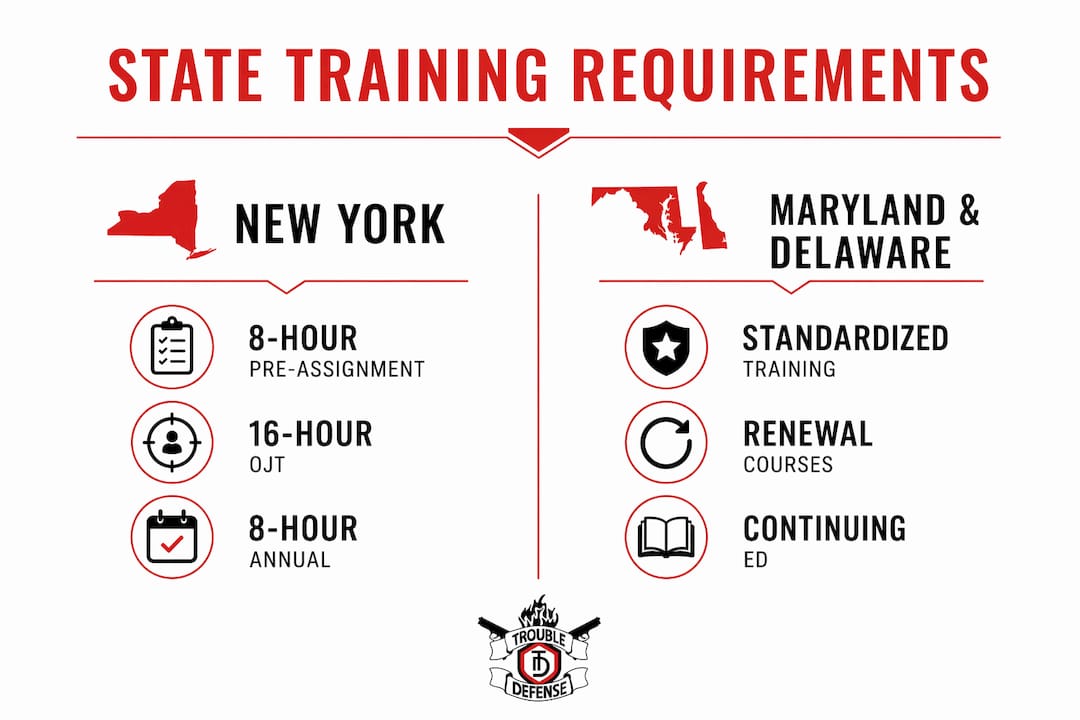
For renewal, guards must complete continuing security training approved by MPCTC. Any certified guard who has not yet completed the 12-hour initial course must do so at renewal. The Maryland State Police handles the certification application; contact them at msp.professionallicensing@maryland.gov or (410) 653-4500.
Delaware
Delaware’s process has two distinct steps that candidates often confuse. First, complete a mandatory training program through a board-approved facility. Options include virtual live, virtual self-paced, and in-person formats. Delaware Technical & Community College (DTCC) offers both virtual formats. Second, pass the state licensing exam at a DTCC campus with a score of at least 75%. Your training provider’s internal assessment does not substitute for this exam. The exam fee is $49.00, and you must take it within one year of your training certificate date.
What types of security guard training programs are available?
The format of your training matters as much as the content, especially if you are balancing a job search with coursework.
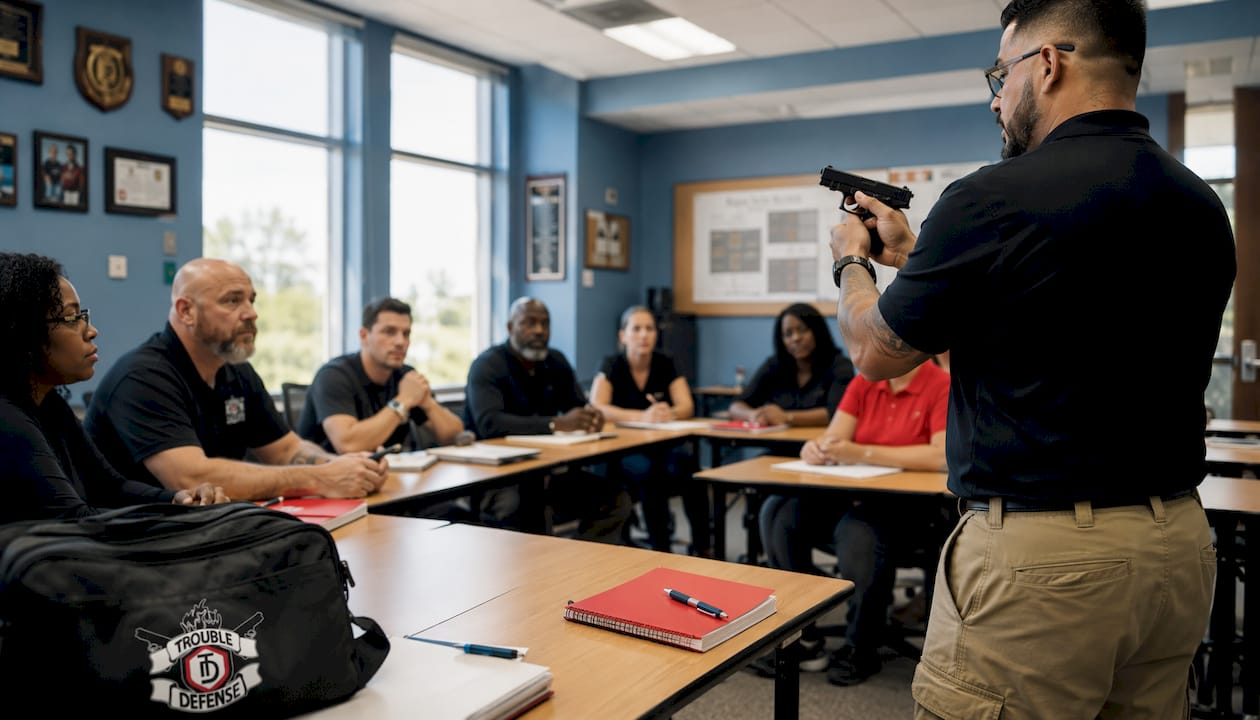
- In-person classroom training: Offered by facilities like Polytech Adult Education in Delaware and various DCJS-approved schools in New York. Best for candidates who learn through direct interaction and want immediate feedback from instructors.
- Virtual live (online with instructor): DTCC and some other approved providers offer scheduled online sessions with a live instructor. You get real-time Q&A without commuting.
- Virtual self-paced (online): Fully asynchronous courses that work on mobile devices, letting you complete hours around your schedule. Delaware’s approved providers include self-paced options.
- Multi-state online courses: These programs cover content relevant to multiple jurisdictions and are useful if you plan to work across state lines. Keep in mind that completing a multi-state course does not replace each state’s separate licensing process. You still apply for a license in every state where you work.
- Employer-provided training: In Delaware, licensed Class B or Class C security agencies with approved trainers can conduct training for their own employees. Check with the agency before assuming this option is available.
State approval is not optional. In New York, all training must be completed at DCJS-approved schools. Maryland requires MPCTC approval. Delaware requires board-approved facilities. A course that lacks the right approval will not satisfy licensing requirements, regardless of its content quality. The role of continuing education in public safety extends beyond initial certification, making provider selection a long-term decision.
How does the licensing process work, and what does it cost?
Training completion and license issuance are handled by different entities. Your training provider issues a certificate of completion. The state licensing authority issues the actual license or registration card. Submitting your training certificate is a prerequisite for the license application, not a substitute for it.
New York:
- Application fee: $36.00, non-refundable, payable to the NYS Department of State.
- Required with your application: completed and signed application, electronic fingerprinting receipt from an approved vendor, the $36.00 fee, and a copy of your 8-hour pre-assignment training certificate.
- Contact the Division of Licensing Services at (518) 474-7569 for registration questions; direct training questions to DCJS at (518) 457-2667.
Maryland:
- Application fee: $15.00, non-refundable, submitted through your employing security guard agency.
- Fingerprints are required. You must be at least 18 years old and of good moral character.
- Renewal requires documentation of continuing training approved by MPCTC; consult the current guidelines for the precise hour requirement.
Delaware:
- Exam fee: $49.00, paid to DTCC. A retake fee applies each time you retest, though there is no limit on attempts within one year of your training certificate.
- Submit your Security Guard Application along with the DTCC-issued exam certification.
- You must present your training certificate and a valid photo ID to sit for the exam.
Background checks are standard across all three states. Maryland’s statute explicitly requires a declaration regarding any convictions for disqualifying crimes or crimes of violence.
What specialized training do armed security guards need?
Armed security guard certification requires a separate track of training that goes well beyond the unarmed baseline. The requirements are more demanding, and the consequences of skipping steps are serious.
New York’s armed guard pathway:
- You must hold a valid New York State pistol license before you can even enroll in the 47-hour Firearms Training Course for security guards.
- The 47-hour course must be completed before applying for a Special Armed Guard Registration Card.
- Once licensed as an armed guard, you must complete an 8-Hour Annual Firearms Training course every calendar year, in addition to the standard 8-hour annual in-service. That is 16 hours of annual training total for armed guards.
- Applicants whose initial firearms training occurred more than 12 months before employment must complete the 8-hour annual firearms course before applying.
Delaware:
- Armed (Red Card) applicants must first obtain their unarmed (Yellow Card) license, then complete a 40-hour Firearms Course with an approved instructor.
Maryland:
- Guards who plan to carry a handgun must declare that intent on their certification application. Specific firearms training requirements are coordinated through the MPCTC approval process.
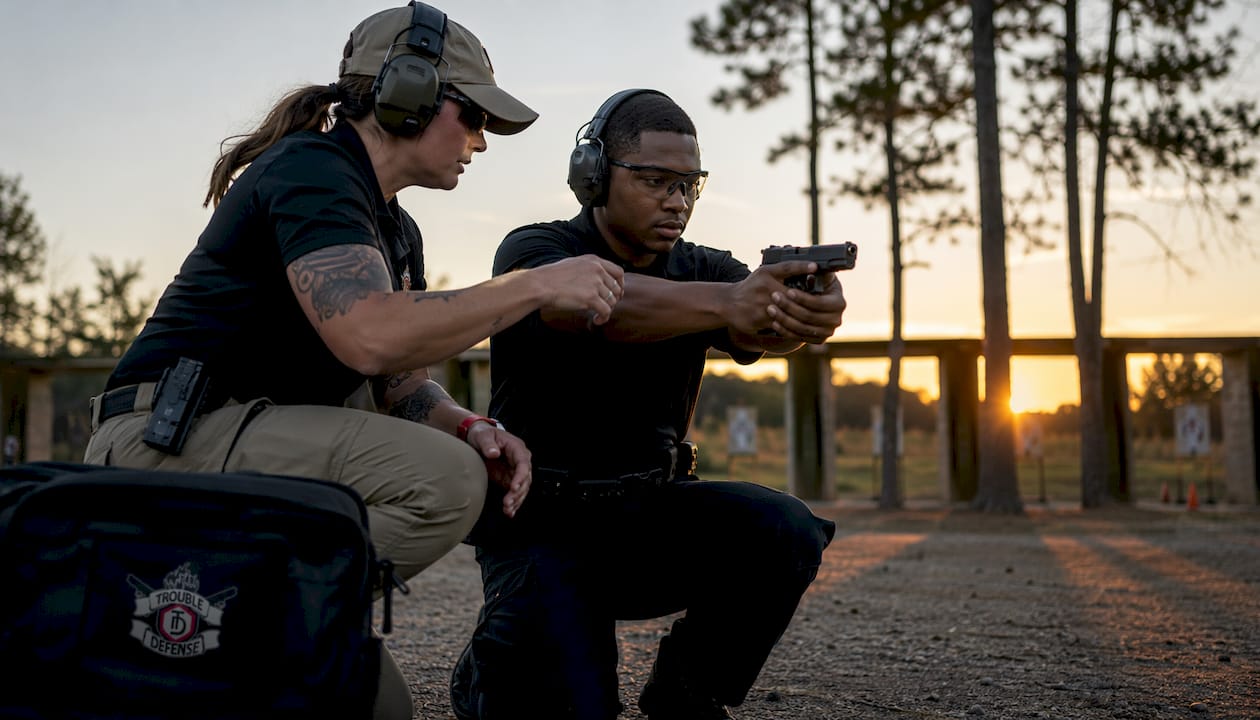
Trouble Defense offers Maryland firearms training for security professionals and a full range of firearm training services built around the real-world demands security officers face. As a veteran-owned academy in Fairfax, VA, Trouble Defense brings NRA-certified instruction and hands-on range experience to every course, whether you are pursuing initial armed certification or your annual qualification.
Pro Tip: Always verify that your firearms training provider is approved by your state’s licensing authority before you register. A certificate from an unapproved school will not satisfy the state’s requirement, and you will have to repeat the course.
How does security guard training open doors for career advancement?
Completing your state-mandated training is the floor, not the ceiling. Guards who invest in additional credentials consistently move into higher-paying and more specialized roles.
Armed guard certification is the most direct upgrade. In most states, it expands the types of assignments you qualify for and commands higher hourly rates. Supervisory and site manager positions typically require documented experience plus additional training in emergency response, access control systems, and report writing.
Specialized certifications in areas like active shooter response, executive protection, and loss prevention open doors in corporate security, healthcare security, and government contracting. Many of these programs build directly on the legal powers, emergency situations, and incident command content already covered in your OJT. If you are working in the DMV area, multi-state firearm training that covers compliance across Virginia, Maryland, and DC is a practical next step for guards who want flexibility across jurisdictions.
Key Takeaways
Security guard training requirements are set by state law, and training completion is a prerequisite for licensing, not a substitute for it.
| Point | Details |
|---|---|
| New York’s three-course structure | Complete 8-hour pre-assignment, 16-hour OJT within 90 days, and 8-hour annual in-service every year. |
| Maryland’s 2025 mandate | Senate Bill 760 requires 12 hours of MPCTC-approved initial training. For renewal, guards must complete continuing training approved by MPCTC, but the precise hour requirement should be confirmed according to current MPCTC guidelines. |
| Delaware’s two-step process | Board-approved training and a separate DTCC exam (75% passing score, $49.00 fee) are both required. |
| Training vs. licensing | Training providers issue completion certificates; state agencies issue the actual license or registration card. |
| Armed guard requirements | New York’s armed track adds a 47-hour firearms course plus 8 hours of annual firearms training on top of standard requirements. |
FAQ
How long does security guard training take?
In New York, the minimum is 8 hours of pre-assignment training before you start, followed by 16 hours of OJT within your first 90 working days. Maryland requires 12 hours of initial training. Delaware’s timeline depends on the format you choose, but you must complete training before sitting for the DTCC exam.
How much does it cost to get a security license in New York?
The New York State Department of State charges a $36.00 non-refundable application fee for a Security Guard Registration Card. Training course fees vary by school and are separate from the application fee.
What training do you need to become a security guard?
Requirements depend on your state. New York mandates an 8-hour pre-assignment course, a 16-hour OJT, and annual 8-hour in-service training. Maryland requires 12 hours of MPCTC-approved initial training. Delaware requires a board-approved training program plus a passing score on the DTCC licensing exam.
Does online security guard training satisfy state requirements?
Online courses can satisfy training requirements if the provider is approved by your state’s licensing authority. In New York, schools must be DCJS-approved. In Maryland, programs must carry MPCTC approval. In Delaware, approved virtual options are available through DTCC and other board-approved providers.
What extra training do armed security guards need in New York?
Armed guards in New York must complete a 47-hour Firearms Training Course and hold a valid NYS pistol license before applying for a Special Armed Guard Registration Card. They also complete 8 hours of annual firearms training every year, in addition to the standard 8-hour annual in-service.

