Yes, the District requires you to register firearms with the Metropolitan Police Department (MPD). Prepare form PD-219 or an MPD Firearms Portal profile, two proofs of DC residency, safety training proof, and an in-person fingerprint and photo appointment. The Chief generally must act within 60 days, subject to exceptions in D.C. Code § 7–2502.07, and you should file immediately after bringing a firearm into DC.
TL;DR:
- A filing within 48 hours of contacting MPD meets the timing rule, while firearms you make yourself must be registered within five business days.
- The fees total $48: $13 for registration and $35 for fingerprinting and the FBI check; accepted payment includes cash, debit, or Visa or Mastercard.
- Confirm a firearm’s make and model against MPD rules before buying; shotguns with sawed off barrels cannot be registered, and magazines cannot exceed ten rounds.
- If MPD denies your application, you generally have 15 days from notice to appeal, and eligibility concerns warrant legal advice before filing.
Table of Contents
- Checklist for the DC firearm registration process
- How to register a gun in DC, step by step
- Who is eligible to register a firearm in DC?
- Which firearms can you register in DC?
- DC firearm registration deadlines and timing rules
- Using the MPD Firearms Portal and booking your appointment
- What to bring and what causes delays
- How do you renew your firearm registration in DC?
- How do you update your firearm registration information?
- How do you deregister a firearm when leaving DC or getting rid of it?
- What happens if you fail to register a firearm in DC?
- What helps people actually finish DC registration
- Prepare for DC registration with Trouble Defense
- FAQ
- Sources
Checklist for the DC firearm registration process
Have everything below in hand before you walk into the Firearms Registration Branch:
- Application: Form PD-219, which you can download from MPD’s firearm forms page, or your completed Firearms Portal profile.
- Residency: Two valid proofs of DC residency, such as a DC driver’s license, vehicle registration, lease, or deed.
- Identification: A government-issued photo ID.
- Training proof: A certificate from an accepted safety course.
- Fees: A $13 registration fee and a $35 fingerprinting and FBI background check fee, paid by cash in person, debit, or Visa/Mastercard.
- The firearm itself: Leave it at home. MPD tells applicants not to bring it to the appointment.
How to register a gun in DC, step by step
MPD’s Complete Firearms Registration Procedures lay out the sequence. Here is how it works in practice.
- Create your profile. MPD recommends the Firearms Portal because you enter your personal information once, upload documents, track your status, and book your appointment in the same place. If you prefer paper, prepare PD-219 instead.
- Finish your safety training. Take MPD’s free online course through the portal, or check with MPD about what training proof it accepts.
- Upload or gather your documents. Upload them in the portal, or bring them with you.
- Schedule your fingerprint and photo visit. The portal lets you pick a slot.
- Attend the appointment. You pay the fees, get fingerprinted, and have your photo taken. D.C. Code § 7–2502.04 requires you to appear in person.
- Wait for notice. MPD tells you when the application is approved. Ask MPD how you will receive your registration certificate.
Pro Tip: Finish the training course before you book your appointment, so your certificate is ready to upload and nothing stalls the review.
Who is eligible to register a firearm in DC?
D.C. Code § 7–2502.03 sets the qualifications. The main points:
- Age: Applicants generally must be 21 or older. A narrow exception lets people aged 18 to 21 register long guns with a notarized parental or guardian liability statement.
- Recent convictions: Certain convictions within the prior five years can disqualify you, including drug offenses, violent misdemeanors, multiple DUIs, stalking, and certain firearm misdemeanors.
- Mental health and court orders: Recent mental-health adjudications and certain protection orders also disqualify applicants.
- Knowledge: You must show you understand DC firearm law and safe storage.
If you are concerned about eligibility or the consequences of an application decision, consult an attorney. You generally have 15 days from notice to appeal, and the law provides a pathway to seek relief from a disqualification. When in doubt about your history, talk to an attorney before you file.
Which firearms can you register in DC?
According to MPD’s general requirements, registrable firearms include rifles, shotguns, revolvers, and handguns, unless a specific prohibition applies. DC law bans registration of certain firearms, with sawed-off shotguns as one example, and it limits magazine capacity to ten rounds.
Check the make and model against MPD’s rules before you buy, not after. If a firearm becomes unregistrable, or you cannot qualify to keep it, ask MPD or an attorney about your lawful options. Do not simply keep it and hope nobody asks. Transport and storage rules also apply inside the District, so read them before moving a firearm across town.
DC firearm registration deadlines and timing rules
Timing is where people slip up. Under D.C. Code § 7–2502.06, you file before taking possession from a dealer, or immediately after bringing a firearm into the District. You satisfy the rule if you communicate with MPD and file within 48 hours of that communication. Self-manufactured firearms must be registered within 5 business days.
The Chief of Police generally must approve or deny your application within 60 days of receipt, subject to statutory exceptions. That clock starts when MPD has your application, so a missing document can quietly push your timeline back.
In practice, delays come from missing documents, portal upload problems, and unavailable appointment slots. Apply early and keep your paperwork tidy.
Using the MPD Firearms Portal and booking your appointment
The portal is the fastest route for most people:
- One-time entry: You enter your details once and reuse them.
- Tracking: You can see where your application stands.
- Scheduling: You book the fingerprint and photo appointment online.
- Training: The free MPD safety course lives there too.
- Payment limits: Bring cash (in person), debit, or Visa/Mastercard. Other methods are not accepted.
- Walk-ins: MPD encourages appointments. Check with MPD about whether walk-ins are accepted.
Pro Tip: Confirm your file formats before uploading, make sure the name and address match your ID exactly, and bring printed backups if you are using paper forms.
What to bring and what causes delays
Use this last-minute list the night before your visit:
- Your PD-219 or portal confirmation
- Two proofs of DC residency
- Government photo ID
- Your training certificate
- Payment in an accepted form
Make sure every document is legible and recent, and that names and addresses match your ID. Potential delays can include mismatched data, incomplete training proof, fingerprint issues, or missing fee payment. Fingerprint mistakes are especially frustrating, and our guide to the CCW fingerprinting format error explains how to avoid them. If you are denied, the law provides a 15-day appeal period. Review the notice and official eligibility information for the applicable process.
How do you renew your firearm registration in DC?
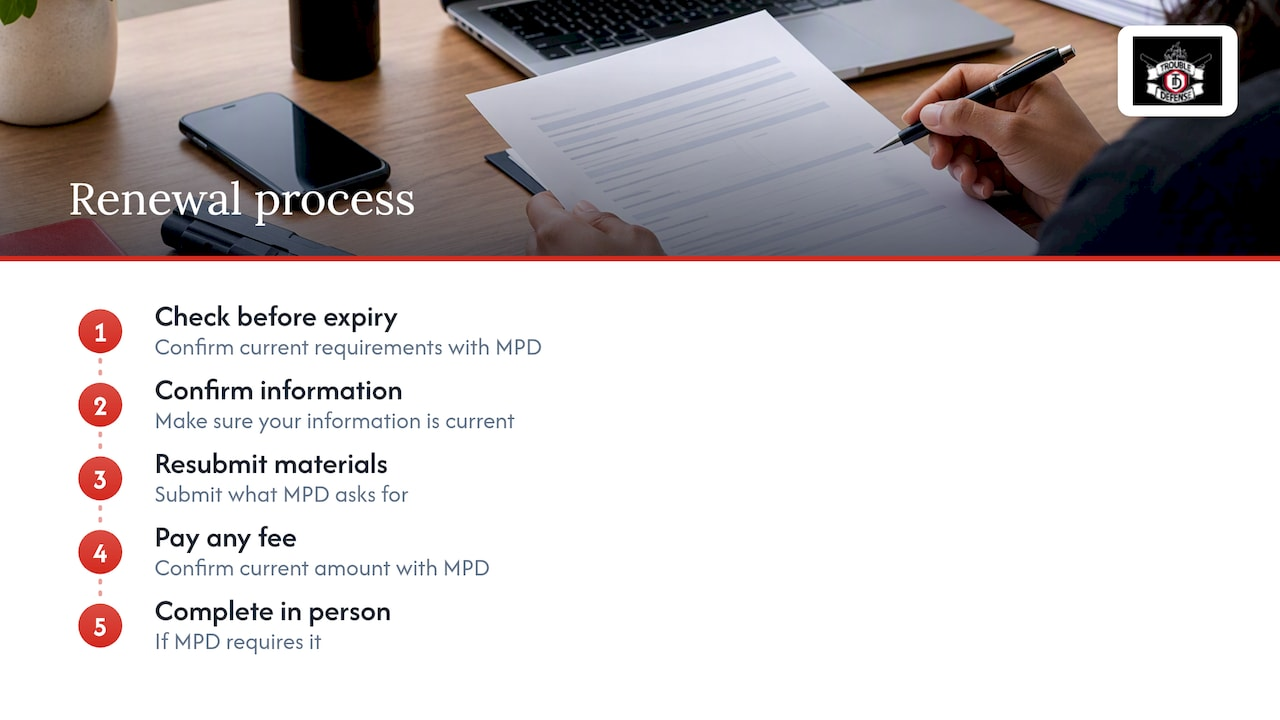
Check your certificate and contact MPD about its expiration date and renewal process. The Firearms Portal is available for registration matters.
Plan on the same core steps: confirm your information is current, resubmit what MPD asks for, pay any fee that applies, and complete the process in person if MPD requires it. Fees and requirements can change, so confirm the current amounts on MPD’s fees and payment page before you go.
Check the current renewal requirements with MPD before your certificate expires. If your eligibility has changed since you first registered, for example a new conviction or protection order, deal with that question before you apply, since MPD will review it again. When you are unsure about any of it, ask MPD directly through the portal or consult an attorney.
How do you update your firearm registration information?
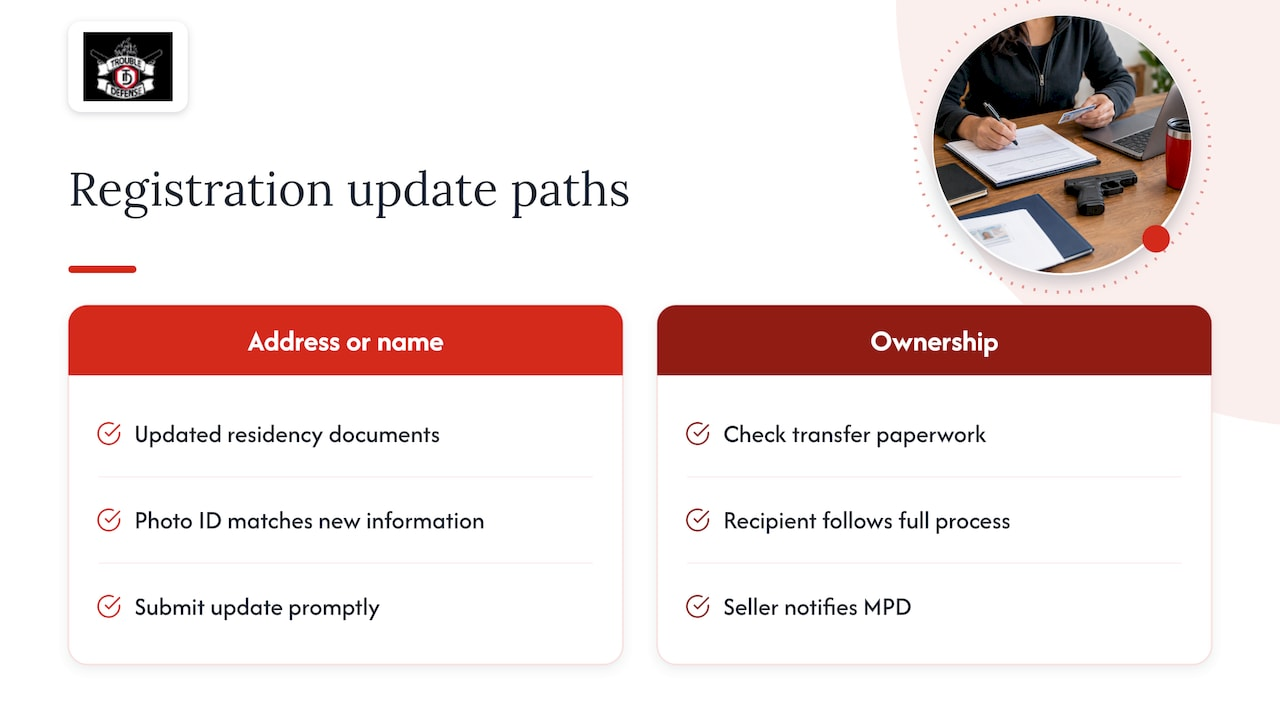
Life changes, and your registration has to keep up. If you move, change your name, or transfer ownership of a registered firearm, check with MPD about whether and how to update its records. MPD offers a Firearms Information Update form among the documents on its firearm forms page, and the portal is the easiest way to submit and track changes.
For a change of address or name, gather the same kind of proof MPD expects at registration, such as updated residency documents and a government photo ID that matches the new information. Submit the update promptly rather than waiting for your next renewal. Mismatched records are one of the quickest ways to create delays later.
Changes in ownership work differently from a simple address change. Check MPD’s procedures for any transfer, including what paperwork is required and what the recipient must do. If you are on the receiving end, follow the full process described above. If you are the seller, notify MPD so the record reflects what actually happened.
How do you deregister a firearm when leaving DC or getting rid of it?
If you are permanently leaving the District or no longer want a registered firearm, check with MPD about how to update its records. Ask MPD whether and how to report a lost, sold, or removed firearm.
If you are moving, find out the firearm laws of your destination before you travel, because they may be stricter or looser than DC’s. If you are selling or giving away the firearm, check the applicable transfer rules and the recipient’s eligibility. If you are surrendering it, arrange that with MPD rather than just dropping it somewhere.
Use MPD’s forms and the Firearms Portal to document the change, and keep copies of anything you submit. A clear paper trail protects you if a question ever comes up about where a firearm went. For the exact procedure and current forms, check MPD’s firearm forms page, since the right form depends on whether you are moving, selling, or surrendering.
What happens if you fail to register a firearm in DC?
Failure to register may have legal consequences. Consult an attorney about your circumstances and the applicable law. Applications are also signed under oath, and D.C. Code § 7–2502.05 makes false statements a perjury concern, so accuracy matters as much as timeliness.
Exact penalties depend on the offense and the facts of the case, so this is a topic for an attorney, not a blog post. Visitors should read our guide on staying legal with firearms in DC, since temporary stays come with their own rules. If you ever interact with police while carrying a firearm lawfully, this guidance on interacting with police as a licensed gun owner is a useful read.
What helps people actually finish DC registration
Most applicants I see struggle with logistics, not the law. Using the portal and bringing a training certificate may help you avoid preventable delays. Check your documents the day before, and book your appointment early rather than the week you need it. Training can help you understand the process, but confirm with MPD what proof it accepts. Preparing in advance may help avoid delays.
— Dee Parker
Prepare for DC registration with Trouble Defense
Training is the part of registration you can fully control, and we make it easy to get right. Our instructors are certified, our approach is judgment-free, and our classes are designed to help you build confidence.
- DC Concealed Carry Classes: Training that prepares you for DC requirements and gives you a certificate to help satisfy MPD’s training proof.
- Online firearm safety class: Learn from home when your schedule is tight.
- Private firearm training: One-on-one instruction from $80 per hour, tailored to your experience level.

Ready to get registration-ready? Contact Trouble Defense today to book your class, and prepare for your MPD appointment. Our DC CCW training guide is a good next read.
FAQ
How do you register your gun in DC?
You apply with MPD using form PD-219 or a Firearms Portal profile, then complete safety training and an in-person fingerprint and photo appointment. Bring two proofs of DC residency, a photo ID, and your fees. MPD’s registration procedures list the full steps.
Is there gun registration in the United States?
There is no single national registry for all gun owners, and rules vary by state and local jurisdiction. Washington, DC, requires registration with MPD. Always check the law where you live or plan to bring a firearm.
How long does it take to do gun paperwork in DC?
The Chief of Police generally must approve or deny an application within 60 days of receipt, subject to statutory exceptions. Your own time depends on how quickly you finish training and gather documents. Using the portal and arriving prepared helps avoid delays.
What are the changes in Washington, DC gun laws for 2026?
We do not have a verified source listing 2026 changes, so check MPD’s Firearms Portal and its published procedures for current rules before you file. Requirements and fees can change, and MPD is the definitive reference. For context on local rules, see our DC Metro Area gun laws overview.
Sources
- § 7–2502.07. Issuance of registration certificate; time period; corrections. | D.C. Law Library
- Register. Apply. Renew.
- Complete Firearms Registration Procedures