Corporate de-escalation training teaches employees to spot rising tension, lower the emotional temperature of a conflict, and leave safely when talking stops working. Done well, it is practice, not a slide deck: short skills, realistic role-play, a clear exit point, and workplace policies that back up what people learn. This guide covers who needs it, what a solid program includes, how to choose a format, and how often to refresh it.
TL;DR
- De-escalation is a skill set for lowering tension, not a script and not a guarantee. Good training also teaches when to stop talking and protect yourself.
- Frontline staff, managers, supervisors, security personnel and customer service teams face different situations, so they need different scenarios.
- Training alone is not enough. Pair it with a workplace risk assessment, a reporting system and clear policies.
- Hands-on, scenario-based practice beats passive lectures, and skills fade without refreshers.
- In Virginia, Maryland and DC, we run workplace safety training in person, built around your site and your people.
Table of Contents
- Why employers invest in de-escalation training
- Who needs it, and what each group needs
- What a solid curriculum covers
- Why practice beats lectures
- Training is not the whole program
- Choosing a format: in person, online or blended
- How often to refresh
- Our perspective
- Work with Trouble Defense
- FAQ
- Sources
Why employers invest in de-escalation training
Most workplace conflict never turns violent. A few incidents do, and employers are expected to take that risk seriously. OSHA says there is no specific standard for workplace violence, but employers should assess their workplaces, determine the threat of violence and, where needed, set up a site-specific prevention program. Training is one part of that program.
Some sectors now have explicit rules. Virginia, for example, amended Code § 32.1-127 so that certain hospitals must track and report workplace violence incidents, effective July 1, 2025. That law covers healthcare facilities, not every employer. Still, it shows where expectations are heading: documented prevention, not good intentions.
There is also the everyday case. A frustrated customer at a counter, a client who hears bad news, a coworker who snaps in a meeting. None of these is a crisis yet. Training is what keeps them from becoming one.
For a wider look at the risk picture, see our practical plan for employers on workplace violence.
Who needs it, and what each group needs
A single generic course for everyone wastes time. The situations differ, so the practice should too.
Frontline and customer service employees
These are the people who meet upset customers first: front desk staff, retail and hospitality teams, call center agents, receptionists, real estate agents showing properties. They need:
- Verbal techniques for angry, anxious or intoxicated people.
- Body language basics: stance, distance, tone and volume.
- A rule for when to call a manager, security or 911.
- Practice handling conflict by phone, in person and in writing.
Managers and supervisors
Managers carry two jobs. They handle conflicts themselves, and they decide what happens after an employee reports one. Their training should add:
- Coaching conversations that address conflict between coworkers before it hardens.
- How to receive and document a report without dismissing it.
- How to step in when a staff member is being yelled at.
- Post-incident follow-up: debriefing, support and policy review.
If you searched for conflict resolution or conflict management training for managers, this is the overlap. Conflict resolution is the long game of fixing a dispute. De-escalation is the first minutes, when you are trying to keep things calm enough to resolve anything at all. A good manager program covers both.
Security personnel
Security officers need everything above plus clear rules about authority, use of force and coordination with law enforcement. Their scenarios should be tied to the real post: a lobby, a campus, an event, a parking structure. They also need to practice the handoff, from talking to physical protection and emergency response, without hesitation.
Everyone else
Even staff with no public contact benefit from knowing the basics of recognizing warning signs, reporting concerns, and what to do if something goes wrong. OSHA’s training material for healthcare makes the point that employees are often the people best placed to take early, critical action for everyone’s safety.
What a solid curriculum covers
Formats vary, but strong programs share the same building blocks.
1. Reading the situation
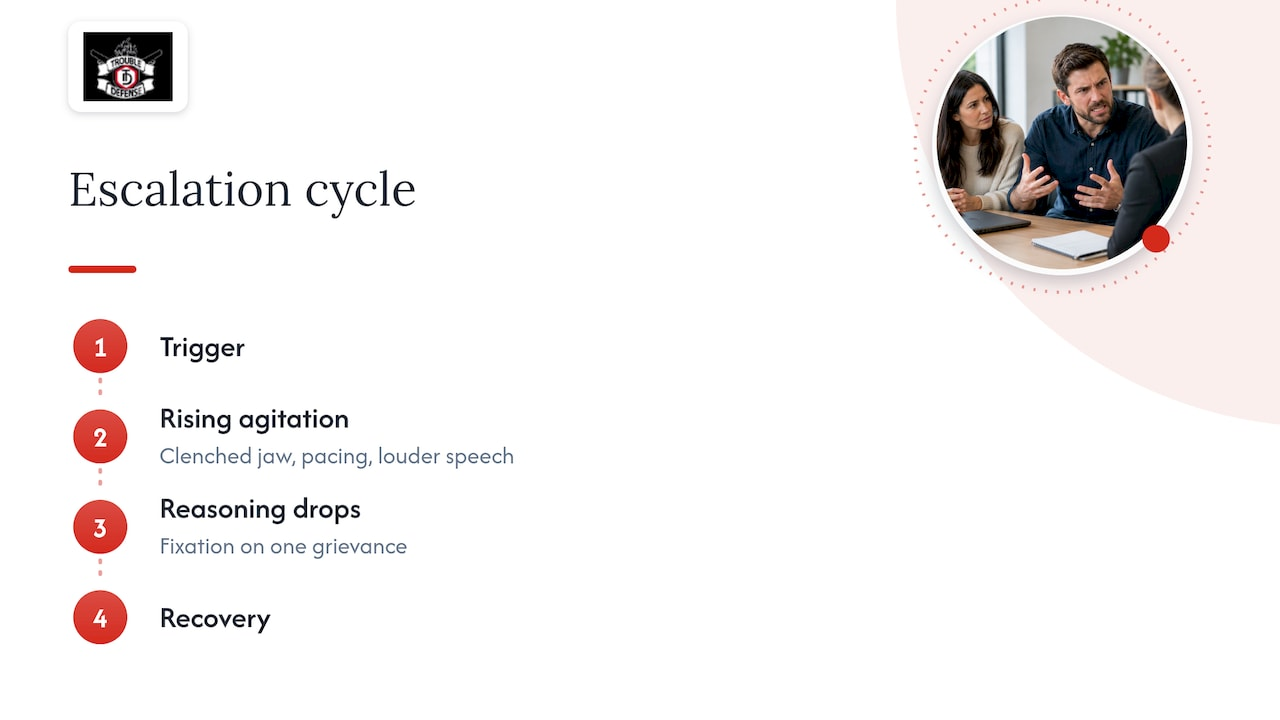
Employees learn the escalation cycle: the trigger, rising agitation, the point where reasoning drops away, and the recovery. Spotting early signs (clenched jaw, pacing, louder speech, fixation on one grievance) gives you time to act before things peak.
2. Managing yourself first
You cannot calm someone else if you are spiking. Training should teach breathing, a steady voice, relaxed hands and limited, non-threatening eye contact. This is the part people skip, and it is often the part that decides the outcome.
3. A simple sequence people can remember
Practitioners use several models. One common five-step sequence, described by a workplace safety training provider, runs like this:
- Calm yourself and read the situation.
- Listen and reflect back what you hear.
- Empathize and acknowledge the emotion.
- Work toward common ground.
- Know when to step back because it is no longer safe.
The same source also mentions a four-part framework: mirroring, active listening, responding and summarizing. Pick one, drill it, and keep it short enough to recall under stress. We lay out a four-step version with practice-ready phrases in our de-escalation plan and scripts.
A few phrases, for example:
- “I want to understand what happened. Tell me more.”
- “That sounds frustrating. Here is what I can do right now.”
- “I can’t help while we’re yelling, but I want to fix this.”
These are starting points, not magic words. People should adapt them to their own voice.
4. Boundaries and limits
Employees must know what behavior they do not have to tolerate and who backs them up when they enforce it. A clear, communicated zero-tolerance policy matters here, because it lets a front desk worker end a conversation without worrying about being blamed.
5. The point of no return
This is the part that separates serious programs from check-the-box ones. De-escalation does not always work. OSHA’s training material frames it as a flexible mindset, not a rigid script: the aim is lowering emotional intensity enough for a safe resolution or a controlled exit, not winning the argument. When a person is no longer rational or violence looks imminent, the plan changes to protection and disengagement.
Every employee should be able to answer three questions before they ever need to:
- What are the signs that talking has stopped working?
- Where do I go, and who do I tell?
- When do I call 911?
This is where active shooter and violent-incident preparedness connects to de-escalation. We cover that handoff in our guide to active shooter training for organizations.
6. Reporting and aftercare
Someone has to write the incident down, someone has to review it, and someone has to check on the employee. Without that loop, the same problem repeats.
Why practice beats lectures
People do not rise to the occasion under stress. They fall back on what they have rehearsed. A slide deck on tone of voice rarely survives the first angry customer.
OSHA’s training material for healthcare workers describes simulation and role-based practice as a way to help people keep thinking clearly under pressure. The setting there is healthcare, but the principle carries over to any workplace: rehearse the hard moment before it happens.
Good scenario work looks like this:
- Short scenes drawn from your actual workplace (the refund dispute, the unhappy tenant, the visitor who will not leave).
- An instructor playing the upset person, escalating on a plan, and stopping to coach.
- Rotation, so every participant tries both roles.
- A final scenario where de-escalation fails, and the group practices the exit.
One caution: OSHA’s guidance for healthcare settings says de-escalation and self-defense training should include a hands-on component. It is written for healthcare and social service, but the lesson applies broadly. Training should match the real risk of the job, and a classroom discussion alone seldom does.
Training is not the whole program
Employers sometimes buy a course and consider the matter closed. That tends to disappoint.
A systematic review of interventions to de-escalate workplace violence against nurses examined what works in healthcare settings. Its subject is nursing, so apply it with care, but the broader lesson fits many workplaces: training works best as one piece of a larger set of measures rather than a one-off event.
Pair training with:
- A site assessment. Walk the space. Are exits clear? Can staff reach help? Is cash handled in ways that make staff targets? OSHA’s factsheet says employers should assess their workplaces and set up a site-specific program where needed.
- A reporting system. Make it easy and safe to flag a concern, including near misses.
- A written policy. State what is unacceptable and what happens next.
- Buddy practices and escalation paths. Nobody should handle a volatile person alone if it can be avoided.
- Debriefs. After any serious incident, review what happened without blame.
Training without these safeguards gives people confidence the workplace has not earned.
Choosing a format: in person, online or blended
There is no single right answer. Match the format to the risk.
| Format | Best for | Limits |
|---|---|---|
| Online, self-paced | Awareness for large or remote teams; onboarding; refreshers | Little practice with live, unpredictable behavior |
| Live virtual | Distributed managers, communication skills | Hard to simulate physical space and distance |
| In person, scenario-based | Frontline staff, security, high-risk sites | Needs scheduling and a qualified instructor |
| Blended | Most organizations: online basics, then live practice | Takes planning to keep the pieces connected |
A few practical points when comparing providers of any type:
- Ask who teaches and what their background is. Real-world experience with confrontation matters.
- Ask how much of the session is practice, not lecture.
- Ask whether the content can be adapted to your site, rather than delivered as-is.
- Ask what happens when de-escalation fails. If the answer is vague, keep looking.
- Be careful with the word “certification.” Course lengths and credentials differ widely, and no single certificate is required of employers across the board. Ask what the credential means and who recognizes it.
Public safety agencies also offer free resources. The FBI’s Active Shooter Attack Prevention and Preparedness (ASAPP) is a two-hour course from the Bureau’s Violence Reduction Unit. It addresses a different, more extreme scenario than everyday de-escalation, but it makes a good complement.
How often to refresh
Skills fade. A one-time session at onboarding will not hold for years, and staff turnover means new hires miss earlier training. Many employers refresh annually, or at least every other year, and add a short drill after any real incident or policy change. High-risk roles, such as security staff and front desk teams in busy public settings, benefit from more frequent practice.
Treat the program like a living document. Scripts, reporting forms and contact lists drift out of date. If your organization runs a large training library, a tool that flags stale content, such as this write-up on keeping training content current through change management, can help you catch outdated material before it reaches staff.
Our perspective
We are a veteran-owned training academy in Fairfax, VA, and most of our work is teaching people to handle firearms safely. That shapes how we see de-escalation. The best outcome of any tense encounter is the one where nobody gets hurt, and nobody has to make a split-second decision under stress.
It also shapes our view on the limits. De-escalation is the first tool, not the only one. Employees deserve to be told plainly that sometimes it does not work, and they deserve a plan for that moment, with permission to act on it. A program that teaches only calm words, with no exit plan, leaves people exposed. A program that skips the calm words and teaches only fear makes workplaces worse.
So we teach in person, in a supportive, judgment-free setting, with scenarios fitted to the people in the room, from beginners to experienced staff. We cover workplace violence prevention and active shooter preparedness for organizations across Virginia, Maryland and DC, and we start by asking what your people really face on a normal day.
— Dee Parker
Work with Trouble Defense
If you want training built around your workplace instead of a generic course, we can help. Our de-escalation training for Virginia, Maryland and DC is delivered in person and covers recognizing warning signs, communication under stress, and what to do when talking is no longer enough. For organizations focused on prevention programs, see our workplace violence prevention training in Virginia, or review our capability statement for procurement. Pricing for these programs is not published, so contact us through our site with your headcount, location and the situations your staff worry about, and we will tell you what fits.
FAQ
What are the 5 steps of de-escalation?
Models differ, but a common sequence is: calm yourself and read the situation, listen and reflect back what you hear, empathize with the emotion, work toward common ground, and know when to step back because it is no longer safe. The last step matters as much as the first four. Your trainer should adapt the wording to your workplace.
Who should take de-escalation training at work?
Anyone who deals with the public, and anyone who manages people who do. That includes customer service staff, front desk and hospitality employees, real estate agents, security personnel, supervisors and managers. Back-office staff benefit from a shorter session on warning signs, reporting and emergency response.
How is de-escalation different from conflict resolution?
De-escalation lowers the intensity of a heated moment so people can think and talk again, and it includes knowing when to leave. Conflict resolution comes afterward and works through the underlying disagreement. Managers usually need both skills.
How often should employees be retrained?
Many employers refresh yearly or every other year, with extra practice after an incident, a policy change or a move to a new site. Frontline and security roles usually benefit from more frequent drills. Whatever the schedule, new hires should be trained before they work alone with the public.
What if de-escalation does not work?
Then the plan changes to protecting yourself and others: create distance, leave if you can, alert security or a supervisor, and call 911 when there is a threat to safety. Your training should rehearse this handoff so no one freezes. If your program does not cover it, it is incomplete.
Sources
- OSHA: Workplace Violence factsheet
- OSHA: Train-the-Trainer Module 1, Introduction
- OSHA: Guidelines for Preventing Workplace Violence for Healthcare and Social Service Workers
- Monash University: Systematic review of interventions to de-escalate workplace violence against nurses
- Sands Anderson: Virginia healthcare workplace violence reporting requirements
- FBI: Active Shooter Attack Prevention and Preparedness (ASAPP)
- CPPS: Workplace Violence Prevention Training, De-Escalation


