In Washington, DC, a concealed carry license does not let you carry everywhere. District law lists places where carrying a pistol is off limits even for a licensed person, and federal law adds more. The list covers government offices, schools and their parking lots, hospitals, Metrorail, stadiums, polling places, and any premises where alcohol is served. This guide walks through each category, the spots that trip people up, and how to plan a day in the District without a legal mistake.
Table of Contents
- TL;DR
- What “gun-free zone” actually means in DC
- Where you can’t carry: the DC list, in plain words
- The traps people fall into
- A quick pre-trip checklist for a day in the District
- Are gun-free zones enforceable?
- Our perspective: knowing the map is part of safe carry
- Training that fits DC’s rules
- Visiting DC without a license
- Frequently asked questions
- Ready to carry with confidence?
- Sources
TL;DR
- A DC concealed carry license does not override the District’s list of prohibited places. MPD publishes that list and enforces it.
- Common trouble spots are Metrorail, restaurants and bars with a liquor license, stadiums and arenas, school grounds, and memorials on the National Mall.
- Temporary zones also exist: events that post notice, and areas around demonstrations or protected officials.
- Federal land is not a loophole. National parks follow local firearm law, and federal facilities stay off limits.
- Good training turns this list into habits. That is what we teach.
This article is general education, not legal advice. If you have a specific situation, such as a past charge or a question about transporting a firearm, talk to a DC-licensed attorney.
What “gun-free zone” actually means in DC
People use “gun-free zone” loosely. In DC, the legal reality is a set of statutes and rules, not just a sign on a door. Some places are prohibited by law for everyone who would otherwise be allowed to carry. Others become prohibited because a property owner or event organizer follows the process the law allows.
The core rule sits in D.C. Code § 7-2509.07, which says where a license holder may not carry a pistol. The Metropolitan Police Department (MPD) turns that into a plain list on its prohibited places page and a companion page on license restrictions. MPD’s position is simple: the license does not erase location restrictions, and violating them can bring serious criminal charges.
Two more points shape everything else:
- The license is conditional. Under the DC regulations, the Chief of Police can limit the geographic area, circumstances, or time of day a license is valid.
- Eligibility is narrow to begin with. An applicant must be at least 21, meet registration requirements, and possess a DC-registered handgun, per MPD’s eligibility page.
Where you can’t carry: the DC list, in plain words
Here is the MPD list, grouped the way people actually move through the city.
Government, schools and institutions
- Buildings or offices occupied by the District of Columbia or its agencies.
- The building and grounds of childcare facilities, preschools, elementary and secondary schools, and public or private colleges and universities, including adjacent parking lots.
- Hospitals, and offices where medical or mental health services are the primary services.
- Penal institutions, secure juvenile residential facilities, and halfway houses.
- Polling places while voting is occurring.
The parking lot detail matters. Many people assume a locked car in a school lot is fine. The MPD list names the adjacent parking lot as part of the prohibited area.
Getting around: Metro and public transit
The list covers any public transportation vehicle, including the Metrorail system and its stations. If your day involves a train ride to a museum or a game, plan how you will travel before you leave home. For many carriers that means driving or rideshare, or leaving the firearm secured at home.
Restaurants, bars and anywhere alcohol is served
Two separate rules apply. You may not carry while consuming alcohol or while impaired. And you may not carry in any premises where alcohol is served, sold and consumed on the premises under a Title 25 license, as laid out in D.C. Code § 7-2509.07.
That is much broader than “bars.” A casual restaurant with a liquor license can fall inside it, even if you are only walking in for a to-go order and have no intention of drinking. Check the venue’s status and signage before you step inside, and when in doubt, skip the stop.
Stadiums, arenas and public events
- Any stadium or arena.
- Public gatherings or special events open to the public, when the organizer has given notice and posted signage prohibiting pistols in advance.
The second item is easy to miss. A street festival or outdoor event may be a gun-free zone for one weekend only. Look for posted signs at entrances.
Memorials on the National Mall
MPD’s list includes the public memorials on the National Mall and along the Tidal Basin. The National Park Service says federal law makes firearm possession in national parks subject to local and state firearms laws, and that visitors are responsible for understanding the rules. So being on parkland does not make carrying lawful. The Lincoln Memorial’s own NPS page carries the same message.
Federal facilities are a separate matter. Buildings like the U.S. Capitol and the White House complex are off limits under federal rules no matter what any state or DC license says.
The traps people fall into
Most violations are not dramatic. They are small lapses in a routine day. These are the ones we see people worry about most.
“I only popped in for takeout”
The alcohol-premises rule does not depend on whether you drink. If the business holds the relevant license and alcohol is served, sold and consumed there, the restriction applies. Treat any restaurant you have not checked as unknown territory.
Demonstrations and protected movements
DC law also bars carrying within 1,000 feet of a demonstration or a dignitary under law enforcement protection when notice has been provided. These zones can appear with little warning. MPD posts traffic advisories for First Amendment activity that are worth watching if you spend time downtown, and local news helps too. If you see road closures, barricades or a heavy police presence, leave the area with your firearm rather than test where the line is.
Off-body carry
MPD’s restrictions guidance says only on-body, holster-based concealed carry is permitted. A firearm in a purse, satchel or bag is a common source of legal trouble. Read the CCL restrictions page carefully before you choose a carry method.
Assuming the license is a right to carry anywhere
License holders must also carry their DC license and firearm registration on their person, and they must disclose their status if stopped by law enforcement, according to MPD’s firearms registration and CCL FAQ. The same FAQ notes that firearms are not permitted inside MPD’s Firearms Registration Branch. Do not bring a firearm to the office to ask questions.
Crossing state lines
The District is a few minutes from Virginia and Maryland, and the three sets of rules differ. A commute from Fairfax into DC can take you from one legal setting to another in a single trip. Our guide to gun laws in the DC metro area explains how the jurisdictions differ, and our DMV firearm training compliance guide covers what to keep straight.
A quick pre-trip checklist for a day in the District
- Map your day. List every stop: office, school pickup, restaurant, transit, event.
- Flag the prohibited categories. Anything touching government buildings, schools, medical offices, Metro, stadiums or alcohol-serving premises is a no.
- Check for events. Look for posted notice at public gatherings and for MPD advisories on demonstrations.
- Decide where the firearm stays. If any stop is prohibited, plan secure storage before you leave, not in the street.
- Carry your paperwork. License and registration on your person.
- Confirm your carry method. On-body, holstered.
- When in doubt, don’t. A skipped errand costs little. A criminal charge costs a great deal.
Are gun-free zones enforceable?
In DC, yes. MPD treats the prohibited-places list as law, and the penalties attach to the license holder who carries into one. How a sign or policy works for private property outside the statutory list is a more specific legal question, and the answer can depend on the facts. For that, a DC attorney who handles firearms cases is the right person to ask. For everyday planning, assume every item on the MPD list is enforced and every posted sign means what it says.
Our perspective: knowing the map is part of safe carry
We are a veteran-owned academy in Fairfax, and most of our students live or work in the DMV. The same question comes up in nearly every class: “Where can I actually take this?”
Our honest answer is that carrying a firearm responsibly is as much planning as shooting. A tight group at 15 yards is a skill. Knowing that you can’t walk from the Metro platform into a licensed restaurant with a holstered pistol is also a skill, and it is the one that protects your license and your freedom.
So we teach both. Our instructors are certified, they explain the law in plain language, and nobody gets talked down to for asking a basic question. We work with complete beginners, women who want to build confidence, seniors, and experienced shooters brushing up. We also run adaptive programs for students with disabilities, including blind and low-vision students. The goal is that you leave certified and confident, with a clear mental picture of where the lines are.
If you carry in the District, treat the prohibited-places list the way a pilot treats a checklist. Review it before every trip until it is automatic.
— Dee Parker
Training that fits DC’s rules
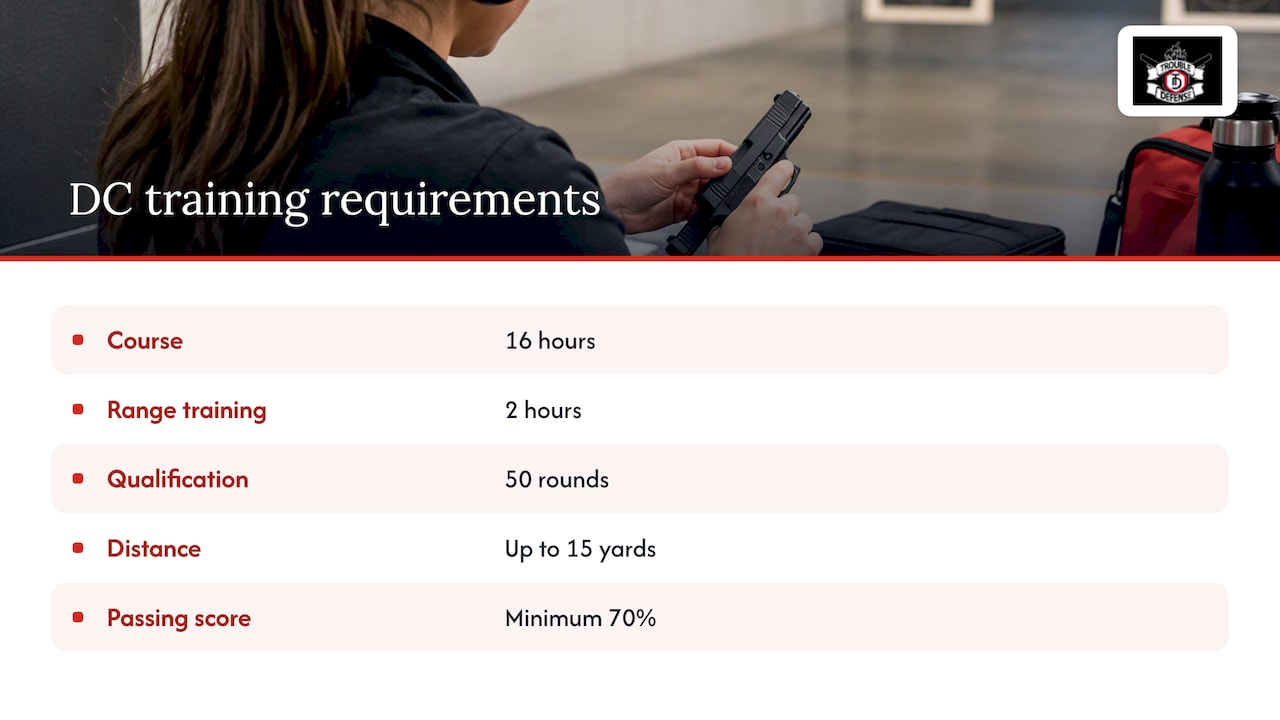
To apply for a DC license, applicants must complete a 16-hour firearms training course plus 2 hours of range training with an MPD-certified instructor, including a 50-round qualification at up to 15 yards with a minimum 70% score, according to MPD’s FAQ. Our DMV Concealed Carry Training Package is $450 one-off, and it is built for people who live and work across Virginia, Maryland and DC. If you need a step-by-step on the paperwork side, start with our guide to applying for a Washington DC concealed carry license or our DC CCW training walkthrough.
If you travel across several states, our Multi-State CCW Reciprocity Package is $500 one-off. Prefer one-on-one coaching? Private Firearm Training starts from $80 per hour.
Visiting DC without a license
If you are a visitor and not a DC license holder, the safest assumption is that you should not bring a firearm into the District unless you have confirmed the law with MPD or an attorney. Being a tourist does not create a special exemption, and the NPS makes clear that federal parkland follows local law.
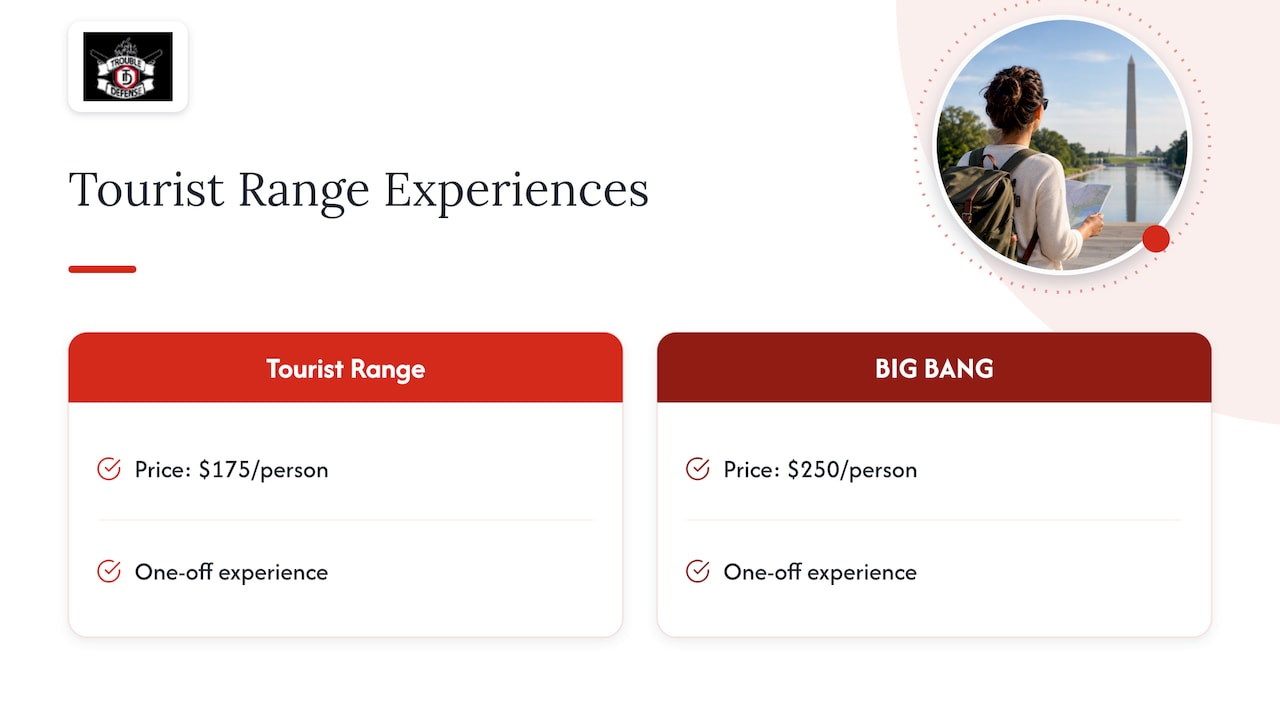
If what you want is a range experience while in the area, we offer tourist shooting experiences: the Tourist Range Package from $175 per person and the BIG BANG Experience at $250 per person, both one-off. It is a supervised, beginner-friendly way to shoot without worrying about where a firearm is allowed.
Frequently asked questions
What are the gun laws in DC?
DC requires registration of firearms and a separate license to carry a concealed pistol. Applicants must be at least 21, have a DC-registered handgun, and complete required training. Even with a license, carrying is barred in a list of places published by MPD.
Can I carry on the National Mall?
Not everywhere. MPD lists the public memorials on the National Mall and along the Tidal Basin as prohibited places, and federal facilities are off limits under federal law. The National Park Service says park visitors must follow local firearm law, so parkland is not an exception.
Can I carry on Metro or into a restaurant?
No to Metrorail and its stations: the MPD list covers public transportation vehicles. For restaurants, the rule applies to premises where alcohol is served, sold and consumed under a Title 25 license, which can include ordinary restaurants. Check before you enter.
Does a Virginia or Maryland permit work in DC?
We can’t give a blanket answer here, because DC licensing rules are specific and change. MPD’s eligibility rules describe who qualifies for a DC license, and a DC-licensed attorney can confirm what applies to your situation. Our instructors can point you to the right starting resources in class.
Where do I get trained?
We teach in the DMV area, with classes for Virginia, Maryland and DC. You can see our range training options or learn more about DC concealed carry classes. Contact Trouble Defense LLC and we will help you pick the class that fits your goals.
Ready to carry with confidence?
Knowing where you can’t carry is half of carrying legally. Contact Trouble Defense LLC through our website to book a class, ask which course fits your situation, or schedule private instruction in Fairfax. We will help you learn the rules, build the skill, and leave with a plan.
Sources
- MPD: Prohibited Places to Carry a Concealed Firearm
- MPD: CCL Restrictions
- MPD: Eligibility Requirements for a Concealed Carry License
- MPD: Firearms Registration and CCL FAQ
- MPD: Traffic Advisory, First Amendment Activity
- D.C. Code § 7-2509.07
- 24 DCMR Chapter 23
- NPS: National Mall and Memorial Parks, Laws & Policies
- NPS: Lincoln Memorial, Laws & Policies
