
If your strong hand is on one side and your dominant eye is on the other, you are cross dominant, and you can still shoot well. The fix is almost never “try harder.” It is a matter of getting your dominant eye behind the sights, either by changing how you hold and present the gun, by changing which shoulder you use, or by using a simple visual aid. This guide walks through how to find out what you have, which correction suits which firearm, and how an instructor sorts it out in about one range session.
TL;DR
- Cross dominance means your dominant eye and your dominant hand are on opposite sides, for example right-handed with a dominant left eye. Research reviews put it somewhere between 10% and 30% of people.
- On a handgun, you can usually keep your strong hand and shift the gun or turn your head slightly so the dominant eye lines up with the sights.
- On a rifle or shotgun, moving to the shoulder on the side of your dominant eye is the most reliable fix. Occlusion (a small dot on your glasses) and the wink method are backups.
- Do not try to force your brain to switch eyes. Adapt your technique instead.
- Before you blame your eyes, rule out grip, stance, gun mount and fit. They cause more misses than dominance does.
Table of Contents
- What cross dominance actually is
- How to test your eye dominance
- Do not try to change your dominant eye
- Your options, from simplest to most involved
- Handgun, rifle or shotgun: how the problem changes
- Rule out the other culprits first
- A simple practice plan for cross-dominant shooters
- Our perspective: what we see in class
- Get it sorted with an instructor
- Common mistakes to avoid
- FAQ
- Sources
What cross dominance actually is
Most people favor one eye the way they favor one hand. Your dominant eye is the one your brain leans on for aiming and pointing. When that eye sits on the same side as your strong hand, the sights line up naturally. When it does not, the gun ends up pointing at one place while your brain “sees” another.
You will hear several names for the same thing: cross-eye dominance, cross-dominant shooting, crossed hand-eye dominance. They all describe a right-handed shooter with a left dominant eye, or a left-handed shooter with a right dominant eye.
It is common. A systematic review of hand-eye laterality in sport reports that roughly 10% to 30% of the general population is cross dominant, and a moving-target guide from Tradesmart Safety cites about 18 percent of shooters. The same review notes that uncrossed shooters may hold a small edge in some target sports, but cross-dominant people can reach a high level with the right adaptations. In other words, you are not handicapped for life. You just need a plan.
Why it shows up in your shots
The symptoms are consistent:
- Groups that land consistently to one side of the point of aim.
- Sights that look “off” or doubled when both eyes are open.
- A tendency to tilt or roll the head awkwardly to see the sights.
- Feeling that you can only aim when you close one eye, and then losing your sense of distance.
If that sounds familiar, test before you guess.
How to test your eye dominance
A simple test takes under a minute, and you can do it at home with an unloaded, empty-handed method. No firearm is needed.
The triangle test
- Stand facing a doorknob or a light switch across the room.
- Extend both arms and form a small triangle with your thumbs and index fingers.
- With both eyes open, center the object in the triangle.
- Slowly pull your hands back toward your face, keeping the object centered.
- The triangle will land on the eye you actually aim with. That is your dominant eye.
Repeat it three or four times. If the result flips, you may have weak or shifting dominance. That happens: fatigue, lighting and the type of target can all nudge which eye leads, as the NSCA Level II instructor manual acknowledges in its section on assessing eye dominance.
The pointing test
With both eyes open, point at a distant object with your index finger. Close your left eye, then your right. The eye that keeps your finger on the object is your dominant one.
A home test tells you what you have. It does not tell you whether it is actually hurting your shooting. For that you need to see where rounds go, which is what a live-fire check does.
Do not try to change your dominant eye
A common piece of advice online is to retrain your brain until the other eye takes over. Be cautious. A paper indexed on PubMed on ocular sighting dominance argues that it is set early in life, and that trying to force a change in adulthood tends to backfire, with the potential for visual strain or double vision. If you have eye pain, double vision or headaches when you shoot, stop and see an optometrist or ophthalmologist before continuing. That is a medical question, not a range-coaching one.
The better approach is to leave your visual system alone and change the way you present the firearm.
Your options, from simplest to most involved
There are four realistic corrections. Which one is right depends on the firearm, your goals and how strongly cross dominant you are.
| Correction | Best for | Main upside | Main trade-off |
|---|---|---|---|
| Shift the gun or turn the head slightly | Handguns | Keep your strong hand and both eyes open | Needs practice to stay consistent |
| Switch shoulders (shoot off the dominant-eye side) | Rifles and shotguns | Most reliable alignment, long-term | Weak-side manipulations feel clumsy at first |
| Occlusion (dot or tape on glasses) | Any, as a training aid | Quick, cheap, effective | Reduces depth perception and peripheral view |
| Wink or close the non-dominant eye | Static targets, short strings | No gear needed | Loses binocular vision, tiring over time |
Option 1: Align the dominant eye on a handgun
With a pistol held at arm’s length, cross dominance is usually easier to manage than with a shoulder-fired gun. Many instructors teach one of two small adjustments:
- Shift the gun slightly toward the dominant-eye line. You are moving the sights in front of the eye that is doing the aiming, not the eye that is on the same side as your hand.
- Turn the head slightly toward the gun hand. Aimpoint’s training tip on eye dominance describes turning the head in the direction of the weapon hand, without rocking or tilting it, so the dominant eye comes behind the optic.
The detail that matters most is keeping the head level. Rolling the neck to find the sights wrecks your posture and makes recoil control harder. Turn, do not tilt.
Keep both eyes open if you can. You will see a ghosted second image of the gun at first. That is normal, and with a few sessions your brain learns to ignore it and focus on the front sight.
Option 2: Move to the other shoulder on a long gun
For rifles and shotguns, the standard professional advice is to shoot from the shoulder on the side of your dominant eye. A shotgun-sports instructor Q&A addresses a right-handed, left-eye-dominant shooter directly: yes, you can learn to shoot well, but some shooters insist on the shoulder opposite their dominant eye and then have to compensate.
There is research behind this. A 2017 study of 24 soldiers, published in the Journal of Motor Behavior, found significantly better accuracy for shooting with the dominant eye and non-dominant hand than with the non-dominant eye and dominant hand. The small sample means you should not treat it as the last word, but it matches what most rifle instructors see.
Switching shoulders feels odd for the first few sessions. Your trigger finger, support hand and magazine changes all have to learn the new side. Dry practice at home with an unloaded, verified-clear training tool helps, and the transition is faster than most people expect.
Option 3: Use occlusion as a training aid
If you do not want to switch sides, you can block the dominant eye’s interference by putting a small dot or piece of translucent tape on the lens of your shooting glasses, over the eye that is competing with your sights. The same NSSA/NSCA piece describes using a dot of about 16mm as a common tactical correction.
Less is more. Start with the smallest, most translucent dot that works. Over-occluding cuts into peripheral vision and depth perception, which you need when you are tracking anything that moves. If you have to cover more than a little, that is a sign a shoulder switch is the better answer.
Option 4: The wink method
Some shooters simply close or squint the non-shooting eye right before the shot. It works on a still target and costs nothing. The downside is that you lose binocular vision at the exact moment you might want it, and holding one eye shut tires your face on a long session. Treat it as a stopgap, not a system.
Handgun, rifle or shotgun: how the problem changes
The firearm changes how much cross dominance matters.
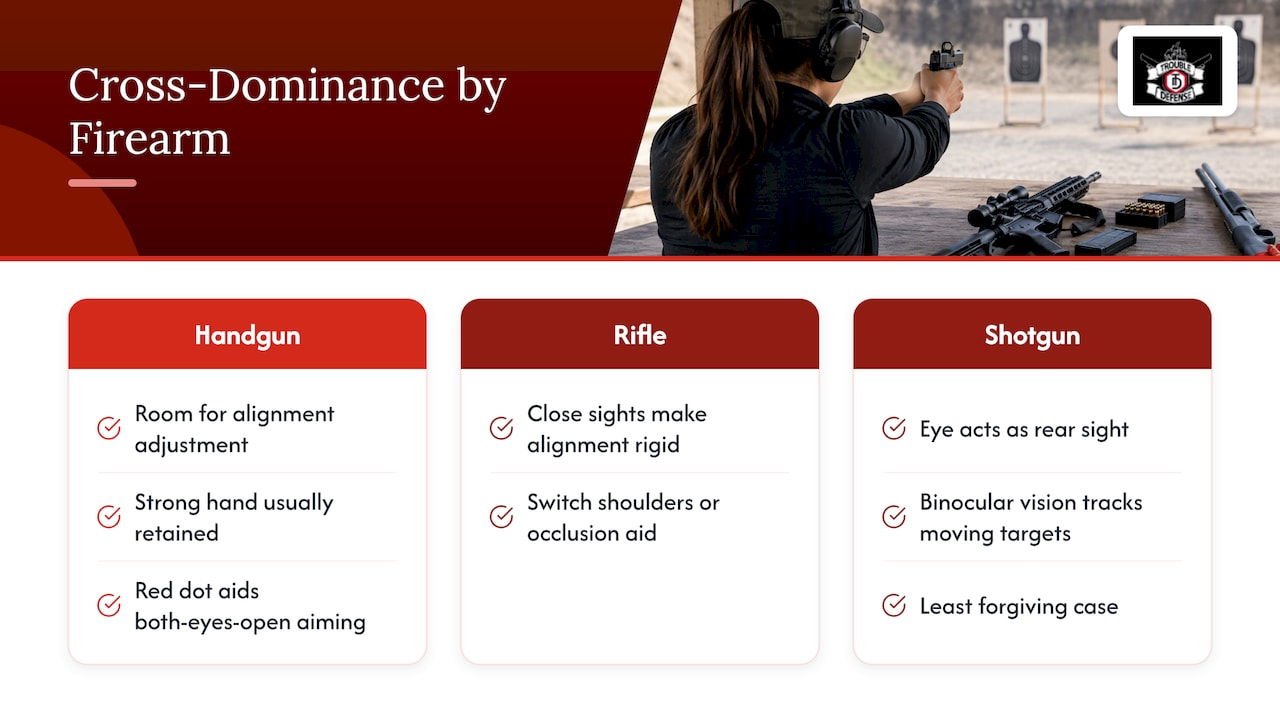
Handguns. The gun is out in front of you, so there is room to shift or turn your head. Most cross-dominant pistol shooters keep their strong hand and make a small alignment adjustment. Red dot optics also forgive a lot, since you focus on the target and the dot rides in your field of view with both eyes open.
Rifles. The sights sit close to your face, so the alignment is more rigid. Either switch shoulders or accept an occlusion aid while you learn.
Shotguns and moving targets. Here your eye acts as the rear sight, and it is the least forgiving case. The Tradesmart Safety moving-target article points out that tracking moving targets relies on the depth perception and peripheral vision of binocular vision, so eye dominance is more of a problem there than on paper at a fixed distance. Instructors usually deal with it early for students heading into clays or 3-gun.
Rule out the other culprits first
Here is the part that most online guides skip. Cross dominance gets blamed for plenty of problems it did not cause. The NSCA instructor manual cautions that instructors should not assume dominance is the cause until other variables are ruled out, including poor gun mount, improper gun fit (especially drop at the comb) and a lack of visual focus on the target.
A quick checklist before you buy glasses or switch shoulders:
- Grip: high on the backstrap, firm, consistent from shot to shot.
- Stance and posture: weight slightly forward, head level, no craning.
- Sight focus: eyes on the front sight for a handgun, on the target for a shotgun.
- Trigger press: straight to the rear, no jerk or push.
- Fit: a long gun that does not fit your face and shoulder will pull your head into a bad position regardless of which eye leads.
Often a student arrives sure they have an eye problem and leaves having fixed a grip problem. Sometimes it is both. The only way to know is to watch live fire.
A simple practice plan for cross-dominant shooters
Once you know your dominant eye and have picked a correction, build the habit in small steps. Always follow your range’s safety rules and the four basic rules of firearm handling.
- Dry practice (5 to 10 minutes, unloaded and verified clear). Present the gun to a safe point and check that the sights fall in front of your dominant eye without a head tilt. Do this in front of a mirror to watch your neck.
- Close range live fire (5 to 7 yards). Shoot slow groups at a large target. Note where they land compared with your point of aim. A consistent offset to one side is a sign the dominant eye is pulling you.
- Compare corrections. Fire a group with a slight head turn, a group with a small occlusion dot, and, for long guns, a group from the opposite shoulder. Keep notes.
- Open both eyes. Whenever you can, return to two-eyed shooting once the technique holds. You get better situational awareness and depth perception.
- Re-test occasionally. Dominance can shift with fatigue and light, so recheck when your shooting suddenly changes.
We lay out the same short-range logic in our own 5 to 7 yard range test for left eye dominance, which walks through the instructor fixes in more detail.
Our perspective: what we see in class
We teach in the DMV, and cross dominance is one of the most common things we find in a first range session. It is rarely the problem the student expected. Someone arrives convinced their eyes are broken, and a ten-minute look at their grip and head position changes the picture. When dominance does turn out to be the cause, the fix tends to be small.
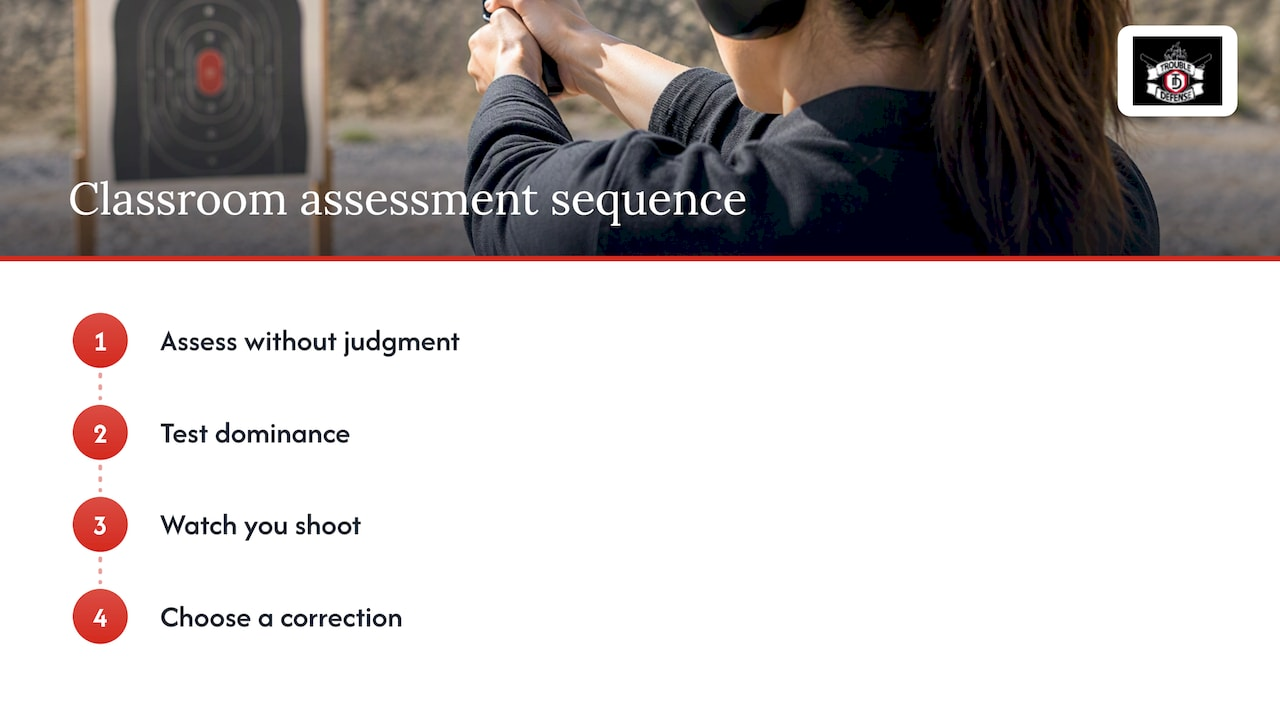
Our approach is simple. We start with a judgment-free assessment, because nobody should feel embarrassed that they have been shooting an inch left for years. We test dominance, then we watch you shoot, and only then do we choose a correction. For most handgun students that means a minor presentation change. For students who want to hunt, shoot clays or run a carbine, it usually means a conversation about shoulders.
We also work with students who see differently. Our adaptive programs cover low vision firearm training and blind shooters, and they taught us a lot about how much of aiming is body position and repeatable structure rather than perfect eyesight. The lesson carries over to every cross-dominant student: build a repeatable setup, and the gun will go where you point it.
One warning from experience. Do not buy gear before you have had a trained set of eyes on your shooting. Dots, glasses and optics are useful, but they are the third step, not the first.
— Dee Parker
Get it sorted with an instructor
You can read about cross dominance all day, but you will fix it faster in person. At Trouble Defense we are a veteran-owned academy in Fairfax, Virginia, with NRA-certified instructors, and we work with first-timers and experienced shooters alike.
- For one-on-one coaching on your sight picture, book private firearm training, listed from $80 per hour.
- If you are heading toward a permit, our DMV concealed carry training package is $450 and covers fundamentals that include sight alignment.
- If you want a beginner-friendly range day while visiting the area, see our tourist range packages, from $175 per person.
Tell us you are cross dominant when you book, and we will plan the session around it. You can reach us through the Trouble Defense home page.
Common mistakes to avoid
- Tilting your head to find the sights. It strains your neck and moves the gun as you press the trigger.
- Switching hands on a pistol without a reason. If a small alignment change solves it, you keep the hand with the better grip and trigger control.
- Covering too much of the lens. A big patch kills depth perception. Use the smallest dot that works.
- Shooting with one eye shut all the time. You lose peripheral awareness. Use it only as a short-term tool.
- Assuming it is permanent. Dominance can vary with fatigue and light, so confirm what is happening on the range rather than relying on one test.
- Skipping dry practice. Ten minutes at home builds the new habit faster than another box of ammunition.
FAQ
Can a cross-dominant person be a good shooter?
Yes. The research shows an uncrossed profile can give a slight edge in some target sports, but people with crossed dominance reach high levels with the right adaptations. Many competitive and professional shooters are cross dominant. What helps is a clear diagnosis and a technique that suits your firearm.
Should a right-handed shooter with a dominant left eye switch to the left shoulder?
For a rifle or shotgun, switching to the shoulder on the dominant-eye side is the standard recommendation. For a handgun, it usually is not necessary: a slight shift of the gun or a level head turn can bring the dominant eye behind the sights. An instructor can watch a few groups and tell you which makes sense for you.
Can I train my eyes to change dominance?
We do not recommend trying. Published expert analysis suggests dominance is set early and that forcing a change as an adult can cause visual strain or double vision. Adapt your technique instead, and see an eye care professional if you have discomfort or double vision.
Do red dot sights fix cross dominance?
They often help on a handgun, because you can keep both eyes open and focus on the target while the dot sits in your view. They are not a cure for poor fundamentals, and some cross-dominant shooters still need a small head turn to get the dot into their dominant eye’s line. Learn your technique with iron sights or a dot under instruction before you invest.
How do I know if my misses are from eye dominance or something else?
Check for a consistent offset to one side and a sight picture that looks doubled with both eyes open. Then rule out grip, stance, trigger press and gun fit, which instructors treat as the more common causes. A live-fire session with an instructor is the quickest way to separate them.
Sources
- Could hand-eye laterality profiles affect sport performance? A systematic review (PMC)
- Effects of an Occupational Therapy Hand Dominance Transfer Intervention for Soldiers With Crossed Hand-Eye Dominance (Journal of Motor Behavior)
- Ask the Instructor: Cross Dominance (NSSA/NSCA)
- Ocular sighting dominance (PubMed)
- Shooting at a Moving Target: 6 Key Tips (Tradesmart Safety)
- NSCA Level II Instructor Certification Manual
- Training Tip Tuesday: 4 Tips to Transition to a Red Dot Sight (Aimpoint)