Yes: with the right safety assessment, prosthetic-appropriate equipment, and a staged training plan, many people with upper-limb prosthetics learn to shoot safely and accurately. The next move is practical, not theoretical: book a readiness check with an occupational therapist or prosthetist, then connect with an instructor who runs adaptive range sessions.
TL;DR:
- A comprehensive assessment by an occupational therapist or prosthetist is essential to ensure socket stability, grip reliability, and range-specific accommodations before shooting.
- Prosthetic type influences firearm choice and handling, with grip control and recoil management requiring tailored discussion with a prosthetist beforehand.
- Adaptive equipment like mounts, stabilizers, and oversized grips improve control, but modifications must always be performed by certified gunsmiths to maintain safety.
- A staged training approach, including dry-fire, simulators, supported, and unsupported live fire, steadily builds proficiency and confidence in prosthesis-assisted shooting.
- Involving a multidisciplinary team and timing training around clinical milestones, such as muscle reinnervation, optimizes safety and skill development.
Table of Contents
- Safety and readiness: core rules and initial assessment
- Prosthetic types and how they change shooting mechanics
- Adaptive equipment and firearm modifications that increase safety and control
- Training drills and a safe progression for one-handed or prosthesis-assisted shooting
- Multidisciplinary pathway: who to involve and timelines
- Practical pre-range checklist and what to bring to your first adaptive training session
- A rehabilitation specialist’s perspective on adaptive shooting
- How Trouble Defense supports adaptive firearms training
- FAQ
- Sources
Safety and readiness: core rules and initial assessment
The four universal firearm safety rules do not change for a prosthetic user, but how you apply them does. Muzzle discipline, trigger finger placement, and safe direction all depend on how reliably your terminal device holds and releases, so those checks come before anything else.
Before live fire, an occupational therapist or adaptive instructor typically evaluates:
- Socket fit and whether it stays stable under recoil and repeated motion
- Residual-limb strength and shoulder control for supporting a firearm’s weight
- Terminal-device grip reliability, including how consistently it releases on command
- Range-specific policies, waivers, and how staff will accommodate your setup
Calling a range ahead of time saves a wasted trip. Ask directly whether staff have hosted adaptive shooters before and whether they allow supported rests or stabilizing mounts.
Pro Tip: Bring your OT or prosthetist’s written notes on your limb’s capabilities to your first range visit. Staff can plan accommodations faster when they see it in writing rather than hearing it secondhand.
Prosthetic types and how they change shooting mechanics
Not all upper-limb prosthetics behave the same way under recoil, and the device you wear shapes which firearm, grip, and support setup makes sense.
- Body-powered hooks rely on cable tension from shoulder or arm movement, giving tactile feedback but sometimes less fine grip control.
- Voluntary-closing prehensors close actively and release passively, which tends to help with a stable, sustained grip on a fore-end.
- Myoelectric hands use muscle signals to control grip force and can offer smoother control once a user has practiced with them.
- Pattern-recognition or TMR-enabled devices interpret multiple muscle signals, often allowing more independent movements than older direct-control systems, though outcomes vary and require sustained therapy.
Grip force and thumb opposition matter most for handguns, where recoil travels straight back into the hand. Long guns distribute recoil across the shoulder and stock, so socket stability often matters more than fine finger control. Whichever device you use, discuss trigger control and recoil management with your prosthetist before deciding on a firearm type.
Adaptive equipment and firearm modifications that increase safety and control
Several adaptive tools exist specifically to help shooters with limited arm or hand function. Mounts like the LM100/HQ100 style adaptive shooting systems support the firearm itself, offering recoil compensation and alternative trigger actuation, and typically run on a standard 12-volt DC power source.
Common adaptations include:
- Yokes and fore-end rings that stabilize a long gun against the body or a rest
- Polymer stabilizers that reduce muzzle drift during slow-fire practice
- Oversized grips or strap systems that improve purchase for a prosthetic hand
- Reinforced sling anchors and recoil-reduction attachments for repeated range sessions
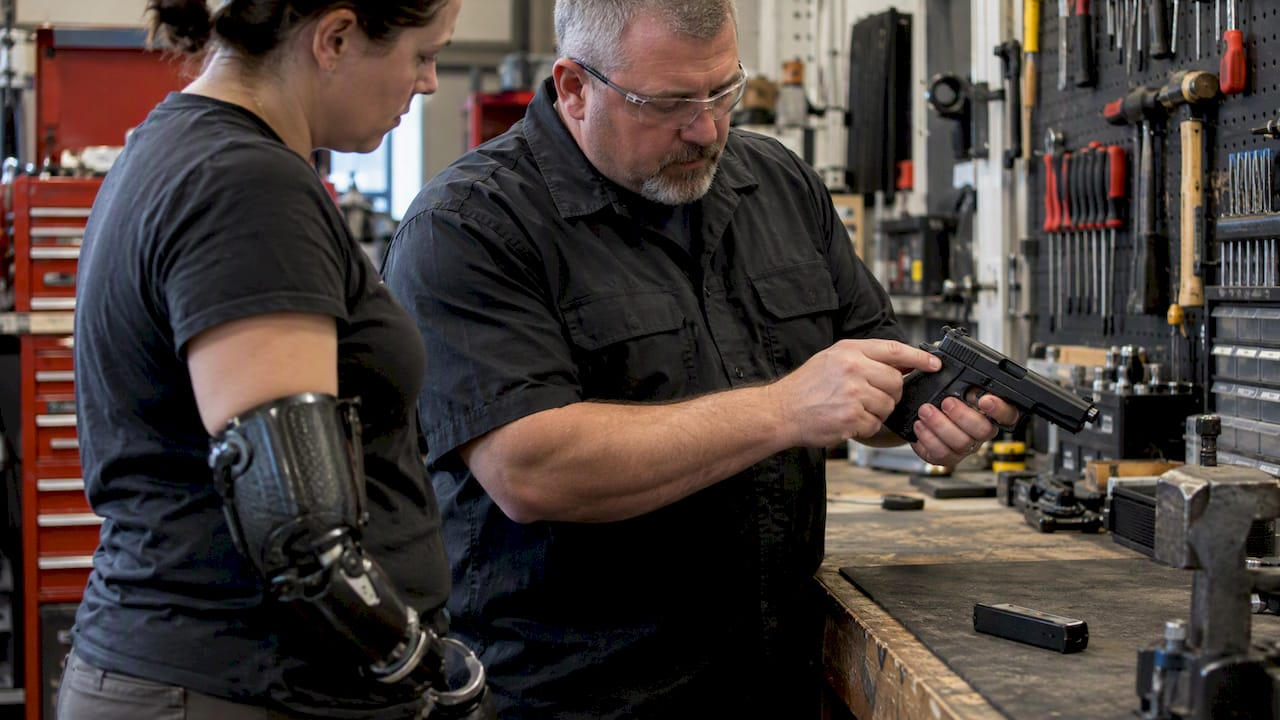
Firearm-side changes belong in the hands of a certified gunsmith, not a prosthetist and never a home workshop. Military rehabilitation guidance recommends prosthetic-friendly firearm attachments installed by certified gunsmiths, since a gunsmith checks structural integrity and confirms a modification will not interfere with safeties, barrel alignment, or the receiver.
Pro Tip: Never modify a safety mechanism yourself to make it easier to reach. A gunsmith can often relocate or adapt a control without compromising the part that keeps the firearm from firing unintentionally.
Training drills and a safe progression for one-handed or prosthesis-assisted shooting
A phased progression protects you while you build the muscle memory for prosthesis-assisted shooting. A Walter Reed pilot program using integrated weapon simulators produced roughly a 30% increase in shooting scores after about 10 hours of simulator practice, with trainees averaging close to 90% target hits, showing how much dry-fire and simulator work can accomplish before live rounds ever enter the picture.
A typical progression looks like this:
- Dry-fire practice with an unloaded firearm to rehearse grip, trigger press, and muzzle control.
- Simulator or laser-trainer sessions to build consistency without live recoil.
- Supported live-fire from a bench or yoke-stabilized rest, starting with 3 to 5 round strings.
- Slow-fire accuracy sets, building toward 10-round strings as grouping tightens.
- Controlled recoil-adaptation sets that gradually remove external support.
- Unsupported live fire once grouping and manipulation speed are consistent.
Track progress with concrete numbers: group size, round-to-round consistency, clean reloads, and how reliably you can safely manipulate the firearm under light time pressure. Those metrics tell you when to move to the next stage, rather than guessing.
Multidisciplinary pathway: who to involve and timelines
Safe, steady progress usually comes from a small team rather than one instructor working alone.
- An occupational therapist handles task-specific training, like grip endurance and repetitive motion tolerance.
- A prosthetist manages socket fit, alignment, and terminal-device selection.
- A physiatrist or surgeon advises on targeted muscle reinnervation (TMR) or related procedures when they are part of your care.
- A range instructor adapts drills and positions to your specific device.
- A certified gunsmith handles any firearm-side modification.
If TMR is part of your rehabilitation, timing matters for your training plan. Occupational therapy protocols for TMR patients describe a phased rehabilitation program where early signs of reinnervation often appear 10 to 15 weeks after surgery, with diagnostic fitting and multifunction prosthesis training following afterward. Separately, research on TMR notes that functional control typically takes 3 to 6 months post-surgery before advanced myoelectric signals become reliable. Build your firearms training schedule around these clinical milestones rather than a fixed calendar date, and share your OT and prosthetist notes with your range instructor so everyone is working from the same plan.
Practical pre-range checklist and what to bring to your first adaptive training session
A little preparation turns a first adaptive session from stressful into straightforward.
- Spare prosthetic parts, liners, or batteries in case of a mid-session issue
- Written medical or OT notes describing your limb’s capabilities and limits
- Government-issued ID, required for most range check-ins
- Eye and ear protection, plus clothing that will not snag on a terminal device
- A clear idea of what you want to accomplish, so staff can stage the session appropriately
Tell staff about your limitations and goals before you step onto the firing line, not after. Most ranges appreciate the heads-up, and it lets them stage drills instead of improvising. Expect a waiver, a quick safety briefing, and a conversation about emergency contacts and any follow-up plan with your clinical team.
Pro Tip: Ask your instructor to document what you practiced and how you performed. That record is useful for your prosthetist and OT when planning your next fitting or training block.
A rehabilitation specialist’s perspective on adaptive shooting
Adaptive shooting rarely follows a straight line, and that is normal. Progress tends to arrive in small, repeatable gains: a tighter group, a faster reload, a grip that finally holds steady under recoil. Adaptive sports programs, including shooting, are often credited with restoring confidence and enabling re-engagement in activities people assumed they had lost. A safety-first, staged approach is slower by design, but it produces the kind of reliable, repeatable skill that actually holds up on the range.
— Dee Parker
How Trouble Defense supports adaptive firearms training
We build our adaptive sessions around your prosthesis, not a generic lesson plan. Our adaptive firearms training starts with an honest conversation about your device, your range goals, and any clinical notes you bring from your OT or prosthetist, and we stage drills from dry-fire through supported live-fire at your pace.
Our instructors are certified and veteran-led, and we treat accessibility as a standing commitment rather than an afterthought, something we spell out in our own accessible firearms training statement. If you need a carry permit once your shooting mechanics are solid, we can incorporate certification training into your plan. Ready to get started? Book private firearm training with us and tell us about your prosthesis when you schedule, so we can prepare the right setup before you arrive.
FAQ
Can someone with a prosthetic arm or hand safely shoot a firearm?
Yes, many people with upper-limb prosthetics shoot safely once a clinician confirms socket stability and grip reliability and an instructor stages training from dry-fire to supported live-fire. The right adaptive mount or grip modification, installed by a certified gunsmith, often makes the biggest practical difference.
What adaptive equipment helps prosthetic users shoot more accurately?
Stabilizing mounts such as LM100/HQ100 style systems, fore-end rings, and oversized grips are common tools that improve control. A certified gunsmith should install any permanent firearm modification to avoid compromising safeties or alignment.
How long after targeted muscle reinnervation can someone train with a prosthesis?
Early signs of reinnervation often appear 10 to 15 weeks after surgery, with functional myoelectric control typically usable around 3 to 6 months post-surgery. Firearms training should follow your surgeon’s and prosthetist’s clearance rather than a fixed calendar date.
Who should be involved in planning adaptive firearms training?
A team approach works best: an occupational therapist for task training, a prosthetist for socket and device fit, a physiatrist or surgeon if TMR is involved, and a range instructor experienced in adaptive sessions. A certified gunsmith handles any firearm-side modification.
Does Trouble Defense offer training specifically for prosthetic users?
Yes, our adaptive firearms training is built around each shooter’s prosthesis and goals, with staged practice from dry-fire through live-fire. Pricing for private sessions starts at $80 per hour.
Sources
- Walter Reed Weapons Training System gets troops back to shooting | Article | The United States Army
- Targeted muscle reinnervation-related research (PubMed entry)
- MonTech item entry: adaptive shooting mount (LM100/HQ100 style)
- Upper limb prosthetics for sports and recreation (military rehabilitation chapter)