The OODA loop, built from four steps—Observe, Orient, Decide, Act—works for civilian self-defense because it speeds up how fast you notice a threat and shortens the gap between recognizing danger and moving to safety. Colonel John Boyd built it for fighter pilots, but the same cycle helps you choose a safer, reversible response before an attacker can settle on their next move. Trouble Defense builds this thinking into its scenario-based training because tempo, not brute force, usually decides who controls a confrontation.
TL;DR:
- Speed and accuracy in observation are critical, as most civilians overlook pre-attack indicators like subtle body language or peripheral cues.
- Rehearsing reversible decision rules, such as retreat rather than confrontation, prevents paralysis and ensures quick, safe responses under stress.
- Practice should involve structured drills that combine perception, decision, and motor skills within a realistic scenario to develop instinctive reactions.
- Proper training emphasizes legal proportionality and ethical assessment, making sure actions remain within laws and avoid unnecessary legal exposure.
- Stress inoculation and tactical breathing are essential to maintaining situational awareness and decision-making clarity during high-pressure encounters.
Table of Contents
- Observe: What Civilians Should Notice and How to Practice Noticing
- Orient: Build Mental Models, Remove Bias, and Pre-Load Responses
- Decide: Fast, Reversible Decision Rules for Safety
- Act: Safe Execution, Quick Feedback, and Looping Back
- Training and Practice: A 4-Week Plan to Build OODA Speed
- Common Mistakes and Weaknesses When Applying OODA to Self-Defense
- How Professional Training Turns OODA Theory Into Reliable Civilian Skill
- Psychological Preparedness and Stress Management During the OODA Loop
- Legal and Ethical Considerations in Self-Defense Decision-Making
- Author Perspective: OODA as a Mindset, Not a One-Time Lesson
- Ready to Put OODA Into Practice? Here’s Your Next Step
- Selected Reading
- Sources
- FAQ
Observe: What Civilians Should Notice and How to Practice Noticing
Observation is raw data collection: exits, lighting, concealment spots, and who’s paying too much attention to you. Most people miss pre-attack indicators, like someone matching your pace across a parking lot or hovering near a doorway, because they’re staring at a phone instead of scanning the room.
A few habits fix that fast:
- Do a slow 360-degree scan every time you enter a new space, noting two exits before you sit down.
- Watch hands and body angle, not faces. Hands throw punches and draw weapons; faces just react.
- Break tunnel vision by naming three unrelated objects in your peripheral vision every 30 seconds in a crowd.
Pro Tip: If you catch your attention locking onto one person or object, take one slow breath and deliberately widen your gaze to the room’s edges. That single breath resets the visual funnel before it becomes a blind spot.
Orient: Build Mental Models, Remove Bias, and Pre-Load Responses
Boyd called Orientation the hub of the whole cycle, and civilian self-defense confirms why. Orientation filters what you observe, shapes which decisions even occur to you, and lets trained people act on instinct instead of grinding through conscious analysis. Boyd himself argued that a fighter with faster orientation beats one who’s simply faster at pulling a trigger.
Two biases wreck civilian orientation constantly: anchoring on a first impression (“that guy looks harmless”) and first-conclusion bias, where you lock onto an early read and stop updating even as new evidence arrives.
Build better orientation with these steps:
- Write “if X, then Y” triggers in advance: if someone blocks my exit, then I move toward the second exit immediately.
- Keep a short decision journal after any tense encounter, noting what you noticed late and why.
- Rehearse those triggers physically, not just mentally, so the response lives in muscle memory.
Pro Tip: Review your decision journal monthly. Patterns in what you consistently miss reveal exactly where your training time should go next.
Decide: Fast, Reversible Decision Rules for Safety
Deciding under stress doesn’t reward perfect analysis. It rewards a decision you can act on now and reverse if it’s wrong. Satisficing, picking the first workable option instead of the theoretical best one, keeps you moving instead of frozen.
Build your decision menu around reversibility:
- Moving toward an exit is reversible; drawing a firearm on an ambiguous threat is not.
- Creating distance almost always beats standing your ground when the threat level is unclear.
- Seeking cover buys time to re-observe without committing to confrontation.
- Reserve controlled confrontation for situations where retreat and cover are genuinely blocked.
Trained, rehearsed responses, like the triggers built during Orient, should run largely on instinct. Save conscious deliberation for genuinely novel situations your training never covered.
Act: Safe Execution, Quick Feedback, and Looping Back
Acting is where plans meet reality, and the rule stays simple: retreat, de-escalate, or create distance before anything else. Every action doubles as a data point for the next loop, so you want actions that are safe to take and quick to evaluate.
Realistic tactical options, in rough order of preference:
- Exit the area entirely if a clear path exists.
- Put a physical barrier, a car, a doorway, a wall, between you and the threat.
- Verbally de-escalate while maintaining distance and watching hands.
- Engage physically only when escape and barriers are exhausted.
Pro Tip: After any action, give yourself a 30 to 90 second gut check: did the threat close distance, back off, or do something unexpected? That quick read restarts Observe and Orient before you commit to a second move.
Training and Practice: A 4-Week Plan to Build OODA Speed
Reading about OODA won’t make it faster under stress. Only repetition does that, and structured drills are what convert theory into something your body does automatically.
Four categories of drills build the full loop:
- Perception drills — timed scans, spotting hidden objects in a room, identifying exits under a countdown.
- Decision drills — scenario cards or verbal “what if” prompts that force a fast reversible choice.
- Motor-skill drills — draw strokes, movement off the line of attack, and barrier positioning, all done slowly before adding speed.
- Integrated scenario rehearsals — combining all three under mild stress, ideally with a partner or instructor.
A sample month looks like this:
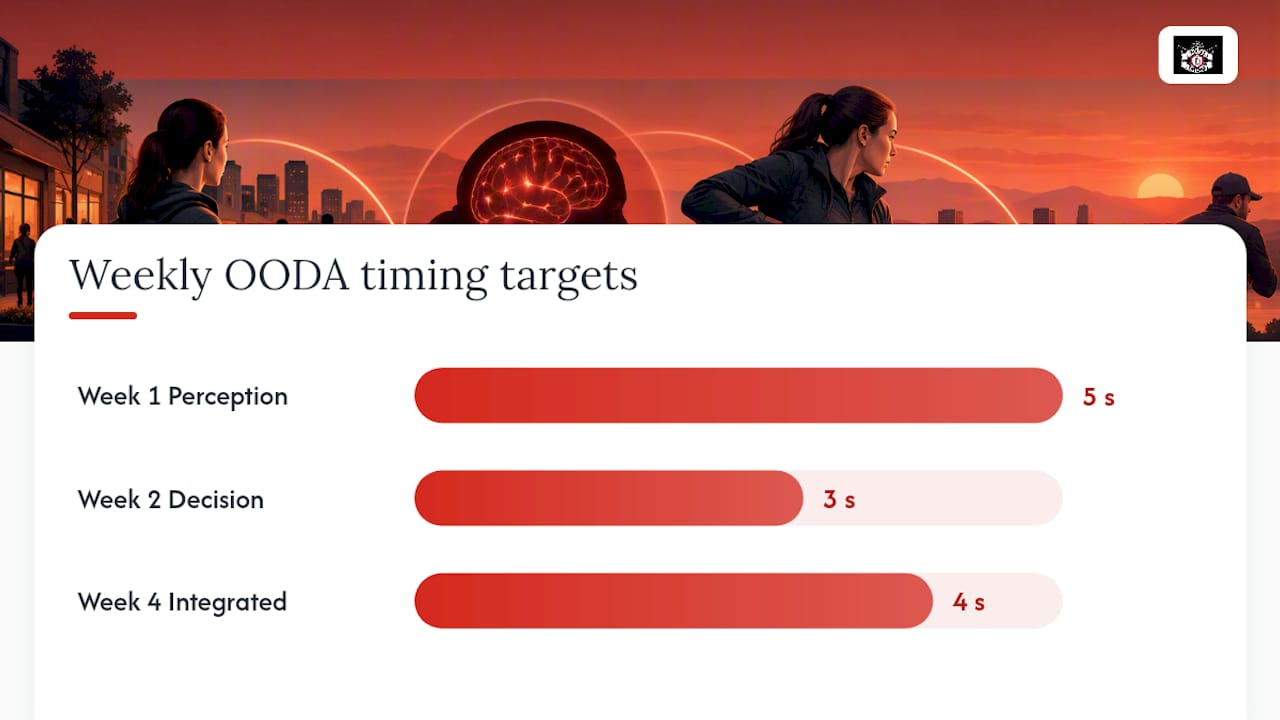
- Week 1: Daily 360-scans and exit identification. Target: spot two exits within five seconds of entering any room.
- Week 2: Add decision drills, ten scenario prompts per session. Target: answer each within three seconds without freezing.
- Week 3: Slow motor-skill repetition, draw strokes or movement drills. Target: consistent form, not speed yet.
- Week 4: Combine all three into a short integrated scenario with a training partner. Target: complete the loop, observe, orient, decide, act, in under four seconds per cycle.
Motor-skill and implicit-action training carry real risk if practiced incorrectly, especially anything involving a firearm or simulated weapon. Solo dry-fire drills and scanning exercises are fine at home. Anything involving live fire, force-on-force scenarios, or defensive tools like OC spray belongs in a supervised class where an instructor can correct form before bad habits become instinct. Trouble Defense’s self-defense training guide breaks down how scenario-based practice bridges that gap safely.
Common Mistakes and Weaknesses When Applying OODA to Self-Defense
The OODA loop fails civilians in predictable ways, and most failures trace back to orientation, not observation or action.
- Tunnel vision narrows your field of view onto one threat and blinds you to a second attacker or an escape route.
- Orientation anchored in myths, believing movies or internet rumors about “what attackers do,” feeds bad triggers into your decision menu.
- Decision paralysis happens when you demand a perfect option instead of a reversible good one.
- Unsafe rapid action with a bad orientation is the most dangerous failure of all. Cycling fast doesn’t help if your read on the situation is wrong. Speed without accurate orientation just gets you to the wrong outcome faster.
Fixes are straightforward: a breathing reset breaks tunnel vision, a reversibility filter cuts through paralysis, rehearsal replaces myth-based assumptions with tested responses, and a decision journal catches orientation errors before they repeat.
How Professional Training Turns OODA Theory Into Reliable Civilian Skill
Reading about drills gets you partway there. Running them under a certified instructor’s eye, with corrections in real time, is what makes the loop actually fast when it matters.
Trouble Defense structures its programs around exactly this progression:
- Defensive Shooting Scenarios train the Decide and Act phases under time pressure, using realistic scenario examples instead of static range drills.
- OC spray and less-lethal training give you a reversible option between verbal de-escalation and firearm use, filling a real gap in most people’s decision menu.
- CCW classes cover the legal and mechanical foundation that has to be solid before Decide and Act can happen safely.
- Women’s firearms training addresses observation and orientation patterns specific to threats women report most often.
The academy is staffed by certified instructors and backed by positive reviews from students who trained in the DMV area. The academy also runs adaptive programs for blind and low-vision students, proof that OODA-based training can be tailored rather than one-size-fits-all.
Picking the right class starts with an honest look at your goals. Someone new to firearms needs foundational safety and legal grounding before scenario work makes sense. Someone already carrying should look at defensive shooting drills that sharpen decision speed under realistic pressure. Expect any solid supervised scenario class to start slow, build one skill at a time, and only add stress once the fundamentals are automatic.
Psychological Preparedness and Stress Management During the OODA Loop
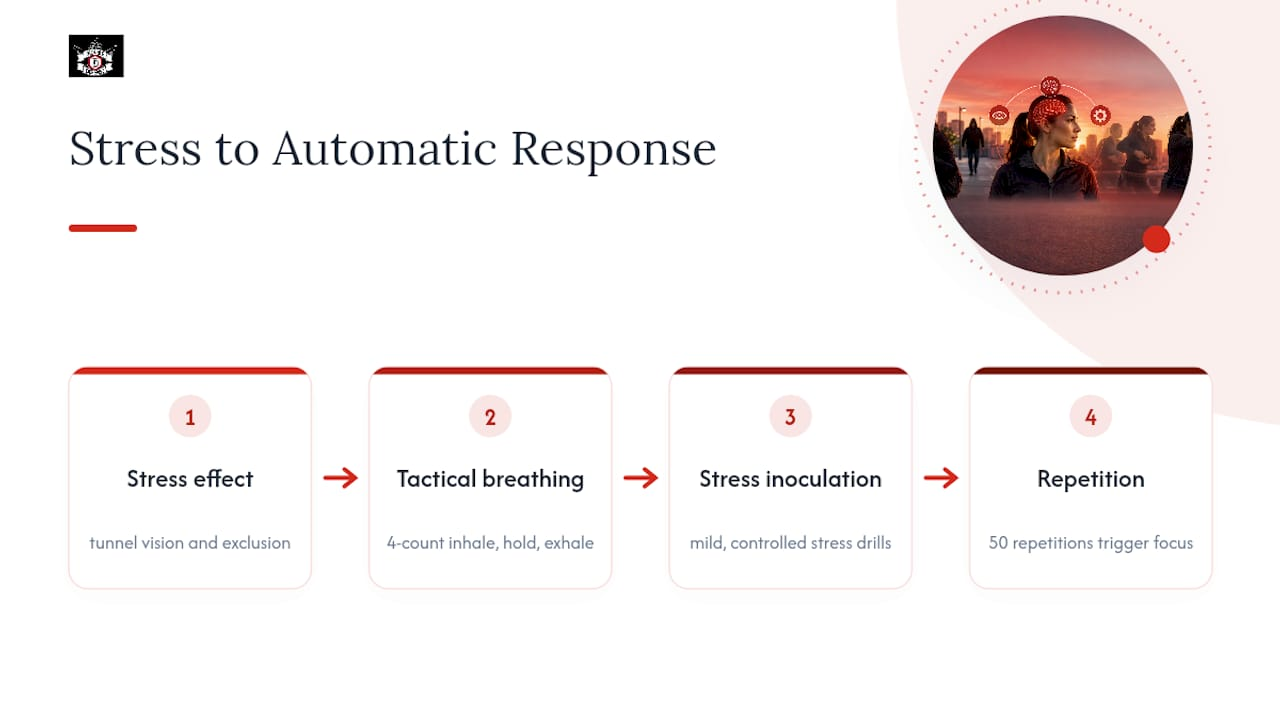
Stress doesn’t just slow you down. It actively degrades each phase of the loop if you haven’t trained for it. Tunnel vision and auditory exclusion, where you literally stop hearing things around you, both intensify under an adrenaline dump, which is exactly when you need Observe working best.
Tactical breathing is the most direct tool for counteracting this. A slow four-count inhale, four-count hold, four-count exhale pattern lowers heart rate enough to keep your visual field wide and your fine motor skills functional. Combat and law enforcement trainers use this pattern specifically because it’s fast to teach and works under genuine physiological stress, not just in a calm classroom.
Preparedness also comes from familiarity. The first time your heart rate spikes over a real threat shouldn’t be the first time you’ve felt that sensation at all. Stress inoculation, exposing yourself to mild, controlled stress during training, like a timer, a partner, or a surprise scenario cue, teaches your nervous system that elevated heart rate doesn’t mean loss of control.
Confidence built through repetition changes what “stress” even feels like. A drill you’ve run fifty times triggers focus instead of panic on run fifty-one. That’s the entire point of a structured practice plan: not to eliminate stress, but to make your response to it automatic long before you ever need it for real.
Legal and Ethical Considerations in Self-Defense Decision-Making
Every phase of OODA has to operate inside the law, and that reality shapes which options belong in your Decide phase at all. Most states, Virginia and Maryland included, require that force used in self-defense be proportional to the threat faced and that a person reasonably believed they faced imminent danger. That standard means your decision menu should default toward retreat and de-escalation whenever those options exist, because a court will ask later whether they did.
Reversibility isn’t just tactically smart. It’s legally protective. An action you can walk back, moving to cover, verbally de-escalating, retreating, rarely creates legal exposure. A firearm drawn or fired against an ambiguous threat can create exposure even when your fear was genuine, if the response wasn’t proportional to what was actually happening.
Ethical decision-making follows the same logic as good orientation: it depends on accurate assessment, not fear-driven assumption. Training that includes legal scenario discussion, not just marksmanship, is part of what separates a responsible CCW holder from someone who’s only practiced the mechanical half of self-defense. Any class worth attending should cover this alongside the physical skills.
Author Perspective: OODA as a Mindset, Not a One-Time Lesson
Orientation is a skill that grows only through repeated contact with real scenarios, not a box you check once. The research on Boyd’s framework backs this up plainly: cycling faster only helps once your mental model is accurate, which means the mental-model work deserves more of your training time than the trigger-pulling does. Pair that study with supervised, scenario-based practice, and the loop stops being theory.
— Dee Parker
Ready to Put OODA Into Practice? Here’s Your Next Step
Reading about tempo and orientation gets you thinking correctly. Running it under pressure, with someone qualified watching your form, is what makes it reliable when you actually need it. Trouble Defense is the training route for readers who want that supervised repetition instead of piecing together drills alone from a blog post.

A few starting points depending on where you’re at: the CCW Permit Class builds the legal and mechanical foundation before any scenario work makes sense. If you’re already carrying, Defensive Shooting Scenarios sharpen Decide and Act under real time pressure. Women new to firearms often start with Women’s Firearms Training, which addresses observation patterns specific to the threats women report most. Bring eye and ear protection if you have them, wear closed-toe shoes, and expect the first session to move slower than you’d like, that’s intentional. Contact Trouble Defense to book a class and get a date on the calendar.
Selected Reading
- John Boyd (military strategist) — Wikipedia)
- OODA Loop — MindTools
- Lessons from Navy SEAL selection — EXITREADY
Sources
- John Boyd: the OODA loop explained — Farnam Street
- The OODA Loop: a practical guide to Boyd’s decision-making framework | StrategyU Blog
- OODA loop for emergency decisions – Survipedia
FAQ
What Are the Weaknesses of the OODA Loop?
The biggest weakness is treating speed as the goal instead of accuracy. Cycling through Observe, Orient, Decide, Act faster only helps if your orientation is correct; a fast decision built on a wrong read of the situation increases danger rather than reducing it.
What Are the 5 A’s of Self-Defense?
Definitions of the “A’s” vary across trainers and aren’t a single standardized framework, so no canonical list applies here. Most civilian self-defense guidance centers on the same core ideas covered in the OODA loop instead: awareness, avoidance, and de-escalation before physical response.
What Are the Best Skills to Train for Self-Protection?
Situational awareness (Observe), fast reversible decision-making (Decide), and basic physical skills like distance creation and barrier use consistently rank as the highest-value skills to train. Supervised, scenario-based practice, like the defensive shooting scenarios Trouble Defense runs, builds all three together instead of in isolation.
What Is the OODA Loop Used for in the Military?
The military uses OODA to describe how a fighter pilot, or any decision-maker, cycles through observing the environment, orienting based on experience and training, deciding on an action, and acting, all faster than an opponent can. Boyd’s original insight was that winning depends on disrupting the other side’s cycle, not just completing your own faster.