Firearms training for couples teaches both partners to handle, communicate, and store firearms safely together, which strengthens household safety and builds real teamwork under pressure. It fits new gun-owning couples, partners drafting a shared home defense plan, and anyone who wants confidence instead of guesswork. The practical next step is simple: find a hands-on, certified course that includes partner drills and a storage-planning session.
TL;DR:
- Couples training significantly improves safe storage practices, with nearly 50% of participants adopting better storage habits after the course.
- Effective classes include live-fire partner exercises and communication drills, which reinforce muscle memory and long-term safety behaviors.
- Private instruction costs between $60 and $450 and varies in length from a few hours to over 16 hours for full certification, with additional fees for ammunition, range fees, or paperwork.
- Look for NRA-certified instructors, clear safety protocols, and adaptable pacing to accommodate different experience levels when choosing a course.
- Creating a shared storage plan involves selecting a secure safe, adding delay devices, and establishing access protocols that should be reviewed regularly with life changes.
Table of Contents
- Why couples-focused training matters
- What a couples class actually covers
- How much couples training costs and how long it takes
- How to choose the right couples class or instructor
- A shared storage plan couples can build today
- Publisher perspective: how Trouble Defense runs couples-friendly training
- The emotional and psychological side of training together
- Legal considerations for couples who own and train with firearms
- Practicing firearms skills safely at home as a couple
- Resolving conflict and making decisions together during training
- Author perspective: partnering for safety, not competition
- Ready to train together? Our couples packages and how to book
- FAQ
- Sources
Why couples-focused training matters
Training together changes behavior, not just knowledge. Structured firearm-safety training is linked to an almost 50% increase in safe-storage practices among participants measured at follow-up, a meaningful shift from good intentions to habits that stick.
Joint training also solves a quieter problem: one partner often becomes the default “gun person” while the other stays uninformed. That gap turns into a liability during an emergency when both people need to know what to do.
Couples who train side by side tend to:
- Share accurate knowledge of every firearm in the house, not just secondhand explanations.
- Build a common vocabulary for commands, handoffs, and range safety.
- Split responsibility for storage, maintenance, and practice instead of leaving it to one person.
Training that pairs live fire with communication drills produces better long-term habits than classroom-only courses, according to federal research on firearm-safety interventions. Couples remember what they practiced with their hands, not just what they heard in a lecture.
What a couples class actually covers
A well-built couples course moves through four stages, usually in this order:
- Safety fundamentals. Grip, stance, muzzle discipline, and the universal safety rules, reviewed together so both partners start from the same baseline.
- Partner communication drills. Verbal commands, signaling, and safe handoffs between partners during loading, unloading, and range transitions.
- Live-fire partner exercises. Paired shooting drills where each partner practices under mild, controlled pressure while the other observes or assists.
- Storage planning. A session dedicated to deciding where firearms live, who has access, and how that access is documented.
Class length varies by scope. A single-day introductory session might run a few hours, while a full concealed-carry certification course typically spans 5 to 16-plus hours, according to the ATF’s firearm safety guidance, depending on state requirements and certification depth.
Before booking, confirm these practical details:
- Whether loaner firearms, eye protection, and ear protection are provided or need to be brought.
- How ammunition is supplied and whether range fees are bundled into the course price.
- Whether the instructor can accommodate mixed skill levels, since couples often start at different experience points.
How much couples training costs and how long it takes
Basic firearms courses typically run $60 to $450, and most fall in that range whether booked as a group class or a private session, per ATF cost benchmarks. Private instruction usually costs more per person than group classes but delivers more direct feedback, which matters when two people are learning different things at the same pace.
Duration tracks with certification depth. A one-day intro class might wrap in a few hours, while multi-state reciprocity or full concealed-carry certification courses can stretch toward the 5 to 16-plus hour range noted above, sometimes split across more than one session.
Watch for these add-ons when comparing quotes:
- Ammunition costs, which are sometimes included and sometimes billed separately per round or per box.
- Range fees charged independently of the instruction fee.
- Certification paperwork or processing fees tied to state permit requirements.
How to choose the right couples class or instructor
Not every class is built for two people learning together. Before booking, run through this checklist:
- Confirm the instructor holds a recognized certification, such as NRA instructor credentials.
- Ask whether the range enforces clear, posted safety protocols and how class size is capped.
- Check for loaner gear availability and instructor experience teaching couples or adapting to different skill levels.
Good questions to ask before paying a deposit include what the syllabus covers hour by hour, the instructor-to-student ratio, the emergency and medical plan on site, and the cancellation or refund policy.
Pro Tip: Ask the instructor how they handle a couple where one partner is a beginner and the other has years of experience. A strong program adjusts pacing instead of running both partners through identical drills.
Red flags include a course with little or no live-fire range time, vague or unposted safety rules, heavy pressure to buy gear or add-on packages, and no visible range affiliation or insurance.
A shared storage plan couples can build today
Training only matters if it changes what happens at home. Federal surveillance data on firearm storage ties secure storage, locked, unloaded, with ammunition kept separately, to lower rates of firearm injury, and that guidance applies to every household, not just families with children.
Three steps turn that guidance into a plan:
- Choose primary locked storage. A safe or lockbox rated for the firearms you own, placed where both partners can reach it without delay in a real emergency.
- Add a delay barrier. A trigger or cable lock inside the safe creates a second layer, a method the VA’s Minutes Matter guide recommends specifically to slow down impulsive access during a crisis.
- Write and rehearse an access protocol. A short, agreed document covering who has codes or keys, where spare ammunition lives, and what happens if one partner is away.
Revisit the plan whenever life changes: new children in the home, visiting guests, a period of stress or mental health risk, or a move. Temporary off-site storage, through a range, a dealer, or a trusted contact, is worth knowing about before a crisis makes that decision urgent.
Publisher perspective: how Trouble Defense runs couples-friendly training
We built our programs around personalized, judgment-free instruction, which matters most when two people with different experience levels are learning in the same room. Our instructors are certified, and we carry many positive reviews from students who came through beginner and advanced courses alike.
For couples specifically, we offer:
- Private Firearm Training, built for one-on-one or paired sessions with pacing that adjusts to each partner.
- Group shooting events, including date-night and team-building formats that work well for couples who want a shared experience without a full certification course.
- Adaptive accommodations for students with disabilities, including low-vision and blind shooters, built into our regular scheduling rather than offered as an afterthought.
Bring eye and ear protection if you have your own, otherwise we provide it, along with loaner firearms for most sessions.
The emotional and psychological side of training together
Learning to handle a firearm exposes nerves, old fears, and sometimes a surprising amount of ego. One partner might freeze up at the range while the other breezes through drills, and that imbalance can sting if it is not handled with patience.
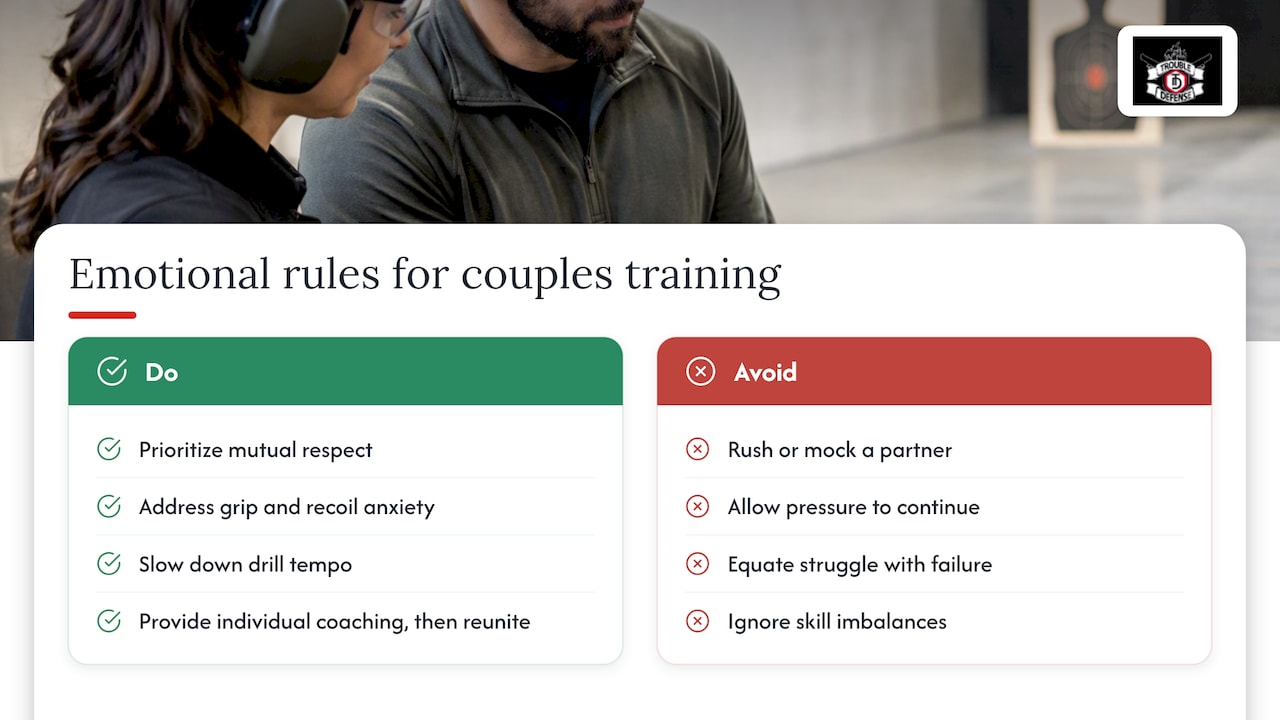
The goal of couples training is not matching skill levels, it is building mutual respect for where each partner stands right now. A partner who struggles with grip strength or recoil anxiety is not failing, they are working through something physical and psychological that good instruction addresses directly rather than glossing over.
Watching your partner handle a firearm competently, and having them watch you do the same, tends to build trust that spills over past the range. Couples who finish a course together often report a different kind of confidence: not just “I can do this,” but “we know what the other person will do.”
That said, pressure cuts both ways. A partner who feels rushed or mocked during drills will disengage, and an instructor who allows that dynamic to continue is doing the couple a disservice. The better programs slow down, separate the partners for individual coaching when needed, and reunite them for the exercises built around teamwork.
Legal considerations for couples who own and train with firearms
Firearm laws vary significantly by state and jurisdiction, and that matters for couples who may live, work, or travel across state lines. Permit reciprocity, storage laws, and transport rules differ enough that assumptions from one state can create real legal exposure in another.
Couples should each hold their own understanding of local law rather than relying on one partner’s research. This matters especially for concealed carry permits, since many states require separate applications, background checks, and training hours per person, not per household.
If either partner has a prior legal issue, a restraining order, or any factor that could affect eligibility, that needs direct attention before firearms enter the home. Questions about CCW violations, transport across state lines, or storage law in a specific jurisdiction are worth directing to a licensed attorney familiar with firearm law rather than guessed at.
Training providers can teach safe handling and general legal frameworks, but they are not a substitute for legal counsel on a specific situation. Treat the legal side of firearm ownership as its own homework assignment, separate from the shooting skills.
Practicing firearms skills safely at home as a couple
Range time builds the core skills, but home practice keeps them sharp between sessions. The rules that apply on a range apply at home too: treat every firearm as if it is loaded, keep muzzles pointed in a safe direction, and never practice live-fire drills indoors.
Dry-fire practice, done with an unloaded firearm and triple-checked chambers, is the safest way to rehearse draws, grip, and trigger press at home. Many couples use this time to rehearse the communication habits from class: calling out “clear,” confirming a safe direction, and practicing handoffs the same way every time.
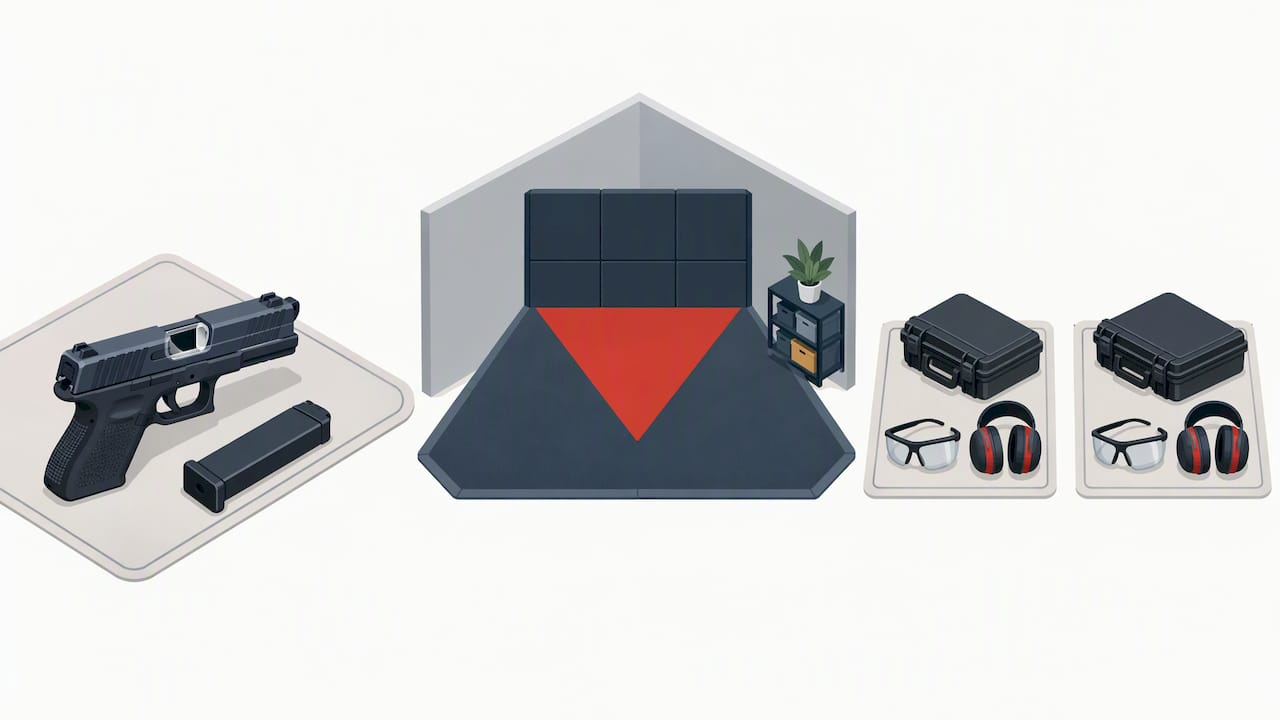
Keep practice sessions short and deliberate rather than casual. A five-minute dry-fire routine done consistently, with both partners checking each other’s form, builds more real skill than an occasional long session.
Never mix home practice with alcohol, distraction, or an audience of children or guests. If storage and practice routines start to feel like a hassle, that is usually a sign the storage plan needs adjusting, not a reason to skip steps.
Resolving conflict and making decisions together during training
Two people learning a physical, high-stakes skill at the same time will disagree sometimes, about pace, about technique, about how seriously to take a given drill. That friction is normal and usually resolves faster with a few ground rules set before the first session.
Agree in advance that feedback during training stays about the task, not the person: “your grip is slipping” lands differently than “you’re not paying attention.” Instructors who build in individual coaching moments give couples room to struggle privately before regrouping for joint drills.
Decision-making about the gear itself, which firearms to buy, where to store them, who carries day to day, works best as a joint conversation rather than one partner deciding and informing the other. Research on household firearm decisions ties written, collaborative plans to better adherence on safe storage, largely because both partners understand the reasoning, not just the rule.
When disagreements come up mid-course, the fix is usually to slow down and separate the skill question from the relationship question. A missed shot is not a referendum on the relationship, and treating it that way turns a learning environment into a scoreboard.
Author perspective: partnering for safety, not competition
Couples training works best when neither partner is trying to outperform the other. Patience and shared responsibility matter more than who shoots tighter groups. My honest advice: book a private session or a beginner-friendly group class, then sit down afterward and draft a short storage plan together while the lessons are still fresh.
— Dee Parker
Ready to train together? Our couples packages and how to book
We make booking straightforward, whether a couple wants a private session built around their pace or a group experience shared with friends. Our instructors handle mixed experience levels every week, so neither partner needs to catch up before walking in.
Relevant options for couples include:
- Private Firearm Training, ideal for partners who want individualized coaching and paired drills without a group setting.
- Group shooting events, including date-night and celebration packages built for two or more people.
- The DMV Concealed Carry Training Package, priced at $450 one-off, for couples who also need permit certification alongside hands-on instruction.
Booking starts with a quick call or online request, and most sessions require only that you show up ready to listen, with closed-toe shoes and comfortable clothing. Reach out through our DMV Concealed Carry Training Package page to check available dates and get your couple’s session on the calendar.
FAQ
How much does a firearm training course cost?
Basic firearms courses typically cost $60 to $450, with private sessions generally priced higher per person than group classes. Our own Private Firearm Training is available at competitive rates, and pricing details for our DMV Concealed Carry Training Package can be found on our website.
What is the best firearm training program in the US?
There is no single best program since quality depends on certified instruction, hands-on range time, and fit for the couple’s experience level. Look for NRA-certified instructors, posted safety protocols, and a course structure that includes live-fire partner drills rather than classroom time alone.
Are firearm safety courses worth it?
Structured training is tied to an almost 50% increase in safe-storage practices among participants at follow-up, which suggests real behavioral change beyond a certificate. For couples, the added benefit is a shared understanding of handling and storage rather than one partner carrying all the knowledge.
How long is a firearm training course?
Course length ranges from a few hours for an introductory session to 5 to 16-plus hours for full certification courses, depending on state requirements and scope. Multi-state or concealed-carry certification programs tend to run on the longer end of that range.
Sources
- Safety and security for firearm owners (ATF)
- Locks for Life / firearm safety intervention (NIOSH/CDC record)
- Firearm storage behaviors — Behavioral Risk Factor Surveillance System (MMWR)
- Minutes Matter: A Veteran’s guide to secure storage (VA)