
A home defense shooting plan is a written, practiced household protocol that prioritizes prevention, safe firearm access, clear roles, and legal limits. Start by mapping your exits and picking a safe room, setting up secure but rapid access to your firearm, and putting a first practice date on the calendar with roles assigned to every household member.
TL;DR:
- A layered firearm storage setup combines quick-access biometric safes near bedrooms with full safes elsewhere to balance security and rapid response.
- Regular practice, including monthly retrieval drills and quarterly live exercises, ensures household members can execute the plan confidently under stress.
- Clear roles and specific communication commands improve response time and reduce confusion during a home defense situation.
- The safest firearm is one that household members are trained to handle effectively and store securely in a quick-access lockbox.
- Staying updated on safety procedures and regularly testing equipment can prevent delays and failures in genuine emergencies.
Table of Contents
- Quick household checklist: what to do in the next 48 hours
- Roles, communication, and family protocols
- Firearm access protocols: secure storage versus rapid access
- Tactical movement and safe-room strategy
- Training and drills: practice schedule and effective drill types
- Legal boundaries and when to call 911
- Child safety, storage, and teaching protocols
- Maintenance and equipment checklist
- How professional training closes the gaps in a home defense plan
- Final practical advice from a home defense trainer’s perspective
- Ready to put your plan to the test
- Sources
- FAQ
Quick household checklist: what to do in the next 48 hours
Before you touch a range schedule or a new safe, get the basics written down. A plan that lives only in your head falls apart under stress, which is exactly when you need it most.
- Write down two escape routes from every bedroom and a meeting spot outside, following the same logic Ready.
- Pick one primary safe room, plus a backup, based on distance from likely entry points.
- Decide in advance who calls 911 and who gathers kids or pets.
- Set up temporary secure storage, a lockbox or safe, with access limited to trained adults.
- Put your first drill on the calendar this week, then schedule recurring practice.
Roles, communication, and family protocols
Confusion kills response time. Give each household member a specific job and a backup person in case they’re not home.
- Assign one adult as the primary defender and a second as backup if the first is unavailable.
- Assign a “caller” whose only job is dialing 911 and speaking clearly to dispatch.
- Assign a “gatherer” who moves children, guests, and pets to the safe room.
- Agree on two or three short verbal commands (for example, a specific phrase meaning “get down and stay quiet”) that everyone recognizes instantly.
- Brief overnight guests or visiting relatives on the plan the same day they arrive.
Rehearsed, specific phrasing matters more than people expect. Research on virtual reality training for firearm safety counseling found that practicing exact verbiage ahead of time builds confidence and steadies performance when stress is high, a principle that applies just as well to a family calling out commands in a dark hallway.
Firearm access protocols: secure storage versus rapid access
The core tension in any home defense plan is this: a firearm locked up tight enough to keep out children and intruders can be too slow to reach in an emergency. The fix isn’t choosing one extreme, it’s layering devices so unsupervised hours default to secure and supervised, alert hours allow fast retrieval by trained adults only.
- Full safes offer the strongest protection against theft and unauthorized access but are too slow for an active threat unless placed within a few steps of your safe room.
- Biometric lockboxes open in one to two seconds for enrolled fingerprints, making them a practical bedside option, though they depend on battery power and clean sensor contact.
- Mechanical lockboxes need no batteries and open by touch combination, a reliable backup when electronics fail.
- Cable locks are cheap and useful for firearms in secondary storage but too slow for a primary home defense weapon.
A workable configuration: one firearm in a biometric lockbox at the bedside for immediate response, with the rest of your collection in a full safe elsewhere in the home. Project ChildSafe notes that quick-access biometric safes can reconcile security with retrieval speed only when they’re paired with regular functional checks and hands-on training.
Pro Tip: Run a monthly timed retrieval drill with an unloaded firearm to confirm your lockbox still opens fast and every enrolled fingerprint still registers.
Tactical movement and safe-room strategy
Your safe room should have a door that locks, a charged phone, and a clear line of sight to the entry point, without windows that expose the room from outside.
- Choose a room central to sleeping areas, ideally with its own door lock and no direct exterior access.
- Move everyone toward that room together rather than splitting up, which reduces the risk of a family member walking into the other’s line of fire.
- Barricade rather than confront when the threat hasn’t located you; only evacuate if fire, gas, or a structural hazard makes staying more dangerous than leaving.
- Keep a flashlight, phone charger, and door-stop wedge in the room so barricading takes seconds, not minutes.
Simple barricading, a doorstop, a heavy piece of furniture pushed against the door, buys time for police to arrive and for you to assess the situation calmly rather than react on instinct alone.
Training and drills: practice schedule and effective drill types
A plan without repetition is just a document. Build a rhythm you’ll actually keep.
- Run a tabletop walk-through within 7 days of writing the plan, talking through each step out loud with the whole household.
- Do a quick review monthly: check locks, confirm roles, and time a lockbox retrieval.
- Run a live drill quarterly, practicing movement to the safe room and communication signals.
- Do a full-family rehearsal twice a year, similar to the frequency Ready.gov recommends for home escape drills.
- Practice low-light movement and draw-to-ready transitions at the range, where you can safely work on speed and control.
- Get hands-on defensive firearm training if you’ve never practiced drawing under time pressure. A qualified instructor will spot habits that feel fine at home but fall apart under stress.
Legal boundaries and when to call 911
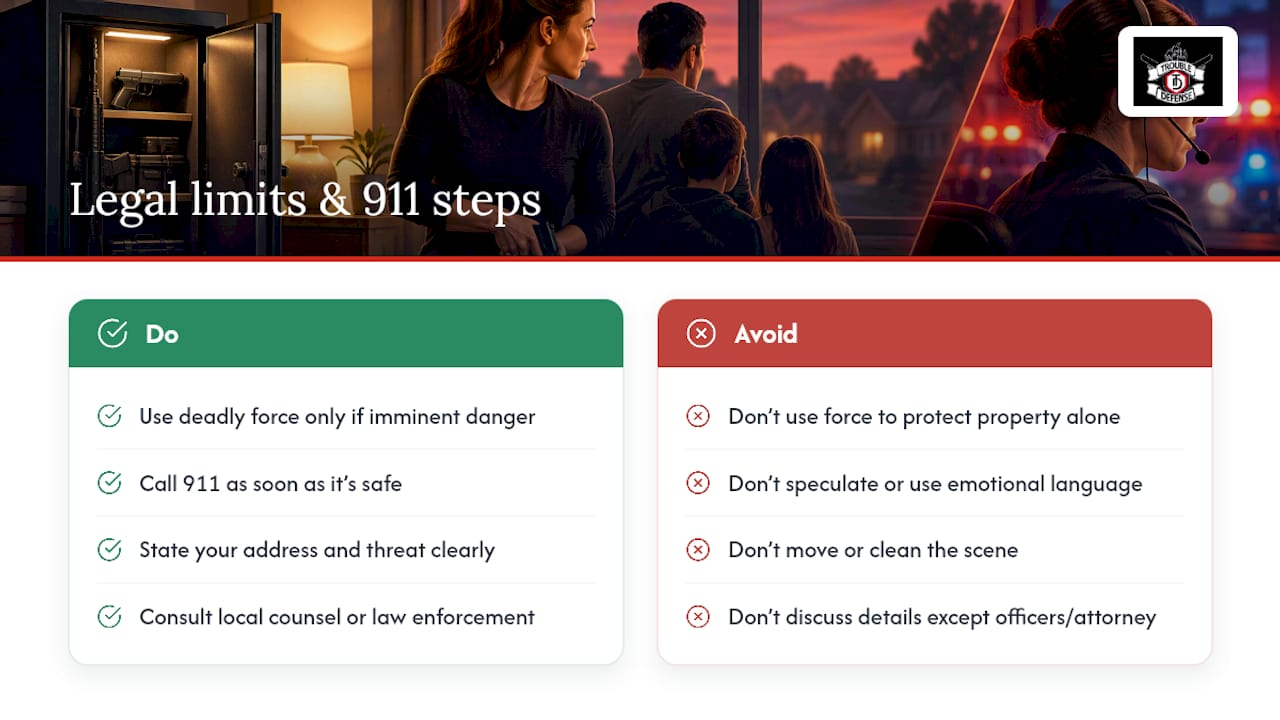
Deadly force is legally justified only when you reasonably believe there is imminent danger of death or serious bodily harm, according to the Department of Justice’s use of force policy. Protecting property alone does not meet that standard.
Call 911 as soon as it’s safe, state your address and the nature of the threat clearly, and avoid speculation or emotional language. After any incident, don’t move or clean anything at the scene, and don’t discuss details with anyone except responding officers and your own attorney. Every state applies these principles differently, so consult local counsel or law enforcement guidance for specifics that apply to your situation.
Child safety, storage, and teaching protocols
Store firearms locked, unloaded, and separate from ammunition. CDC data on unintentional firearm deaths among children found that in incidents with known storage details, the firearm involved was stored loaded 74% of the time and unlocked 76% of the time, often within reach on a nightstand or in a sleeping area.
- Move any defensive firearm off the nightstand and into a lockbox, even one rated for fast access.
- Talk to kids directly rather than assuming the topic is too scary to raise. A randomized trial on gun safety videos found children who watched a short safety video at home handled a real gun more cautiously afterward.
- Ask before visits: when your kids go to another home, ask whether firearms are stored securely there.
- Reinforce the message regularly rather than treating it as a one-time conversation.
Maintenance and equipment checklist
Gear that hasn’t been checked in months is gear you can’t trust in an emergency.
- Lockbox or safe with fresh batteries and a backup mechanical key.
- Flashlight, charged phone, and a basic medical kit in the safe room.
- Backup magazine and a door reinforcement kit or wedge.
- Check safes and lockboxes monthly for battery life and smooth operation, following the same cadence outlined in firearms examiner training on device maintenance.
- If a lockbox sticks, misreads fingerprints repeatedly, or a firearm shows feeding issues during dry-fire, get it serviced immediately rather than waiting.
How professional training closes the gaps in a home defense plan
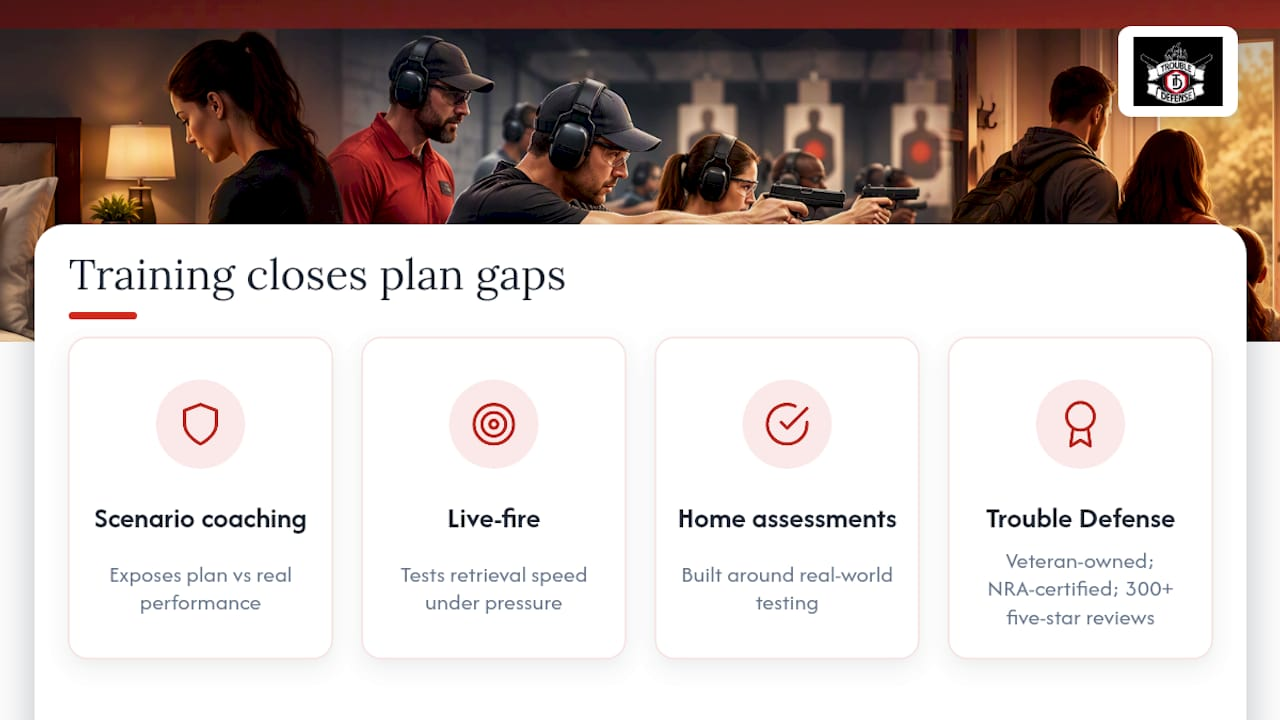
A written plan tells you what to do. Training tells you whether you can actually do it under pressure. Scenario coaching and live-fire fundamentals expose the gap between a plan on paper and real retrieval speed or decision-making. Trouble Defense, a veteran-owned academy with certified NRA instructors and over 300 five-star Google reviews, offers private firearm training and home defense assessments built around exactly this kind of real-world testing.
Final practical advice from a home defense trainer’s perspective
The plans that hold up aren’t the most detailed ones, they’re the ones families actually rehearse. Update yours every time your household changes, and don’t wait for a scare to find out your lockbox sticks or your kid doesn’t know the meeting spot.
— Dee Parker
Ready to put your plan to the test
Most of the mistakes in a home defense plan don’t show up until someone times themselves opening a lockbox in the dark or tries to recall a command under stress. Trouble Defense sessions are built to surface exactly that, with instructors who walk you through real retrieval drills, decision-making scenarios, and firearm fundamentals rather than just theory.

A few options fit naturally into the plan you just built:
- Private Firearm Training to test your draw and retrieval speed one on one.
- DMV Concealed Carry Training Package covering fundamentals plus concealed carry skills.
- Home defense assessment, an on-site walkthrough of your safe room, storage setup, and access points.
Book a session through the DMV Concealed Carry Training Package page and get hands-on with the skills your written plan assumes you already have.
Sources
- Ready
- Department of Justice policy on use of force
- Feasibility and Acceptability of a Virtual Reality Curriculum to Support Firearm Safety Counseling Skills
- Unintentional firearm injury deaths among children — MMWR
This article is general information, not a substitute for advice from a qualified lawyer. Consult a qualified legal professional about your own circumstances before acting on anything here.
FAQ
What is the safest gun to keep at home for home defense?
There’s no single “safest” firearm; the right choice depends on the shooter’s training, hand strength, and comfort with recoil. A handgun that a household member can reliably hit their target with and store securely in a quick-access lockbox is generally more useful than a larger or more powerful gun the shooter handles poorly.
What are some good home defense plans?
A solid plan combines a written escape route for every room, a designated safe room, secure but fast firearm access, and assigned roles for calling 911 and gathering family members, closely following the structure Ready.gov recommends for home emergencies. Practicing that plan regularly matters as much as writing it down.
What is the 21 foot rule in self-defense?
The 21 foot rule is a rough guideline suggesting a person with an edged weapon can close before a defender can draw and fire, though it’s a training reference point rather than a legal standard. It’s useful for thinking about distance and reaction time, not a rule that determines whether force is legally justified.
What is the most effective home defense weapon?
Effectiveness comes down to the shooter’s skill and familiarity with the firearm rather than the type of gun itself, since even a reliable handgun is only as useful as the training behind it. Regular practice, including drills that test retrieval speed and decision-making, matters more than the specific model chosen.