The best documented firearm safety certification programs in the DMV area are those that satisfy Maryland and Virginia state law, carry NRA or USCCA accreditation, and produce paperwork a court or licensing agency will actually accept. Get any one of those three wrong and your permit application gets denied before it reaches a reviewer’s desk.
Here is what the top recognized programs look like, what each state requires, and how to pick the right one.
1. Maryland Wear and Carry permit training
Maryland sets the strictest standard in the region. New applicants must complete at least 16 hours of instruction from a Qualified Handgun Instructor, pass a live-fire qualification at 70% accuracy on a certified range, and upload a signed MSP 29-14 Certified Qualification Score Sheet through the state’s licensing portal. Renewal applicants need 8 hours. Training completed more than two years before your application date will not be accepted, so timing matters.
The classroom component covers Maryland and federal firearm law, safe storage, conflict de-escalation, and suicide prevention. Skipping any piece, or using an instructor not listed in the eMDSP database, results in automatic denial.
2. Virginia concealed handgun permit training
Virginia takes a more flexible approach. The circuit court requires proof of demonstrated competence in person, but sets no minimum hour count. Accepted proof includes NRA or USCCA course certificates, affidavits from state-certified or nationally certified instructors, hunter safety completions, law enforcement training records, or documented competitive shooting experience.
Pro Tip: Virginia proof of competence never expires under state law, but courts still expect a certificate or instructor affidavit. Get that document in writing before you leave class.
One critical rule: online-only certificates have not been accepted for Virginia nonresident permits since January 1, 2021. In-person training is the only path.
3. NRA CCW Course
The NRA CCW Course covers multiple classroom lessons with duration varying depending on state requirements. It is specifically built to meet the minimum standards of every state that issues concealed carry permits, which makes it one of the most portable certifications you can hold. Virginia accepts it outright under § 18.2-308.02. Maryland accepts it when delivered by a Qualified Handgun Instructor who also administers the required live-fire component.
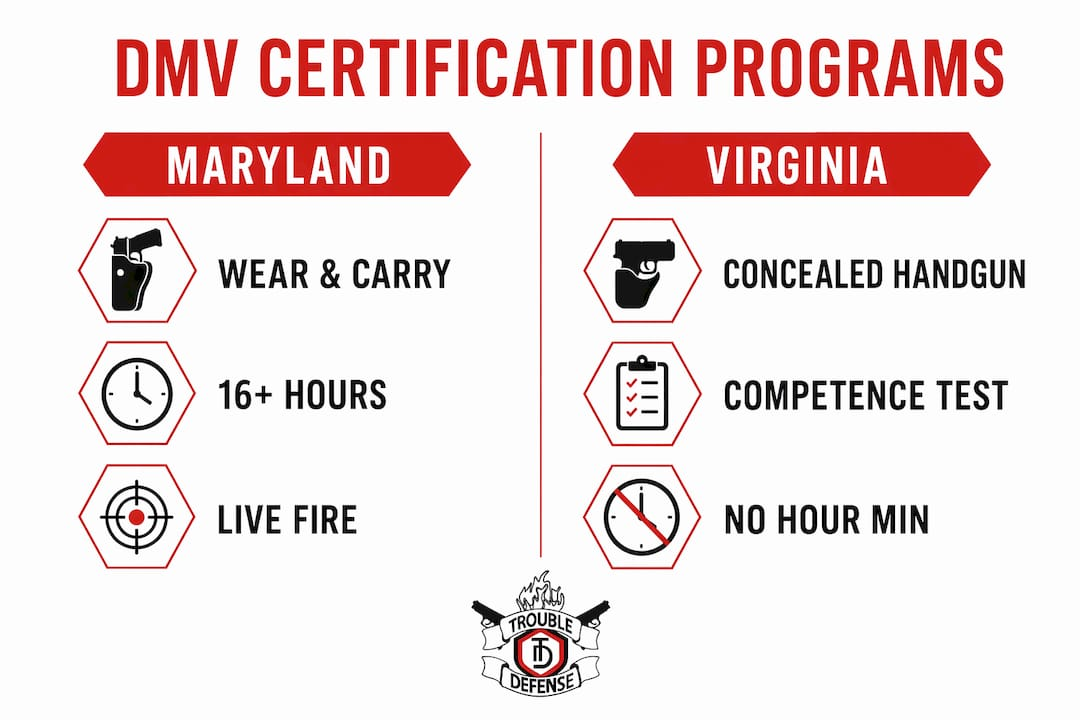
The NRA’s training network includes a very large number of instructors nationwide, which means you can find a certified course almost anywhere in the DMV.
4. USCCA certified courses
The United States Concealed Carry Association certifies instructors who teach courses recognized by Virginia for concealed handgun permit applications. USCCA courses emphasize legal use of force, situational awareness, and live-fire fundamentals. Like NRA courses, they satisfy Virginia’s competence requirement when delivered in person by a certified instructor. For Maryland, USCCA-certified instruction counts when the instructor also holds Qualified Handgun Instructor status with the Maryland State Police.
5. Maryland HQL firearms safety training
The Handgun Qualification License requires at least 4 hours of instruction from a Qualified Handgun Instructor, covering safe handling, storage, and basic operation. There is no renewal training requirement for the HQL itself, but the license is a prerequisite for purchasing a regulated firearm in Maryland. Many students complete HQL training as a first step before pursuing the full Wear and Carry permit.
6. Hands-on, personalized instruction from certified instructors
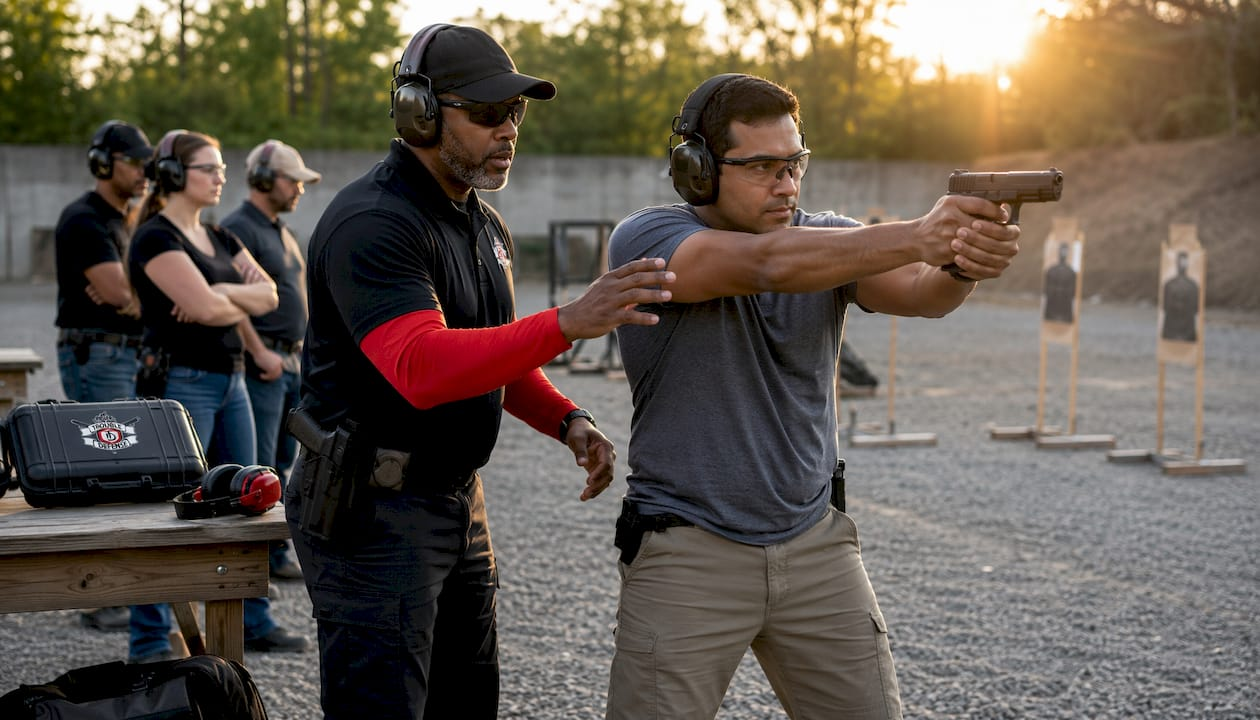
The gap between a passing score and real competence usually comes down to one thing: feedback during live fire. Nationally certified instructors who provide personalized, hands-on coaching produce students who retain skills far longer than those who sit through a lecture and fire a few rounds at the end. Look for programs where the instructor-to-student ratio stays low enough for individual correction.
For students with specific needs, adaptive programs and women’s firearm training courses offer the same certification outcomes in an environment built for their learning style.
7. Ongoing training beyond initial certification
Firearm proficiency is a perishable skill. NRA training experts recommend continuing with advanced, tactical, and private range sessions after initial certification to maintain both safety and legal readiness. Active shooter preparedness courses and reality-based training add practical layers that no one-day certification class can cover. Scheduling a refresher every six months keeps your mechanics sharp and your legal knowledge current.
8. Documentation standards and compliance verification
Good documentation is what separates a recognized certification from a piece of paper. For Maryland, that means a completed MSP 29-14 score sheet uploaded digitally within two years of your application. For Virginia, it means a course completion certificate or a signed instructor affidavit, per 19VAC30-190-50. Before you register for any course, confirm the provider issues the exact document your state requires. A compliance guide can help you verify what to collect before, during, and after training.
9. How to verify a program’s accreditation and legitimacy
Three checks cover most situations. First, confirm the instructor appears in the Maryland eMDSP database or holds a current NRA or USCCA certification number. Second, ask the provider which specific state permit the course satisfies and request a sample of the completion certificate. Third, check Google reviews and ask whether past students successfully used the certificate for their permit application. Over 300 five-star reviews is a meaningful signal; a provider with no verifiable track record is a risk you do not need to take.
10. Step-by-step timeline to obtain certification in the DMV
The process typically runs four to eight weeks from registration to permit in hand.
- Register for a state-compliant course with a Qualified Handgun Instructor (Maryland) or NRA/USCCA-certified instructor (Virginia).
- Complete training including all required classroom hours and live-fire qualification.
- Collect documentation: MSP 29-14 score sheet for Maryland; certificate or affidavit for Virginia.
- Submit your application through Maryland’s licensing portal or your Virginia circuit court.
- Background check and processing: Maryland processes within a reasonable time; Virginia courts have 45 days before a de facto permit issues automatically.
11. Trouble Defense LLC: top-rated local training in the DMV
Trouble Defense, a veteran-owned academy based in Fairfax, VA, covers every step of this process for Virginia, Maryland, and DC students. NRA-certified instructors lead all courses, from Virginia CCW certification to Maryland Wear and Carry training, Maryland HQL, and DC concealed carry preparation. Adaptive programs serve blind and low-vision students; dedicated women’s courses run regularly. With many five-star Google reviews and thousands of students trained since 2012, Trouble Defense is one of the most recognized names in DMV-area firearm education.
Key Takeaways
The most recognized firearm safety certification programs in the DMV combine state-compliant instruction hours, live-fire qualification, and proper documentation from NRA or USCCA-certified instructors.
| Point | Details |
|---|---|
| Maryland hours requirement | New Wear and Carry applicants need at least 16 hours; renewals need 8 hours. |
| Live-fire passing score | Maryland requires 70% accuracy on a certified range with a signed MSP 29-14 score sheet. |
| Virginia flexibility | Virginia accepts NRA, USCCA, and other in-person certifications with no minimum hour count. |
| Documentation is binding | Maryland requires digital upload within 2 years; Virginia requires a certificate or instructor affidavit. |
| Trouble Defense | Veteran-owned, NRA-certified, 300+ five-star reviews, serving VA, MD, and DC since 2012. |
Trouble Defense is the clearest path to a DMV concealed carry permit
If you want to skip the guesswork on which course actually satisfies your state’s requirements, Trouble Defense does that work for you. Every course is taught by NRA-certified instructors who know exactly what Maryland’s MSP 29-14 scorecard requires and what Virginia’s circuit courts accept. You leave class with the right certificate, the right documentation, and the confidence that comes from real range time with an instructor watching your technique.
Trouble Defense offers comprehensive firearm safety training for beginners through experienced shooters, plus specialized courses for women, adaptive learners, seniors, and security professionals. Check the training calendar and register for an upcoming class today.
FAQ
What are Maryland’s training requirements for a Wear and Carry permit?
New applicants must complete at least 16 hours of instruction from a Qualified Handgun Instructor and pass a live-fire test with 70% accuracy; renewals require 8 hours.
Does Virginia require a minimum number of training hours for a concealed handgun permit?
No. Virginia law requires demonstrated competence in person but sets no minimum hour count, accepting NRA, USCCA, and other certified in-person courses.
How do I verify that a certification program is legitimate?
Confirm the instructor holds current NRA or USCCA certification or appears in Maryland’s eMDSP database, and ask for a sample of the completion certificate your state’s licensing agency requires.
Will an online-only course satisfy Virginia’s concealed carry requirement?
No. Virginia stopped accepting online-only certificates for nonresident permits as of January 1, 2021, and in-person training is required for resident permits as well.
Does Trouble Defense offer courses for both Maryland and Virginia permits?
Yes. Trouble Defense provides Maryland Wear and Carry training, Maryland HQL courses, Virginia CCW certification, and DC concealed carry preparation, all taught by NRA-certified instructors in the Fairfax, VA area.