
Armed security training is the specialized process of preparing security professionals to carry and use firearms responsibly within the scope of their duties. Unlike civilian firearms courses, professional armed security training covers use of force law, tactical judgment, situational awareness, and live-fire qualification under state-regulated standards. Security professionals in Virginia, Maryland, Washington DC, and across the country must meet specific credentialing requirements before carrying a firearm on duty. This guide breaks down what that training involves, what the law requires, and how to choose a program that builds real-world competency, not just a certificate.
What are the armed security training requirements by state?
Training requirements vary significantly by state, and the gap is wider than most professionals expect. Florida requires 28 hours for Class G licensing, while New York mandates 47 hours for armed security certification. That 19-hour difference represents an entire additional week of instruction, which means the depth of legal and tactical preparation varies considerably depending on where you work.
Most states set the minimum age for an armed security license at 21. However, Texas, Arizona, Virginia, and Pennsylvania allow certification at 18 when all other requirements are met. Security professionals in the DMV area should note that Virginia falls in this group, making it one of the more accessible states for younger candidates entering the field.
The table below compares key requirements across four major states to help security professionals and organizations plan accordingly.
| State | Minimum training hours | Minimum age | License type |
|---|---|---|---|
| Florida | 28 hours | 21 | Class G Armed License |
| New York | 47 hours | 21 | Armed Guard Registration |
| Virginia | Not publicly listed | 18 | DCJS Armed Registration |
| Texas | Varies by level | 18 | Level III Security License |
One distinction that catches many professionals off guard: an armed security license is not the same as a civilian concealed-carry permit. The two credentials serve different legal purposes, and a civilian permit does not substitute for a security license while on duty.
What core skills does an effective security training program cover?
The best security training programs go well beyond marksmanship. Effective curricula address the full range of skills a security professional needs to make sound decisions under pressure, not just put rounds on a target.
The Texas Level III Private Security curriculum, for example, includes all of the following modules:
- Use of force law: Understanding when force is legally justified and what level is appropriate
- Situational awareness: Identifying threats before they escalate to physical confrontation
- Conflict resolution: De-escalating tense situations without drawing a weapon
- Firearm safety and maintenance: Safe handling, storage, and proper gun cleaning procedures
- Defensive tactics: Weapon retention, physical control techniques, and body positioning
- Incident scene management: Securing a scene and coordinating with law enforcement
- Emergency first aid: Basic trauma response, including Stop the Bleed protocols
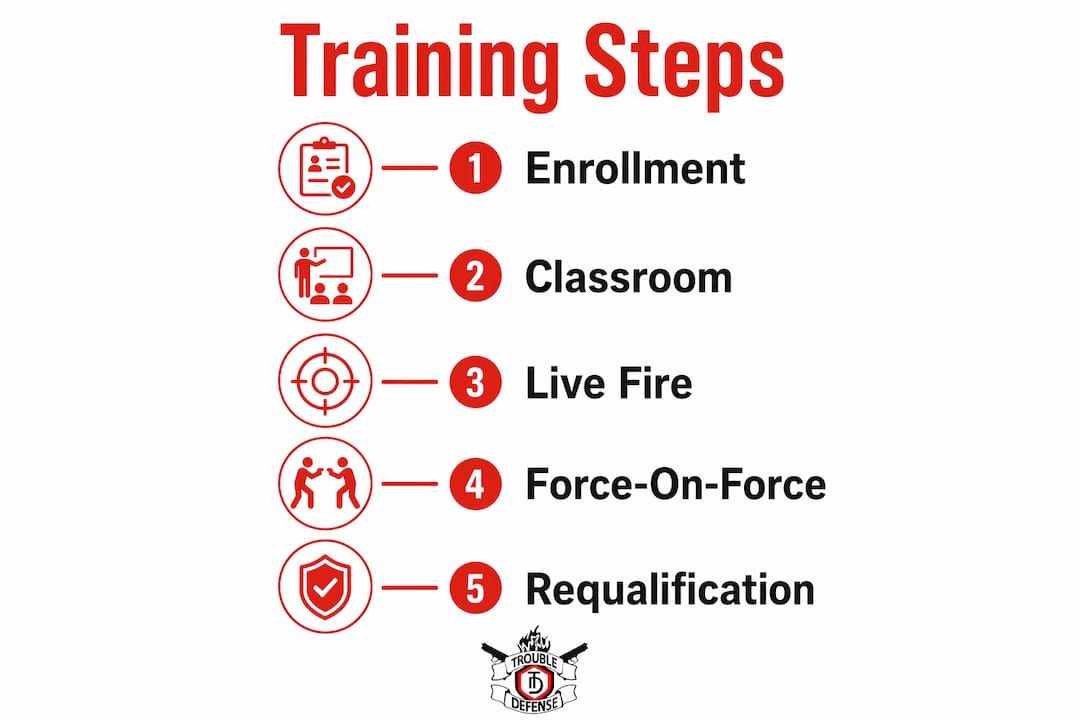
Classroom instruction on law and tactics pairs with mandatory live-fire range qualifications to build both knowledge and physical competency. Neither component alone produces a ready professional.
Pro Tip: Look for programs that include force-on-force scenario drills, not just static range shooting. Stress-inoculation exercises, where you practice decision-making under simulated pressure, build the muscle memory and judgment that matter most in real incidents.
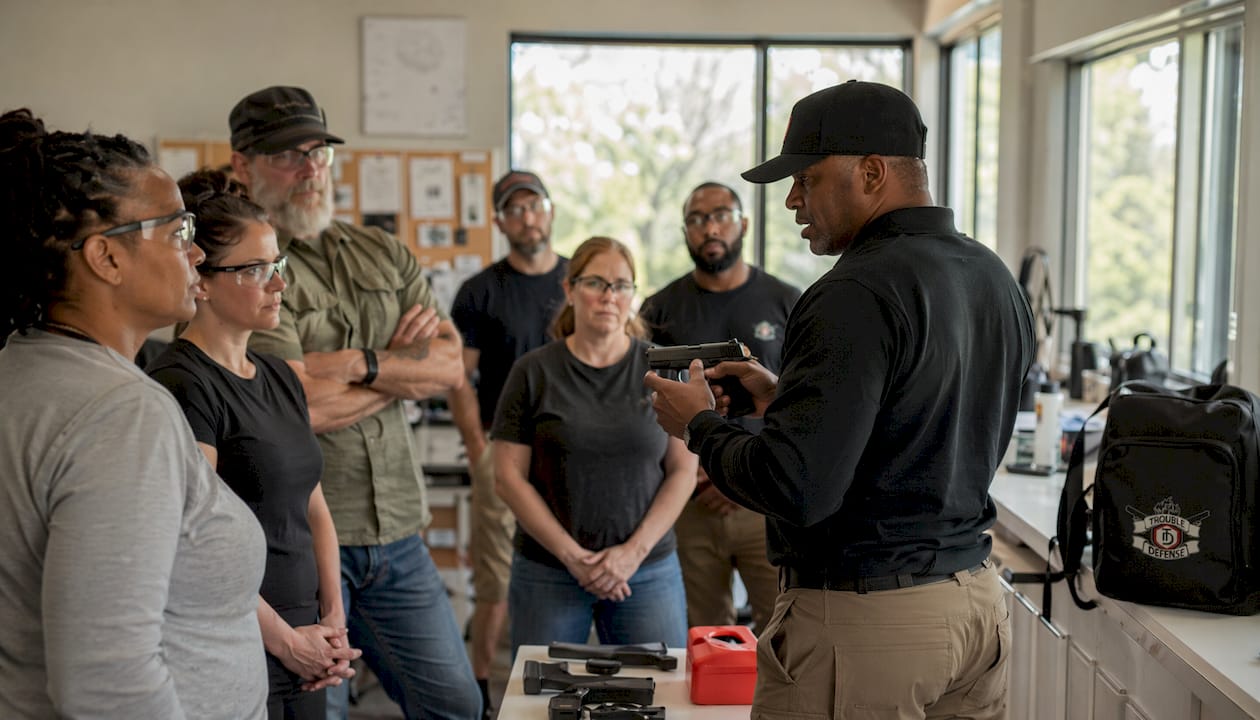
Defensive tactical skills like weapon retention and conflict management are where most failure points actually occur. Poor situational control, not poor marksmanship, is the more common cause of serious incidents in the field.
How do you maintain armed security qualifications over time?
One-time training is not enough to maintain operational readiness. Professional standards require ongoing dry-fire practice and range sessions to keep decision-making skills and muscle memory sharp. A security professional who qualified two years ago and has not trained since is not the same professional who passed that course.
Florida makes this explicit: skipping annual live-fire requalification results in suspension of the armed guard license, regardless of original certification. Most states with armed security licensing frameworks have similar provisions. Employers who allow officers to lapse on requalification expose themselves to significant liability.
Ongoing training should include:
- Annual live-fire range days to meet state requalification standards
- Dry-fire drills at home to maintain trigger control and draw mechanics
- Tactical scenario reviews to keep decision-making frameworks current
- Legal updates on use-of-force statutes, which change at the state level
Pro Tip: Add supplemental courses like Stop the Bleed and advanced de-escalation training to your annual schedule. These go beyond minimum legal standards and address the real-world, high-stress situations that basic certification rarely covers.
Advanced firearms training is not a luxury for security professionals. It is the difference between a credential that satisfies a licensing board and a skill set that holds up under real pressure.
How do you select the right armed security training program?
Choosing a training program requires more than checking a box for state compliance. Programs with documented pass rates and current curricula produce officers who are genuinely prepared, not just technically licensed.
Use the criteria below to evaluate any program before enrolling your team or yourself.
| Evaluation criterion | What to look for |
|---|---|
| State-approved accreditation | Verify the program is recognized by your state’s licensing authority |
| Instructor qualifications | Confirm instructors hold current certifications and field experience |
| Curriculum currency | Check that use-of-force law content reflects current statutes |
| Live-fire component | Confirm range qualification is included, not just classroom hours |
| Tactical scenario training | Look for scenario-based exercises beyond static target shooting |
| Pass rate transparency | Ask for documented completion and pass rates |
Public safety training programs that emphasize decision-making and de-escalation alongside firearms skills produce officers who perform better in the field. A program that only teaches you to shoot is not preparing you for the job.
Organizations hiring armed security teams should also verify that each officer’s credentials are current before deployment. Credential gaps create liability exposure the moment an incident occurs.
What legal and liability issues apply to armed security professionals?
The legal distinction between an armed security license and a civilian concealed-carry permit is one of the most misunderstood issues in the field. An armed security license is job-specific and requires employer authorization. A civilian permit does not grant the right to carry a firearm while performing security duties, and using one as a substitute creates immediate legal exposure.
Employer liability shifts the moment a firearm is authorized for on-duty carry. Adherence to agency policies and periodic requalification become critical risk management tools, not optional best practices. An officer who carries on duty without current credentials exposes both themselves and their employer to civil and criminal liability.
“Professional judgment and legal understanding of use-of-force statutes are more important than marksmanship alone for armed security effectiveness. Instructors emphasize ‘safety beyond the range’ as critical to preventing career-ending liabilities.” — Armed Security Class G Course, Florida
Security professionals working across Virginia, Maryland, and DC face an additional layer of complexity. Each jurisdiction has its own licensing authority, carry rules, and use-of-force framework. Navigating multi-state requirements requires deliberate planning, not assumptions carried over from one state’s rules to another.
The practical advice is straightforward: confirm your credentials are current, confirm your employer has authorized your carry, and confirm your training reflects the laws of the jurisdiction where you work. All three must align before you carry on duty.
Key Takeaways
Effective armed security training combines legal knowledge, tactical judgment, and ongoing live-fire practice to produce professionals who are both compliant and genuinely prepared for high-stakes situations.
| Point | Details |
|---|---|
| State requirements vary widely | Training hours range from 28 in Florida to 47 in New York, so verify your state’s specific mandate. |
| Licenses differ from carry permits | An armed security license is job-specific and requires employer authorization; a civilian CCW does not substitute. |
| Requalification is legally required | Missing annual live-fire requalification suspends your license in states like Florida, regardless of original certification. |
| Curriculum depth matters | The best programs cover use of force, defensive tactics, scenario drills, and first aid, not just marksmanship. |
| Ongoing training is non-negotiable | Dry-fire practice, legal updates, and supplemental courses maintain the readiness that initial certification cannot sustain alone. |
Why armed security training is about judgment, not just shooting
By Dee Parker
After years of working with security professionals at every experience level, the pattern I see most often is this: officers who passed their initial certification and then stopped training. They have the credential. They do not have the readiness.
The biggest misconception in this field is that passing a firearms qualification makes you prepared. It makes you licensed. Those are two different things. Transitioning from classroom theory to real-world application is where most officers struggle, and it is where most training programs fall short. A static range qualification does not teach you what to do when a situation is ambiguous, when de-escalation is possible but time is short, or when your employer’s policy and your instinct point in different directions.
What I have found actually works is this: train the decision, not just the draw. Scenario-based exercises that force you to assess, decide, and act under time pressure build the judgment that protects you legally and professionally. Defensive shooting scenarios are not a bonus module. They are the core of what makes a security professional effective.
The officers I have seen perform best under real pressure are not necessarily the best shots on the range. They are the ones who trained consistently, understood the law, and knew exactly when not to use their firearm. That combination is what armed security training should produce, and it is the standard every program should be held to.
— Dee Parker
Trouble Defense training for armed security professionals
Security professionals and organizations in the DMV area have access to training that goes beyond minimum certification requirements. Trouble Defense, a veteran-owned firearms training academy based in Fairfax, VA, offers security firearms training and tactical courses designed for professionals who need more than a basic qualification.
Trouble Defense serves Virginia, Maryland, and Washington DC with programs led by certified NRA instructors. Whether your team needs initial armed guard certification, annual requalification, or advanced tactical scenario training, Trouble Defense builds programs around your operational requirements. The academy also offers Maryland Wear and Carry training and Virginia CCW instruction for professionals who carry across jurisdictions. With over 300 five-star Google reviews, Trouble Defense has built a reputation for producing confident, legally prepared professionals across the DMV area. Contact Trouble Defense to discuss training options for your team or individual career goals.
FAQ
What is armed security training?
Armed security training is a state-regulated program that prepares security professionals to carry and use firearms lawfully on duty. It covers use of force law, firearm handling, tactical judgment, and live-fire qualification.
How many training hours are required for armed security certification?
Training hour requirements vary by state. Florida requires 28 hours for Class G licensing, while New York mandates 47 hours for armed security certification.
Is an armed security license the same as a concealed-carry permit?
No. An armed security license is job-specific and requires employer authorization. A civilian concealed-carry permit does not substitute for a security license while on duty.
How often do armed security officers need to requalify?
Most states with armed security licensing require annual live-fire requalification. In Florida, missing this requirement results in license suspension regardless of original certification status.
What should I look for in an armed security training program?
Choose a program with state-approved accreditation, qualified instructors, current use-of-force curriculum, mandatory live-fire range qualification, and scenario-based tactical exercises.