Federal law sets the floor: licensed dealers can’t sell a handgun to anyone under 21 or a long gun to anyone under 18, and possession of a handgun by anyone under 18 is generally illegal. The one exception that matters most for families: a minor may handle a handgun for target practice, hunting, or instruction if a parent has given prior written consent. State law and individual range policies can be stricter, so call ahead, bring photo ID, and carry that signed consent letter with you.
TL;DR:
- Many ranges set their own minimum age requirements for entry and shooting, often higher than federal law’s restrictions.
- Parental written consent is essential for minors to handle or shoot firearms legally during supervised activities, but not for casual possession or non-supervised use.
- State laws frequently raise the minimum age for purchase or possession, sometimes linked to hunter education or youth hunting programs starting as early as age 11 or 12.
- Range policies typically require signed liability waivers, parental consent letters, and appropriate documentation, which may vary by activity and state.
- Always verify local, state, and range-specific rules beforehand to ensure compliance and proper documentation, especially when crossing state lines or planning a trip.
Table of Contents
- Federal Range Age Requirements: The Statutes Behind the Rules
- How State Laws Change the Picture
- What Ranges Actually Require When You Show Up
- Your Range Day Checklist: Documents to Bring
- Hunting, Competitions, and Apprentice Programs: The Exceptions Within the Exceptions
- What Trainers See at Intake, and Why It Changes the Outcome
- Get Certified and Confident Before Your Next Range Visit
- Primary Sources Worth Bookmarking
- Sources
- FAQ
Federal Range Age Requirements: The Statutes Behind the Rules
The starting point for any range age requirements question is 18 U.S.C. 922, the federal statute that governs firearm sales and transfers. Licensed dealers cannot sell handguns or handgun ammunition to anyone they know or have reason to believe is under 21, and they cannot sell long guns like rifles or shotguns to anyone under 18, according to ATF guidance on minimum age for gun sales and transfers. That’s a sale-age rule, not a possession rule, and the difference matters at a range.
Federal law separately makes it generally illegal for anyone under 18 to possess a handgun. But there’s a carve-out built specifically for situations like a family range trip: a minor can possess a handgun for target practice, hunting, or firearms instruction if a parent or guardian has given prior written consent, per Giffords Law Center’s summary of federal minimum-age law.
A few things follow from that setup:
- Buying a firearm and briefly handling one under supervision are legally different acts, governed by different rules.
- A range letting a 14-year-old shoot a rented .22 pistol under a parent’s watch isn’t violating federal law, as long as consent exists.
- The consent has to be in writing and, per the statute’s practical interpretation, on the minor at the time.
- No federal exception covers unsupervised handgun possession by a minor outside these specific activities.
How State Laws Change the Picture
Federal law is the floor, not the ceiling. States regularly raise the bar, and a rule that’s perfectly legal in one state can be a violation twenty miles away, once you cross a state line.
Some states have pushed purchase or possession ages up to 21 across the board, closing gaps that federal law leaves open for long guns. Others build out detailed hunter-education frameworks that let younger minors handle firearms in the field long before they could legally buy one. Washington State, for example, ties youth hunting and possession privileges to completion of a hunter education course, with specific age thresholds spelled out in its own statute on hunter education and age rules. Florida, similarly, has its own minimum-age framework for purchase and possession that layers on top of the federal baseline, detailed by Giffords’ state-specific guidance.
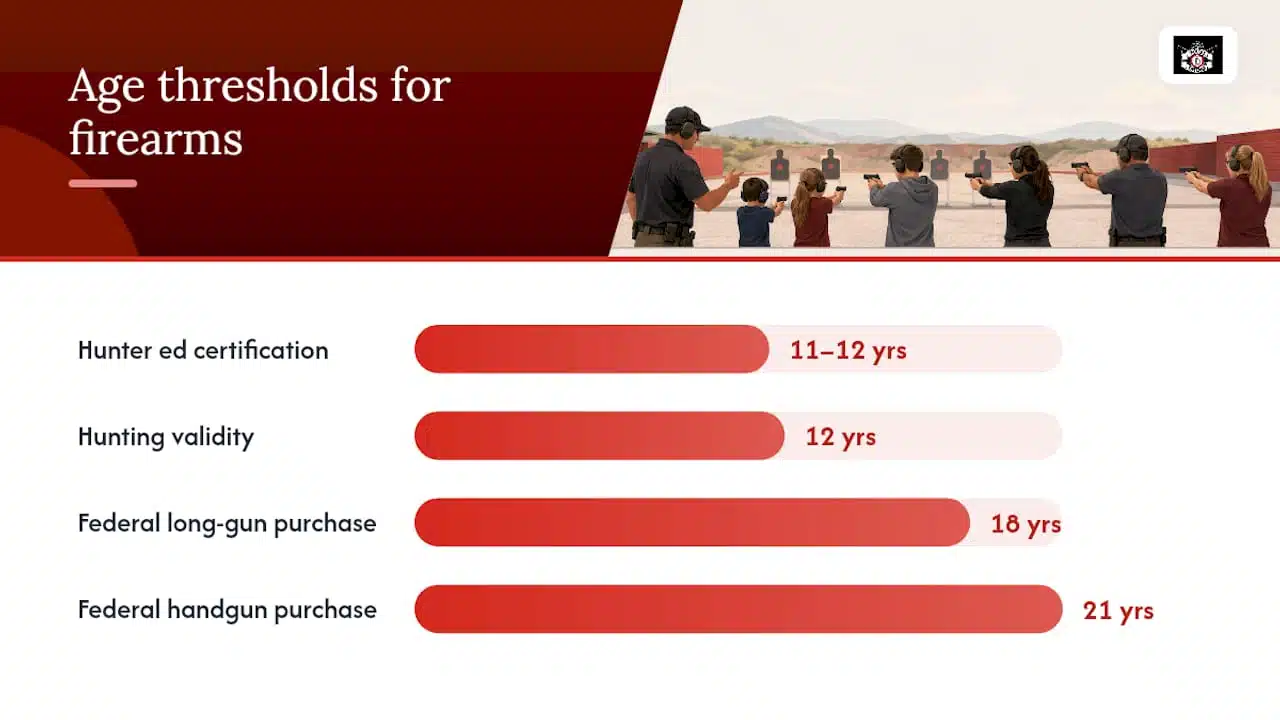
Quick fact: hunter education programs in states like Minnesota let kids as young as 11 or 12 complete certification coursework, with hunting validity often starting at age 12 — years before they could legally purchase a firearm themselves.
Before you plan a range visit, especially while traveling:
- Check your state’s fish and wildlife or public safety agency website for hunter-education and youth possession rules.
- Search for your state’s firearm statute directly, not just a summary blog post.
- Call the range itself. Written law and posted range policy don’t always match.
- If you’re crossing state lines, check the destination state’s rules, not just your home state’s.
What Ranges Actually Require When You Show Up
Law sets the outer boundary. Range policy is what actually determines whether your kid gets to shoot that day, and most commercial ranges layer their own rules on top of the legal minimums, partly for insurance reasons and partly for plain safety management.
- Entry age floors. Many ranges set a minimum age to walk onto the range floor, often around the age of early elementary school or higher, according to LegalClarity’s review of range policies for minors.
- Shooting age floors. A separate, usually higher, minimum age for actually firing a firearm, typically in preteen to early teen years.
- Supervision ratios. Expect an “arm’s reach” rule, meaning a responsible adult stays within arm’s length of the minor at all times, sometimes with a one-adult-to-one-minor cap.
- Caliber and firearm restrictions. Most ranges start minors on low-recoil options like smaller caliber firearms and may restrict rentals for younger shooters regardless of parental ownership.
- Waivers and consent forms. Nearly every range requires a signed liability waiver, and many build parental consent language directly into that paperwork.
Pro Tip: Don’t assume the range’s waiver satisfies the federal written-consent requirement. Legally, the burden is on the parent and minor, so bring your own signed consent letter even if the range hands you a form to sign at the counter.
Your Range Day Checklist: Documents to Bring

Showing up without the right paperwork is the most common reason families get turned away or delayed. A government-issued photo ID is standard for adults, and most ranges don’t ask for anything more exotic than that. No special gun license is typically required just to visit and shoot, according to LegalClarity’s breakdown of range entry requirements.
For minors, bring:
- A written parental consent letter naming the supervising adult, the activity, the date, and a contact number.
- A photocopy of the parent’s ID if that parent won’t be physically present.
- Hunter-education certification, if the visit relates to a hunting-prep program.
- Custody paperwork, if someone other than a parent is the supervising adult.
| Who | What to bring |
|---|---|
| Adult/guardian | Government-issued photo ID |
| Minor (target practice) | Signed written parental consent letter |
| Minor (hunting prep) | Hunter-education certificate |
| Non-parent supervisor | Custody or guardianship documentation |
Our firearm safety documentation guide walks through how to draft that consent letter correctly.
Hunting, Competitions, and Apprentice Programs: The Exceptions Within the Exceptions
Recreational range visits aren’t the only path minors have into legal firearm use. Hunter-education and apprentice-hunter programs open the door earlier than most people expect, provided the paperwork is in order.
- Many states let kids complete hunter-education coursework starting around age 11 or 12, with field validity often kicking in at 12.
- Apprentice or mentored-hunter programs let a younger participant hunt under close, direct adult supervision before they’ve completed full certification.
- Competition shooting sports (like youth trap or rifle leagues) typically run under their own sanctioning-body age rules, separate from state hunting law.
- These pathways are activity-specific. Certification for hunting doesn’t automatically extend to unsupervised range use or ownership.
What Trainers See at Intake, and Why It Changes the Outcome
Instructors who work with families regularly run through the same intake sequence: verify ID, confirm written consent, ask about prior experience, then match the child to a firearm that won’t overwhelm them physically. Recoil management, not marksmanship, is usually the first real hurdle for a first-time young shooter.
Staged progression works better than throwing a kid straight onto a live lane. Classroom safety fundamentals first, then dry-fire or coached handling, then short, supervised live sessions with breaks. That sequence is why some veteran-owned training academies build youth firearm safety programs around structured, hands-on stages rather than a single walk-in session, with positive reviews from families across the DMV area backing that approach.
— Dee Parker
Get Certified and Confident Before Your Next Range Visit
This training provider offers an alternative to guessing your way through a first range visit with a minor. Instead of piecing together consent forms and hoping the range’s policy matches what you read online, families can receive hands-on guidance from certified NRA instructors who walk you through the paperwork and supervision standards before anyone touches a firearm.
The programs available cover youth firearm safety education, women’s firearms training, adaptive instruction for blind and low-vision students, and concealed carry certification options for parents who want their own permit sorted out at the same time. If you’re wondering how a course fits into what you’ve read here, our firearm safety training guide explains the formats available and how a staged, supervised approach reduces both legal risk and safety risk for first-time young shooters. Reach out to Trouble Defense today to book a session and walk into your next range visit already prepared.
Primary Sources Worth Bookmarking
- ATF’s minimum-age infographic lays out the federal sale-age statute in plain terms.
- Giffords Law Center’s minimum age overview covers the possession exception and links to state-specific rules.
- Washington’s hunter education statute shows how one state builds age rules into certification.
- Minnesota DNR’s firearms safety page details a typical hunter-education age pathway.
- For legal commentary specific to your state, resources like MPC Law’s firearm law guidance can help you track down the exact statute language.
This article is general information, not a substitute for advice from a qualified lawyer. Consult a qualified legal professional about your own circumstances before acting on anything here.
Sources
- ATF — Minimum age for gun sales and transfers (infographic)
- Giffords Law Center — Minimum age
- LegalClarity — Can minors shoot guns at a gun range?
- Minnesota DNR — Firearms safety and hunter education
FAQ
What is the minimum age to buy a gun at a range?
Federal law sets the FFL sale minimum at 21 for handguns and 18 for long guns, per ATF guidance. Most ranges don’t sell firearms directly to visitors anyway. That rule applies to licensed dealers, not to shooting or renting under supervision.
Can a minor shoot a handgun at a range?
Yes, under the federal exception for target practice, hunting, or instruction, but only with prior written parental consent, according to Giffords Law Center. Many ranges also set their own minimum shooting age on top of that federal rule.
Do tourists need a special license to shoot at a U.S. gun range?
No special gun license is typically required to visit a range. A government-issued photo ID is generally enough for entry and age verification, per LegalClarity, though international visitors should confirm ID requirements with the specific range beforehand.
What paperwork does a minor need to bring to a shooting range?
Bring a signed written parental consent letter naming the supervising adult and the activity, plus a copy of that adult’s photo ID if they won’t be present in person. Hunter-education certificates apply only if the visit relates to hunting preparation, not standard target practice.
Does Trouble Defense offer training for families with minors?
Yes. Trouble Defense provides youth firearm safety education, adaptive programs, and staged, hands-on instruction designed to prepare minors and their parents before a first live-fire range session.
Can a 10-year-old legally shoot a firearm at a range?
It depends on the range’s internal policy and the state you’re in, since federal law doesn’t set a specific minimum age for supervised target practice. Many facilities set their own shooting-age floor between 10 and 14, so calling ahead is the only reliable way to confirm.