
You hear gunfire at work. What do you do?
Active shooter at work training starts with the room you’re in. Picture your desk, the people beside you, and the door you’d use if the lobby were unsafe.
Which door would you point to in an active shooter at work?
It’s 10 on a Tuesday. A visitor is signing in. A new hire is waiting for a badge. You hear what sounds like gunfire near reception during an active shooter at work. The visitor turns to you and asks, “How do we get out?”
Could you point to a safe way out from where you’re sitting? Would that route work for someone using a wheelchair in an active shooter at work? What if you were shopping with your family instead of sitting at your desk during an active shooter at work?
If one of those questions made you pause, take it to your next staff meeting. Ask people to point to a second exit from their own work area. An answer like “I think that door is locked” gives your team something concrete to check today.
What would you do first?
Three people in the same building can have different safe options. Pick a response to see how one detail changes the decision. You can change your answer or skip ahead at any time.
In an actual emergency, call 911 as soon as it’s safe.
Based on the FBI’s civilian response guidance ↗01A visitor needs a way out
You’re at the front desk. A coworker sees a shooter near the main lobby. The side door next to you leads outside, away from the danger. A visitor beside you doesn’t know the building.
02The hallway is unsafe
You’re in a conference room. Gunfire is coming from the hallway, the room has a door you can lock, and there is no other safe exit.
03You are outside and safe
You have reached safety. You saw the incident from the reception desk and know the street address. Someone nearby says they heard a second shooter was upstairs.
Match your response to the danger.
The FBI describes three options for someone facing an active shooter. Where you are, where the danger is, and whether you have a safe way out should guide your choice.
Run
If a safe route leads away from the danger, use it. Leave bags behind. Help someone else get out if you safely can. A familiar entrance may be the wrong way to go.
Hide
If you can’t get out safely, get out of sight. Secure the door if possible, quiet your devices, and turn vibration off. Stay quiet.
Fight
Physical resistance is a last resort when your life is in immediate danger and you cannot safely escape or hide.
When officers arrive, keep your empty hands visible and follow their directions. From safety, give 911 the street address, the floor or entrance, and what you actually saw or heard. It’s okay to say you don’t know.
Read the FBI quick-reference guide ↗
Recent shootings in places people know.
A store at the end of a shift. A classroom in the middle of the day. These are selected U.S. incidents reported through November 3, 2026. Each entry uses the description supported by its source. The separate FBI index below covers every incident in its latest completed annual report.
Fairfield, California Solano Town Center
Police described the shooting inside a seasonal store as targeted. One woman was killed and six people were wounded. For a retail team, a practical question is how a temporary employee could guide shoppers to an unfamiliar exit.
Associated Press ↗Bend, Oregon Silver Rail Elementary School
Three children and a teacher were killed when a gunman opened fire in a classroom. The school community lost people it knew and loved. A question for school leaders is how each classroom receives instructions in a form every student can use.
Police account reported by ABC News ↗Manassas, Virginia United Rentals
Manassas police reported that an employee shot three coworkers. Two died and one was injured. If a supervisor is among the people affected, who else on your shift knows how to notify staff?
Manassas police account reported by ABC News ↗Waynesboro, Virginia Westwood Hills Elementary School
A staff member was shot and students sheltered during a lockdown. Families later reunited at a nearby church. For anyone responsible for visitors or children, the plan needs to cover how people reconnect after they reach safety.
Virginia Mercury ↗Minneapolis, Minnesota Loring Park apartment building
Police responding to gunfire found victims in the lobby and heard more shots. The city identified a separate location where residents could reunite. Could a property manager give clear directions to residents who are already outside?
City of Minneapolis ↗Norfolk, Virginia Old Dominion University
A shooting in Constant Hall killed an ROTC instructor and wounded students. The university later released an independent review. A department can use the same habit after a practice session by recording what was confusing and who will follow up.
Old Dominion University ↗Evergreen, Colorado CommonSpirit Primary Care
The Jefferson County Sheriff’s Office called the gunfire inside a medical office an active shooter incident. Deputies cleared both the office and the surrounding shopping center. Does your plan account for patients or visitors who have never seen the back of your building?
Jefferson County Sheriff’s Office ↗Explore all 34 FBI-designated cases from 2025
The FBI designated 34 active shooter incidents in 2025. Fourteen occurred at businesses. Open a quarter for the dates and locations, or read the original case summaries. Full FBI annual report ↗
January–March · 6 cases
- Antioch High School · Antioch, Tennessee
- Southern Hens Inc. · Moselle, Mississippi
- KDC/ONE warehouse · New Albany, Ohio
- Harris Teeter · Crozet, Virginia
- C.F. Harvey Parkway and NC 11 · Kinston, North Carolina
- Walgreens · Madera, California
April–June · 8 cases
- Chevron · Baker, California
- 800 block of Middle Road · Sabattus, Maine
- Florida State University · Tallahassee, Florida
- Multiple locations · Memphis, Tennessee
- Jackson County Public Library · Seymour, Indiana
- 500 block of Third Street NW · Washington, D.C.
- CrossPointe Community Church · Wayne, Michigan
- Canfield Mountain · Coeur d’Alene, Idaho
July–September · 16 cases
- Border Patrol Rio Grande Valley Sector Annex · McAllen, Texas
- Interstate 5, milepost 15 · Ashland, Oregon
- Grand Sierra Resort · Reno, Nevada
- 345 Park Avenue · New York, New York
- The Owl Bar · Anaconda, Montana
- 2nd Armored Brigade Combat Team complex · Fort Stewart-Hunter Army Airfield, Georgia
- Centers for Disease Control and Prevention · Atlanta, Georgia
- Target · Austin, Texas
- Annunciation Roman Catholic Church · Minneapolis, Minnesota
- Alas Locas Bar · Liberty County, Texas
- Evergreen High School · Evergreen, Colorado
- Sky Meadow Country Club · Nashua, New Hampshire
- Immigration and Customs Enforcement field office · Dallas, Texas
- American Fish Company · Southport, North Carolina
- Kickapoo Lucky Eagle Casino Hotel · Eagle Pass, Texas
- The Church of Jesus Christ of Latter-day Saints · Grand Blanc Township, Michigan
October–December · 4 cases
- Mission Landscape Supplies · San Antonio, Texas
- 17th and I Street NW · Washington, D.C.
- Brown University · Providence, Rhode Island
- Shoshone County Sheriff’s Office · Wallace, Idaho
Inside the I-66 active shooter at work training in Manassas.
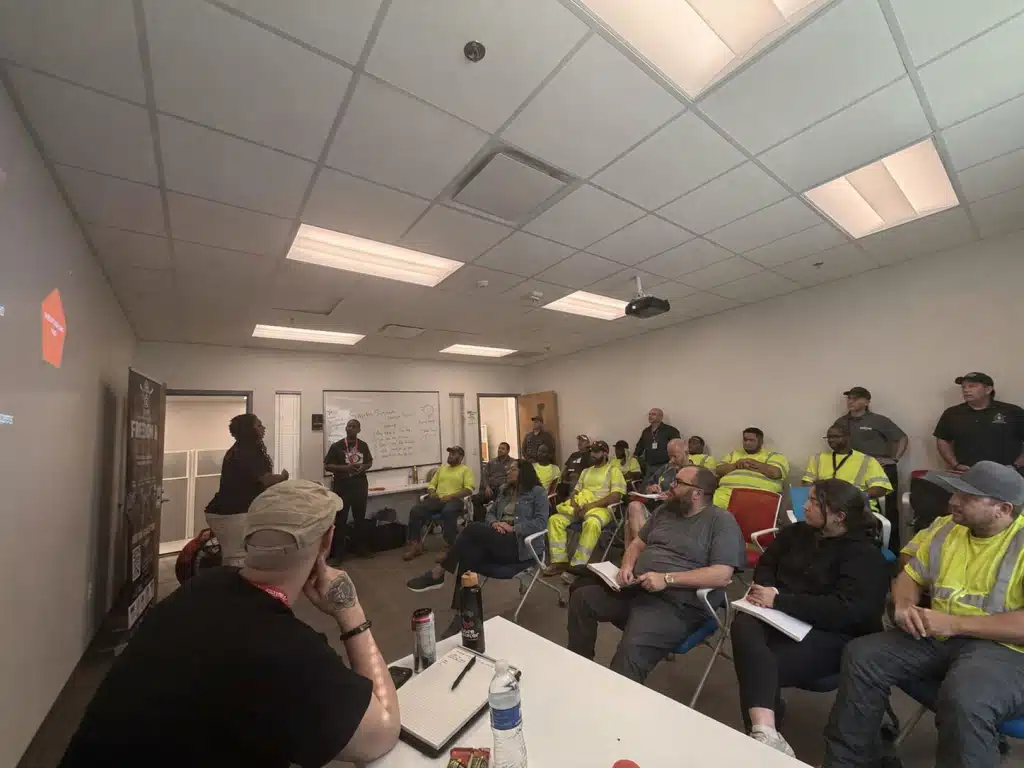
How do you train a hundred people while a transportation operation keeps moving? In August 2026, we delivered the same four-hour program twice for I-66 Express Mobility Partners, which operates the 66 Express Lanes Outside the Beltway. Employees could participate in groups while their coworkers kept operations running.
What employees practiced
After a safety briefing, employees rotated through four stations. One involved a conflict between coworkers. Another involved a threatening customer. The last two covered an edged-weapon threat and an active shooter at work emergency. The changing situations gave employees a chance to decide when to speak, move away, or get to safety.
What happened after practice
Our instructors brought the group back together to discuss the decisions people made, the information they had, and what they might do differently. Employees could ask about the choices that felt unclear. Participants who completed the program received certificates.
We’ve also trained teams in education, hospitality, and senior living. A hotel needs to account for guests who arrived that morning. A school has to get instructions to a substitute teacher. We start by asking who depends on your staff and what those people would need to hear.
See the I-66 photos and program recap ↗Give the newest person a turn.
Ask someone who recently joined your team to describe the exit they would take in an active shooter at work. Then ask the person who closes the building. A door that’s available at noon might be locked after the public leaves. That difference belongs in your training.
Walk the route together during a normal shift, so you know it in an active shooter at work. Invite coworkers with access or communication needs to describe what works for them. Before the meeting ends, give one person responsibility for checking any unanswered question and set a date to report back.
Can your team do these four things?
Before you book an active shooter at work session.
Can we start with a discussion at a staff meeting?
Yes. Ask us about an instructor-led discussion built around a room your staff knows. We can walk through a situation together, hear the questions it raises, and discuss whether your team would benefit from hands-on scenarios.
Do employees need firearms experience?
No. The employee decisions covered here include recognizing danger, finding a safe route, sheltering when leaving is unsafe, and communicating with responders. Front-desk staff, supervisors, contractors, and new hires can all take part in that conversation.
How do we include people with different access needs?
Tell us about the barriers your staff or visitors might encounter, such as stairs on an exit route, announcements that are hard to hear, or instructions available in only one language. We can discuss those needs with your planning team before the session.
How much does workplace training cost?
We quote group training around your location, headcount, session length, and number of shifts. Send those details and tell us whether you want a briefing or time to practice. We’ll help you choose a format. Request a group quote.
Can a nonprofit apply for a donated seminar?
Yes. Through the Trouble Defense Community Safety Initiative, we select one community-serving group each quarter for an instructor-led preparedness seminar with no instructor fee. Apply for your organization.
Can I ask about training for just myself?
Yes. Tell us your city and that you’re looking for individual active shooter preparedness training. We’ll let you know what options are available. Ask about individual training.
Let’s start with your building.
Tell us where your team works, how many people need training, and one active shooter at work situation you want to practice. If all you have is a question, send that. Our team will help you work out the next step.
Prefer to talk? Call 703-835-0692. Interested in a single seat? Ask about joining a class.