If you carry with kids present, lock up every firearm you are not wearing, use a holster with real retention when you are, keep ammunition stored separately, and talk to your kids about guns before a crisis forces the conversation. Check right now: are all off-body firearms locked, is ammunition stored apart, and are bags or purses with a firearm ever within a child’s reach? These priorities track guidance from the CDC and the American Academy of Pediatrics.
TL;DR:
- Choose a holster with adjustable retention and full trigger guard coverage, and practice unloaded seated draws before carrying near car seats or strollers.
- An off body firearm belongs in a dedicated, lockable bag compartment that stays on your body or within arm’s reach, not on a playground bench.
- Although 25% to 41% of owners in homes with children still kept a firearm loaded and unlocked, layer locks and store ammunition separately.
- Teach mobile toddlers to stop, leave, and tell an adult when they see a firearm, then revisit the rule regularly as children’s independence grows.
- If someone at home is in crisis, arrange temporary firearm storage elsewhere, but check state transfer laws before giving a firearm to another person.
Table of Contents
- Choosing Holsters That Reduce Accidental Access
- Safe Concealment in Bags, Purses, and Backpacks
- Secure Storage at Home: Safes, Lock Boxes, and Ammo Separation
- Teaching Kids Firearm Safety at Every Age
- Vehicle and Travel Practices With Kids Along
- Mental Health, Suicide Risk, and Temporary Storage
- How Hands-On Training Builds These Habits
- Age-Specific Supervision When Carrying Around Kids
- Legal Responsibilities When Carrying Around Children
- What to Do if Your Child Finds or Handles a Firearm
- Talking to Kids About Firearm Safety, Again and Again
- Emergency Response Planning for Firearm-Related Incidents
- Balancing Responsible Carry and Family Safety
- Practice These Habits With Hands-On Training
- FAQ
- Sources
Choosing Holsters That Reduce Accidental Access
A holster built for family carry needs real retention, not just a snug fit. Look for audible or tactile retention clicks, full trigger-guard coverage, and a fit that keeps the firearm seated even when you bend, crouch, or scoop up a toddler.
Consistency matters as much as hardware. Wearing the same holster in the same position every day means your hands know where the firearm is without looking, even while you are juggling a diaper bag or buckling a car seat.
- Choose a holster with adjustable retention and full trigger-guard coverage.
- Avoid loose nylon holsters or pocket carry without a dedicated pocket holster.
- Practice seated draws as dry-fire only, never loaded, to build muscle memory around a car seat or stroller.
- Reholster slowly and look every time, especially when distracted by kids.
Pro Tip: Practice your draw and reholster motions unloaded, at home, before you ever need them with your kids nearby.
Safe Concealment in Bags, Purses, and Backpacks
Carrying off-body in a purse or diaper bag works only when the firearm sits in a dedicated, lockable compartment designed for that purpose. A soft-sided bag with an internal holster or locking insert keeps the trigger guard covered and the firearm oriented the same way every time you reach for it.
The bigger risk is not the holster itself but where the bag ends up. A diaper bag set down at a playground bench or a purse left on a shopping cart becomes reachable the moment you look away.
- Use a purse or bag with a dedicated, zippered firearm compartment, never a loose pocket.
- Keep the bag on your body or within arm’s reach at all times, never set aside.
- Check car seats, floorboards, and seat-back pockets before kids climb in.
- When you will be actively chasing or holding a child, consider on-body carry instead of a bag you might set down.
Our purse safety guide covers holster inserts and bag selection in more detail for parents who carry off-body most of the day.
Secure Storage at Home: Safes, Lock Boxes, and Ammo Separation
At home, the firearms you are not actively carrying need to be locked, unloaded, and separated from ammunition. A cable lock threads through the action or magazine well to block loading. A trigger lock covers the trigger and guard. A lock box, mechanical or electronic, holds one or two firearms for faster access than a full safe. A gun safe secures an entire collection and resists both tampering and casual discovery.
Layering these matters more than picking just one. A firearm in a locked safe, with a cable lock still attached and ammunition stored in a separate location, gives you three points of friction instead of one. Project ChildSafe recommends exactly this layered approach rather than relying on a single device, and notes that hiding a firearm on a closet shelf or under a mattress is not storage at all.
In homes with both a child and a loaded firearm, 25% to 41% of owners still stored at least one loaded firearm unlocked, and roughly 4.6 million children live in a home with a firearm stored loaded and unlocked. That gap between what parents intend and what actually sits in a nightstand drawer is where most preventable incidents start.
- Avoid nightstand or bedside storage, since it is the first place a curious child checks and the most common access point in fatal incidents.
- Use a biometric safe cautiously: some models have been recalled or shown to open for unauthorized users, including children.
- Request a free cable lock through Project ChildSafe distribution partners if you need one before buying a safe.
- Budget for a mid-range lock box or safe; devices with real steel construction and a reliable lock mechanism typically run from around $50 for a basic lock box to several hundred dollars for a full safe.
Our gun safe guide walks through specific models and features if you are shopping for your first safe.
Teaching Kids Firearm Safety at Every Age
Toddlers need one rule repeated often: if you see a gun, do not touch it, and go tell an adult. School-age kids can handle more: what a real firearm looks like compared to a toy, why they should never point anything at a person, and what to do if a friend shows them a gun. Teens can learn the actual rules you follow: how you store, carry, and handle firearms, and why.
- Teach a simple stop-tell-leave script: stop touching, tell an adult, leave the area.
- Walk through what a real gun looks and feels like so curiosity does not turn into a guessing game.
- Revisit the conversation every few months, not just once.
- Keep safe codes and keys private, even from kids who know the rules.
- Ask your pediatrician about firearm safety at well visits, since the AAP treats this as standard anticipatory guidance.
Our youth firearm safety article breaks these scripts down further by age group.
Vehicle and Travel Practices With Kids Along
A center console or glove box is not secure storage. Use a mounted lock box bolted to the vehicle, or keep the firearm unloaded in the locked trunk with ammunition stored separately, especially on longer trips.
- Before any playdate or overnight stay, ask the host family how they store their firearms, the same way you would ask about a pool or allergies.
- For range trips, transport the firearm unloaded and locked in a case, with ammunition in a separate bag.
- Never leave a loaded firearm accessible in a parked car, even briefly.
Mental Health, Suicide Risk, and Temporary Storage
Unsecured firearms in the home are linked to higher adolescent suicide risk, and secure storage along with child access prevention laws is associated with fewer pediatric firearm deaths, according to AAP research summaries. When anyone in the household is in crisis, removing firearm access, even temporarily, is a protective step worth taking seriously.
- Arrange temporary off-site storage with a trusted friend, a local range, or law enforcement, and check your state’s transfer laws first.
- Ask your doctor directly about lethal-means counseling if depression, anxiety, or a crisis is present in your home.
- Know your state’s rules on Extreme Risk Protective Orders if a loved one’s safety is in question.
- Call 988 for the Suicide and Crisis Lifeline or 911 for an immediate emergency.
Secure storage and removing firearm access during a crisis measurably reduce suicide risk, per guidance compiled by Colorado’s public health department on lethal-means counseling.
How Hands-On Training Builds These Habits
Reading a checklist is one thing. Practicing a holster draw with a car seat in the way, or demonstrating a lock box to your spouse, is another. Hands-on instruction turns the steps above into muscle memory instead of a list you half-remember under stress.
- Our classes cover legal carry fundamentals alongside safe-handling drills.
- Private sessions let a parent walk through storage demonstrations and scenario practice one-on-one with an instructor.
- Classes are led by certified instructors within a training environment built around judgment-free instruction.
- We have earned numerous positive reviews from students ranging from first-time owners to experienced carriers.
Check our training calendar or book private firearm training to rehearse these habits with an instructor watching.
Age-Specific Supervision When Carrying Around Kids
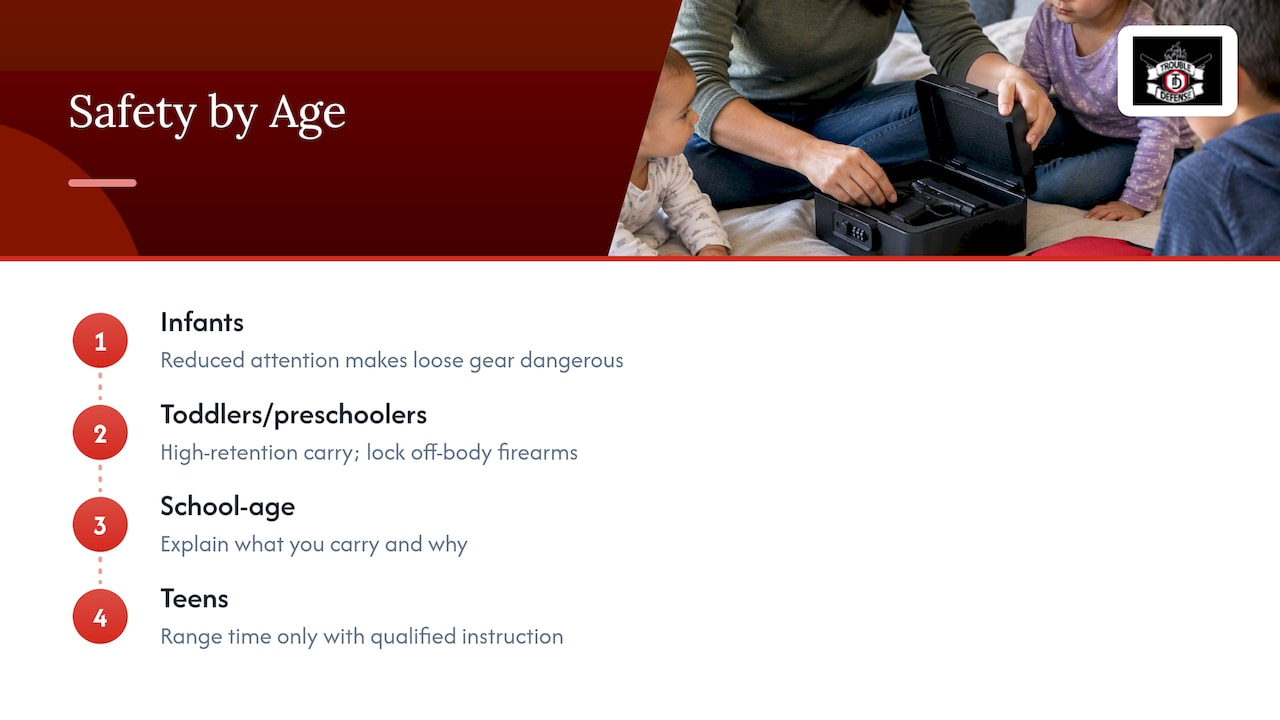
Supervision needs shift as kids grow, and your carry habits should shift with them. An infant who cannot move independently poses almost no direct risk to a holstered firearm, but the adult holding that infant has less free hand and less attention, which is exactly when a loose holster or unsecured bag becomes dangerous.
Toddlers and preschoolers are the highest-risk group for curious hands and climbing. At this age, on-body carry with a high-retention holster beats a bag set on the floor, and any off-body firearm at home needs to be locked, full stop.
School-age kids understand rules but test boundaries, so this is the age to start explaining, in simple terms, what you carry and why, rather than just enforcing stop-tell-leave. Supervision at this stage is less about physical reach and more about honest conversation.
Teens can handle real information about your carry habits, your training, and your reasoning. Some families choose to introduce supervised range time once a teen shows maturity and genuine interest, always under qualified instruction. At every age, the rule is the same: the younger and more physically active the child, the tighter your on-body retention and the stricter your off-body lockup need to be.
Legal Responsibilities When Carrying Around Children
Carrying concealed around your own kids does not change your underlying legal obligations, but a few areas deserve extra attention. Most states have child access prevention laws that create liability if a child obtains an unsecured firearm and someone is hurt, regardless of whether you intended to carry that day.
Permit holders should also know that some venues restrict concealed carry regardless of family status, including schools and certain government buildings, and violating those restrictions carries separate penalties on top of any storage liability. If you are driving across state lines with kids in the car, reciprocity rules for your permit may not automatically apply in every state you pass through.
Because these rules vary by state and change over time, verify current child access prevention laws and reciprocity rules for your specific state before you travel or make storage decisions based on assumptions. A permit class is a good place to get these specifics confirmed directly rather than guessing.
What to Do if Your Child Finds or Handles a Firearm
If you discover your child has found or handled a concealed firearm, stay calm. A panicked reaction teaches a child that guns are a secret to hide rather than something to report, which works against everything you are trying to build.
Secure the firearm immediately, check that it is unloaded if you are not certain of its state, and move it to proper storage. Then talk through what happened without shaming the child: ask what they saw, what they touched, and whether they told anyone.
Use the moment to reinforce the stop-tell-leave rule rather than only punishing the discovery, since kids who fear punishment are less likely to report the next unsecured firearm they find, whether it is yours or a friend’s. Afterward, review how the firearm became accessible in the first place: a holster left on a dresser, a bag within reach, a lock skipped during a rushed morning. Close that specific gap before anything else.
Talking to Kids About Firearm Safety, Again and Again
One conversation does not stick. Firearm safety works like any other repeated safety habit, closer to seatbelt reminders than a single lecture, and it needs refreshing as your child’s curiosity and independence grow.
Keep the tone matter-of-fact rather than frightening. Describe firearms as tools that require respect and rules, the same way you would describe a kitchen knife or a car, rather than framing them as forbidden mysteries that invite exploration.
Use real moments as teaching opportunities: cleaning a firearm, returning from the range, or putting one away after carrying all day. Narrate what you are doing and why, out loud, so the routine becomes visible instead of hidden. Ask your kids to repeat the stop-tell-leave rule back to you periodically, the same way you might quiz them on a fire escape plan, and correct gently when they forget a step.
Emergency Response Planning for Firearm-Related Incidents
A family plan for a firearm-related incident should exist before you ever need it, the same way you would plan for a fire or a severe allergy. Decide in advance who calls emergency services, where the first-aid kit lives, and how older kids should respond if a sibling or friend is injured.
Make sure every adult caregiver in the home, including babysitters and grandparents, knows where firearms and ammunition are stored and how to reach you immediately in an emergency. If a firearm is ever discharged accidentally in the home, the priority sequence is always the same: secure the scene, call 911, and provide first aid while waiting for responders.
Teach older kids the basics of calling 911 and giving a clear address, since a firearm incident is exactly the kind of high-stress moment where a calm, prepared child can make a real difference. Review this plan with the same regularity as a fire drill, not as a one-time conversation.
Balancing Responsible Carry and Family Safety
Carrying concealed around kids is not one decision made once. It is storage checked daily, a holster trusted because you tested it, and conversations repeated until they stick. Treat it as a habit, not a one-time fix, and lean on real training to make it automatic.
— Dee Parker
Practice These Habits With Hands-On Training
Reading about retention holsters and layered storage only goes so far. We built our Virginia CCW class and private training sessions specifically so parents can practice safe draws, storage demonstrations, and family scenarios with an instructor correcting technique in real time, not guessing alone at home.

Whether you need your first permit or want a refresher on carrying safely with a toddler in tow, our DMV Concealed Carry Training Package and private firearm training sessions cover exactly this ground. Book a session and turn this checklist into practiced habit.
FAQ
Is it safe to carry a concealed firearm around my kids?
Yes, when the firearm stays in a high-retention holster on your body or in a locked compartment when off-body, and ammunition is stored separately at home. Pair that with ongoing safety conversations and the risk drops substantially compared to unsecured storage.
What is the safest way to store a firearm when kids are in the house?
The AAP recommends storing firearms locked, unloaded, and separate from ammunition. A layered approach, such as a safe plus a cable lock, is stronger than relying on any single device or on hiding the firearm.
At what age should I start teaching my child about guns?
Start as soon as a child is mobile, with a simple stop-tell-leave rule for toddlers, and add detail as they age into school-age and teen years. Repeating the conversation regularly matters more than any single age milestone.
What should I do if my child finds my concealed firearm?
Secure the firearm immediately without punishing the child, then calmly walk through what happened and reinforce the stop-tell-leave rule. Afterward, identify and close whatever storage or carry gap allowed access in the first place.
Where can I get free gun locks?
Project ChildSafe distributes free cable locks through law enforcement partnerships in many areas. Contact a local partner agency or check their site for distribution locations near you.
Sources
- Morbidity and Mortality Weekly Report (CDC): Study of firearm storage among homes with children
- Project ChildSafe (NSSF) safety and lock-distribution program
- American Academy of Pediatrics: Safe storage of firearms