
Sign up for Fairfax Alerts, check that your doors and windows lock properly, put together a 3 to 5 day emergency kit, and save 703-691-2131 for non-emergency police calls. Those four steps cover most of what Fairfax County asks residents to do before anything goes wrong. The sections below walk through each one, plus home security, firearm safety, and where to get hands-on training.
TL;DR:
- Fairfax Alerts can cover up to five addresses through text, email, or calls; enable neighborhood targeting and quiet hours for nonurgent notices.
- Keep a 3 to 5 day shelter kit at home, a lighter evacuation bag, and vehicle supplies; tailor contents for infants, seniors, people with disabilities, and pets.
- Online nonemergency reports can take three business days for review and remain inactive; call 703-691-2131 when you know a suspect or need an officer.
- Use 3 inch strike plate screws, motion lights, and a bar or pin on sliding doors; these changes address common entry points without major renovations.
- A Virginia concealed carry permit does not automatically apply in Maryland or Washington, DC, so confirm current rules with each jurisdiction before traveling.
Table of Contents
- Practical personal and home safety tips
- Fairfax Alerts: how to sign up and customize what you receive
- Emergency kits built for Fairfax hazards
- When to call 911 versus the non-emergency line
- Community preparedness: CERT, camera registration, and neighbor action
- Quick checklist you can finish today
- Firearm-specific community safety guidelines and responsible ownership in Fairfax
- Local firearm laws and regulations relevant to community safety
- Safe storage practices that prevent unauthorized access
- Responding safely to an active shooter situation in Fairfax
- Local resources for firearm training and certification
- Why local, hands-on skills matter alongside county preparedness
- Train with us for hands-on community safety skills
- FAQ
- Sources
Practical personal and home safety tips
Most crime in Fairfax County happens because an opportunity presents itself, not because someone planned a specific target. The Fairfax County Police Department points out that trusting your instincts, walking with purpose, and staying aware of your surroundings reduce the chance you become that opportunity.
Vehicles are a common target because people leave valuables in plain sight. Locking your car every time, even in your own driveway, and recording serial numbers of bikes, electronics, and tools makes recovery easier if something is stolen.
Home hardening doesn’t require a major renovation. A few changes close most of the easy entry points burglars look for:
- Replace short door strike-plate screws with 3-inch screws that reach the door frame.
- Add motion-sensor lighting at entry points and along side yards.
- Secure sliding doors with a bar or pin, not just the factory latch.
- Trim shrubs below window height so they can’t hide someone approaching your house.
- Get at least two written estimates before hiring a contractor, and insist on a signed contract with clear start and end dates.
A $15 pack of security screws or a $30 motion light often does more for your household than an expensive alarm system nobody monitors closely.
Fairfax Alerts: how to sign up and customize what you receive
Fairfax Alerts is the county’s official emergency notification system, covering public safety incidents, severe weather, traffic disruptions, police notifications, and community drills. Registering takes a few minutes and puts official information in your hands before rumors spread on social media.
- Go to the Fairfax Alerts signup page and create an account with your email or phone number.
- Register up to five addresses, home, work, a relative’s house, or anywhere else you want coverage.
- Choose your delivery channels: text, email, or phone call, since residents can select multiple methods.
- Set “do not disturb” hours for non-urgent categories so only critical alerts wake you up.
- Enable geo-targeted alerts so you get notifications specific to the neighborhoods you’ve registered.
Pro Tip: Register your workplace address even if it’s outside Fairfax, since many residents commute and still want to know about conditions affecting their drive home.
Emergency kits built for Fairfax hazards
Ready Fairfax recommends every household keep a 3 to 5 day shelter-in-place kit, stocked with water, non-perishable food, medications, toiletries, a battery or hand-crank NOAA radio, flashlights, phone chargers, copies of important documents, and some cash in small bills.
A shelter-in-place kit and a go-bag serve different purposes. The shelter kit stays home for power outages or winter storms; a go-bag is lighter, grab-and-run gear for evacuation, and a basic vehicle kit (blanket, water, jumper cables, flashlight) covers you if you’re stuck in traffic during severe weather.
Tailor your kit to your household:
- Infants need formula, diapers, and extra clothing sized for growth spurts.
- Seniors and people with disabilities may need backup medical supplies, mobility aids, or spare batteries for equipment.
- Pets need food, water, a leash, and vaccination records.
- Check expiration dates on food, water, and medications twice a year, ideally when clocks change in spring and fall.
County emergency-management guidance also recommends identifying the hazards most likely to actually affect your household, severe storms, flash flooding, extreme heat, or extended power outages, rather than trying to prepare for every scenario at once.
When to call 911 versus the non-emergency line
Call 911 for anything life-threatening or a crime in progress. For everything else, the non-emergency number is 703-691-2131, covering noise complaints, past property crimes, and general police assistance.
Fairfax County’s Community Reporting System (CRS) lets you file certain non-emergency reports online, but submissions are reviewed within three business days and classified as inactive rather than actively investigated. If there’s a known suspect or you need an officer on scene, call instead of filing online.
Before reporting anything, gather:
- A clear description of what happened and when.
- Any photos, serial numbers, or video footage.
- Insurance policy information if property was damaged or stolen.
Community preparedness: CERT, camera registration, and neighbor action
Fairfax County Fire & Rescue runs a Community Emergency Response Team (CERT) program that teaches residents basic fire safety, light search and rescue, and disaster medical operations, typically over roughly 25 hours of training capped with a hands-on final exercise. It’s a practical way to become the person your block turns to when something goes wrong before first responders arrive.
Registering home or business security cameras with Connect Fairfax is voluntary, but it speeds up investigations because police can quickly check whether nearby footage exists after an incident.
At the neighborhood level:
- Start a simple phone or text chain with neighbors for quick alerts.
- Create a check-in list for elderly or homebound neighbors during storms.
- Volunteer together for CERT training so your block has multiple trained responders.
Quick checklist you can finish today
- Register for Fairfax Alerts with up to five addresses.
- Save 703-691-2131 and 911 as separate contacts in your phone.
- Walk your home’s exterior and check every lock, hinge, and light.
- Pull together or refresh your 3 to 5 day kit.
- Write down one neighbor you’d check on, and one who’d check on you.
Households with infants should add formula and diapers to the kit now rather than during a storm warning. Households with seniors or pets should confirm medication and food supplies are current.
Firearm-specific community safety guidelines and responsible ownership in Fairfax
Owning a firearm in Fairfax carries a responsibility that extends past your own front door. Responsible ownership means secure storage, proper training, and knowing the legal boundaries of when and how you can use force in self-defense.
Community safety starts with the basics: never leave a firearm unattended in a vehicle, never hand a firearm to someone without confirming they know how to safely handle it, and keep ammunition separate from the firearm when it’s not in active use. These habits matter as much in a quiet Fairfax cul-de-sac as they do anywhere else.
Responsible owners also stay current on their own skills. A firearm you haven’t practiced with in years isn’t a reliable self-defense tool, and rusty habits around a loaded weapon are a safety risk to your own household. Periodic refresher training, especially after a long gap, keeps your handling sharp and your judgment calibrated.
Neighbors notice when firearm owners are careless, and that perception affects how the broader community views lawful gun ownership.
Local firearm laws and regulations relevant to community safety
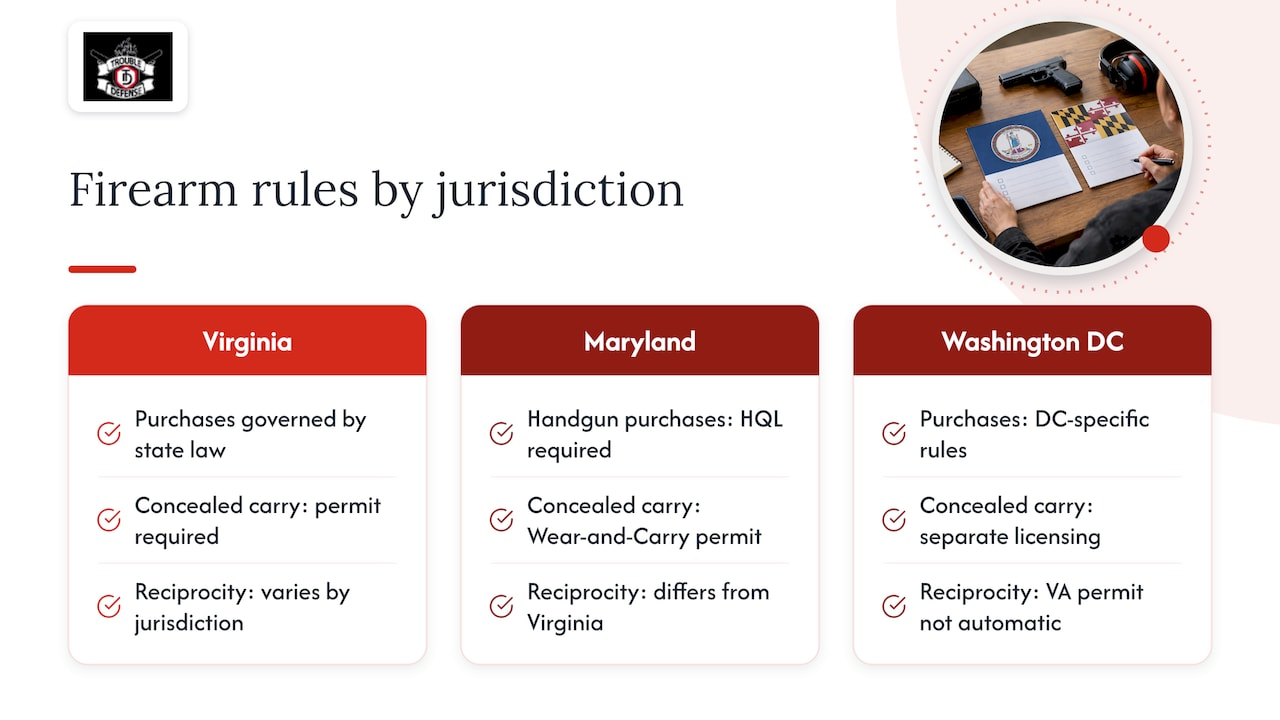
Virginia law governs how firearms are purchased, carried, and stored within Fairfax County, and the rules shift depending on whether you’re carrying openly, concealed, or transporting a firearm in a vehicle. Concealed carry in Virginia requires a permit, and residents who also spend time in Maryland or Washington DC need to understand that each jurisdiction sets its own separate rules for carrying and permit reciprocity.
Maryland requires a Handgun Qualification License (HQL) before most handgun purchases, along with its own Wear and Carry permit process for concealed carry, both of which differ meaningfully from Virginia’s requirements. Washington DC has its own concealed carry licensing process as well, and residents who commute across the DMV area should never assume a Virginia permit automatically covers them elsewhere.
Because these laws change and vary by jurisdiction, treat this as a starting point rather than a complete legal reference. Anyone planning to carry across state lines, whether for work, travel, or daily commuting through the DMV, should confirm current requirements with the relevant state agency or a qualified instructor before assuming their permit applies.
Safe storage practices that prevent unauthorized access
Safe storage is the single biggest factor in keeping firearms out of the hands of children, visitors, or anyone else who shouldn’t have access. A firearm safe or lockbox rated for fire and impact resistance is the standard baseline, and it should be anchored so it can’t simply be carried off.
Store ammunition separately from the firearm itself when children are in the home, and never leave a loaded firearm in a nightstand drawer or under a mattress where curious hands can find it. Biometric or quick-access safes offer faster retrieval for home defense while still keeping the firearm secured from unauthorized users.
Vehicles deserve the same discipline. A firearm left in a glove compartment or center console is one of the easier targets for a car break-in, and Fairfax’s own vehicle-crime prevention guidance applies directly here: lock the car, and don’t leave valuables, firearms included, in plain sight.
If anyone in your household is unfamiliar with how to safely handle or store a firearm, hands-on instruction closes that gap faster than reading a manual. A short course on safe storage and handling pays for itself the first time it prevents an accident.
Responding safely to an active shooter situation in Fairfax
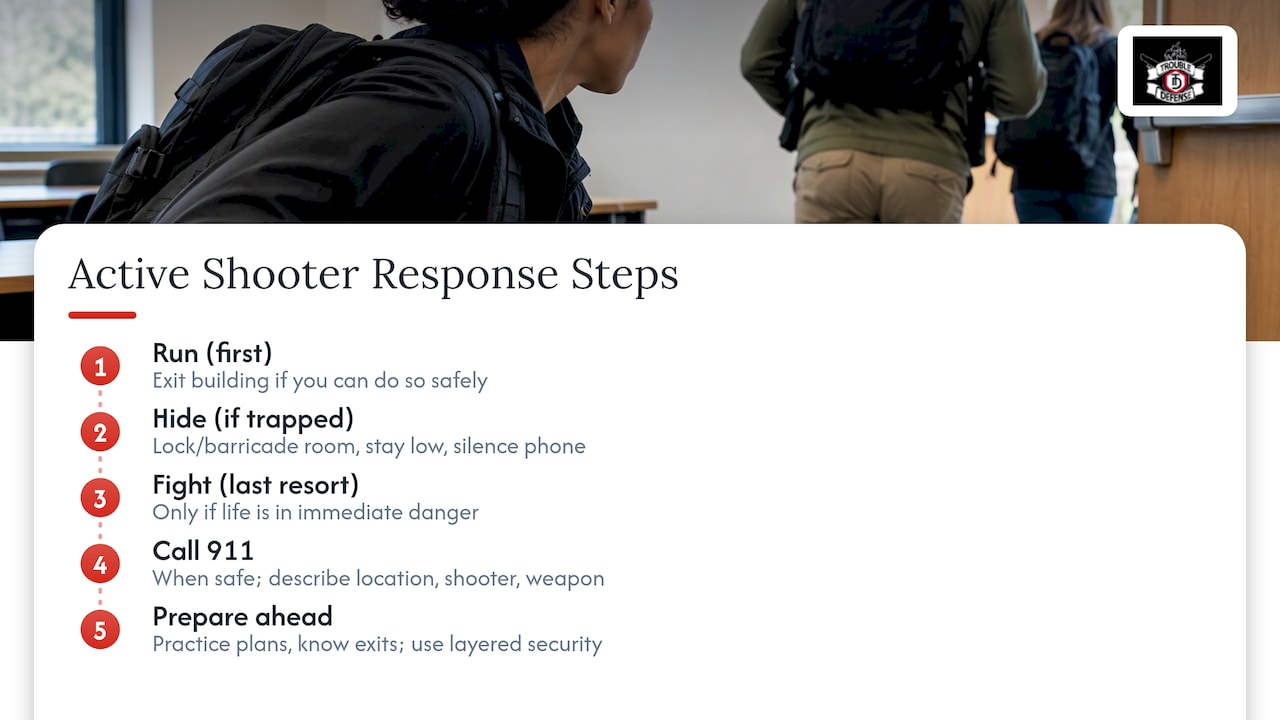
The standard guidance for an active shooter situation is run, hide, fight, in that order of preference. Get out of the building if you can do so safely, putting distance between yourself and the threat. If you can’t escape, find a room you can lock or barricade, stay low, silence your phone, and wait for law enforcement.
Fighting back is the last resort, used only when escape and hiding aren’t possible and your life is in immediate danger. Call 911 as soon as you’re safe enough to do so, even if that means waiting until you’ve reached a secure location, and be ready to describe the shooter’s location, description, and weapon if you saw them.
Workplaces, schools, and places of worship in Fairfax benefit from having a practiced plan rather than improvising in the moment. Knowing your building’s exits, meeting points, and lockdown procedures before an emergency happens is what turns a chaotic few minutes into a survivable one. Workplace violence prevention training builds exactly this kind of readiness into a team before it’s ever needed.
Layered physical security in shared spaces, like parking lots, lobbies, and common areas, also reduces risk long before a worst-case scenario develops. A layered approach combining lighting, patrols, and camera coverage addresses the kind of opportunistic access that makes public spaces vulnerable in the first place.
Local resources for firearm training and certification
Reading about safe storage and active shooter response is a starting point, but hands-on practice is what makes those habits automatic under stress. Fairfax has several options for firearm training and certification, ranging from concealed carry classes to specialized instruction for specific needs.
We built our firearm training programs around the idea that skills need to be practiced, not just read about. Our course lineup covers Virginia concealed carry certification, Maryland Wear and Carry training, DC concealed carry classes, active shooter training, women’s firearm training, and an adaptive program for blind and low-vision students who want to learn to shoot safely and confidently. We also run court-ordered firearm safety courses for residents who need certification to satisfy a legal requirement.
Our classes are led by experienced instructors in a supportive setting designed for questions and repetition. Whether you’re new to firearms, renewing a permit, or seeking training for your household, hands-on instruction helps turn safety knowledge into practiced skills.
Why local, hands-on skills matter alongside county preparedness
County systems like Fairfax Alerts and CERT give you information and a framework, but they don’t teach you how to handle a firearm safely under stress. With adaptive and women’s firearm programs and strong positive feedback, we see firsthand how much confidence comes from practiced skills, not just good intentions. Preparedness works best when neighbors train together and still call 911 first.
— Dee Parker
Train with us for hands-on community safety skills
Reading a checklist builds awareness, but a few hours on the range builds the kind of confidence that actually holds up in a stressful moment. We provide a range of community-focused training in Fairfax that includes concealed carry certification, active shooter training, workplace violence prevention, women’s firearm training, and adaptive programs for blind and low-vision students.

Our instructors are certified, veteran-led, and focused on getting you comfortable with real skills, not just paperwork. If you’ve been putting off getting certified or want your household trained together, start with our DMV Concealed Carry Training Package or reach out through our contact page to find the class that fits your schedule.
FAQ
What are the main problems faced by Fairfax County?
Fairfax County residents commonly deal with traffic congestion, high housing costs, and the typical opportunity crimes that affect any large suburban county, like vehicle break-ins and property theft. The Fairfax County Police Department notes that most local crime stems from opportunity rather than targeted planning, which is why basic prevention habits make a real difference.
Is Fairfax, VA liberal or conservative?
Fairfax County generally leans Democratic in its voting patterns, consistent with much of Northern Virginia. Political leanings vary by neighborhood and don’t change the practical safety steps every household should take.
What is the crime rate in Fairfax, VA?
Specific crime statistics change year to year and are best checked directly through Fairfax County Police Department data rather than secondhand summaries. What stays consistent is the department’s guidance that most incidents are crimes of opportunity, which basic prevention habits can reduce.
Is Fairfax, VA a good place to raise a family?
Many families choose Fairfax for its schools, parks, and community programs, and the county backs that up with active resources like Fairfax Alerts, CERT, and neighborhood crime prevention guidance. Taking advantage of those official programs, alongside basic home security and emergency planning, helps families get the most out of living there.
Who do I call for a non-emergency police matter in Fairfax?
Use the non-emergency line at 703-691-2131 for situations like past property crimes, noise complaints, or general police assistance. Reserve 911 strictly for life-threatening emergencies or crimes actively in progress.