There is no single best pistol for every left-handed shooter, but there is a short list worth putting in your hand. Look for a full-size or compact striker-fired pistol with true ambidextrous controls: a slide stop on both sides, a magazine release you can reverse or reach from either side, and a grip that fits your hand. The HK VP9, Springfield Echelon, Walther PDP, CZ P10C, Glock 19 Gen 5 and IWI Masada all show up on that list. The only way to pick the winner is to shoot a few of them.
We are a veteran-owned training academy in Fairfax, VA, and we teach left-handed students every month. This guide covers what actually matters for a lefty, which pistols to rent first, and where the marketing oversells.
TL;DR
- True left-handed pistols are rare. Most lefties are better served by a pistol with ambidextrous controls and a comfortable grip.
- The pistols that come up most often for lefties: HK VP9, Springfield Echelon, Walther PDP, CZ P10C, Glock 19 Gen 5, Beretta APX A1 and IWI Masada.
- “Ambidextrous” does not mean equal. Test the right-side slide release and magazine release before you buy.
- Rent two or three models at a range, then train with an instructor before you commit.
- Safety rules are the same for every shooter, whatever their dominant hand.
Table of Contents
- What lefties actually need from a pistol
- Pistols worth putting in your hand
- “Ambidextrous” does not mean equal
- How to test before you buy
- Our perspective: train the shooter, then pick the gun
- Safety does not depend on your dominant hand
- Training that fits the pistol you choose
- Match the pistol to your goal
- Common mistakes lefties make when buying
- Ready to find your fit?
- FAQ
- Sources
What lefties actually need from a pistol
Most handguns are built around a right-handed shooter. Controls sit on the left side of the frame, where a right-handed thumb reaches them. A left-handed shooter has to adapt, buy a gun with mirrored controls, or both.
That said, many experienced trainers do not treat left-handedness as a reason for special equipment. In a USCCA community discussion, the common view was that most drills are the same right- or left-handed, and that the focus should be on learning to manipulate your specific firearm. The same thread has a member summing it up with the line “everything for right-handed applies to left-handed.”
Still, a pistol that works with you rather than against you makes training easier. Here are the features that matter.
Slide stop on both sides
The slide stop (often called the slide release) locks the slide back on an empty magazine and lets you send it forward. On a standard pistol it is on the left side only. A lefty can often reach it with the trigger finger, but that is a habit to build, not a given. A pistol with a slide stop on both sides gives you a choice.
Magazine release you can reach
A button you press with your thumb works fine for right-handed shooters. For a lefty, the options are a reversible button, a button on both sides, or a paddle-style release. Reversible buttons require you to move the button yourself, often with a tool, and some pistols need compatible magazines. On a Glock Gen 5, for example, you need magazines notched on both sides to use the reversible release. Check the manual before you swap anything.
Safety lever, if there is one
Most modern striker-fired pistols have no manual safety. If you want one, check that it works from both sides. Many lever-style safeties are single-sided, and a few 1911-style pistols have ambidextrous versions.
Ejection direction
Almost every standard semi-automatic ejects spent cases to the right. For a lefty, that means brass flies across your body or past your face. This is a concern for some lefties, but most learn to adapt with proper training and eye protection. Wear shooting glasses with side coverage. If brass bothers you, tell your instructor on day one; stance and grip tweaks often fix it.
Grip size and trigger reach
Controls are only half the story. If the grip is too big for your hand, you will struggle to reach the trigger and control the gun regardless of how many levers are mirrored. Smaller-handed shooters commonly try slimmer compact and subcompact frames. Try the gun in your hand before you rent it.
Pistols worth putting in your hand
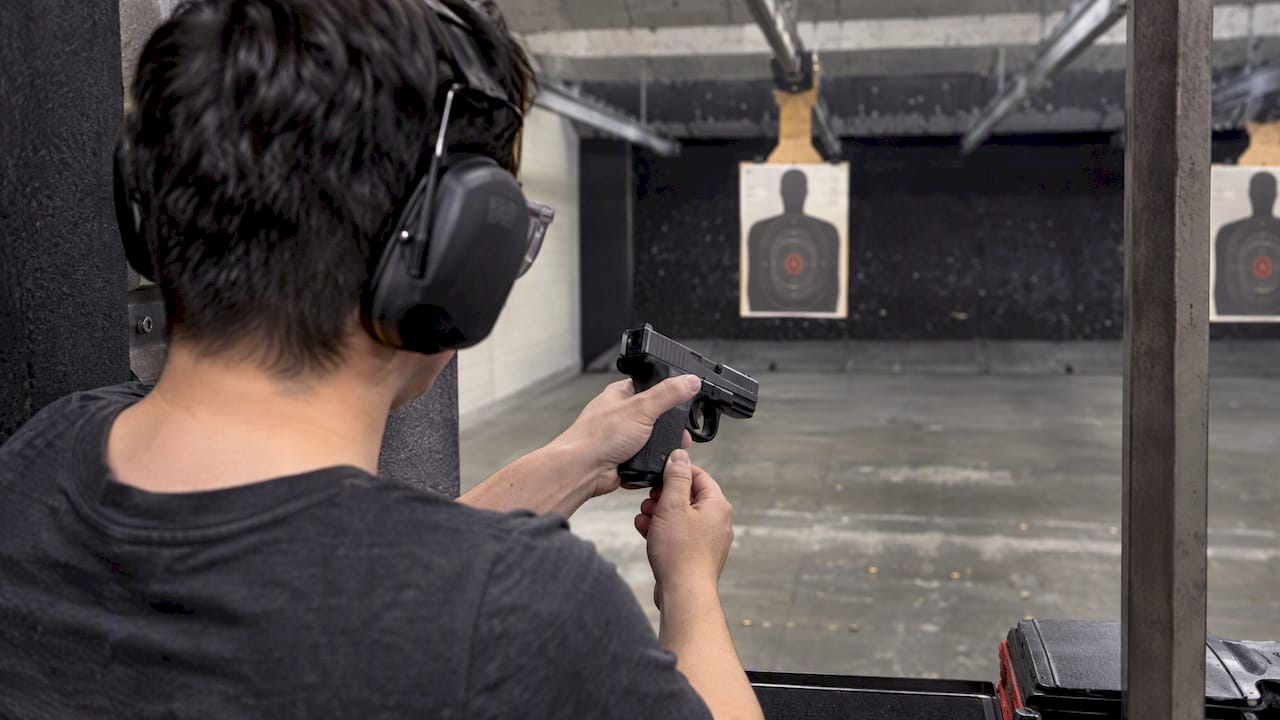
The list below is a starting point, not a ranking. A roundup from Guns America names the HK VP9 A1 as its top overall pick for left-handed shooters and also covers the Arex Delta Gen 2, the Springfield Echelon and an optics-ready FN 509 variant. A USCCA community thread on left-handed pistols lists the Glock 19 Gen 5, HK VP9, P30 and CC9, Walther PDP, CZ P10C, Springfield Echelon, Beretta APX A1 and IWI Masada as having significant ambidextrous features.
| Pistol | Why lefties try it | What to check |
|---|---|---|
| HK VP9 / VP9 A1 | Controls are largely mirrored, which is why it is often cited as the easy answer for lefties | Size and weight; it is a full-size duty-style gun |
| Springfield Echelon | Modular design with ambidextrous controls | Newer platform; check holster and magazine availability |
| Walther PDP | Commonly recommended for trigger feel and grip ergonomics | Grip size; the lineup includes several slide lengths |
| CZ P10C | Compact with a reversible magazine release | Reversing the release takes a few steps; check how you reach the slide stop |
| Glock 19 Gen 5 | Reversible magazine release and slide stop on both sides, plus huge holster and accessory support | Right-side slide stop can feel stiffer; use compatible magazines |
| Beretta APX A1 | Ambidextrous features and a modern striker-fired design | Hold it first; grip shape is personal |
| IWI Masada | Pronounced slide lock lever that is the same on both sides, according to one USCCA member | Fewer holster options than the big names |
| Cabot Left-Hand 1911 | A dedicated left-handed 1911 with ambidextrous safety and reversible magazine release | Specialty price tier and single-stack capacity; mostly a range or collector choice |
We are not telling you to buy any of these off a table. They are the ones to rent or handle first.
A note on revolvers
Revolvers sidestep many handedness issues because they eject nothing. The cylinder swings out to the left on most models, which suits a right-handed shooter and takes some adapting for lefties. If a revolver interests you, ask to try one with a qualified instructor present.
Optics and holsters
If you plan to carry, holster choice can matter more than the pistol brand. Check that the holster you want exists in a left-handed version for your specific model. Popular guns have the widest choice, which is part of why Glock-pattern pistols remain common even with their quirks.
“Ambidextrous” does not mean equal
Here is the catch that catches new buyers. On many pistols that advertise ambidextrous controls, the right-side slide release is a secondary connection to the primary one. The USCCA thread notes that on guns like the Glock 19 Gen 5 or the Smith & Wesson M&P 2.0, the right-side lever can be noticeably harder to operate than the left.
That does not make those guns bad choices. Many lefties run them well. It means the spec sheet cannot answer the question. Your hands can.
The same discussion makes a point we agree with: comfort and confidence with the specific tool matter more to accuracy than simply buying something marketed as ambidextrous. The best pistol is the one you can operate consistently and safely under stress.
How to test before you buy
Use this order. It costs less than buying the wrong gun first.
- Handle it unloaded. At a store, with the action clear and the counter attendant watching, check grip fit and where each control falls under your finger.
- Run the controls. Press the magazine release and slide stop with your dominant thumb or trigger finger. Do it ten times. Does it feel natural or like a stretch?
- Rent two or three models. Ranges often rent common models. Shoot the same drill with each, and pay attention to where you are tense.
- Check magazine compatibility. If you want a reversible release, make sure the magazines you will actually buy support it.
- Test with your holster. Draw, press check and reholster with an unloaded gun, in the setting your instructor approves.
- Get a second opinion. An instructor who has taught left-handed shooters will spot grip and trigger finger issues you will not feel yourself.
What to look for when you shoot
- Can you reach the magazine release without shifting your grip?
- Does the slide lock back reliably when you are using your support-hand thumb or trigger finger?
- Is brass hitting your face, hat or glasses?
- Does the trigger finger land naturally on the trigger, or does the gun twist in your hand?
Our perspective: train the shooter, then pick the gun
We see this pattern with first-time buyers all the time. They arrive having already bought a pistol based on a review, and then discover it does not suit their hand. Lefties are especially likely to get stuck, because the advice online is contradictory: one forum says buy a mirrored gun, another says learn to adapt.
Our view is that both are right, in order. First learn the fundamentals: the grip, the trigger press, the safe handling of any firearm. Then use that experience to test pistols with confidence. Our instructors are NRA-certified and veteran-led, and our whole approach is personalized, judgment-free instruction. If you are left-handed, we will work with you on grip, support-hand technique, malfunction clearing and manipulating the controls of the gun in front of you, rather than telling you to change hands.
We also tell students that fit beats features. A pistol with perfect ambidextrous controls that is too large for your hand will still shoot poorly. A slightly less mirrored gun that fits well and that you practice with often will outshoot it.
— Dee Parker
Safety does not depend on your dominant hand
The National Shooting Sports Foundation states that safety is independent of handedness and lists the four core rules: treat every gun as loaded, keep the muzzle in a safe direction, keep your finger off the trigger until ready to shoot, and be sure of your target and what is behind it. Those apply to every shooter and every pistol on this list.
Beginners should also learn the mechanical characteristics of their particular firearm before they use it. With a left-handed setup, that includes knowing which controls are reversed, which are not, and what happens if you press the wrong one.
Training that fits the pistol you choose
A good pistol will not fix a bad grip. Once you have narrowed your options, put time into instruction. Here is how that looks with us.
Private lessons for lefties
One-on-one time is the quickest way to find out which controls work for your hand. Our private firearm training in Fairfax starts from $80 per hour. Bring the pistol you are considering or ask us what to try, and we will run you through grip, draw, reloads and malfunction drills with your dominant side.
Concealed carry classes
If your goal is carrying, build the pistol choice into your permit class. Our DMV Concealed Carry Training Package is $450 one-off. For travelers, the Multi-State CCW Reciprocity Package is $500 one-off.
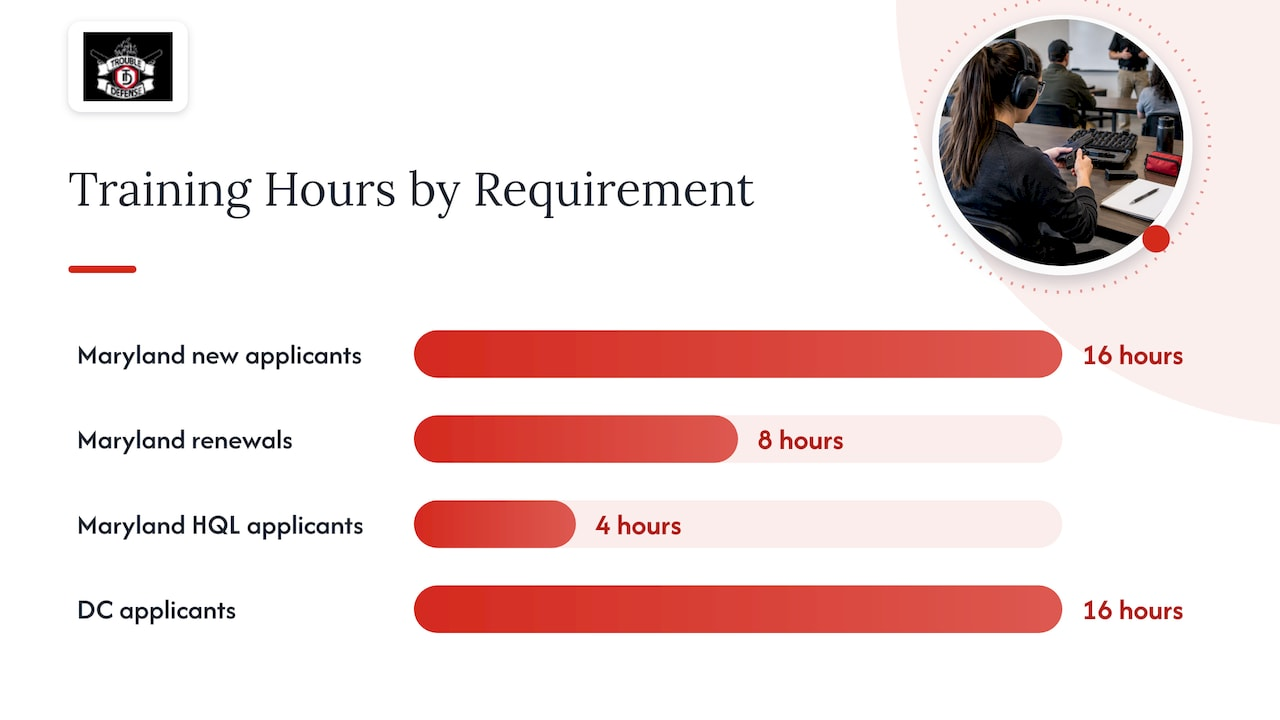
Training requirements differ across the region. Maryland requires at least 16 hours of instruction for new Wear and Carry applicants and 8 hours for renewals, with a minimum score of 70% accuracy, according to the Maryland State Police. The same page says new Handgun Qualification License applicants need at least 4 hours. For the full process, see our Maryland Wear and Carry Training page. In DC, applicants need a course of at least 16 hours from a certified instructor, as the DC code on application requirements states, and our DC CCW training guide walks through what to expect. Check current requirements with the issuing agency before you register, since rules change.
The DC police FAQ also says you must own or be in the process of purchasing a handgun to apply for a concealed carry license, according to the Metropolitan Police Department. That makes the pistol decision part of your permit timeline.
Not ready to buy? Shoot first
If you are still deciding, our Tourist Range Package starts from $175 per person, and it is a low-pressure way to handle a firearm with an instructor beside you. Our training calendar lists upcoming classes in Virginia.
Match the pistol to your goal
The best pick depends on what you will do with it.
Home defense and range use
Full-size and mid-size pistols are easier to shoot well. Their longer grips and sight radius help most beginners, and weight absorbs recoil. The HK VP9, Springfield Echelon and Walther PDP sit in this space.
Concealed carry
Compact pistols such as the Glock 19 Gen 5 or CZ P10C balance concealability and shootability. Pair the pistol with a holster made for your specific model and your dominant side, and practice drawing safely and in compliance with your instructor’s guidance. Before you carry, learn where you may and may not carry. Our Maryland permit guide covers that for Maryland.
Small hands
Smaller-handed lefties often hear about slim subcompact and micro-compact pistols. Those can be harder to shoot than a mid-size gun because there is less to hold. Shoot one before you assume it is the easy option.
Learning the basics
Advice from experienced shooters in the Reddit r/Firearms thread that tops this search includes starting with a reliable .22 LR pistol for target practice. Low recoil lets you build fundamentals without flinching. That is a reasonable route if you are new, and we can help you structure it.
Common mistakes lefties make when buying
- Buying online without handling. Grip feel and control reach cannot be judged from photos.
- Trusting a label. “Ambidextrous” ranges from one mirrored lever to full controls on both sides.
- Forgetting magazines. Reversible releases may need specific magazines.
- Ignoring holsters. Left-hand holster options are narrower for less popular models.
- Skipping instruction. Bad habits formed alone stay with you.
Ready to find your fit?
Trouble Defense LLC serves Virginia, Maryland and Washington, DC from Fairfax. Whether you want a private lesson to test a pistol, a concealed carry class or a first range visit, contact us through our site and we will set up a session that fits your hand, your schedule and your goals.
FAQ
Are there pistols made only for left-handed shooters?
Very few. Dedicated left-handed pistols exist mainly in the 1911 world, such as Cabot’s left-hand models. Most lefties choose a standard pistol with ambidextrous or reversible controls.
Is the Glock 19 a good pistol for a lefty?
Many lefties shoot it well. The Gen 5 has a reversible magazine release and a slide stop on both sides, though the right-side lever can feel stiffer, and you need magazines notched on both sides to use the reversible release. Rent one before you buy.
Should a left-handed beginner learn to shoot right-handed?
There is no need to switch. Trainers generally say the drills are the same either way, and the key is learning the manipulation of your specific firearm. Train with your dominant hand and eye, then practice support-hand work as a secondary skill.
Does brass hitting my face mean I have the wrong pistol?
Not necessarily. Almost all standard semi-automatics eject to the right, and most lefties adapt with proper training and eye protection. If it keeps bothering you, ask an instructor to check your grip and stance.
Do I need training before I buy?
You do not need a class to browse, but a lesson first can save you money. In Maryland and DC, permit applicants also have mandatory training hours, so training is part of the process anyway.
Sources
- Left-handed pistols? (USCCA Community)
- Handguns for left handed people (USCCA Community)
- South Paws (USCCA Community)
- Best Handguns for Left-Handed Shooters (Guns America)
- Left Handed 1911s (Cabot Guns)
- What firearms are suitable for left handed shooting (Reddit r/Firearms)
- Firearms Safety Training (Maryland Department of State Police)
- DC Code § 7-2509.02 application requirements
- Firearms Registration and CCL FAQ (Metropolitan Police Department)
- Rules of firearm safety (NSSF)