Yes, Virginia permit holders may carry a concealed handgun into a restaurant licensed to serve alcohol, as long as they do not drink while armed. That single rule, set out in § 18.2-308.012 of the Code of Virginia, is the line between lawful carry and a Class 2 misdemeanor. The Virginia State Police confirm this standard for resident permit holders, and students are guided through it in concealed carry classes.
TL;DR:
- Virginia’s restaurant rule turns on consumption, not impairment, so even a single drink can violate it, regardless of how little you consume.
- Consuming alcohol while carrying is a Class 2 misdemeanor, punishable by up to six months in jail and a $1,000 fine.
- Courts typically notify the issuing authority after either conviction; if the permit is revoked, reapplication is barred for five years.
- Restaurants may prohibit firearms with posted signs or direct requests; refusing to leave when asked can expose a permit holder to trespassing charges.
Table of Contents
- What the statute actually says about carrying in restaurants
- Penalties for drinking while carrying or carrying while impaired
- Who is exempt, and how out-of-state permits work here
- Restaurant owner rights and what happens if you’re asked to leave
- Can you carry concealed in a bar? Here’s the difference
- Signage: does a “no firearms” sign carry legal weight?
- How “no carry” rules apply in mixed-use and chain locations
- Local ordinances versus state law: who actually controls this?
- What to do if you’re accidentally served alcohol while carrying
- Enforcement trends: what actual cases tell us
- What permit holders get wrong about impairment versus consumption
- Learn the law hands-on at a Trouble Defense class
- FAQ
- Sources
What the statute actually says about carrying in restaurants
Virginia’s concealed handgun law does not ban permit holders from restaurants that serve alcohol. Instead, § 18.2-308.012 draws a narrower line: you can carry, but you cannot drink while you carry. The statute applies specifically to establishments licensed under Title 4.1, the state’s alcoholic beverage control framework, for on-premises consumption. That covers sit-down restaurants, hotel dining rooms and similar venues where a server might set a cocktail in front of you.
The operative language is simple: a permit holder “shall not consume an alcoholic beverage while in a restaurant or club” that holds an on-premises license, while carrying a concealed handgun. There is no allowance for a single beer or a toast at a birthday dinner. The prohibition covers the act of consuming, not a blood alcohol threshold.
A few practical points fall out of the statute’s structure:
- Carry itself is legal in ABC-licensed restaurants; only consumption while armed is restricted.
- Active law enforcement officers are exempt from this particular prohibition.
- The rule applies regardless of how little alcohol is consumed.
For anyone double-checking the text, the full language is available directly from the Code of Virginia, and the Virginia State Police resident permit page restates the same standard in plain terms for permit holders.
Penalties for drinking while carrying or carrying while impaired
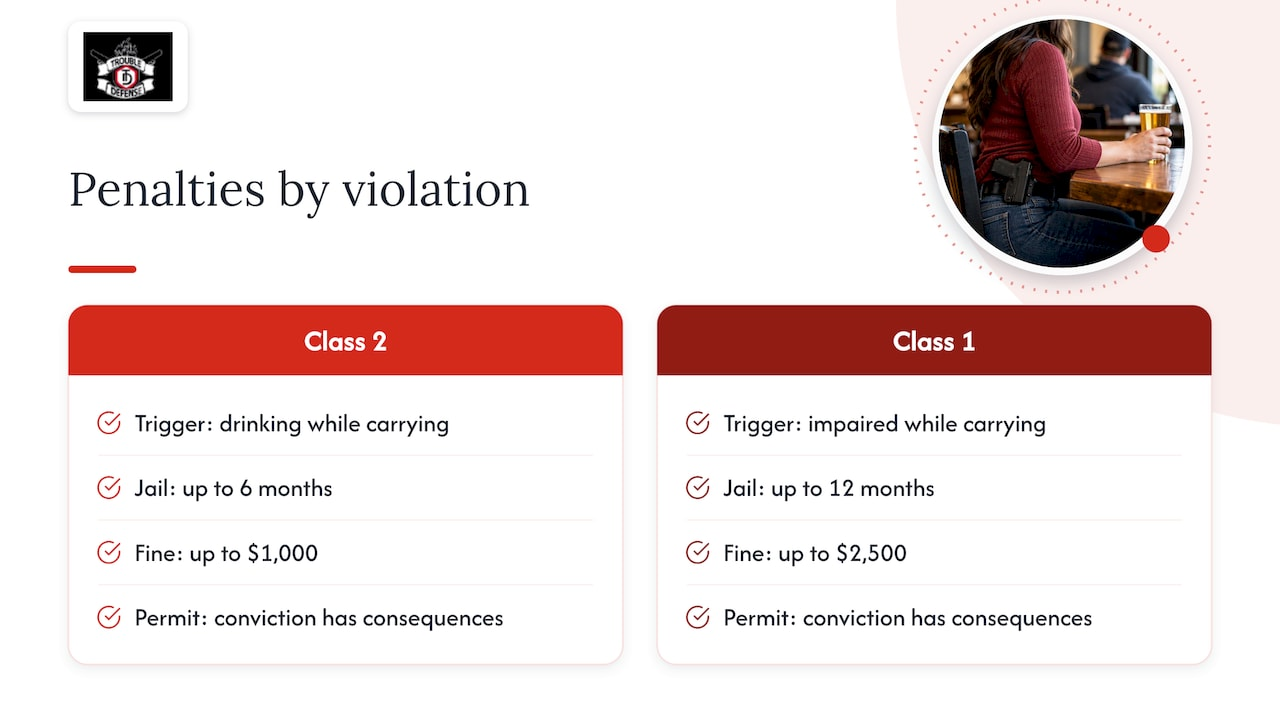
Virginia treats this violation in two tiers, and the difference matters. Consuming any alcohol while carrying a concealed handgun in a licensed restaurant is a Class 2 misdemeanor under § 18.2-308.012, which can carry up to six months in jail and a $1,000 fine.
One Class 2 misdemeanor conviction under § 18.2-308.012 is enough to trigger permit consequences, separate from any jail or fine imposed by the court.
Being under the influence of alcohol or drugs while carrying is a more serious Class 1 misdemeanor, which raises the potential penalty to up to twelve months in jail and a $2,500 fine. A conviction under either provision typically leads the court to notify the permit-issuing authority, and a revoked permit carries a five-year period of ineligibility before you can reapply. Beyond the courtroom, a misdemeanor firearm conviction can surface in background checks for employment, security clearances and insurance underwriting, long after the fine is paid; for more on firearm ownership restrictions after conviction, see firearm ownership after a criminal conviction.
Who is exempt, and how out-of-state permits work here
Active law enforcement officers are exempt from the restaurant-consumption rule, and the exemption generally extends to qualified retired officers carrying under the same statutory authority. For permit holders, these exemptions do not apply. Everyone else, resident or visitor, follows the same restaurant rule.
Nonresidents carrying in Virginia operate under a separate reciprocity framework. The basics, drawn from § 18.2-308.014 and Virginia State Police guidance, include:
- You must meet Virginia’s minimum age requirement to carry under reciprocity.
- You must display your permit and photo identification on demand to a law enforcement officer.
- Your home-state permit must not have been previously revoked in Virginia.
Before any trip, check the Virginia State Police reciprocity page for the current list of recognized states, and the nonresident permit page if you plan to apply for a Virginia nonresident permit directly.
Restaurant owner rights and what happens if you’re asked to leave
Virginia law lets a permit holder carry into most ABC-licensed restaurants, but that right does not override private property rights. A restaurant owner or manager can prohibit firearms on the premises through posted signage or a direct verbal request, and refusing to comply once asked can turn a legal carry situation into a trespassing charge.
Picture this: you’re carrying lawfully at a chain restaurant, a manager notices your firearm and asks you to leave. The carry itself was legal, but staying after being asked to leave is not. If that happens, here’s how to handle it:
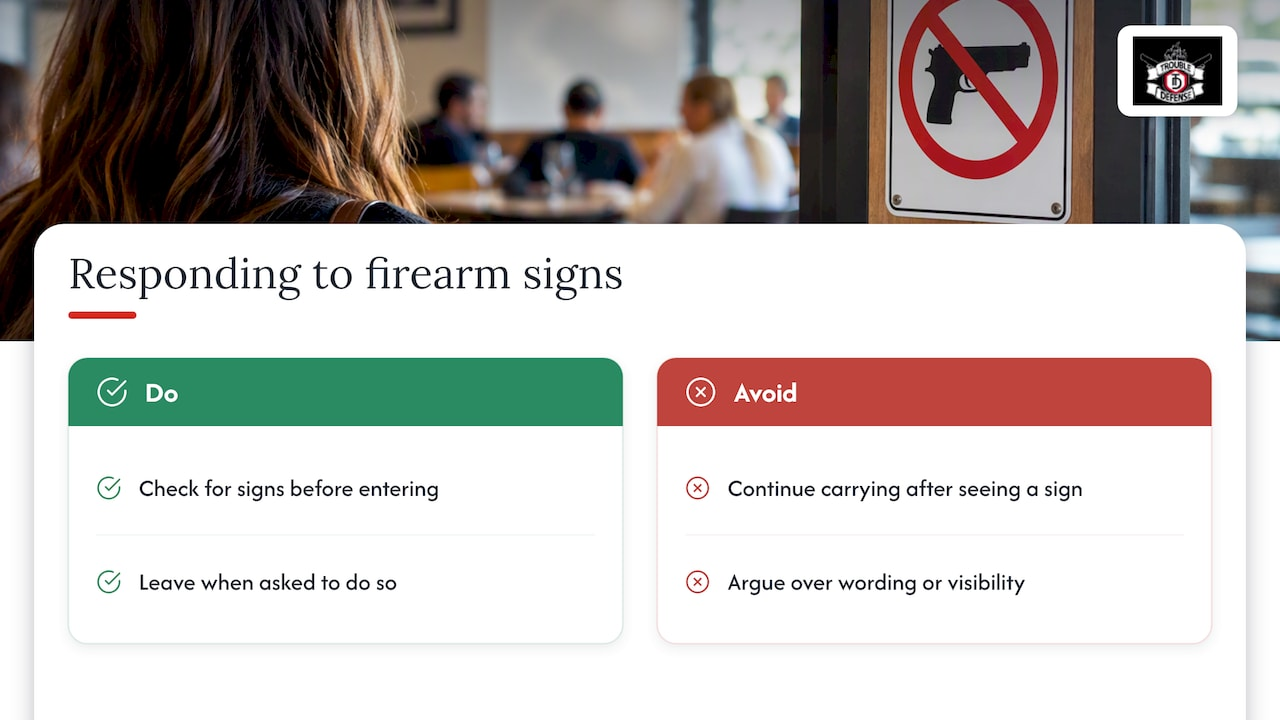
- Comply immediately and calmly; do not argue about your legal right to carry.
- Leave the premises and secure your firearm before returning to your vehicle.
- Document the time, location and what was said, in case you need it later.
- Contact an attorney if you are cited or charged with trespassing.
A calm exit protects you far more than winning an argument with a host stand ever will.
Can you carry concealed in a bar? Here’s the difference
Restaurants and bars are not the same thing under Virginia law, and permit holders often blur the line. The restaurant-carry rule under § 18.2-308.012 is built around establishments licensed for on-premises alcohol consumption, which includes most sit-down restaurants and many hotel dining rooms. A venue that operates primarily as a bar, with food as an afterthought, falls under the same licensing category and the same consumption prohibition applies: you can carry, but you cannot drink while armed.
The practical difference is not the legal rule itself, it’s the risk profile. A restaurant where you order dinner and a soda carries low risk of accidentally crossing the line. A bar built around drinking puts you in an environment where the social pressure to order a drink is constant, and where staff and other patrons are less likely to notice or report a firearm until something goes wrong. Many permit holders choose not to carry into bar-style venues at all, simply because the entire purpose of the visit conflicts with the one rule that matters most.
If your plan for the evening includes drinking, the simplest and safest choice is to leave the firearm secured at home or in your vehicle before you walk in, rather than trying to track your own sobriety against a legal threshold that has none.
Signage: does a “no firearms” sign carry legal weight?
Restaurants in Virginia can post signage prohibiting firearms, and that signage has real legal effect even though it is not a statute. A clearly posted sign functions as notice: once you see it, continuing to carry into or within that establishment can expose you to a trespassing charge if management later asks you to leave and you refuse, or in some cases simply for entering after notice was given.
Virginia does not require a specific font, color or placement for this kind of sign the way some states mandate exact statutory language. In practice, a sign at the entrance stating that firearms are prohibited is generally enough to put a reasonable person on notice. Chain restaurants sometimes apply a no-firearms policy company-wide, while a locally owned spot might only post one if the owner personally objects to carry on the premises.
The compliance step is simple: look for posted signage before you walk in, and treat a sign you missed on entry the same way you’d treat a verbal request once it’s pointed out to you. Arguing that a sign was poorly worded or hard to see rarely helps once you’re already being asked to leave. Respecting posted policy, even where you believe the law would otherwise allow you to carry, keeps a legal activity from turning into a legal problem.
How “no carry” rules apply in mixed-use and chain locations
Modern dining often blurs the line between a single restaurant and a larger retail or entertainment complex, and that creates real questions for permit holders. A restaurant inside a shopping mall, a food hall with multiple vendors, or a chain location attached to a hotel lobby can each have different rules stacked on top of each other.
The restaurant’s own ABC license and § 18.2-308.012 govern the dining area itself. But the mall, hotel or complex that houses it may have its own posted policy covering common areas, parking structures or the building as a whole. A permit holder might be fully compliant with the restaurant’s seating area and still cross into a zone with separate restrictions by walking through a connected retail space or event venue.
Chain restaurants add another layer: corporate policy sometimes applies a uniform no-firearms stance across every location in a state, regardless of what Virginia law technically allows. That policy functions the same way local signage does, as a private property rule you’re expected to follow once posted or communicated. The safest approach in any mixed-use setting is to check for signage at each entrance you pass through, not just the restaurant door, since the complex’s policy and the restaurant’s policy are not always identical.
Local ordinances versus state law: who actually controls this?
Virginia law generally reserves firearm regulation to the state, which limits how much a city or county can add on top of § 18.2-308.012 for restaurant carry specifically. That means the baseline rule, carry permitted, consumption prohibited, applies consistently whether you’re dining in Fairfax, Richmond or a small town in the Shenandoah Valley.
Where local rules matter more is in related areas: some localities regulate firearms in specific government buildings, parks or public events, and those restrictions can sit near or adjacent to dining establishments, such as a restaurant inside a public park facility or a convention center. A restaurant operating under a special event permit on public property might also inherit restrictions tied to that property rather than its own ABC license.
The practical guidance is straightforward: assume the statewide restaurant rule governs your typical dinner out, but pay attention when a venue sits inside a government building, public park or a facility hosting a permitted public event, since those layers can add restrictions the restaurant itself wouldn’t otherwise have.
What to do if you’re accidentally served alcohol while carrying
Mistakes happen. A server brings the wrong drink, a round gets comped by a friend without asking, or a dish arrives with alcohol in the sauce that wasn’t mentioned on the menu. The statute’s language focuses on consuming alcohol while carrying, so the safest response the moment you realize a drink in front of you contains alcohol is simple: don’t drink it.
If you haven’t taken a sip, send it back and explain the mix-up to your server. If you’ve already had a sip before realizing, stop immediately, and treat the rest of the visit as if you were anywhere else where carrying while impaired is a concern: don’t order anything else, and plan to leave rather than linger. Document what happened, including the time and what the server said, in case the situation ever needs explaining later.
This is also a good moment to remember that the law doesn’t require intent. Being honestly unaware a dish contained alcohol doesn’t automatically protect you from the statute’s language, which is exactly why trainers emphasize asking servers directly about ingredients when you’re carrying and dining out.
Enforcement trends: what actual cases tell us
Reporting on Virginia restaurant-carry enforcement is thin, and most of what shapes public understanding is legislative attention rather than court cases. In 2024, SB 57 proposed banning concealed carry in restaurants that serve alcohol altogether, a notable attempt to tighten the existing rule. The bill did not become law, and the original consumption-based standard under § 18.2-308.012 remains in force today.
The bigger risk for most permit holders isn’t a headline-making prosecution, it’s the quieter trespassing or disorderly conduct situation that follows a disagreement with restaurant staff over a posted policy. Those incidents rarely make the news, but they’re the ones trainers hear about most often from students who later enroll in a class to avoid a repeat.
What permit holders get wrong about impairment versus consumption
A frequent mix-up I hear in class is the idea that a little alcohol is fine as long as you don’t feel impaired. The statute doesn’t measure impairment for the Class 2 misdemeanor, it measures consumption itself.
Scenario-based training, where students walk through a server offering a drink or a manager asking about a visible firearm, builds the habit of pausing before reacting. That rehearsal, more than reading the statute once, is what keeps a legal evening legal. We’ve built that approach into our classroom work across Virginia, Maryland and DC.
— Dee Parker
Learn the law hands-on at a Trouble Defense class
Reading a statute is one thing, knowing how to apply it at a dinner table when a server hands you a drink menu is another. Concealed carry classes walk through § 18.2-308.012 and situations like the ones covered here, using real scenarios rather than just the code text.
A few places to start:
- The Virginia Concealed Carry Class covers the statutes behind lawful carry, including restaurant and alcohol rules.
- Our DMV Concealed Carry Training Package combines certification with practical, scenario-based instruction.
- Readers who split time between states can look at our Multi-State CCW Reciprocity Package to understand how carry rules travel with you.
Visit Trouble Defense to check class schedules and book a seat with a certified instructor.
This article is general information, not a substitute for advice from a qualified lawyer. Consult a qualified legal professional about your own circumstances before acting on anything here.
FAQ
Is Virginia a no-carry state?
No, Virginia is not a no-carry state. Permit holders may carry concealed handguns in most public places, including restaurants that serve alcohol, as long as they don’t consume alcohol while carrying under § 18.2-308.012.
Can I open carry in Walmart in Virginia?
Virginia law generally allows open carry in retail stores like Walmart unless the store posts signage prohibiting firearms or an employee asks you to leave. Store policy functions as a private property rule, so always check for posted signs before entering with a visible firearm.
Which states recognize Virginia concealed carry permits?
Recognition of Virginia permits varies by state and changes over time, so the current list is best checked directly on the Virginia State Police reciprocity page before traveling. Always verify the destination state’s own rules, since reciprocity can be one-directional.
What restaurants are only in Virginia?
This question falls outside Virginia’s concealed carry laws and firearm regulations, which is the focus of this article. For legal guidance on carrying in restaurants, review the statute and official Virginia State Police resources linked throughout this piece.
Can I drink one beer while carrying in a Virginia restaurant?
No, Virginia’s statute does not allow any alcohol consumption while carrying a concealed handgun in an ABC-licensed restaurant. Consuming even a single drink while armed is a Class 2 misdemeanor under § 18.2-308.012.