
If your left eye is dominant, the most reliable starting choice for shoulder-fired firearms is to mount on the left shoulder or adjust your head position so your left eye sits directly behind the sights, then confirm the fix at the range. Shotguns and reflex-sight setups often work fine with both eyes open, so a shoulder change may not even be necessary there. Whatever you try, practice unloaded first, wear eye and ear protection once live fire starts, and ask an instructor if your groups stay inconsistent.
TL;DR:
- Crossed eye dominance can significantly reduce rifle accuracy, with studies showing an 86.1% qualification rate for matched dominance shooters versus 56.5% for crossed dominance.
- For shotguns and reflex sights, keeping both eyes open and focusing on the target often outperforms switching shoulders or eye closure, leveraging depth perception benefits.
- Testing your eye dominance with the hand triangle or hole-in-card method at multiple distances and range confirmation helps prevent unnecessary shoulder switches.
- Adjusting head tilt, using optics, or employing temporary occluders are practical, non-permanent methods suited for different firearm types and comfort levels.
- Professional evaluation can detect form and safety issues that trial-and-error alone might miss, ensuring better accuracy and range safety.
Table of Contents
- How to Test Your Dominant Eye
- What Studies and Instructors Say About Crossed Dominance and Accuracy
- Practical Technique Options for Left-Eye-Dominant Shooters
- Step-by-Step Practice Plan to Test and Adopt the Right Approach Safely
- Instructor Perspective and When Professional Evaluation Helps
- Does Left-Eye Dominance Mean You Have to Change Shoulders?
- The Real Lesson Buried in the Research
- How Trouble Defense Can Help You Fix Your Aim
- FAQ
- Sources
How to Test Your Dominant Eye
Before changing anything about your stance, confirm which eye actually leads. Misreading dominance is common, and plenty of shooters chase a shoulder switch they never needed.
The hand-triangle test, sometimes called the hole-in-card or Miles test, is the standard method taught in hunter-education courses. Texas Parks & Wildlife Department’s hunter-education curriculum describes it this way: face an object roughly 10 feet away, form a small triangle with your hands by overlapping your thumbs and fingers, then bring that triangle up to your face while keeping both eyes open. The opening will drift toward your dominant eye.
A few tips to get a clean result:
- Repeat the test at two or three distances, since fatigue or a shifted head angle can skew a single try.
- Try a rolled paper tube or a card with a small hole punched in it as an alternative; look through it naturally and see which eye you default to.
- Confirm your result on the range with live sights rather than relying on a single living-room test, since stance and grip change how your eyes track.
If the test contradicts your handedness, you are dealing with crossed dominance, and the next sections cover what that actually means for your shooting.
What Studies and Instructors Say About Crossed Dominance and Accuracy
Crossed dominance is not a cosmetic quirk. It measurably affects how consistently a shooter groups rounds, at least with rifles.
A pilot study of 308 military recruits found that shooters with matched hand and eye dominance qualified on rifle marksmanship at an 86.1% rate, compared with 56.5% for crossed-dominance shooters, a gap the researchers reported as statistically significant. That is a meaningful difference in a training pipeline where everyone received the same instruction, and it is a strong argument for screening dominance before a new shooter ever loads a rifle, as emphasized in expert rifle training programs.
Shotgun sports tell a different story. A PLOS ONE study on archery shooting found that binocular viewing improved target-centering and arrow convergence compared with monocular viewing, which lines up with what many shotgun instructors already teach: both eyes open tends to help with tasks built around depth perception and tracking a moving target.
Put the two bodies of evidence side by side and a pattern emerges:
- Rifle and pistol work rewards a clean, single-eye sight picture, so crossed dominance tends to cost more accuracy there.
- Shotgun, trap, and skeet rely heavily on depth judgment and target tracking, where binocular vision often has the advantage.
- The practical takeaway is that your fix should match your firearm type, not a one-size-fits-all rule about which shoulder to mount on.
Practical Technique Options for Left-Eye-Dominant Shooters
Once you know your dominant eye, you have several ways to adapt. None of them are universally “correct.” Each trades off comfort, speed, and how much retraining it demands.
- Left-shoulder mount. This puts your dominant eye directly behind the sights with no compensation needed, but it means relearning bolt, lever, or charging-handle manipulation on the opposite side. Rehearse reloads and malfunction clearing slowly before adding speed.
- Modified head and eye position. Some shooters tilt or rotate their head slightly while staying on their natural shoulder, letting the dominant eye line up with the sight without a full mount change. This works best when the tilt is small enough to avoid neck strain over a long session.
- Both-eyes-open shotgunning. For shotguns and reflex-sight carbines, keeping both eyes open and focusing on the target rather than the front sight often outperforms forcing a monocular dominant-eye picture, consistent with the binocular advantage seen in the archery research above.
- Temporary occluders. A small piece of tape on the inside of shooting glasses or on one lens can help a beginner lock onto a consistent sight picture while the habit forms, though it reduces depth cues and should not become a permanent crutch.
- Optics and eye relief adjustments. Red dots and low-power scopes with generous eye relief are more forgiving of small head position changes than fixed iron sights, so upgrading optics sometimes solves the problem without touching your mount at all.
Pro Tip: If any option causes sharp neck or shoulder pain, or makes safe muzzle control harder, stop. That technique is not a fit for your body, and forcing it is a safety risk rather than a training problem.
Step-by-Step Practice Plan to Test and Adopt the Right Approach Safely
Treat this like any new skill: build it slowly, unloaded, before you ever add live rounds.
- Dry practice first. With an unloaded firearm, safe muzzle direction, and a clear backstop, rehearse your mount, cheek weld, and sight alignment a dozen times. Note how naturally your dominant eye lines up.
- Move to close-range live fire. Start at 5 to 7 yards with single, deliberate shots. Resist the urge to rush; you are gathering information, not testing speed.
- Track simple metrics. Record group size, where the group centers relative to your point of aim, how long reloads take, and whether you feel any shoulder or neck discomfort.
- Adjust one variable at a time. If groups drift, change only your head position or only your mount, never both in the same session, so you know what actually fixed it.
- Extend distance gradually once your groups tighten and your handling feels automatic.
A few things to keep constant throughout:
- Eye and ear protection stay on for every live round, no exceptions.
- Follow all posted range commands and never change technique mid-string.
- If your groups stay scattered after several focused sessions, or if switching shoulders feels unsafe, pause and get an instructor’s eyes on your form. For a safety refresher before your next range trip, see our firearm safety guide for range visits.
Instructor Perspective and When Professional Evaluation Helps
A qualified instructor checks things a mirror or a video cannot: dominance under your real shooting stance, not a relaxed test; whether your grip and stance stay safe through a shoulder change; whether your firearm’s length of pull and sight geometry actually fit your new position; and whether your follow-through holds up once fatigue sets in.
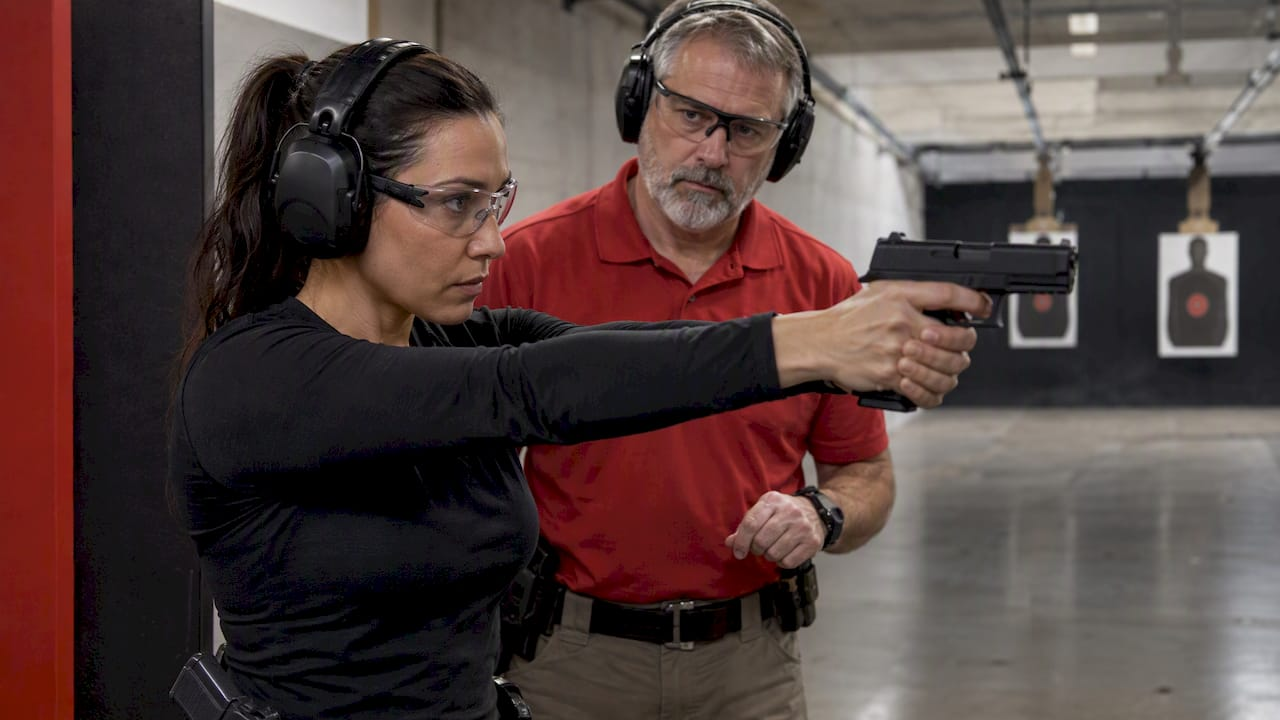
Our instructors provide this kind of evaluation as part of our standard training sessions.
A supervised session catches a mismatched mount or a flinch disguised as a dominance problem far faster than trial and error alone, and it gives you an objective read on whether your groups are actually improving.
Does Left-Eye Dominance Mean You Have to Change Shoulders?
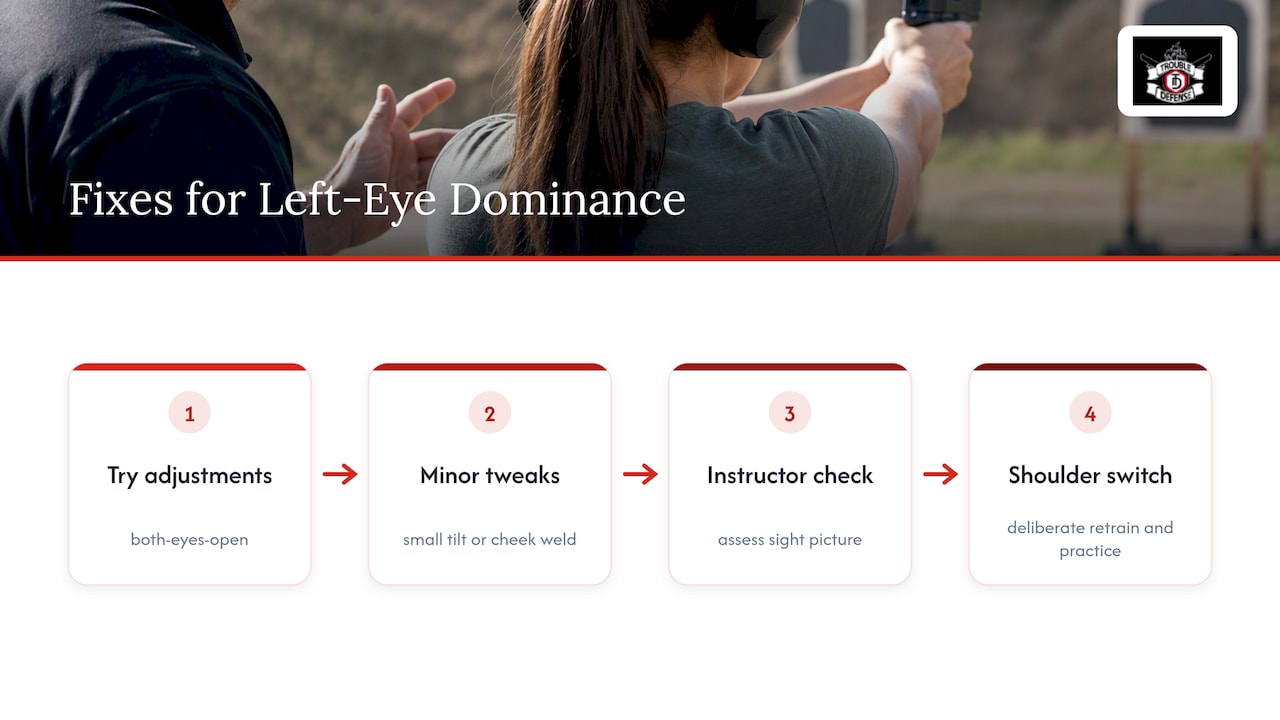
No, not automatically. Changing shoulders is one tool among several, and for a lot of shooters it is not even the first one worth trying.
If you shoot a shotgun or a reflex-sight carbine, a both-eyes-open approach often solves the problem without touching your mount at all, since those platforms lean on depth perception rather than a precise monocular sight picture. If you shoot a rifle or pistol with iron sights, a small head tilt or a modified cheek weld can bring your dominant eye into line while keeping your natural shoulder and all the muscle memory that comes with it.
A full shoulder switch makes the most sense when your dominance is strongly one-sided, when no amount of head adjustment gives you a clean sight picture, or when you are training for precision rifle work where a consistent, repeatable cheek weld matters more than convenience. Even then, it is worth treating as a deliberate retraining project rather than a quick fix: you will need to rehearse reloads, safety manipulations, and transitions on your new side before you trust it under pressure. An instructor can tell you in one session whether a small adjustment will do the job or whether the full switch is worth the retraining investment.
The Real Lesson Buried in the Research
Most advice on this topic treats eye dominance as a single problem with a single fix: switch shoulders. The research does not actually support that. A rifle shooter and a shotgunner are solving different visual problems, and the data backs different solutions for each. The rifle study shows a real accuracy cost for crossed dominance, but the archery research points toward both-eyes-open binocular technique as an advantage for anything depth-dependent.
What gets overrated is the shoulder switch itself, treated as a mandatory step rather than one option among several. What gets underrated is simply testing your actual groups at the range before committing to a retraining project that may cost you weeks of muscle memory you did not need to rebuild. Prioritize the cheapest experiment first: a head adjustment or a both-eyes-open approach, tested live, before you tear down and relearn an entire mount.
— Dee Parker
How Trouble Defense Can Help You Fix Your Aim
We built our private instruction around exactly this kind of troubleshooting. A typical one-on-one session starts with a dominance check under your real shooting stance, moves into dry practice to find the mount or head position that actually fits you, then adds a guided live-fire progression so you leave with real data instead of guesswork about what works.
- Private Firearm Training offers dedicated screening and customized drills tailored to your needs.
- Our adaptive training programs include approaches for students with unique visual profiles.
- Concealed Carry Training Packages include dominance and fit checks within a structured certification course format.
Book a private firearm training session and get a straight answer on your technique instead of another round of trial and error.
FAQ
If you are left-handed, which eye is most likely to be your dominant eye?
Handedness and eye dominance do not always match, and a notable share of left-handed shooters are actually right-eye dominant. The only reliable way to know is to run the hand-triangle test described above and confirm it at the range.
Can a left-handed person shoot a right-handed shotgun?
Yes, with some adjustment. A left-handed shooter can shoulder a right-handed shotgun, though ejection pattern and stock cast may feel awkward at first, and many shooters find a both-eyes-open approach or a short period of practice resolves most of the discomfort.
Is it better to shoot left-handed archery if my left eye is dominant?
Matching your bow hand to your dominant eye tends to make aiming more natural, since archery relies heavily on a consistent sight picture similar to rifle shooting. If switching your entire stance feels impractical, some archers instead close or occlude the non-dominant eye to simplify their sight alignment.
Is it better to shoot with your dominant eye?
For precision tasks like rifle and pistol shooting, aligning your sights with your dominant eye generally produces more consistent accuracy, a pattern reflected in the military marksmanship pilot study referenced above. For shotgun work, a both-eyes-open approach that leans on binocular depth perception often performs just as well or better.
Sources
- Association between eye dominance and training for rifle marksmanship: a pilot study
- Chapter 3 – Shooting Skills — Texas Parks & Wildlife Department
- Effect of binocular vision during target shooting in archery | PLOS One