If you manage people or a facility, the question usually arrives after something uncomfortable: a customer who would not calm down, a terminated employee who kept showing up, a front desk that froze when a stranger walked past reception. That is when most employers start looking into corporate safety training Tysons VA companies can actually fit into a workweek, and it is a fair question to ask what the training really includes before you spend money on it.
The short answer is that a good program teaches your staff how to handle the minutes before professionals arrive. It covers the conversations that are getting tense, the warning signs that should never sit in one person’s inbox, and the first decisions in an emergency. It is practical skills, taught for your building and your people, not a lecture about someone else’s workplace.
What corporate safety training Tysons VA programs actually cover
The core of the training is workplace de-escalation. Your front desk, your customer service team, and your field staff are the people who meet an angry client or an agitated visitor first. De-escalation training gives them practiced language for those moments: how to listen without escalating, how to set a limit without issuing a threat, how to create distance and call for help early instead of hoping the situation burns itself out. These are learnable skills, and staff who have rehearsed them handle tense conversations very differently from staff who are improvising.
The second piece is workplace violence prevention. Most serious incidents do not arrive without signals. There are usually comments, grievances, sudden changes in behavior, or a coworker who mentions being afraid. Prevention training teaches employees what warning signs look like, what is worth reporting, and exactly where a report goes inside your organization. That last part matters. People stay silent when they do not know the reporting path, or when they are not sure anyone wants to hear it. A clear path, explained before there is a problem, is one of the most useful things training can leave behind.
The third piece is active shooter preparedness and emergency communication. Nobody wants to think about it, which is exactly why the thinking has to happen in advance. Staff should know how your building’s exits actually work, how an alert reaches everyone quickly, who speaks to arriving responders, and what employees should do in the first moments of an emergency. Trouble Defense builds this part around your floor plan and your chain of command, because a plan copied from another company rarely survives contact with your hallways.
Built around your workplace, not a generic slide deck
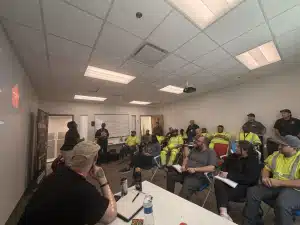
Trouble Defense delivers training on-site at your workplace or virtually, and programs are scoped to the employer rather than sold off a shelf. That scoping is what separates useful corporate safety training Tysons VA employers can rely on from a seminar everyone forgets by Friday. A medical office, a property management firm, and a government contractor in the Tysons corridor all face different traffic, different visitors, and different risks. The training should reflect your layout, your staff roles, and the situations your people actually meet.
A scoped program typically works through items like these:
- De-escalation practice built on the conversations your staff really have with customers and clients
- Warning-sign awareness and a reporting path your employees can repeat back to you
- An emergency communication plan: who alerts staff, how, and in what order
- Active shooter preparedness walked through your own exits, stairwells, and gathering points
- Role assignments for managers, reception, and floor leads during an incident
- A follow-up drill or refresher so the first session is not the last time anyone thinks about it
Because each program is built this way, pricing is quoted individually. As a reference point, Trouble Defense’s de-escalation training workshops run from $995 depending on format, and broader programs are scoped and quoted after a conversation about your workplace. You can also review what a dedicated active shooter training session involves if that is your primary concern.
What corporate safety training does not do
Honesty matters here, because oversold training creates its own risk. Corporate safety training does not replace the police or a security department. In a real emergency, your staff’s job is to create distance, get people out, and get help coming; law enforcement does law enforcement’s job. Training simply keeps those first minutes from being wasted.
It also does not turn employees into security guards, and it should not try. Your receptionist’s role in a crisis is communication and evacuation, not physical intervention. And a single session is not a checkbox that makes a workplace permanently safe. No responsible instructor can guarantee outcomes, and you should be cautious with anyone who does. What training can honestly promise is narrower and more valuable: staff who have practiced decisions in advance will make better decisions than staff who are meeting the situation for the first time.
Practice matters more than a single session
Skills fade. The employee who handled a de-escalation scenario smoothly in a workshop will be rusty a year later, and new hires arrive with none of it. That is why reinforcement matters more than any single event: short refreshers, walk-through drills, and a reporting culture that managers keep mentioning in ordinary weeks. Treat the first session as the foundation, not the finish line, and your workplace keeps the benefit instead of renting it for a day.
Start with a conversation about your workplace
If you are weighing training for an office or facility in Tysons or anywhere in the Northern Virginia and DC metro area, the right first step is a short conversation about your building, your staff, and the situations that worry you. From there, the program can be scoped honestly: what it should cover, what it should skip, and what it will cost.
See what corporate safety training Tysons VA employers book through Trouble Defense looks like in practice, and request a quote built around your workplace. Call (703) 835-0692 and we will talk through your layout and your team before anyone talks about a contract.