Women’s firearms training is a specialized instructional approach that builds confidence, safety awareness, and shooting proficiency through curricula tailored to women’s physiological and social needs. Unlike general firearms classes, this training adapts grip mechanics, recoil management, and classroom dynamics to address the real barriers women face when learning to handle a firearm for the first time. The result is not just a certificate. It is a measurable shift in how you carry yourself, make decisions under pressure, and understand your own capacity for self-defense.
What is women’s firearms training, and how does it differ?
Women’s firearms training is defined by its deliberate adaptation of instruction to fit how women actually learn, move, and process risk. General firearms courses are designed around an average male shooter’s hand size, grip strength, and prior exposure to firearms. Women’s courses correct for all three.
The physiological differences are concrete. Women typically have smaller hand spans, lower average grip strength, and different upper-body mechanics than men. A standard full-size pistol grip may require a different hand position to achieve proper trigger reach. Adapting for hand size and grip strength produces measurably better results than forcing a standard technique onto a frame it was not designed for.
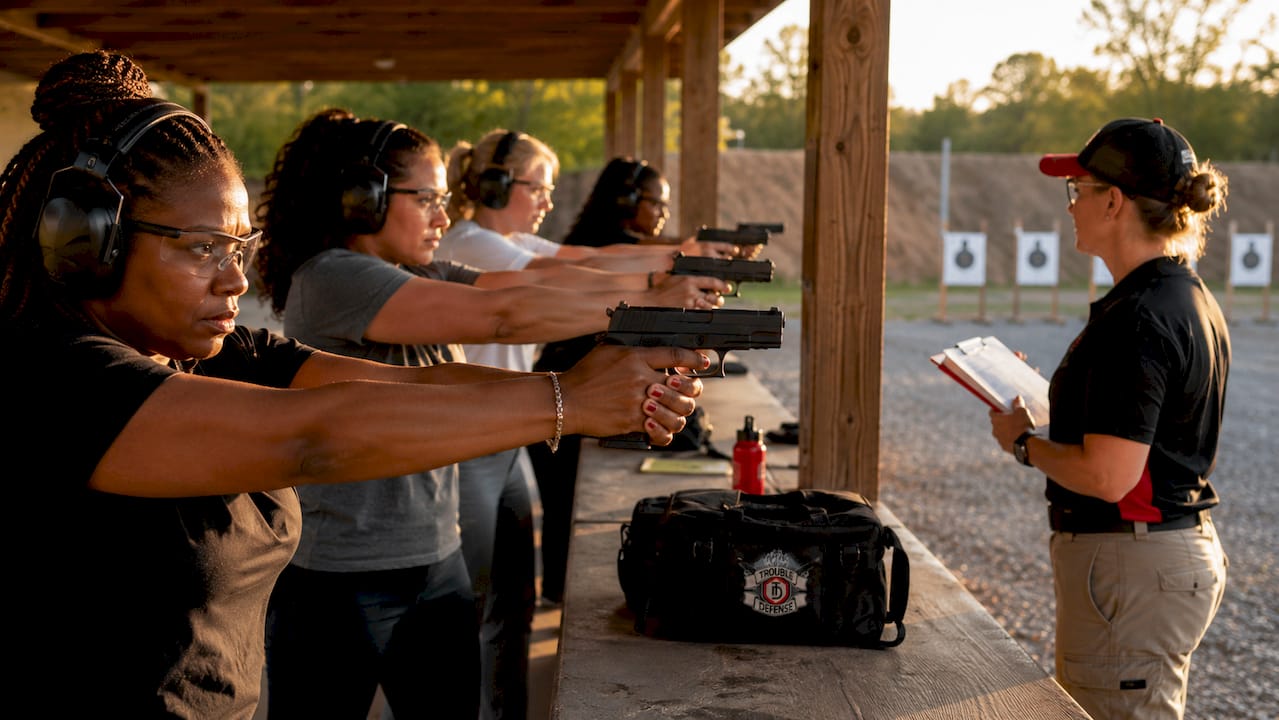
The social dimension matters just as much. Small group sizes of three to eight participants, combined with all-female or women-experienced instructors, lower intimidation and increase the quality of personalized feedback. Women who have never held a firearm benefit from environments where that inexperience is normalized rather than treated as a deficiency.
What separates quality women’s firearms training from a gimmick is the curriculum itself. Watch out for these red flags:
- Generic “pink-branded” classes that rebrand standard instruction without adapting content
- Large group “ladies night” events that prioritize social atmosphere over skill development
- Courses that skip situational awareness and legal context in favor of range time only
- Instructors with no experience teaching women or adapting to different learning styles
Pro Tip: Before enrolling, ask the instructor directly: “How do you adapt your teaching for women with no prior firearms experience?” A confident, specific answer tells you everything.
What does a women’s firearms training program cover?
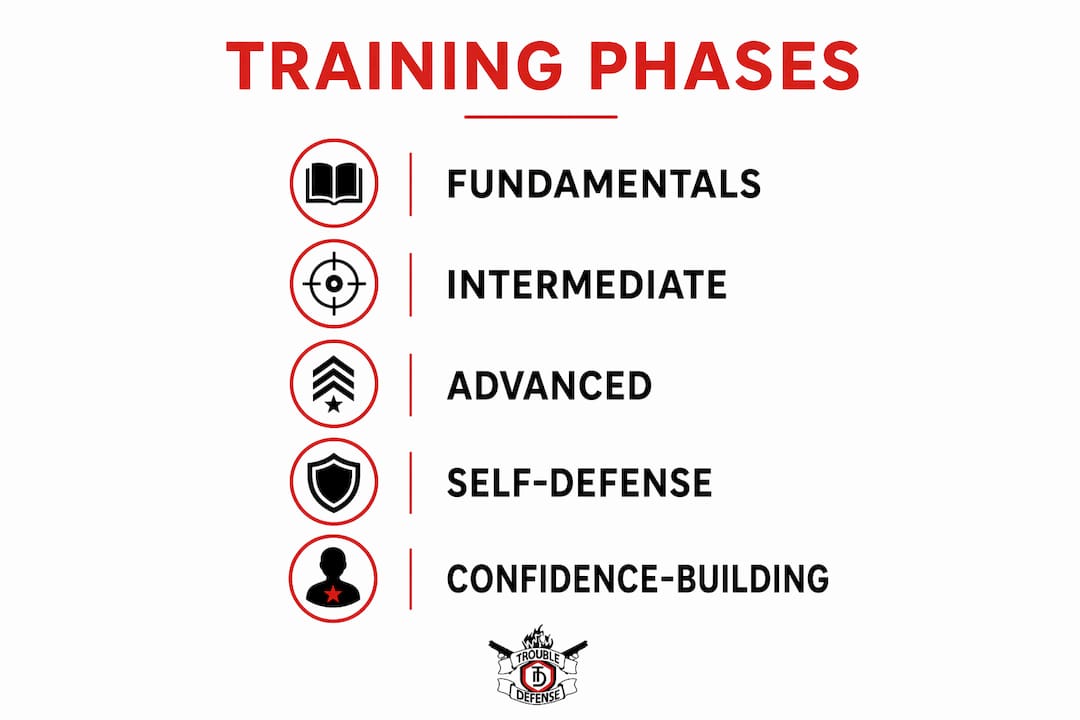
A well-structured program moves through three phases: fundamentals, foundation building, and application. A progressive 90-day curriculum ensures core competencies are retained beyond a single session, which is the primary weakness of one-day introductory events.
Here is how a quality program typically sequences its content:
- Universal Firearm Safety Rules. Every reputable course opens here. The four rules (treat every firearm as loaded, never point at anything you are not willing to destroy, keep your finger off the trigger until ready to shoot, know your target and what is beyond it) form the non-negotiable foundation.
- Grip, stance, and sight alignment. These fundamentals determine accuracy before a single round is fired. Instructors work on hand placement, body positioning, and how to align the front and rear sights with the target.
- Dry fire practice with snap caps. Dry fire training builds familiarity with firearm manipulation mechanics before live fire, significantly reducing anxiety and improving skill retention. Snap caps protect the firing pin and allow full trigger cycles safely.
- Live fire fundamentals. Students apply grip, stance, and trigger control under real conditions. Instructors provide immediate, specific feedback on each shot.
- Defensive scenarios and situational awareness. Understanding why you might need a firearm is as important as knowing how to use one. Legal and practical context integrated into training empowers better decisions, including decisions that avoid drawing a weapon entirely.
- Concealed carry preparation. For students pursuing a Virginia CCW, Maryland Wear and Carry permit, or DC concealed carry certification, this phase covers holster selection, drawing from concealment, and the legal framework for carrying in public.
Most introductory courses run three to four hours and cost between $85 and $200. That price range reflects a single session. A multi-week progressive series costs more but delivers substantially stronger outcomes.
| Training phase | What you develop |
|---|---|
| Fundamentals (weeks 1-2) | Safety rules, grip, stance, dry fire mechanics |
| Foundation building (weeks 3-6) | Live fire accuracy, recoil management, malfunction clearing |
| Application (weeks 7-12) | Defensive scenarios, concealed carry prep, situational awareness |
| Certification readiness | Virginia CCW, Maryland Wear and Carry, or Maryland HQL qualification |
Common misconceptions about guns and female shooting training
The most damaging myth in female shooting training is that smaller guns are better for women. This belief leads beginners directly into a worse shooting experience. Smaller compact handguns produce higher felt recoil and present greater ergonomic challenges than full-size or compact models. A subcompact pistol with a short grip leaves fewer fingers on the frame, reduces control, and amplifies muzzle flip.
The better approach is fitting the firearm to the shooter’s hand, not defaulting to the smallest option available. Full-size and compact 9mm pistols with adjustable backstraps, such as the Smith & Wesson M&P Shield Plus or the Glock 19, give most women better recoil management and more consistent accuracy than any micro-compact marketed as a “lady’s gun.”
| Common myth | What the evidence shows |
|---|---|
| Small guns are easier for women | Subcompacts produce more felt recoil and are harder to grip correctly |
| Women need lighter calibers | Proper grip mechanics matter more than caliber selection for beginners |
| One class is enough | A 90-day progressive curriculum builds lasting competence; single sessions do not |
| Any instructor will do | Instructor patience and ability to adapt technique are the top factors women cite |
Pro Tip: When testing a firearm before purchase, ask to try a full-size 9mm alongside a subcompact. Most women find the full-size significantly easier to control. Let your hands decide, not the marketing.
How to choose a women’s firearms training class that actually works
The single most important variable in any firearms class is instructor quality. Patience, ability to teach fundamentals, and delivering specific feedback are the qualities women consistently rank above venue, equipment, or price. An instructor who treats you as a capable adult learner and adjusts technique based on your body mechanics will produce better results in one session than a technically advanced instructor who lectures at you.
When evaluating a class, look for these qualities:
- Small class sizes. One-on-one or small group instruction outperforms large group formats because you can ask questions freely and receive feedback calibrated to your specific technique.
- Certified instructors. NRA-certified instructors have completed standardized training in how to teach firearm safety and fundamentals. Certification is a baseline, not a guarantee, but it filters out unqualified candidates.
- Situational awareness content. Courses that include legal context and decision-making alongside range skills produce more capable, confident graduates than pure shooting courses.
- Progressive structure. A single session builds exposure. A multi-week program builds competence. Ask whether the course is part of a series or a standalone event.
- Women-specific curriculum. The course should explicitly address grip adaptation, recoil management for different hand sizes, and the psychological aspects of defensive decision-making. If the instructor cannot explain how the curriculum differs from a standard course, it probably does not.
The gun safety classes that integrate self-defense law and real-world decision-making alongside range fundamentals consistently produce graduates who are more prepared and more confident than those from range-only programs.
Key takeaways
Women’s firearms training produces lasting competence only when it combines physiological adaptation, qualified instruction, and a progressive multi-session curriculum.
| Point | Details |
|---|---|
| Tailored instruction matters | Adapting grip, stance, and recoil management to women’s physiology produces better outcomes than standard courses. |
| Small classes outperform large ones | Groups of three to eight participants allow personalized feedback and reduce intimidation for beginners. |
| Avoid the small-gun myth | Full-size or compact 9mm pistols give most women better control than subcompact models marketed to women. |
| Progressive curricula build real skills | A 90-day multi-session program develops lasting competence; single-session events rarely do. |
| Instructor quality is the top variable | Patience, adaptability, and specific feedback matter more than venue or equipment. |
Why confidence-first training changed how I think about this
I have worked with hundreds of women who walked into their first class convinced they were not “gun people.” Most of them had been told, directly or indirectly, that firearms were not for them. Some had been handed a tiny pink pistol by a well-meaning partner and told it was perfect for them. Almost none of them had been asked what they actually needed.
What I have learned is that confidence is not something you bring to training. It is something training builds in you. The women who leave genuinely capable are the ones whose instructors slowed down, adapted the technique to their hands, and explained the why behind every drill. The ones who leave frustrated are almost always the ones who sat through a generic class where the instructor assumed prior knowledge or rushed through fundamentals to get to the fun part.
The women’s firearm training approach I believe in starts with safety, moves through dry fire before live fire, and never treats a question as a sign of weakness. The instructors who do this well are not just firearms experts. They are teachers who understand that a new shooter’s first experience shapes every experience that follows.
My honest recommendation: skip the one-day event and invest in a progressive series. Skip the subcompact and try a full-size 9mm first. And choose an instructor whose first instinct is to listen before they teach.
— Dee Parker
Train with Trouble Defense in the DMV area
Trouble Defense offers women’s firearms training programs in Fairfax, VA, designed specifically for beginners through experienced shooters who want to sharpen their skills. Led by certified NRA instructors with over 300 five-star Google reviews, the programs cover firearm safety, marksmanship fundamentals, and defensive decision-making in a supportive, small-group environment.
Whether you are preparing for a Virginia CCW class, a Maryland Wear and Carry permit, or simply building the confidence to handle a firearm safely at home, Trouble Defense structures every session around your pace and your goals. The team also offers Maryland Wear and Carry training for women seeking legal carry certification across the DMV. Contact Trouble Defense to find the right program for where you are starting from.
FAQ
What is women’s firearms training?
Women’s firearms training is structured instruction that adapts firearm safety, handling, and marksmanship fundamentals to women’s physiological and social needs. It prioritizes a low-pressure environment, small class sizes, and progressive skill development over speed or performance pressure.
How long does a women’s firearms training course take?
Introductory courses typically run three to four hours, while a full progressive curriculum spans 90 days across multiple sessions. Single sessions build exposure; multi-week programs build lasting competence.
Do I need to own a gun before taking a class?
No. Many courses provide firearms and ammunition, though some require participants to supply their own ammo. Contact your instructor before the first session to confirm what equipment is included.
What type of handgun is best for women beginners?
Full-size or compact 9mm pistols with adjustable backstraps, such as the Smith & Wesson M&P Shield Plus or Glock 19, give most women better recoil control and accuracy than subcompact models. Smaller guns produce more felt recoil and are harder to grip correctly.
How do I find a qualified women’s firearms instructor?
Look for NRA-certified instructors who teach small groups, explicitly adapt technique for women’s physiology, and include situational awareness alongside range fundamentals. Ask directly how their curriculum differs from a standard firearms course before enrolling.