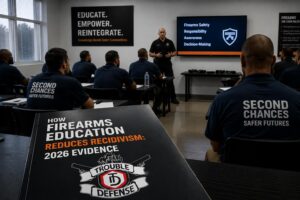
Active shooter training is a structured, ongoing program that prepares people to recognize threats, respond quickly, and survive life-threatening situations involving an armed attacker. Between 2000 and 2024, there were 528 active shooter incidents in the United States. The scale of that number makes one thing clear: preparedness is not optional. Federal standards from the Department of Homeland Security (DHS) and OSHA provide the framework, but the real work happens inside organizations that commit to regular, well-designed emergency response training. Trouble Defense builds that kind of program for individuals and organizations across the DMV area.
What does effective active shooter training include?
Effective active shooter training follows recognized federal standards and covers far more than a single video or a one-page handout. DHS developed the “Run, Hide, Fight” framework as the baseline for civilian response. Programs that align with DHS standards also incorporate certified instructors, scenario-based exercises, and scheduled refreshers to keep skills sharp.
The core components of a credible program include:
Threat awareness and recognition. Most attackers show warning signs before an incident. Training teaches participants to identify escalating anger, threatening statements, and other pre-attack behavioral signals so that intervention is possible before violence begins.
Reporting protocols. Participants learn who to contact, what to say, and how to document concerns without creating a hostile environment. Clear reporting channels save lives.
Response options. Programs like ALICE (Alert, Lockdown, Inform, Counter, Evacuate) give individuals a flexible decision-making model rather than a rigid script. That flexibility matters when conditions change by the second.
Behavioral threat assessment. Organizations learn to evaluate reported concerns systematically, reducing both under-reaction and overreaction.
Scenario-based practice. Tabletop exercises and role-play simulations build muscle memory and reduce panic. Passive lectures alone do not produce reliable behavior under stress.
OSHA’s General Duty Clause requires employers to provide a workplace free from recognized hazards. Active shooter preparedness falls under that obligation. Organizations that skip training carry real legal exposure if an incident occurs and no program was in place.
Pro Tip:Schedule a tabletop exercise before any live drill. Tabletop sessions let participants talk through decisions without physical stress, which builds a shared mental model that makes live drills far more productive.
How should training handle psychological safety?
Trauma-informed delivery is the standard for responsible active shooter preparedness programs. Surprise drills cause measurable psychological harm. Advance notice and opt-outs are best practices, not optional courtesies. Participants who feel ambushed by a drill are less likely to engage honestly and more likely to carry lasting anxiety.
The following practices define a trauma-informed approach:
Announce training dates and formats well in advance.
Provide a clear opt-out path for participants with trauma histories, medical conditions, or other valid concerns.
Avoid graphic role-play, fake gunfire, or simulated casualties without explicit participant consent and professional facilitation.
Offer access to mental health resources, such as an Employee Assistance Program, in the days following any drill.
Conduct exercises during non-operational hours when possible to reduce disruption and stress.
Effective violent intruder drills do not require shock value to be effective. Research consistently shows that advance notice, clear communication, and post-exercise support produce better learning outcomes than surprise tactics. Participants who feel psychologically safe during training retain more, engage more honestly, and apply skills more reliably under real pressure.
Tabletop exercises are the right starting point for most organizations. They walk participants through scenarios verbally, test decision-making, and reveal gaps in communication plans without physical risk. Once the tabletop phase is complete, organizations can move toward structured, announced physical exercises with appropriate safeguards in place.
How to implement active shooter preparedness in your organization
A well-built crisis management training program follows a clear sequence. Skipping steps creates gaps that show up at the worst possible moment.
Conduct a vulnerability assessment. Walk the facility with a trained instructor. Identify entry points, sight lines, lockable rooms, and communication dead zones. This assessment shapes every decision that follows.
Customize scenarios to your environment. A school, a hospital, and a corporate office each face different risks and have different populations. Generic training misses the specific threats and constraints of each setting. School shooting training, for example, requires age-appropriate content and coordination with school resource officers.
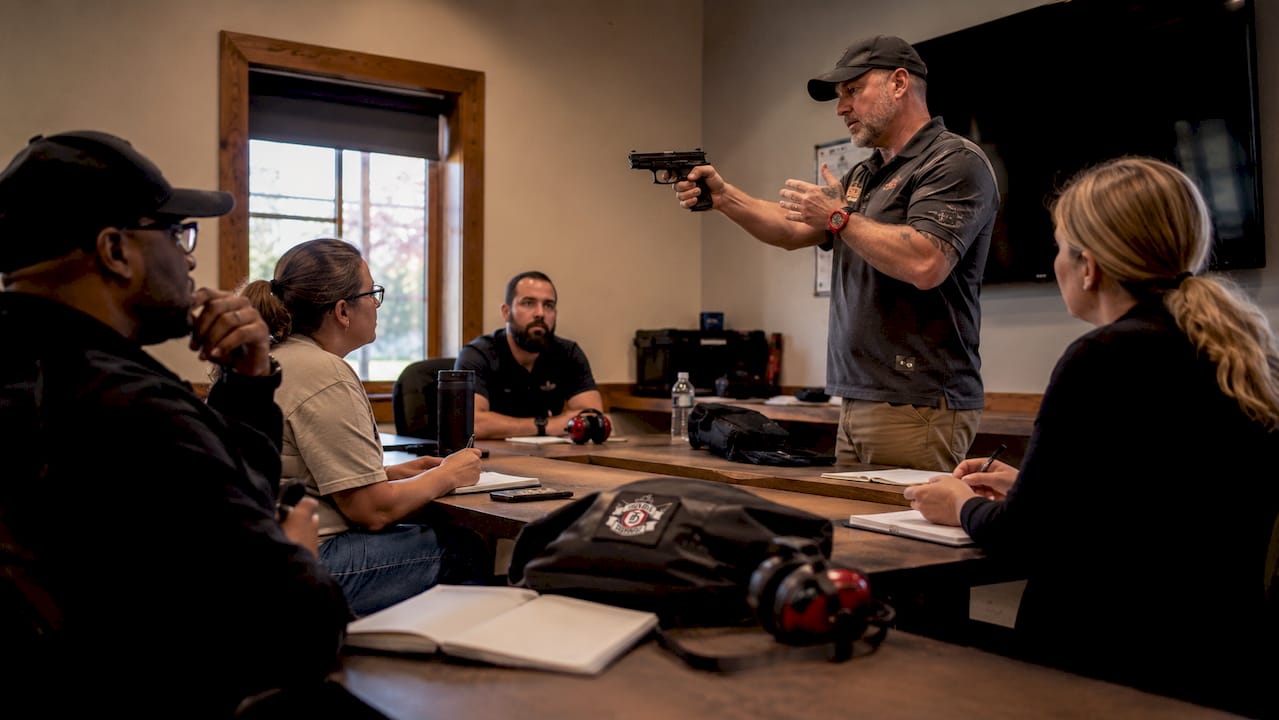
Select qualified instructors. Look for credentials tied to law enforcement, DHS, or recognized certification bodies. Trouble Defense’s certified firearms instructors bring both tactical knowledge and teaching experience to every session.
Schedule training for all staff, including new hires. Active shooter preparedness fades without reinforcement. Build onboarding training into your HR process and schedule annual refreshers for existing staff.
Coordinate with local law enforcement. Invite your local police or sheriff’s department to review your plan. Many agencies offer free consultations and will walk your facility. Their input also improves response time if an incident occurs, because officers will already know your layout.
Document everything. Record attendance, content covered, instructor credentials, and participant feedback after every session.
Proper training documentation supports evidence of reasonable care and protects organizations legally if a workplace violence incident ever results in litigation.
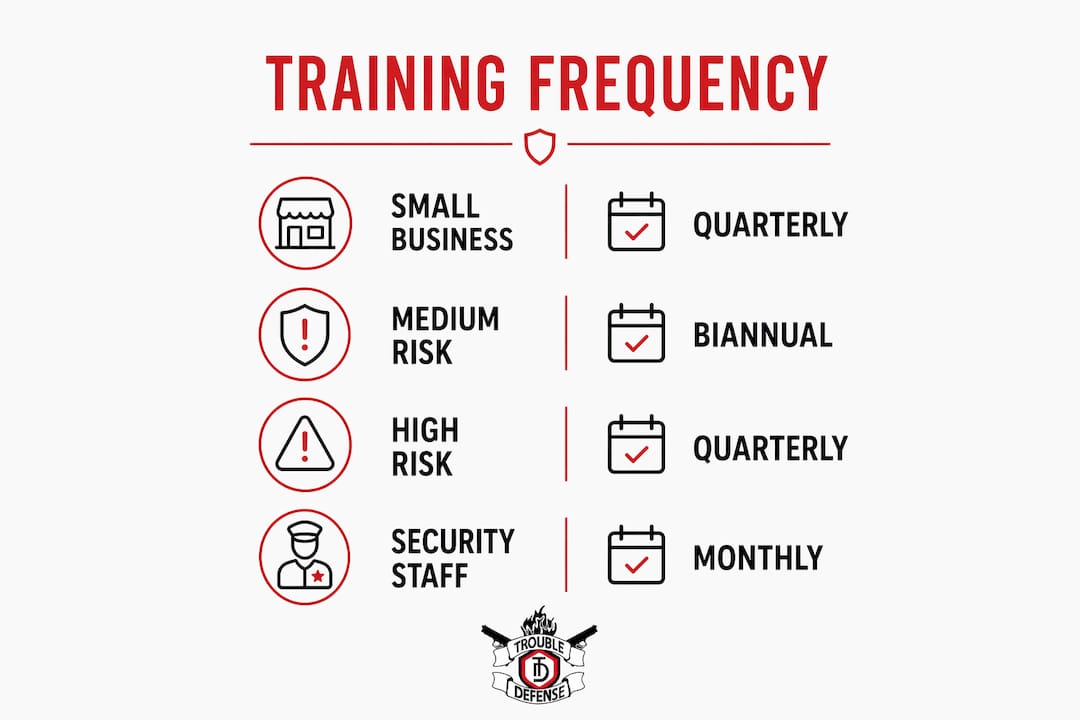
The table below shows how training frequency should scale with organizational risk level.
Organization type
Recommended frequency
Key focus areas
Small business (under 50 staff)
Annual full training, quarterly reminders
Run, Hide, Fight basics; reporting protocols
Mid-size workplace (50–500 staff)
Biannual full training, monthly awareness
ALICE framework; threat assessment; drills
School or campus
Annual full training, semester drills
Age-appropriate response; lockdown procedures
Healthcare facility
Biannual training, quarterly scenario review
Patient protection; communication; evacuation
Large enterprise (500+ staff)
Quarterly training cycles, ongoing e-learning
Integrated response; behavioral threat teams
Pro Tip:Pair your training documentation with a written workplace violence prevention policy. The policy and the training records together form the strongest legal defense available to an organization.
What are the most common mistakes in active shooter training?
The most dangerous mistake in survival tactics training is teaching a single, rigid response. Options-based models like ALICE exist precisely because no two incidents unfold the same way. A lockdown that saves lives in one scenario can trap people in another. Training that gives participants only one option creates false confidence and real risk.
A second critical error involves confusing concealment with cover. Concealment hides you from view. Cover stops bullets. Cubicles and drywall offer concealment, not cover. Concrete pillars, steel desks, and engine blocks provide actual cover. Most people do not know this distinction until someone teaches it. Effective training makes this difference explicit and unforgettable.
Electronic devices create a third, underappreciated hazard. A phone set to vibrate still makes noise. A screen that lights up in a dark room reveals a hiding person’s location. Fully disabling notifications during an active threat is a specific, teachable skill that most general safety programs skip entirely.
Other common failures include:
Running surprise drills without advance notice, which causes trauma and erodes trust.
Skipping post-training mental health support, leaving participants to process stress alone.
Relying on outdated “perimeter and wait” models that ignore integrated response with fire, EMS, and immediate communication.
Treating training as a one-time compliance checkbox rather than a living program.
Failing to update content when local threat patterns or federal guidance changes.
The fix for most of these errors is the same: hire qualified instructors, follow current DHS and OSHA standards, and build a program that evolves. Workplace violence prevention training that integrates behavioral threat assessment with physical response options covers far more ground than a basic drill ever could.
Key Takeaways
Active shooter training works best as a continuous, options-based program built on federal standards, trauma-informed delivery, and thorough documentation.
Point
Details
Start with a vulnerability assessment
Identify facility-specific risks before designing any training scenario or drill.
Use options-based frameworks
ALICE and DHS Run, Hide, Fight give participants flexible tools, not rigid scripts.
Prioritize trauma-informed delivery
Advance notice, opt-outs, and post-training support protect participants and improve retention.
Teach cover versus concealment
Drywall hides you; concrete stops bullets. This distinction is a core survival skill.
Document every session
Attendance records, content logs, and feedback forms provide legal protection and drive improvement.
Why I think most organizations underestimate this training
Most organizations treat active shooter preparedness as a compliance task. They run one drill, check a box, and move on. That approach gives people just enough training to feel safe without actually making them safer. I have seen it firsthand, and the gap between perceived readiness and actual readiness is significant.
The programs that genuinely work share one quality: they treat training as a living system. Threats change. Staff turns over. Building layouts shift. A program designed in 2019 and never updated does not reflect the threat environment of 2026. The organizations that stay ahead of this update their content annually, debrief every drill honestly, and integrate behavioral threat assessment into their everyday culture, not just their emergency plans.
Options-based training is the other piece most organizations get wrong. Telling people to “run if you can, hide if you can’t, fight as a last resort” is a starting point, not a complete program. Real preparedness means practicing each option under simulated pressure so that the decision feels familiar when it matters. That kind of muscle memory does not come from a video. It comes from repetition with a qualified instructor who can correct mistakes in real time.
Trauma-informed delivery is not a soft add-on. It is what separates programs that people actually engage with from programs that people endure and forget. When participants feel respected during training, they retain more, ask better questions, and are more likely to act when it counts.
— Dee Parker
Trouble Defense offers professional preparedness training in the DMV area
Trouble Defense is a veteran-owned training academy based in Fairfax, VA, serving individuals and organizations across Virginia, Maryland, and Washington, DC. The team brings certified instructor credentials and real-world experience to every program, from workplace violence prevention to hands-on active shooter response.
Trouble Defense builds customized preparedness programs for businesses, schools, and community organizations throughout the DMV area. Every program follows current DHS and OSHA standards, uses trauma-informed delivery, and includes thorough documentation for compliance. Whether your organization needs a first-time assessment or a full annual training cycle, Trouble Defense has the credentials and the experience to deliver it. For answers to common training questions, the firearm and safety training FAQ covers the topics most organizations ask about first. Contact Trouble Defense to schedule a consultation and build a program that fits your environment.
FAQ
What is active shooter training?
Active shooter training is a structured program that teaches individuals to recognize threats, make real-time response decisions, and survive an armed attack. Programs typically follow DHS frameworks like Run, Hide, Fight or options-based models like ALICE.
How often should organizations conduct active shooter drills?
Most organizations should conduct full training annually, with quarterly reminders or tabletop exercises in between. High-risk environments like schools and healthcare facilities benefit from more frequent scenario reviews.
Are surprise active shooter drills recommended?
No. Best practices require advance notice, clear communication, and opt-out options for participants. Surprise drills cause psychological harm and reduce training effectiveness.
What is the difference between cover and concealment?
Concealment hides you from view but does not stop bullets. Cover, such as concrete pillars or steel desks, physically blocks projectiles. Effective training teaches participants to seek cover, not just concealment.
Does OSHA require active shooter training?
OSHA’s General Duty Clause requires employers to address recognized workplace hazards, which includes the risk of workplace violence. Organizations that fail to implement preparedness training carry legal exposure if an incident occurs.


 Trouble Defense builds customized preparedness programs for businesses, schools, and community organizations throughout the DMV area. Every program follows current DHS and OSHA standards, uses trauma-informed delivery, and includes thorough documentation for compliance. Whether your organization needs a first-time assessment or a full annual training cycle, Trouble Defense has the credentials and the experience to deliver it. For answers to common training questions, the firearm and safety training FAQ covers the topics most organizations ask about first. Contact Trouble Defense to schedule a consultation and build a program that fits your environment.