01
Check your license path.
Before paying, confirm which New York licensing authority will accept your application and training documents. Use our simple guide ↓
Need a New York concealed carry license? Start with clear, hands-on training close to home. Learn New York's rules, finish the required course, and know what to do next.
Questions first? Call 703-835-0692. Your training certificate is not a carry license; New York decides who qualifies.

New York does not honor your Virginia, Maryland, or DC permit as permission to carry there. If you're eligible to apply in New York, you generally need New York-specific training. Trouble Defense helps make that training easier to understand and complete.
Complete our in-person classroom and range course at your assigned Northern Virginia training location.
Understand safety, where carry is restricted, storage rules, and lawful decision-making.
After you pass the required assessments, receive your endorsed certificate for the application process.
Clear instruction and supervised range time—not just reading a website or watching a video.

You don't need to know all the legal terms before you call. We'll help explain the training portion.
Before paying, confirm which New York licensing authority will accept your application and training documents. Use our simple guide ↓
Learn in person for 16 classroom hours, then complete 2 hours of live-fire range instruction and assessments.
After passing the written and live-fire assessments, receive your course certificate. Submit it to the proper New York licensing office along with its other requirements.
The course has two parts. First you learn New York's rules and safe firearm practices. Then you apply what you learned in a supervised range setting.
 PART 1 · 16 HOURS
Learn the important rules and practice safer decisions with an instructor who can answer your questions.
 PART 2 · 2 HOURS
Practice range safety and complete the New York-required live-fire proficiency assessment under instructor supervision.
How do you pass? New York requires at least 80% on the written test plus a successful live-fire assessment. Under the published state minimum, that live-fire assessment includes placing at least 4 of 5 rounds on the required target at 4 yards, along with demonstrating safe handling. Read the official standards ↗
Dee Parker and Sheena Parker are both named on Monroe County's public List of Self-Certifications for Firearm Safety Courses for classroom and live-fire training. That is a verifiable instructor listing, not a government guarantee of license approval.
Trouble Defense is a veteran-owned company that has taught firearm safety since 2012. We focus on safe habits, questions you can ask without feeling rushed, and practical learning in a professional environment.
Verify Our Instructor Listing
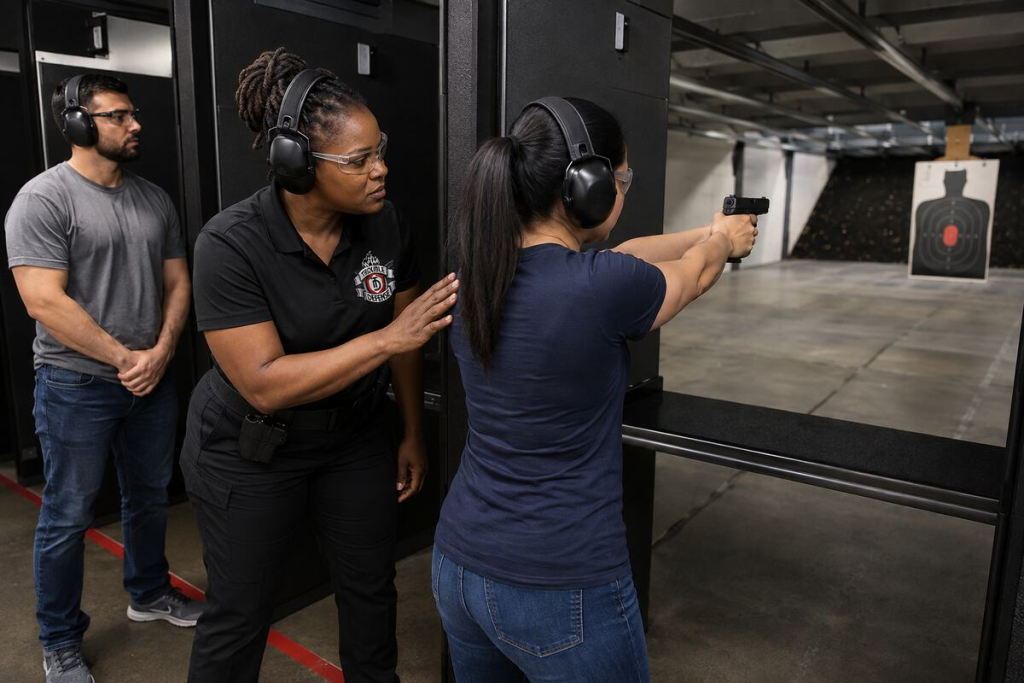
A look at Trouble Defense instruction, with a mix of real training photos and New York-themed visuals. Your confirmed class and range locations are in Northern Virginia.
 Real Trouble Defense range training
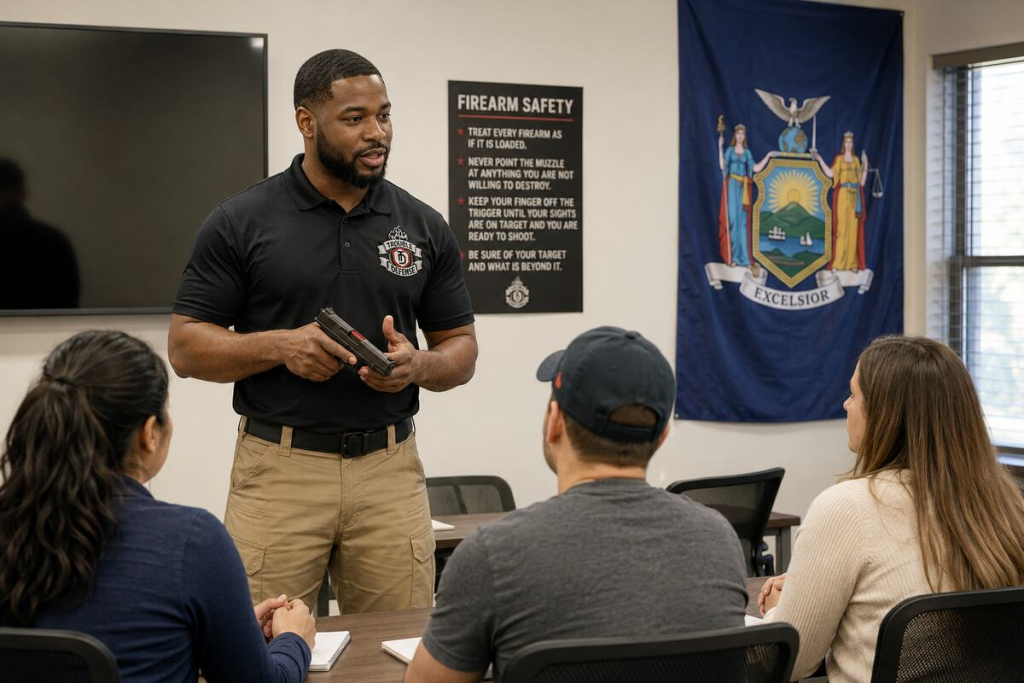 New York CCW classroom illustration
 New York live-fire training illustration
Image note: New York-themed images on this page are illustrative artwork, not photographs of a New York training facility. Your actual training location is provided when scheduling.
You can be eligible to apply as a nonresident, but New York has different licensing offices. Choose what describes your destination and see the next step.
Pick one. We'll show an informational starting point.
Tell the New York agency where you plan to apply that you are a nonresident. Ask which license you need, how to apply, and what training documentation it accepts. Official New York guidance ↗
This guide is educational. It does not check your legal eligibility or issue a permit.
Tap an item when you're done. This stays on your screen only—nothing gets submitted.
One course price for the training Trouble Defense describes here. No confusing packages to compare.
Before you register: Trouble Defense's published gear list requests a handgun, secure holster, at least 100 rounds of ammunition, eye/ear protection, and photo ID. Confirm any range fees, rentals, ammunition or other charges directly with our team.
New York government application fees and the licensing decision are separate from this training price. Never transport or bring a firearm unless it is lawful for you to do so and your instructor has confirmed the arrangements.
Your confirmation will tell you which classroom and range to use. Both of these partner facilities are used for Trouble Defense instruction.
8194-M Terminal Road
Lorton, VA 22079
Tap any question to see the answer. No need to search through a wall of legal language.
New York's published guidance says state residency or in-state employment is not required to apply, and nonresident applications should be evaluated under the same standards. You still must meet the licensing authority's requirements. Read New York's official FAQ ↗
No. New York does not recognize another state's carry permit as authorization to carry a handgun in New York. You need the appropriate New York license and must comply with all applicable New York laws and location restrictions.
The listed Trouble Defense tuition is $400 for the 18-hour course. Ask us whether any range fee, ammunition, equipment, rental or other charge applies to your booking. Government application fees are separate.
No. New York's minimum standards require 16 hours of in-person classroom instruction and two hours of live-fire range training. This is an in-person course, not a fully online or Zoom course.
We welcome questions from newer students, but the course includes a required written exam and live-fire proficiency assessment. Contact us first if you're unsure about your current experience or want private firearm instruction before the assessment.
The minimum written passing score is 80%. You must also demonstrate safe firearm handling and pass the state's live-fire proficiency assessment. The official minimum assessment specifies at least four of five rounds on target at four yards, along with the required safety steps. See official standards ↗
The current course information requests a handgun, secure concealed-carry holster, at least 100 rounds of ammunition, eye protection, ear protection and photo ID. The 100-round request is for the class, not the five-round scored test. Contact Trouble Defense before class about equipment availability, fees and lawful firearm transport. Do not bring a firearm without verifying that you can legally possess and transport it and that it is permitted at your training location.
Course locations vary by booking. Trouble Defense uses the NRA Range in Fairfax and Sharpshooters Indoor Range in Lorton for classroom and live-fire training. Your exact location is included in your confirmation. The Fairfax Boulevard office is for meetings and appointments, not your default class location.
Yes. Dee Parker and Sheena Parker are each publicly listed for both classroom and live-fire courses on the Monroe County Clerk's List of Self-Certifications for Firearm Safety Courses ↗. This is a self-certification listing, not a guarantee that any specific licensing office will approve an application.
No. Passing the course earns qualifying training documentation. You must apply separately and meet the requirements of the appropriate New York licensing authority. Only that authority decides whether to issue your license.
Not automatically. NYC has its own licensing rules. A license issued elsewhere in New York generally does not by itself authorize carry within New York City without the appropriate NYC authorization. For NYC, check the NYPD licensing portal ↗ and confirm the current rules.
Use the New York Gun Safety FAQ ↗, the NY State Police/DCJS training standards ↗, and your intended licensing office. These are better references for current rules than an outdated blog article.
Start by asking us about the next 18-hour New York CCW class. We'll help you confirm the schedule, training location, what to bring, and the registration process.
Official references: NYS minimum course standards · NY nonresident licensing FAQ · Public instructor self-certification listing