
Court ordered firearms training is a mandatory educational program that judges assign as a condition of sentencing, probation, or a legal agreement, requiring you to complete an approved course and submit proof of completion to satisfy your court’s requirements. Known formally as court mandated gun training or mandatory firearms education, this process is not optional. Missing a deadline or submitting the wrong certificate can trigger probation violations or extend your legal supervision. This guide walks you through every step of the court ordered firearms training process, from understanding your court order to submitting valid proof, so you can close the compliance loop without surprises.
What are court ordered firearms training requirements and prerequisites?
Court ordered firearms training is mandated by judges as a condition of sentencing or probation, requiring proof of completion to satisfy legal compliance. That means the training is not voluntary education. It is a legal obligation with a deadline attached.
Courts assign mandatory firearms education for a range of reasons. Common triggers include:
- A firearms-related offense or charge
- A domestic violence conviction or restraining order
- Probation conditions tied to firearm ownership
- Plea agreements that include a safety education requirement
- Child endangerment cases involving unsecured firearms
Requirements vary significantly by state and jurisdiction. A Virginia court may specify different approved providers and course hours than a Maryland or DC court. Colorado, for example, passed SB25-003, which from 2026 requires a firearms safety eligibility card issued by a county sheriff, with local officials retaining discretion to deny based on danger assessments. That level of local variation is exactly why you must read your court order word for word before enrolling in any course.
Non-compliance with mandated training is treated seriously and can result in revoked probation or further legal action, making on-time completion and evidence submission vital. The stakes are real. Treat the deadline on your court order as a hard cutoff, not a suggestion.
Pro Tip: Ask your attorney or probation officer to highlight the specific course requirements in your order before you search for a provider. One missed detail, such as a required minimum course length, can invalidate an otherwise completed course.
How do you choose and verify an approved court ordered firearms course?
The single most common compliance failure is enrolling in a general firearm safety course that does not meet the specific acceptance criteria your court requires. Many compliance failures arise from participants enrolling in courses that fail to provide compliant completion certificates. A general NRA basic pistol class, for instance, may not satisfy a court order that specifies a court approved gun safety course with a verified certificate format.
Use this checklist when evaluating any provider:
- Confirm the provider is listed as approved by your state or court
- Verify the course covers the topics named in your order (safe handling, storage, legal responsibilities)
- Check that the certificate includes your full name, course hours, instructor credentials, and provider details
- Ask the provider directly whether their certificate has been accepted by courts in your jurisdiction
- Confirm whether your court order permits online completion or requires in-person instruction
Many court ordered firearms safety courses can be completed online with live or self-paced modules, allowing convenient scheduling for participants under supervision. Online options are legitimate in many jurisdictions, but you must verify this with your probation officer or attorney before enrolling. Some courts require a live instructor component regardless of format.
Approved programs are state-recognized and mandatory. Non-compliance can trigger probation violations or extend legal consequences. Choosing an unapproved provider wastes your time and money and puts your compliance at risk.
Pro Tip: Call the court clerk’s office or your probation officer and ask for a list of accepted providers before you register. Getting that confirmation in writing protects you if a question arises later.
Trouble Defense, based in Fairfax, VA, offers firearm safety training recognized across Virginia, Maryland, and DC. Their certified NRA instructors can confirm whether their courses align with your specific court order requirements.
Step-by-step walkthrough of completing court mandated gun training
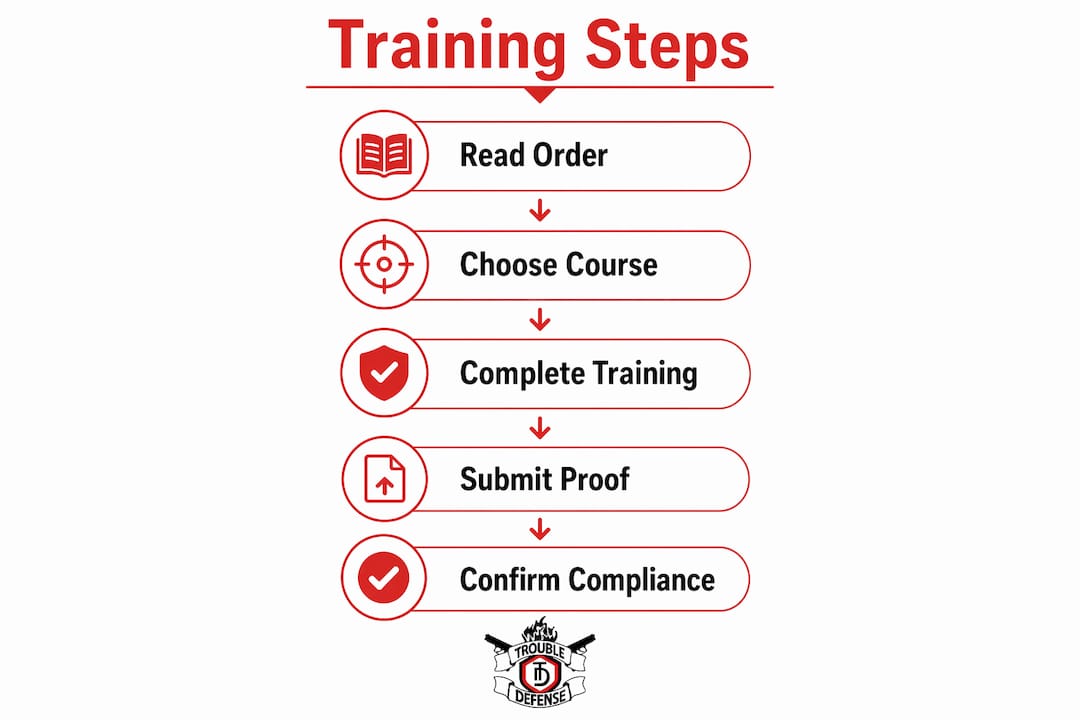
Understanding the full sequence before you start removes uncertainty and keeps you on track. Here is what the typical court ordered firearms training process looks like from enrollment to certificate.
Read your court order carefully. Identify the required course type, minimum hours, approved provider criteria, and submission deadline. Write these details down before contacting any provider.
Contact an approved provider. Confirm the course matches your order’s requirements. Ask specifically about certificate format and whether their documentation has been accepted by courts in your area.
Register and pay. Complete enrollment. Keep your registration confirmation as a record of your intent to comply.
Complete the coursework. Most court mandated courses cover safe firearm handling, secure storage practices, and legal responsibilities under state and federal law. Course length typically ranges from a few hours for basic safety education to a full day for more comprehensive programs. Some orders require a live fire component, meaning you will handle and discharge a firearm under instructor supervision.
Pass any required assessment. Many courses include a written test or practical evaluation. You must pass to receive a valid certificate.
Receive your certificate. Review it immediately. Confirm your full legal name is spelled correctly, the course hours are accurate, and the instructor’s credentials and provider information are present. In Texas, court approved gun safety courses require certificates showing the participant’s name, course hours, and provider details following state law. Most jurisdictions follow similar standards.
Make multiple copies. Store the original in a secure location. Keep digital scans as backup. You may need to submit copies to more than one party.
The firearms certification process at Trouble Defense includes documentation designed to meet court and state compliance standards. Their instructors walk students through what the certificate contains and how to use it correctly.
How to properly submit proof of completion to the court

Completing the course is only part of the process. Submitting your certificate correctly and on time is what closes the legal compliance loop. Submitting your certificate to the proper court official with all required information and retaining copies is critical for legal compliance.
The table below outlines the most common submission scenarios and what each requires.
| Submission recipient | What to provide | How to confirm receipt |
|---|---|---|
| Probation officer | Original or certified copy of certificate | Request a signed acknowledgment or email confirmation |
| Defense attorney | Copy of certificate before your next court date | Ask attorney to file it with the court on your behalf |
| Court clerk | Certificate plus any required cover sheet or case number | Request a file-stamped copy for your records |
| Judge (at hearing) | Bring original and two copies to court | Certificate is entered into the record at the hearing |
Common mistakes to avoid:
- Submitting a certificate with a misspelled name or incorrect course hours
- Missing the submission deadline stated in your court order
- Sending a copy when the court requires the original
- Failing to follow up to confirm the document was received and accepted
Pro Tip: Submit your certificate at least one week before your court deadline. That buffer gives you time to correct any issues, such as a rejected format or a missing field, without violating your order.
Courts impose firearms training to educate individuals about safe ownership and reduce recidivism rather than just punishing. Understanding that purpose helps you approach the process with the right mindset. You are not just checking a box. You are building knowledge that has real safety value.
Key Takeaways
The court ordered firearms training process requires matching your course exactly to your court order, completing it on time, and submitting a compliant certificate to the right official before your deadline.
| Point | Details |
|---|---|
| Read your court order first | Identify required course type, hours, provider approval, and submission deadline before enrolling. |
| Verify provider approval | Confirm the provider’s certificate is accepted by your specific court or probation officer. |
| Check certificate details | Your certificate must include your full name, course hours, instructor credentials, and provider information. |
| Submit to the right party | Deliver proof to your probation officer, attorney, or court clerk and get written confirmation of receipt. |
| Meet the deadline with buffer | Submit at least one week early to allow time to fix any rejected or incomplete documentation. |
What I’ve learned from watching people navigate this process
The most preventable compliance failures I see come from one mistake: people treat the court order as a general suggestion rather than a precise legal document. They enroll in the first firearm safety course they find online, complete it, and then discover the certificate does not include the fields the court requires. That is a frustrating and avoidable outcome.
My honest advice is to slow down at the start. Spend 20 minutes reading your order carefully and another 20 minutes on the phone with your probation officer or attorney before you register for anything. That 40 minutes of preparation can save you weeks of legal headaches.
The other thing I want you to understand is that this training has real value beyond compliance. Courts impose mandatory firearms education because it works. Programs focused on firearms education and recidivism show that structured safety training changes how people think about firearm responsibility. You will leave knowing more than you did when you walked in. That knowledge matters.
Finally, do not underestimate the importance of record keeping. Store your certificate, your registration confirmation, and any written acknowledgment from the court in one folder, physical and digital. Legal situations can resurface years later, and having clean documentation protects you every time.
— Dee Parker
Trouble Defense can help you complete your required training
Trouble Defense LLC is a veteran-owned firearms training academy based in Fairfax, VA, serving Virginia, Maryland, and Washington DC. Their certified NRA instructors deliver structured courses covering safe handling, secure storage, and legal responsibilities, with documentation designed to meet court and state compliance standards.
Whether you need a court recognized firearms safety course or want to confirm that a specific program aligns with your court order, Trouble Defense has the experience and local knowledge to guide you. They offer flexible scheduling, in-person instruction, and adaptive programs for individuals with disabilities. With over 300 five-star Google reviews, Trouble Defense is a trusted name across the DMV area. Check their upcoming training calendar to find a class that fits your timeline and compliance deadline.
FAQ
What is court ordered firearms training?
Court ordered firearms training is a mandatory educational program assigned by a judge as a condition of sentencing or probation. It covers safe handling, secure storage, and legal responsibilities, and requires a verifiable certificate of completion.
Can I complete court mandated gun training online?
Many jurisdictions allow online completion, but you must confirm this with your probation officer or attorney before enrolling. Some courts require a live instructor component or in-person attendance regardless of format.
What should a court approved firearms training certificate include?
A valid certificate must include your full legal name, total course hours, instructor credentials, and provider details. In Texas and most other states, missing any of these fields can result in the certificate being rejected by the court.
What happens if I miss the firearms training deadline?
Missing the deadline is treated as non-compliance with your court order and can result in revoked probation or additional legal consequences. Submit your certificate at least one week before the deadline to allow time to address any issues.
How do I know if a training provider is court approved?
Contact your probation officer, defense attorney, or court clerk and ask for a list of accepted providers in your jurisdiction. Ask the provider directly whether their certificate has been accepted by courts in your area, and get that confirmation in writing.
One thing that stood out to me was the emphasis on verifying that a course is actually court approved before enrolling, since that can prevent delays and extra costs later. The section on submitting proof of completion is also helpful because missing documentation seems like an easy mistake to make. It would be interesting to know how much these requirements vary between different courts or jurisdictions.
One thing that stood out was the emphasis on verifying that a training provider isCourt Ordered Firearms Training actually court approved before enrolling, since that can save people from unnecessary delays. It might also help readers to keep copies of both their completion certificate and any submission confirmation, just in case the court requests additional documentation later.
The step-by-step breakdown makes it much clearer that completing the training is only part of the process, and that submitting the correct documentation to the court is just as important. One thing that also helps is keeping copies of your certificate and any correspondence in case there are questions about your compliance later.