
Fairfax firearm training is the process that teaches individuals the safety skills, handling techniques, and legal knowledge required to use firearms responsibly under Virginia law. Whether you are a first-time owner, seeking a Virginia concealed handgun permit (CHP), or fulfilling a court-ordered requirement, structured firearm education is not optional. It is the foundation of safe, legal ownership. Trouble Defense, a veteran-owned academy based in Fairfax, VA, offers NRA-certified courses that cover everything from basic gun handling classes to full concealed carry certification, serving beginners and experienced shooters alike across the DMV area.
What are the legal requirements for Fairfax firearm training?
Virginia law sets a clear standard for firearm training, and it starts with one non-negotiable rule. As of January 1, 2021, Virginia Code requires all concealed carry permit training to be completed in person. That means no online-only course qualifies on its own for a Virginia CHP application.
This requirement exists because competency with a firearm cannot be verified through a screen. Live-fire practice and direct instructor observation are the only ways to confirm that a student can handle a weapon safely. Virginia courts and circuit clerks will reject applications that rely solely on virtual coursework.
Here is what your training and application must include to meet Virginia’s legal standard:
- In-person instruction from a certified NRA instructor, law enforcement officer, or other state-approved trainer
- Proof of training completion, such as a certificate or signed documentation from your instructor
- Valid government-issued ID submitted with your CHP application
- Background check authorization as part of the application process
- Application fee paid to the circuit court clerk in your jurisdiction
Application fees vary by jurisdiction and range from $15 to $50. That fee covers processing, not the training itself. Budget for both when planning your path to certification.
| Requirement | Details |
|---|---|
| Training format | In-person only; online courses are not accepted alone |
| Instructor credential | NRA-certified, law enforcement, or state-approved |
| Documentation | Certificate of completion required with application |
| Application fee | $15–$50 depending on jurisdiction |
| Background check | Required as part of the CHP application |
Pro Tip: Keep your original training certificate in a safe place. Circuit court clerks require it at submission, and replacing a lost certificate takes time.
What happens during a typical Fairfax shooting course?
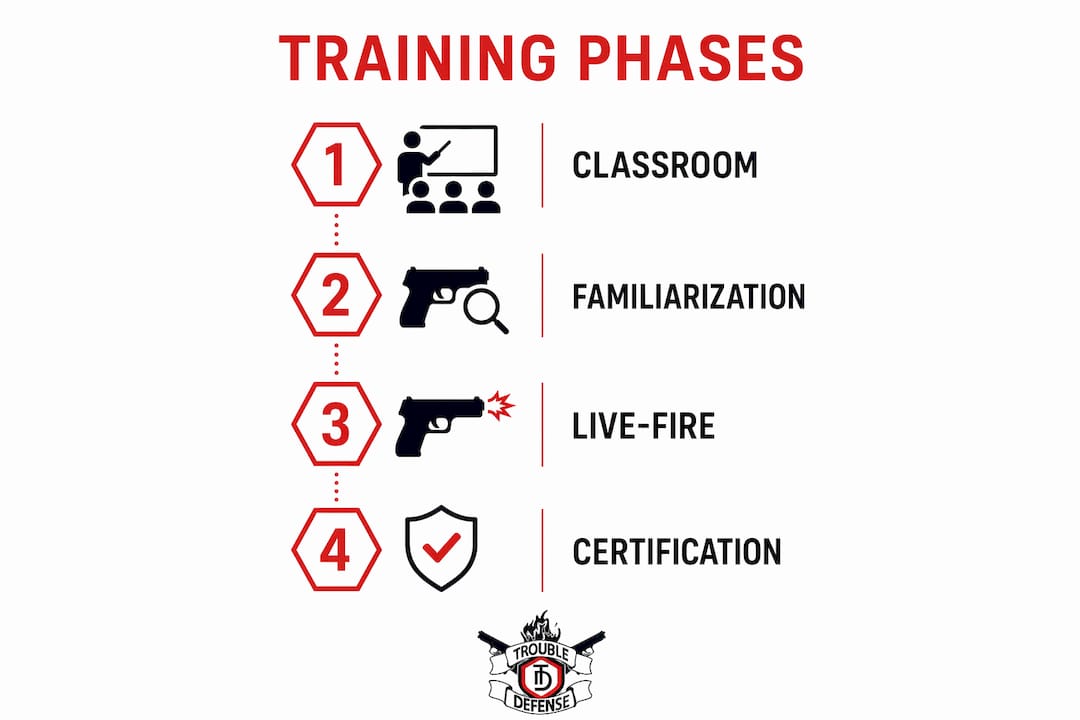
A well-structured firearm course moves through three clear phases: classroom instruction, firearm familiarization, and supervised live-fire practice. Training starts with safety rules, then progresses into hands-on handling and shooting drills with direct instructor supervision. Each phase builds on the last, so no student is rushed to the range before they are ready.
Classroom safety instruction
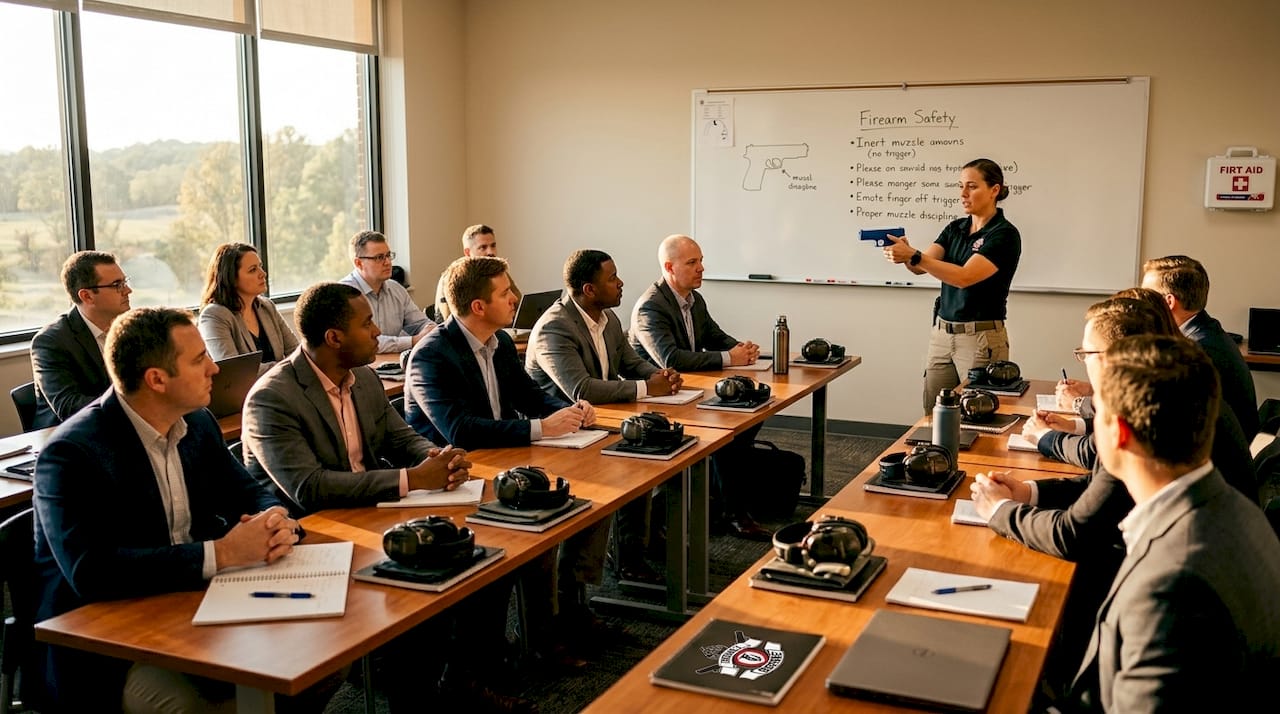
The first phase covers the four universal firearm safety rules. You will learn how to treat every firearm as if it is loaded, keep your finger off the trigger until ready to shoot, never point a muzzle at anything you are not willing to destroy, and always know your target and what lies beyond it. Instructors also cover Virginia range rules, safe storage, and the legal framework around defensive use.
Firearm familiarization
Before you fire a single round, you will handle the firearm in a controlled setting. This phase covers the parts of the pistol, how to load and unload safely, how to clear a malfunction, and how to perform a safe dry-fire check. For students in pistol training sessions, this is where grip, stance, and sight alignment are introduced and corrected before live ammunition enters the equation.
Supervised live-fire practice
The range session is where classroom knowledge becomes muscle memory. Instructors observe your grip, trigger control, and muzzle discipline in real time. Corrections happen immediately, which is far more effective than reviewing video footage after the fact. Students in firearm education programs at Trouble Defense report that this direct feedback is what separates a good course from a great one.
What to bring to your first session:
- Closed-toe shoes and clothing that covers your chest and neckline (to prevent hot brass burns)
- Eye protection and ear protection (often provided, but confirm with your instructor)
- A valid ID
- Any required course materials or pre-registration confirmation
Pro Tip: Eat a light meal before your range session. Low blood sugar affects concentration, and concentration is everything when handling a firearm.
How do you choose the right firearm training class in Fairfax?
Choosing the right course starts with knowing exactly why you need training. The answer shapes every decision that follows, from course type to instructor credential to class format.
-
Define your goal. Are you a first-time owner who needs firearm safety training? Are you applying for a Virginia CHP? Do you need court-ordered documentation? Each goal points to a different course type. Beginners benefit most from a safety-focused orientation. CHP applicants need a state-compliant concealed carry course. Court-ordered students need a course that produces legally recognized documentation.
-
Verify instructor credentials. The best firearm instructors hold NRA certification, law enforcement credentials, or both. Trouble Defense instructors are NRA-certified and carry years of real-world experience. Certification matters because it signals that the instructor has passed a standardized competency evaluation, not just logged range hours.
-
Confirm the course is in-person. Online firearm safety classes do not satisfy Virginia’s CHP requirement on their own. Some hybrid courses offer online pre-work followed by an in-person session. That format is acceptable, but the in-person component is mandatory. Always ask before you register.
-
Gather your documents before class day. Most courses require a valid ID at check-in. CHP-track courses may also ask for a completed application form. Having everything ready on day one prevents delays and keeps the class moving.
-
Handle your certificate carefully after completion. Your training certificate is a legal document. Store it with your other important records. If you are applying for a Virginia CCW, submit a copy and keep the original. Trouble Defense provides official documentation that circuit courts across Virginia accept.
For students who want to go beyond the basics, private firearm training offers one-on-one instruction tailored to your specific skill gaps, schedule, and goals. Private sessions are especially useful for students who felt rushed in a group setting or who want to build on their certification with more advanced drills.
Common questions about carrying laws and firearm training costs
Fairfax residents often have questions that go beyond the classroom. Here are the most common ones, answered directly.
How much does a concealed carry class cost in Fairfax?
Costs for concealed carry classes in Virginia typically range from $50 to $150, depending on course length and location. That range covers most standard CHP-track courses. Specialty courses, private instruction, or multi-state training programs carry higher fees.
Can I open carry in Fairfax without a permit?
Virginia is an open carry state, but open carry laws vary by locality, and Fairfax County has specific restrictions. Concealed carry always requires a valid CHP. Before carrying in any configuration, confirm current local ordinances. Laws change, and the consequences of a violation are serious.
Can I shoot in my backyard in Fairfax?
No. Shooting in residential backyards is heavily regulated and generally prohibited in Fairfax due to local safety ordinances. Discharge of a firearm outside of an approved range or designated area can result in criminal charges. Always use a licensed range.
Does online training count for my Virginia CHP?
Online-only courses do not meet Virginia’s legal standard for CHP applications. A hybrid course with a mandatory in-person component may qualify, but the in-person session cannot be skipped. When in doubt, ask your instructor to confirm that their course produces documentation accepted by Virginia circuit courts.
Trouble Defense also serves students who need training beyond Virginia. Programs cover Maryland Wear and Carry permits, Maryland HQL, and DC concealed carry requirements, making it a practical choice for DMV-area residents who cross state lines regularly.
Key takeaways
Fairfax firearm training requires in-person instruction from a certified trainer, produces legally recognized documentation, and builds the safety habits that responsible ownership demands.
| Point | Details |
|---|---|
| In-person training is mandatory | Virginia law requires in-person completion; online-only courses do not qualify for CHP applications. |
| Certification matters | Choose NRA-certified or law enforcement instructors to meet Virginia’s legal standard. |
| Know your goal before enrolling | Beginners, CHP applicants, and court-ordered students each need a different course type. |
| Costs are manageable | Virginia concealed carry courses typically range from $50 to $150. |
| Your certificate is a legal document | Store it carefully and submit it with your CHP application to the circuit court clerk. |
What I have learned from watching beginners become confident shooters
By Dee Parker
The most common thing I hear from first-time students is some version of “I don’t know if I can do this.” That fear is real, and it deserves respect. But I have watched hundreds of people walk into a classroom nervous and walk out of a range session with a completely different posture. Not because they became experts in one day, but because they finally understood what they were dealing with.
Proper training is designed to replace anxiety with structured habits. That is not a marketing claim. It is what happens when a patient instructor slows everything down and teaches you to think before you act. The students who struggle most are not the ones who are afraid. They are the ones who think they already know everything.
The lesson I keep coming back to is this: safety is not a checklist you complete once. It is a discipline you practice every single time you handle a firearm. Marksmanship is secondary. A student who hits the target but sweeps the muzzle across the room is more dangerous than a student who misses every shot but keeps the muzzle pointed downrange.
My advice to anyone starting out is to stay humble and stay curious. Ask questions. Accept corrections without embarrassment. The instructors who correct you are not criticizing you. They are doing exactly what they were trained to do. That feedback is the most valuable thing in the room.
— Dee Parker
Trouble Defense offers certified training built for Fairfax residents
Trouble Defense is a veteran-owned firearms training academy in Fairfax, VA, with over 300 five-star Google reviews and a track record of producing confident, certified graduates. Every course is led by NRA-certified instructors who prioritize patience, safety, and personalized coaching.
Courses include Virginia CCW certification, women’s firearm training, adaptive programs for individuals with disabilities, and safety orientations for first-time owners. If you need a fast-track CCW certification or want to review the full training calendar to find a class that fits your schedule, Trouble Defense has options ready. Contact Trouble Defense today to register for a course that meets Virginia’s legal requirements and builds the skills you need to carry with confidence.
FAQ
What is required to get a Virginia concealed carry permit?
Virginia requires proof of in-person firearm training from a certified instructor, a valid ID, a completed application, and a fee of $15–$50 paid to the circuit court clerk in your jurisdiction.
How long does a typical Fairfax firearm training course take?
Most standard concealed carry and safety courses run between four and eight hours, covering classroom instruction, firearm familiarization, and live-fire practice in a single day.
Can a first-time gun owner take a concealed carry class?
Yes. Courses like those offered by Trouble Defense are structured to accommodate complete beginners, starting with foundational safety rules before moving to hands-on firearm handling and range work.
Does Trouble Defense offer training for women and adaptive learners?
Yes. Trouble Defense provides dedicated women’s firearm training and adaptive programs designed for individuals with disabilities, including blind and low-vision students.
Is court-ordered firearm training available in Fairfax?
Yes. Certified in-person courses that produce legally recognized documentation satisfy court-ordered training requirements in Virginia. Confirm with your instructor that their course produces the specific documentation your court requires.
I like that you broke down what a typical training course includes instead of focusing only on permit requirements. One thing that also helps new shooters isBlog Comment Creation practicing the safety habits they learn between classes, since consistency can make a big difference in building confidence and handling a firearm responsibly.