Advanced firearms training is the process of developing superior shooting skills, safety awareness, and decision-making abilities through structured, scenario-based instruction that builds on basic proficiency. Most gun owners who stop at a basic safety course or casual range visits are leaving a critical gap between what they know and what they can actually do under pressure. That gap is exactly why advanced firearms training matters. Programs like those offered by Trouble Defense in Fairfax, VA, and the Texas A&M Engineering Extension Service (TEEX) demonstrate that structured, instructor-led training produces measurably better outcomes than self-directed practice alone.
Why advanced firearms training matters more than range time alone
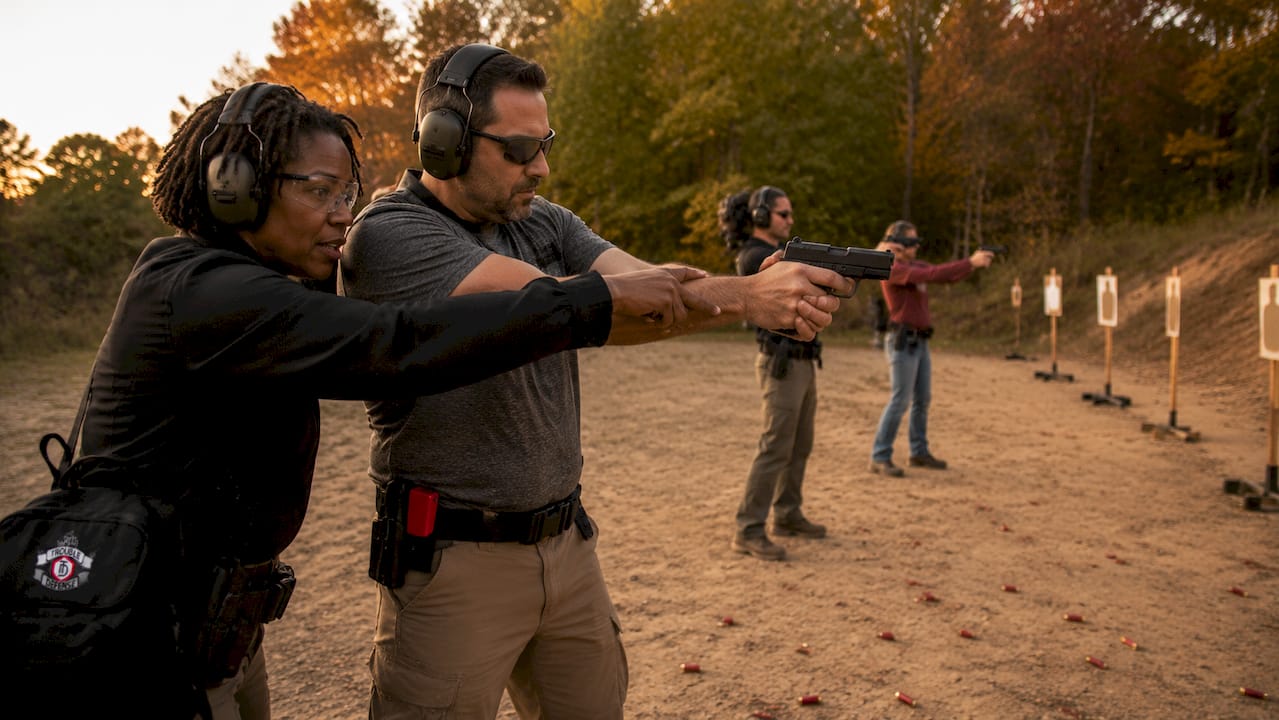
Spending hours at the range firing rounds does not automatically make you a better or safer shooter. Without professional instruction, poor techniques become permanent habits regardless of how much you practice. Grip errors, inconsistent draw mechanics, and poor recoil management get repeated and reinforced, not corrected.
Advanced marksmanship training fixes this by focusing on quality over quantity. A certified instructor watches how you grip the firearm, how you draw from a holster, and how your body reacts when the shot breaks. That diagnostic feedback is something no amount of solo range time can replicate.
A 2026 analysis of group shooting courses found that unstructured high-volume training dilutes supervision and skill development, and can reinforce unsafe behaviors. The takeaway is direct: volume without structure produces false confidence, not real capability.
True advanced shooting techniques also integrate movement, multiple targets, and shooting under physical and mental stress. These elements force your nervous system to adapt in ways that static range drills never will. The result is a shooter who can perform when conditions are unpredictable, not just when conditions are perfect.
Pro Tip: Record yourself at the range with your phone. Watching your own grip, stance, and trigger pull on video reveals errors that feel invisible in the moment. Bring the footage to your next instructor session for targeted corrections.
How does advanced training improve firearms safety?
Safety is not just a rule you memorize. It is a set of behaviors that must be trained until they are automatic. Advanced firearms safety training builds those behaviors through structured environments, qualified instructors, and formal safety systems that basic courses rarely include.
TEEX, one of the country’s leading public safety training organizations, requires its firearms instructor candidates to master course design, shooter diagnostics, safety gear standards, and documentation practices aligned with state certification standards. That level of rigor does not exist in casual range sessions.
Formal advanced training programs implement specific safety protocols that protect every person on the range:
- Mandatory safety gear standards including eye and ear protection requirements for all participants
- Stand-down protocols that allow any participant to pause training without penalty when safety concerns arise
- Drop on request procedures used in high-risk training environments, including those modeled after U.S. Navy CENSECFOR directives, which give participants full authority to stop an exercise immediately
- Supervised diagnostics where instructors identify and correct unsafe handling before bad habits cause accidents
- Documentation practices that track each shooter’s progress and flag recurring safety issues for follow-up
These systems matter because they create a feedback loop. Instructors who analyze shooter deficiencies and document training outcomes can catch safety problems early. That is a structural advantage that no amount of solo practice provides.
Trouble Defense builds this same safety-first culture into every course it offers, from Virginia CCW classes to adaptive firearms training for individuals with disabilities. Certified NRA instructors lead every session, and the training environment is designed so students leave confident, not just certified.
What role does psychological readiness play in advanced training?
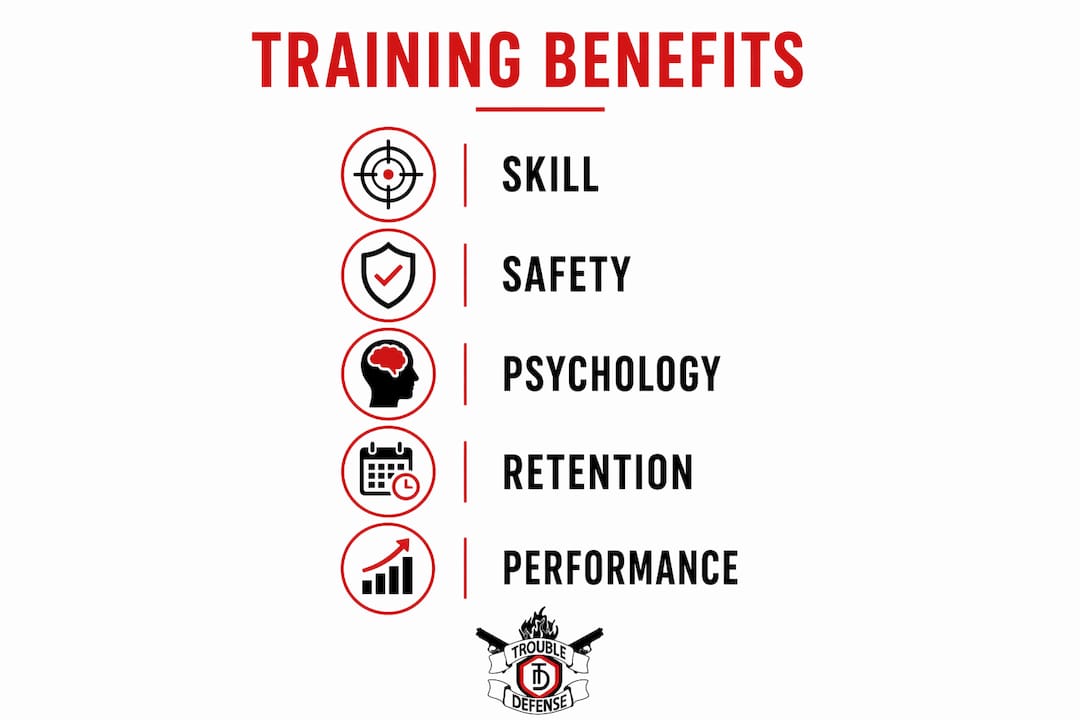
Psychological readiness is the most underestimated component of advanced firearms training. Most gun owners focus on the mechanical side, but the mind fails before the hands do in a real confrontation.
A 2026 randomized controlled trial with police cadets found that integrated psychological skills training produced large improvements in static, rapid, and tactical shooting performance. That means mental training is not a soft add-on. It is a core driver of shooting outcomes.
Stress degrades fine motor skills and narrows attention. Under real threat conditions, shooters who have only practiced on a calm square range often freeze, fumble, or make poor decisions. Scenario-based training that mimics real-world chaos is the only way to prepare the nervous system for those moments.
Effective stress inoculation training follows a clear progression:
- Baseline skill building under calm, controlled conditions to establish correct mechanics
- Timed pressure drills that introduce time constraints and force faster decision-making
- Scenario-based exercises using realistic props, role players, or force-on-force simulations
- Debrief and analysis where instructors review decisions made under stress and identify gaps
- Progressive overload by increasing scenario complexity as the shooter demonstrates readiness
The 2026 police training research also found that mindfulness and regulated breathing produce measurable improvements in attentional control during high-stakes shooting tasks. That finding applies directly to civilian defensive shooting, not just law enforcement.
Pro Tip: Practice controlled breathing before every live fire drill. Inhale for four counts, hold for four, exhale for four. This activates the parasympathetic nervous system and reduces the physiological arousal that degrades fine motor control.
Trouble Defense incorporates defensive shooting scenarios into its training curriculum, giving students the chance to practice decision-making under realistic pressure rather than just punching paper.
How does skill retention change without ongoing practice?
Skills learned in training decay without regular reinforcement. This is not opinion. A 12-month simulation study on basic life support found measurable skill decline within a year of initial training, even among participants who performed well immediately after their course. Firearms skills follow the same pattern.
The practical implication is direct: a gun owner who completes an advanced course and then stops practicing is not maintaining their capability. They are losing it.
The table below summarizes how skill retention typically behaves over time without reinforcement:
| Time Since Training | Skill Retention Level | Recommended Action |
|---|---|---|
| 0–30 days | High | Reinforce with weekly dry fire practice |
| 1–3 months | Moderate decline | Schedule monthly live fire sessions |
| 3–6 months | Noticeable degradation | Enroll in a refresher or skills course |
| 6–12 months | Significant loss | Complete a full advanced course review |
| 12+ months | Substantial decay | Treat as near-baseline and restart structured training |
Monthly range time slows decay but does not stop it. Periodic advanced courses, at minimum annually, are the only way to rebuild and extend capability. Trouble Defense offers a training calendar with more than 10 classes in Virginia, making it straightforward for DMV-area gun owners to stay current.
The impact of firearms education extends beyond individual skill. Gun owners who train consistently demonstrate better judgment, safer storage habits, and more responsible carry behavior. That is the long-term benefit that a single certification course cannot deliver on its own.
Key Takeaways
Advanced firearms training builds safety, skill, and psychological readiness through structured instruction that solo range practice cannot replicate.
| Point | Details |
|---|---|
| Range time alone is insufficient | Without corrective instruction, poor techniques become permanent habits that increase risk. |
| Qualified instructors are non-negotiable | Certified instructors diagnose shooter deficiencies and implement formal safety protocols. |
| Psychological readiness is trainable | Stress inoculation and scenario-based drills improve decision-making under real pressure. |
| Skills decay without reinforcement | Research shows measurable decline within 12 months, requiring regular refresher training. |
| Consistency beats volume | Monthly practice combined with annual advanced courses produces lasting capability. |
What I’ve learned about choosing the right advanced training program
The firearms training market has a real problem. A lot of what gets marketed as advanced instruction is closer to tactical entertainment. High round counts, dramatic drills, and military-style aesthetics attract students but do not always produce safer, more capable shooters.
The programs worth your time share three characteristics. First, the instructors hold verifiable credentials and can explain the reasoning behind every drill they run. Second, the curriculum progresses logically, building on assessed skills rather than jumping straight to complex scenarios. Third, there is a feedback mechanism, whether written assessments, video review, or instructor debriefs, so you leave knowing exactly what improved and what still needs work.
I have seen gun owners complete a 500-round weekend course and walk away with worse habits than they arrived with, because no one corrected their grip during the first drill. I have also seen a focused two-hour session with a qualified instructor produce more lasting improvement than months of solo range visits.
Mental rigor matters as much as physical repetition. The shooters who improve fastest are the ones who treat every drill as a diagnostic, not a performance. They are asking “what did I do wrong?” after every string of fire, not counting how many rounds they put downrange.
If you are in Virginia, Maryland, or DC, look for programs that offer concealed carry and self-defense training with structured assessments and certified instructors. That combination is the clearest signal that a program prioritizes your actual development over your entertainment.
— Dee Parker
Trouble Defense offers advanced training across Virginia, Maryland, and DC
Trouble Defense LLC is a veteran-owned firearms training academy based in Fairfax, VA, serving gun owners across the DMV area with structured, instructor-led courses that go well beyond basic certification.
Trouble Defense offers self-defense firearm training in Virginia, Maryland, and DC, along with Virginia CCW classes, Maryland Wear and Carry permit courses, women’s firearms training, active shooter response training, and adaptive programs for individuals with disabilities. Every course is led by certified NRA instructors in a supportive, safety-first environment. With over 300 five-star Google reviews, Trouble Defense has built a reputation as the DMV area’s most trusted training resource. Check the full course schedule and book the class that fits your current skill level.
FAQ
What is advanced firearms training?
Advanced firearms training is structured instruction that builds on basic marksmanship by adding scenario-based drills, stress inoculation, movement, and decision-making under pressure. It goes beyond static range practice to prepare gun owners for real-world defensive situations.
How often should you take advanced firearms training?
Annual advanced courses combined with monthly live fire practice is the minimum needed to prevent significant skill decay. Research on simulation-based training shows measurable decline within 12 months without reinforcement.
Does psychological training really improve shooting performance?
A 2026 randomized controlled trial found that integrated psychological skills training produced large improvements across static, rapid, and tactical shooting tasks. Mental preparation is a core component of advanced marksmanship, not an optional add-on.
What makes a firearms instructor qualified?
Qualified instructors hold recognized certifications such as NRA credentials or state-approved designations, and they can diagnose shooter deficiencies, design progressive courses of fire, and implement formal safety protocols. TEEX-level instructor training includes documentation practices and safety gear standards as core competencies.
Is advanced training only for law enforcement or military?
Advanced training is equally valuable for civilian gun owners, especially those who carry concealed. Trouble Defense serves clients ranging from first-time gun owners to veterans, offering courses in Virginia, Maryland, and DC designed specifically for civilian safety and self-defense preparedness.