Low vision firearm training is specialized instruction that equips individuals with visual impairments with adaptive tools and techniques to handle firearms safely and effectively. The goal is not just basic familiarity. It is genuine competence, personal safety, and confidence. Programs use equipment like high-contrast illuminated sights and electronic red-dot optics alongside tactile and auditory training methods. Certified instructors trained in adaptive techniques are the backbone of every effective program. Trouble Defense, a veteran-owned training academy in Fairfax, VA, offers adaptive firearms training recognized as a leading resource for visually impaired shooters across the DMV area.
What is low vision firearm training and who does it serve?
Low vision firearm training is defined as structured instruction designed for people whose vision cannot be fully corrected by standard lenses. This includes individuals with conditions like macular degeneration, glaucoma, diabetic retinopathy, and other forms of partial sight loss. The training does not require perfect vision. It requires the right methods and the right instructor.
The industry term for this field is adaptive firearms training, though “low vision firearm training” accurately describes the population it serves. Both terms appear throughout this guide because both reflect real search behavior and real program names. What matters most is that the training is built around your specific visual ability, not around an assumption that you see the way most shooters do.
Trouble Defense serves clients across Virginia, Maryland, and Washington DC who are looking for blind and low vision training that respects their abilities and builds on them. The program is recognized by the National Federation of the Blind, which signals a standard of credibility that generic shooting courses cannot match.
What adaptive equipment is used in low vision firearm training?
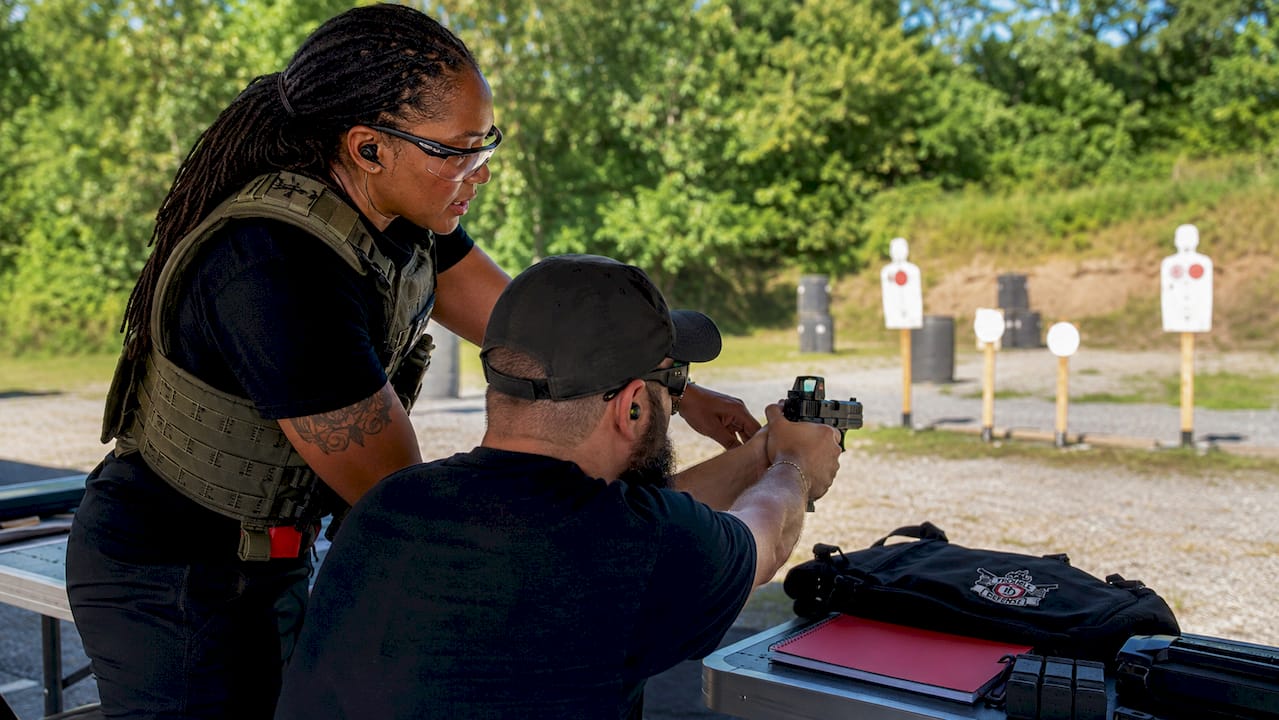
Electronic optics simplify aiming by providing a single focal plane, eliminating the multi-point alignment that traditional iron sights demand. That single change removes one of the biggest barriers visually impaired shooters face. Instead of aligning a rear sight, a front sight, and a target simultaneously, you focus on one point.
The table below summarizes the primary adaptive equipment categories, their function, and their benefit for low vision shooters.
| Equipment Type | Primary Function | Benefit for Low Vision Shooters |
|---|---|---|
| Red-dot optics | Projects a single illuminated dot onto a lens | Eliminates multi-plane sight alignment |
| Holographic sights | Displays a reticle at the target plane | Works at low magnification with reduced eye strain |
| High-contrast illuminated sights | Bright fiber-optic or tritium front sight | Visible in low light without electronic power |
| Tactile indexing aids | Physical reference points on grip and frame | Allows consistent hand placement by feel alone |
| Auditory feedback devices | Beeps or tones on trigger reset | Reinforces correct technique without visual confirmation |
Tactile indexing aids deserve more attention than they typically receive. These are physical markers, often raised dots or textured panels, placed on the firearm so the shooter can confirm grip and alignment by touch. They work alongside optics rather than replacing them. Together, these tools reduce the cognitive load of shooting so you can focus on safety and accuracy.
Pro Tip: Ask your instructor to let you handle the firearm with your eyes closed before your first live-fire session. This builds tactile memory faster than any visual drill.
How does adaptive firearm training actually work?
Professional adaptive instruction matters more than equipment alone. A red-dot sight placed in the hands of someone without proper coaching produces inconsistent results. The same sight, paired with a certified adaptive instructor, produces a shooter who understands why each technique works.
The NRA Adaptive Shooting Program trains instructors specifically to work with shooters who have physical and sensory disabilities. Instructors learn to use tactile cues, verbal coaching, and modified drills that replace or supplement visual feedback. This methodology is the foundation that programs like Trouble Defense build on.
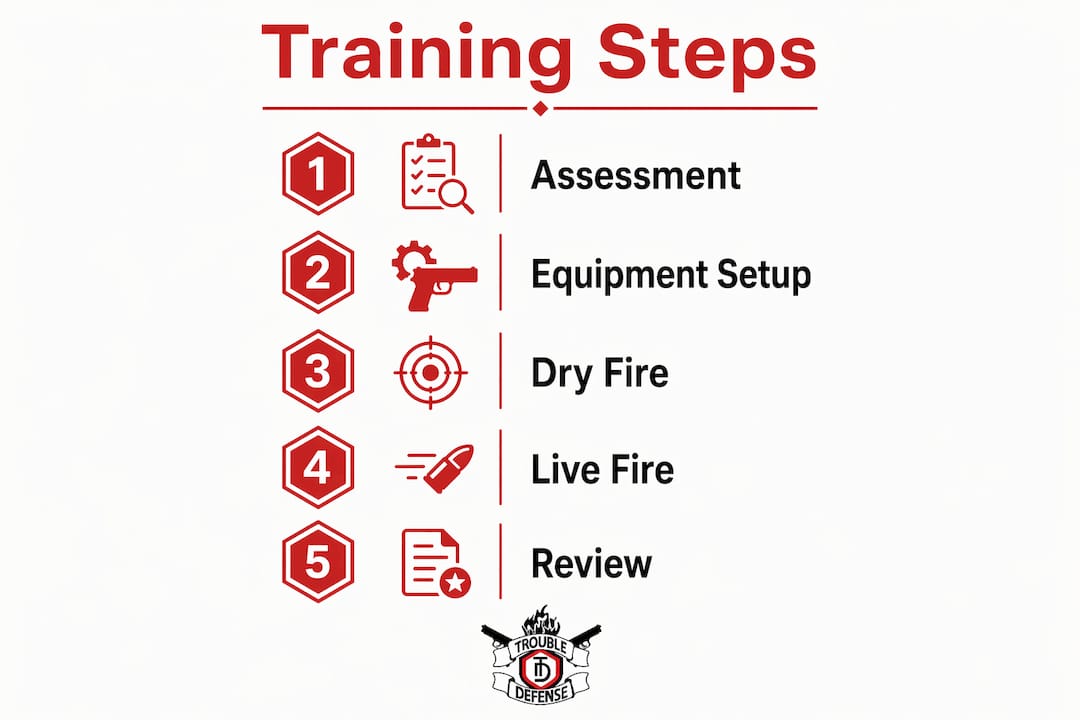
A typical adaptive session follows a structured progression:
- Safety orientation. Review of the four fundamental firearm safety rules, adapted for tactile and auditory confirmation rather than visual checks alone.
- Equipment fitting. Selecting and adjusting the optic, grip aids, and any tactile indexing tools to match your specific vision profile.
- Dry-fire practice. Repeated trigger pulls and grip drills without live ammunition to build muscle memory before adding the variable of recoil.
- Stance and position work. Establishing a consistent, repeatable body position that does not depend on visual reference points.
- Live-fire fundamentals. Short-distance shooting with immediate instructor feedback, using auditory cues to confirm trigger reset and follow-through.
- Review and adjustment. Debriefing on what worked, what needs refinement, and what the next session will target.
Adaptive shooting programs typically offer one-on-one instruction at approximately $40 per session, including equipment and ammunition. That cost reflects the personalized attention required. Group classes cannot deliver the same level of customization.
Pro Tip: Record your sessions on a phone or tablet placed behind you. Reviewing your stance and grip on video catches errors that neither you nor your instructor can see in real time.
What are the legal considerations for visually impaired firearm owners?
The legal environment for firearm training for visually impaired individuals varies significantly by state. State requirements differ widely, with some states requiring vision tests for carry permits and others allowing training accommodations. Iowa, for example, allows permits for individuals with significant visual impairments provided they complete training. Nebraska requires documented vision proof, which limits access for many applicants.
New York’s legislation S.10438 allows seated live-fire training for individuals with physical disabilities without reducing safety or proficiency standards. That law reflects a broader national shift toward accommodation rather than exclusion. It also signals that legislators are beginning to recognize that disability does not equal danger.
Disability rights advocates argue that excluding visually impaired people from firearm training or carry rights may violate the Americans with Disabilities Act. The ADA requires equal access to public accommodations and services, and firearms training facilities are increasingly being evaluated under that standard.
Key legal points every low vision shooter should know before enrolling in a program:
- Verify your state’s vision requirements for concealed carry permits before investing in training. Requirements are not uniform and can change.
- Request written accommodation policies from any training facility before booking. A reputable program will have them.
- Carry documentation of your visual condition to your first session. Instructors need accurate information to tailor the program safely.
- Understand that training completion does not guarantee permit approval. Licensing decisions rest with state authorities, not instructors.
- Consult a firearms attorney if your state’s requirements seem to conflict with your ADA rights. Several advocacy organizations offer free initial consultations.
Trouble Defense publishes a clear accessible training statement outlining its ADA compliance policies and commitment to low vision clients. Reviewing that document before your first call saves time and sets accurate expectations.
How do you choose and prepare for an adaptive firearm training program?
Selecting the right program starts with verifying instructor credentials. Look for certification through the NRA Adaptive Shooting Program or equivalent recognized bodies. A general firearms instructor without adaptive training experience is not the right fit for a low vision shooter.
Questions to ask before committing to a program:
- Does the instructor have documented experience with low vision or blind shooters specifically?
- What adaptive equipment does the facility provide, and can you test it before purchasing your own?
- Is the range physically accessible, including parking, restrooms, and the shooting bay itself?
- What is the cancellation and rescheduling policy if a session needs to change?
- Does the program offer a progression path from beginner to advanced, or is it a single introductory session?
Preparation before your first session matters as much as the session itself. Effective preparation includes understanding your state’s laws, confirming your physical readiness, and communicating your specific vision profile to your instructor in advance. Bring any existing medical documentation about your vision condition. The more your instructor knows before you arrive, the more productive the session will be.
Expect your first two or three sessions to focus almost entirely on safety and dry-fire fundamentals. Progress in adaptive shooting is real, but it is measured in weeks and months, not a single afternoon. Budget for at least four to six sessions before evaluating whether the program is working for you.
What challenges do low vision shooters face, and how do you overcome them?
Common challenges include reduced visual feedback, inconsistent muscle memory, and fatigue from heightened concentration. These are real obstacles. They are also manageable with the right approach.
Practical strategies for overcoming the most frequent difficulties:
- Reduced visual feedback. Replace it with tactile and auditory confirmation. Trust your grip index and listen for trigger reset rather than watching the sight picture.
- Inconsistent muscle memory. Commit to short, frequent dry-fire sessions at home between range visits. Fifteen minutes daily beats a two-hour session once a month.
- Mental fatigue. Adaptive shooting demands more cognitive focus than standard training. Keep sessions to 45–60 minutes until your concentration builds.
- Overreliance on the optic. An electronic sight can fail. Practice with your tactile indexing aids as a backup so you are never entirely dependent on a battery.
- Isolation. Connect with adaptive shooting communities online and in person. Peer support from other low vision shooters accelerates learning and sustains motivation.
Pro Tip: Set a specific, measurable goal for each session, such as achieving a consistent grip index on ten consecutive draws. Vague goals produce vague results.
Key Takeaways
Adaptive firearm training gives low vision individuals a structured, safe path to genuine shooting competence through specialized equipment and certified instruction.
| Point | Details |
|---|---|
| Equipment reduces complexity | Red-dot and holographic optics eliminate multi-plane alignment, the biggest technical barrier for low vision shooters. |
| Instructor quality is decisive | Certified adaptive instructors, not equipment alone, determine whether training produces safe, confident shooters. |
| Legal requirements vary by state | Research your state’s vision and permit rules before enrolling; Iowa and Nebraska represent opposite ends of the spectrum. |
| Preparation accelerates progress | Communicating your vision profile to your instructor before session one produces faster, safer results. |
| Consistency builds skill | Short, frequent practice sessions outperform infrequent long ones for building the muscle memory adaptive shooting requires. |
Why adaptive firearm training changed how I think about personal safety
I have worked with hundreds of students across a wide range of abilities, and the ones who surprise me most are low vision shooters who arrive convinced they cannot do this. Within two sessions, that belief is gone. What replaces it is not just a shooting skill. It is a fundamentally different relationship with personal safety.
The technology has genuinely changed the picture. Red-dot optics and tactile indexing tools available in 2026 are far more refined than what existed even five years ago. But I want to be direct about something the equipment conversation often obscures: the instructor matters more than the gear. I have seen expensive setups fail students because the coaching was generic. I have seen simple, affordable setups produce excellent shooters because the instruction was tailored and patient.
What I find most meaningful is the shift in confidence that happens outside the range. Students who complete adaptive training carry themselves differently. They make better decisions about personal safety because they understand their own capabilities clearly. That clarity is the real outcome of good training. The shooting skill is the vehicle. The confidence is the destination.
If you have low vision and you have been told that firearms are not for you, I would push back on that hard. The right program, with the right instructor, changes that narrative completely.
— Dee Parker
Trouble Defense’s adaptive training program for low vision shooters
Trouble Defense offers adaptive blind and visually impaired firearms training led by certified instructors with direct experience working with low vision and blind shooters. Sessions are personalized, one-on-one, and built around your specific vision profile and safety goals.
The program covers adaptive equipment selection, tactile and auditory technique, safety fundamentals, and a clear progression path from beginner to confident shooter. Trouble Defense serves clients across Virginia, Maryland, and Washington DC, with scheduling options designed to fit real life. If you have questions about whether adaptive training is right for you, the firearm safety training guide on the Trouble Defense website is a strong starting point. Contact Trouble Defense directly to discuss your situation and book a consultation.
FAQ
What is adaptive firearm training for low vision individuals?
Adaptive firearm training is specialized instruction that uses modified equipment and non-visual techniques to teach safe, effective shooting to people with visual impairments. It replaces traditional sight-based aiming with tactile indexing, auditory cues, and single focal plane optics.
Can a person with low vision legally carry a firearm?
Legal rights vary by state. Iowa permits individuals with significant visual impairments to carry with proper training, while states like Nebraska impose stricter vision documentation requirements. Disability advocates note that blanket exclusions may conflict with ADA protections.
How much does adaptive firearm training cost?
Adaptive shooting programs typically charge around $40 per session, including equipment and ammunition, based on one-on-one instruction formats. Costs vary by location, instructor credentials, and session length.
What equipment do low vision shooters use at the range?
Low vision shooters commonly use red-dot optics, holographic sights, high-contrast illuminated front sights, and tactile indexing aids placed on the grip and frame. These tools reduce the complexity of aiming and allow consistent positioning by feel.
How do I find a certified adaptive firearms instructor?
Look for instructors certified through the NRA Adaptive Shooting Program or programs recognized by organizations like the National Federation of the Blind. Trouble Defense in Fairfax, VA is one recognized provider serving the DMV region.