How Your First Shooting Experience Works: A Beginner’s Guide
Your first shooting experience is a safe, structured, and instructor-led process designed to help new shooters feel comfortable from the moment they arrive. Understanding how your first shooting experience works removes uncertainty and helps you focus on learning the fundamentals of firearm safety and marksmanship. Whether you’re visiting a gun range for recreation, personal protection, or firearms training, knowing what to expect makes the experience far more enjoyable.
Many people imagine their first shooting experience will be intimidating, but most beginners quickly discover that the biggest challenge isn’t shooting the firearm—it’s simply learning how the range operates. Once you understand the check-in process, safety rules, and instructor guidance, your confidence grows with every step.
This guide explains how your first shooting experience works, from checking in at the front desk to taking your gun range first shot under the supervision of a certified instructor. If it’s your beginners first time shooting, you’ll know exactly what to expect before you ever step onto the range.
How Does Your First Shooting Experience Work Step by Step?
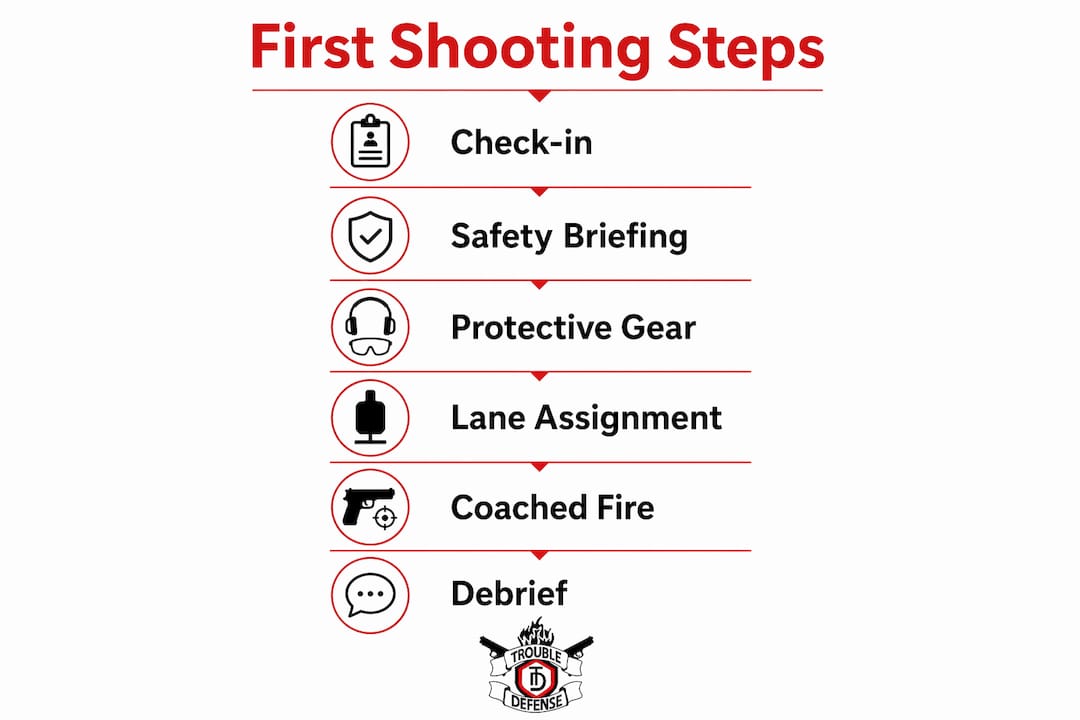
Every professional indoor shooting range follows a structured process to ensure safety, organization, and a positive learning environment. Your first shooting experience typically includes:
- Check-in and registration
- Safety briefing
- Protective equipment
- Lane assignment
- Firearm orientation
- Supervised live-fire practice
- Coaching and skill improvement
Following these steps allows beginners to enjoy safe and successful shooting experiences while building confidence with every round fired.
Step 1: Check-In and Paperwork
Your first shooting experience begins at the front counter. You’ll present a valid government-issued photo ID, complete a liability waiver, and answer a few questions about your previous firearms experience. This process usually takes less than ten minutes.
The staff will ask whether this is your beginners first time shooting so they can recommend the appropriate firearm, assign an instructor if needed, and ensure you receive the proper level of guidance. At Trouble Defense LLC, we tailor every beginner lesson to your comfort level, making your first visit enjoyable and stress-free.
Step 2: Safety Orientation
Before handling any firearm, every new shooter participates in a mandatory safety briefing. This orientation explains how your first shooting experience works while covering the range’s rules, emergency procedures, and the Four Universal Rules of Firearm Safety.
You’ll also learn common range commands such as:
- Range Hot
- Range Cold
- Cease Fire
Understanding these commands before stepping onto the firing line helps eliminate anxiety during your first shooting experience. Knowing exactly what each command means allows you to focus on learning instead of worrying about what comes next.
Step 3: Protective Gear
No shooting experiences begin without proper safety equipment. Eye and ear protection are required at all times while on the range.
Most ranges provide loaner safety glasses and hearing protection, although many shooters eventually purchase their own electronic earmuffs for greater comfort and communication. Protective gear should remain on whenever the firing line is active, including while preparing for your gun range first shot.
Once you’re properly equipped, your instructor will escort you to your shooting lane, explain how the firearm operates, and guide you through your very first shots in a safe, controlled environment.
Step 4: Lane assignment and firearm introduction
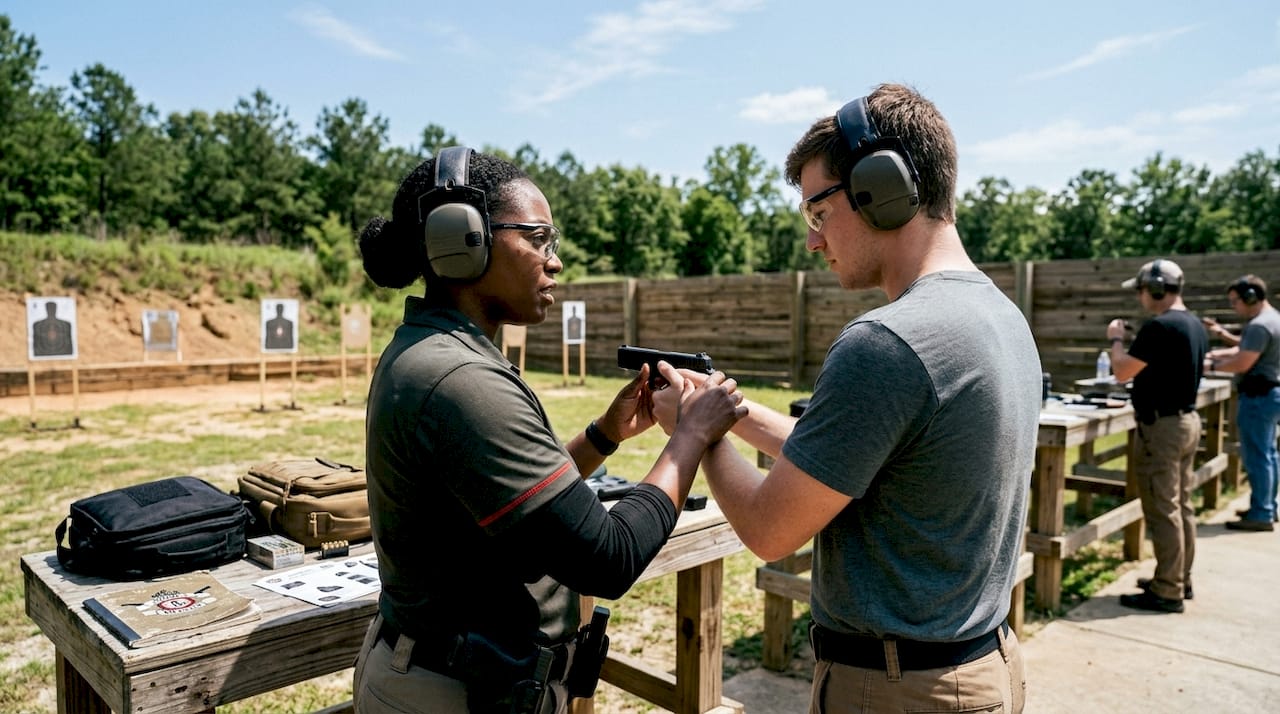
A staff member or certified instructor walks you to your assigned lane and introduces you to the firearm you will use. For most beginners, that means a .22 LR pistol or a 9mm semi-automatic. The instructor demonstrates how to hold the firearm, where to place your finger, and how to point the muzzle safely downrange before any live ammunition is involved.
Step 5: Coached live fire
First-time live fire is best conducted at close distances, around 3–7 yards, focusing on fundamentals rather than speed or accuracy. Your instructor coaches stance, grip, sight alignment, and trigger control in real time. You fire a small number of rounds, pause, and receive feedback before continuing.
Step 6: Debrief and next steps
After your session, the instructor reviews what you did well and where to improve. This is the right moment to ask about beginner classes, Virginia CCW training, or any follow-up programs that match your goals.
Pro Tip: Arrive 15 minutes early on your first visit. The extra time lets you complete paperwork without feeling rushed and gives you a few minutes to observe the range environment before your briefing starts.
What are the four firearm safety rules every beginner must know?
The four foundational safety rules are taught upfront to every beginner: treat every firearm as loaded, keep the muzzle pointed in a safe direction, keep your finger off the trigger until you are ready to shoot, and identify your target and what lies beyond it. These rules are not suggestions. They are the non-negotiable baseline for every person who handles a firearm.
Here is what each rule means in practice:
- Treat every firearm as loaded. Even if you watched someone clear the chamber, handle the gun as if it can fire. This habit prevents the most common cause of accidental discharge.
- Keep the muzzle pointed in a safe direction. Downrange is always safe. Toward the ceiling, floor, or a person is never acceptable. This rule applies whether you are loading, unloading, or simply holding the firearm.
- Keep your finger off the trigger until ready to shoot. Your trigger finger stays straight and outside the trigger guard until your sights are on the target and you have made the decision to fire. Instructors will correct this immediately if they see it.
- Identify your target and what lies beyond it. A bullet does not stop at the target. Knowing what is behind your target is a legal and ethical responsibility, not just a range rule.
“Safety rules work as a layered system where failure of one rule is mitigated by others.” — AGI Safety Guide
That layered approach is what makes the system so effective. If you forget one rule in a moment of distraction, the others still protect everyone around you. Reviewing these gun safety rules before your visit gives you a head start that instructors will notice.
How does instructor support shape a beginner’s experience?
Instructors do far more than watch you shoot. Range staff encourage beginners to ask questions at any point and provide continuous safety oversight throughout the session. That open-door approach removes the pressure of feeling like you should already know what you are doing.
Here is what good instructor support looks like during a first session:
- Stance and grip coaching. Your instructor positions your feet, adjusts your grip, and checks your wrist angle before you fire a single round. A correct safe gun handling stance prevents fatigue and improves control immediately.
- Trigger control feedback. Instructors watch for jerking or slapping the trigger and correct it with verbal cues and physical demonstration. Smooth trigger press is the single biggest factor in where your shots land.
- Flinch management. Flinching is an expected physiological reaction when firing a gun for the first time. Instructors focus on smooth trigger press and controlled breathing to help you work through it. Most shooters see improvement within the same session.
- Command reinforcement. Instructors confirm that you understand commands like “range hot” and “cease fire” before the range goes live. Understanding these commands boosts both safety and comfort.
- Normalizing nerves. Good instructors acknowledge that nervousness is normal and reframe it as readiness. Recognizing that feeling as a natural response prevents it from becoming a distraction.
Pro Tip: Before touching the trigger, ask your instructor to confirm your muzzle direction and finger position. That 10-second check builds the habit of deliberate verification that experienced shooters use every time.
What practical tips help first-time shooters succeed?
A successful first session comes down to managing expectations and focusing on the right things. Starting close with simple targets builds confidence faster than pushing for accuracy or speed early on. Here is what to keep in mind:
- Set up at 3–7 yards. Close distance removes the pressure of hitting a small target and lets you focus entirely on technique. Accuracy follows good fundamentals, not the other way around.
- Use a simple target. A single center dot or a basic silhouette reduces perceptual overload. The “aim small, miss small” principle applies here: a small aiming point sharpens your focus on sight alignment and trigger press.
- Wear the right clothing. Closed-toe shoes are required at most ranges. Avoid low-cut tops, which can allow hot brass casings to fall inside your collar. A simple T-shirt and jeans work well.
- Keep your session short. One to two hours is enough for a first visit. Mental fatigue sets in faster than physical fatigue when you are processing new information and managing sensory input.
- Expect the noise. Even with hearing protection, the sound of a gunshot is intense. The first shot will likely startle you. That reaction is normal and fades quickly with repetition.
- Do not compare yourself to experienced shooters. The person in the next lane has likely fired thousands of rounds. Your only benchmark on day one is safe, deliberate trigger press.
- Ask about follow-up training. After your session, ask staff about beginner firearm classes, indoor shooting range programs, or structured courses that build on what you learned.
The goal of your first visit is not a tight group on paper. The goal is leaving the range with safe habits, a clear understanding of the process, and the confidence to come back.
Key Takeaways
A first shooting experience follows a structured, instructor-guided process where safety rules, protective gear, and close-range practice work together to build confidence and foundational skills.
| Point | Details |
|---|---|
| Structured check-in process | Every visit starts with ID, a waiver, and a mandatory safety briefing before any firearm handling. |
| Four safety rules are non-negotiable | Treat every gun as loaded, control the muzzle, keep finger off trigger, and know your target and backstop. |
| Start at 3–7 yards | Close-range shooting builds correct habits faster than chasing accuracy at distance. |
| Instructors manage flinch and nerves | Flinching is normal on first shots; instructors use breathing and trigger drills to correct it quickly. |
| Command literacy matters | Knowing “range hot,” “range cold,” and “cease fire” before you arrive reduces stress and increases safety. |
What I’ve learned watching first-timers find their footing
Most first-timers walk in expecting the hardest part to be the shooting. It almost never is. The real adjustment is the environment: the noise, the commands, the unfamiliar equipment, and the feeling of being watched. Once the safety briefing ends and the first round fires, the tension drops noticeably for the majority of new shooters.
What I have seen consistently is that the shooters who progress fastest are not the ones with the steadiest hands. They are the ones who ask the most questions. Asking your instructor to check your grip, confirm your stance, or explain a command is not a sign of weakness. It is exactly the behavior that separates shooters who build lasting skills from those who develop bad habits they spend years correcting.
The other thing worth saying plainly: patience with yourself is a skill. Beginners who compare their first session to an experienced shooter’s performance almost always leave frustrated. Beginners who focus on one clean trigger press at a time leave with something real. That focus on building firearm confidence through small, deliberate wins is what good instruction looks like in practice.
One common mistake I see is skipping the debrief. That five-minute conversation after your session is where you find out what you actually did well and what to work on next. Do not walk past it. The feedback you get there shapes your next session more than anything else.

— Dee Parker
Ready to take your first step at Trouble Defense?
Trouble Defense is a veteran-owned firearms training academy based in Fairfax, VA, serving the entire DMV area including Virginia, Maryland, and Washington DC. Certified NRA instructors lead every class, and the environment is built specifically for new shooters who want clear guidance without pressure.
Whether you are pursuing a Virginia CCW certification, a Maryland Wear and Carry permit, or simply want to build safe firearm habits from day one, Trouble Defense has a program for you. The academy also offers women’s firearm training, adaptive programs for individuals with disabilities, and youth firearm safety education. With over 300 five-star Google reviews, Trouble Defense is the trusted starting point for new shooters across the region. Explore the full firearm safety training guide to find the right class for your goals.
FAQ
What ID do I need for my first range visit?
A government-issued photo ID such as a driver’s license or passport is required at check-in. You will also sign a liability waiver before entering the range floor.
What should I wear to a shooting range?
Wear closed-toe shoes and avoid low-cut tops, since hot brass casings can fall inside open necklines. Comfortable, form-fitting clothing that does not restrict arm movement works best.
Is flinching normal for first-time shooters?
Yes. Flinching is a normal physiological reaction to the noise and recoil of a first shot. Instructors address it directly through breathing techniques and smooth trigger press drills.
How close should a beginner shoot on their first visit?
Starting at 3–7 yards is the standard recommendation. Close distance keeps the focus on fundamentals like grip, stance, and trigger control rather than on hitting a distant target.
Do I need to bring my own firearm or gear?
No. Most ranges, including Trouble Defense, provide firearms, ammunition, and loaner protective gear for beginners. Bringing your own eye and ear protection is always an option if you prefer a personal fit.