
Firearm Safety Before Your Range Visit. Firearm safety before a range visit is defined as the complete set of handling rules, equipment checks, and behavioral protocols a shooter must follow before stepping onto a firing line. The National Shooting Sports Foundation (NSSF) and the NRA both identify four core rules as non-negotiable: treat every firearm as loaded, never point the muzzle at anything you are not willing to destroy, keep your finger off the trigger until ready to shoot, and know your target and what lies beyond it. Skipping any one of these steps before you arrive at the range creates real risk. This guide walks you through exactly what to bring, how to inspect your firearm, and how to conduct yourself once you get there.
What essential items should you prepare before your range visit?Firearm Safety Before Your Range Visit 2
Every indoor shooting range requires a valid government-issued photo ID, a signed safety waiver, and ANSI/ISEA Z87.1 approved eye and ear protection. That standard is not optional. Eye protection marked “Z87+” on the frame or lens meets the high-impact requirement; anything less does not qualify.
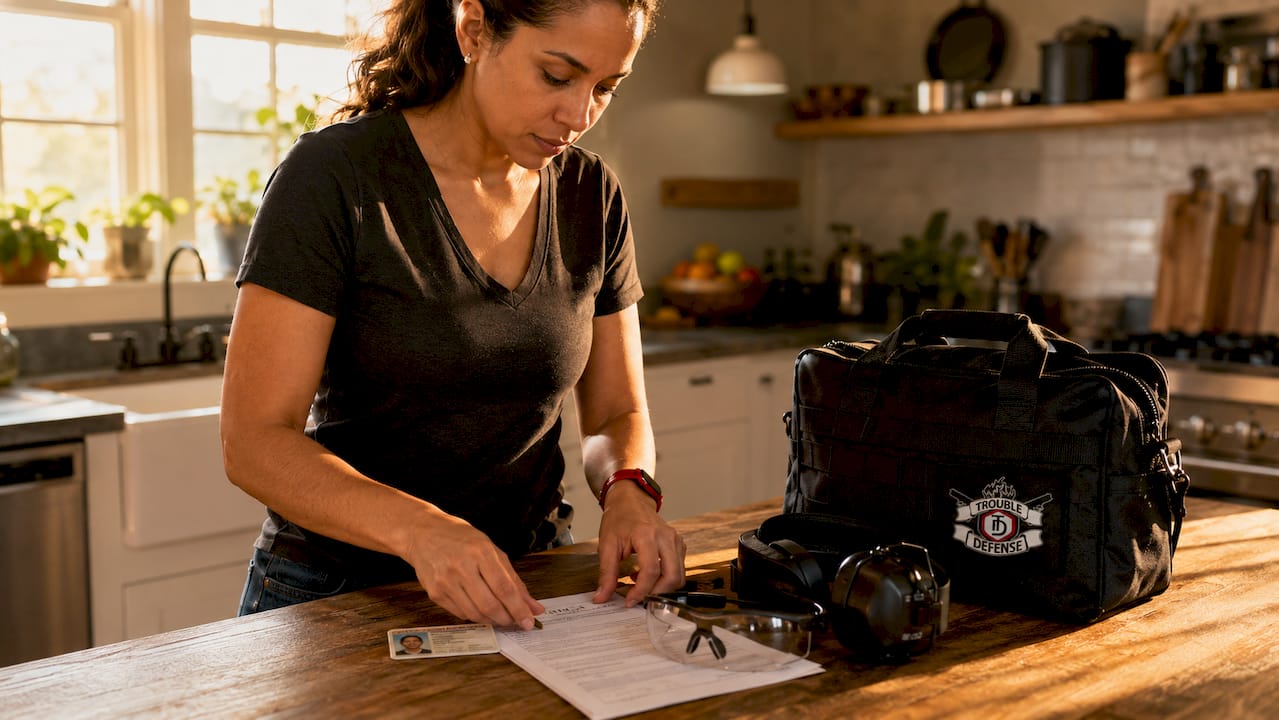
Clothing matters more than most first-time shooters expect. Wear closed-toe shoes and a high crew-neck shirt. Brass casings eject at high speed and land on exposed skin, which causes flinching and unsafe muzzle movement. A snug collar prevents hot brass from falling inside your shirt.
For a typical first indoor handgun session, bring 100–200 rounds and 3–4 magazines. That quantity keeps you shooting without constant interruptions to reload, which helps you stay focused on technique rather than logistics.
Your pre-range checklist:
- Valid government-issued photo ID
- Signed range safety waiver (some ranges provide this on arrival; others require advance completion)
- ANSI/ISEA Z87.1 rated safety glasses marked “Z87+”
- Hearing protection rated at least NRR 25 (earmuffs or foam plugs)
- Closed-toe shoes and a high crew-neck shirt
- 100–200 rounds of factory-loaded ammunition in the correct caliber
- 3–4 magazines or speed loaders
- A basic range toolkit: a small cleaning rod, a bore snake, and a microfiber cloth
- Targets (many ranges sell them on site, but bringing your own saves time)
- A range bag to keep everything organized and transport your firearm safely
Pro Tip: Call the range ahead of time to confirm their specific ammunition restrictions. Some indoor ranges prohibit steel-core or steel-jacketed rounds to protect their backstops.
How to properly inspect your firearm before heading to the range. Firearm Safety Before Your Range Visit 3
A standard pre-range inspection takes about 10 minutes and covers barrel condition, mechanical safety function, trigger feel, and ammunition integrity. Those 10 minutes prevent the majority of mechanical malfunctions on the firing line.
Start with the barrel. Remove the magazine, lock the slide or cylinder open, and visually inspect the bore for obstructions. Even a small obstruction, like a patch of dried solvent or a fragment of a previous round, can cause a dangerous pressure spike. If you cannot see daylight through the barrel clearly, do not shoot until you clear it.
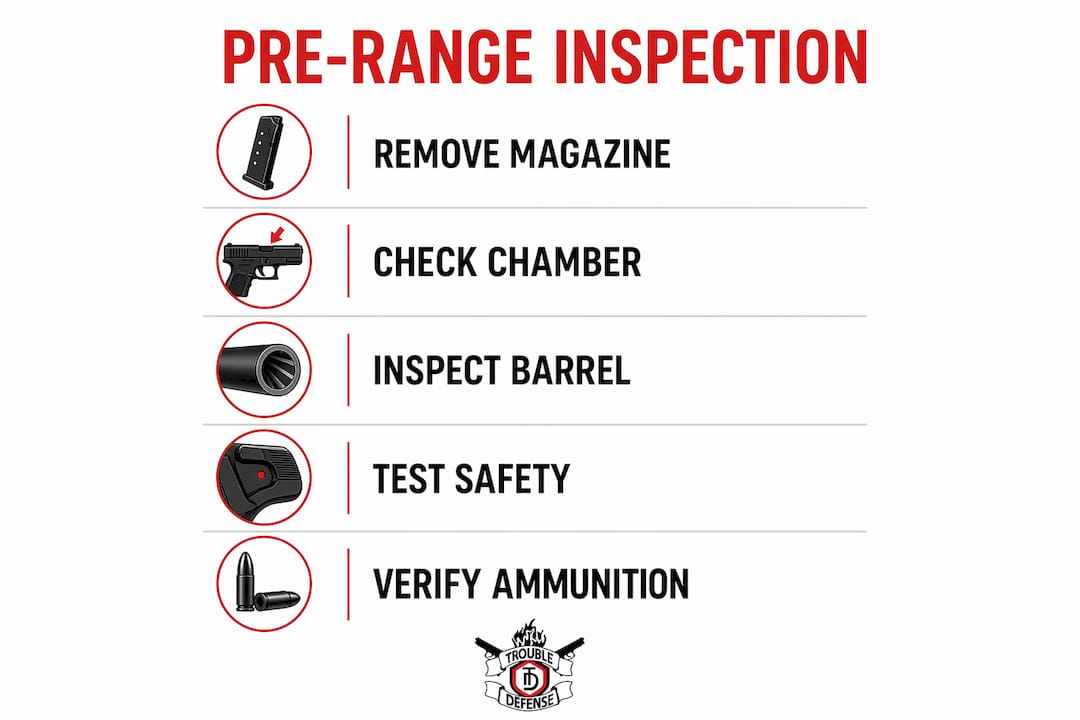
Next, check the mechanical safety. Engage and disengage it several times to confirm it moves crisply and holds position. A safety that feels loose or fails to engage is a warning sign that needs attention before the range, not during it.
Step-by-step firearm inspection:
- Remove the magazine and lock the action open.
- Visually inspect the chamber to confirm it is empty.
- Inspect the barrel bore for obstructions using a bore light or natural light.
- Check the mechanical safety for crisp engagement and release.
- Inspect the trigger for smooth, consistent pull with no grinding or excessive play.
- Examine the frame, slide, and grip for cracks, rust, or damage.
- Inspect each round of ammunition for dents, corrosion, discoloration, and bullet setback.
- Perform a dry-fire test pointing in a safe direction to confirm trigger reset and feel.
Inspection checkpoints and warning signs:
| Checkpoint | What to look for | Warning sign |
|---|---|---|
| Barrel bore | Clear, clean, no obstructions | Visible blockage, pitting, or fouling |
| Mechanical safety | Crisp engagement and release | Loose, sticky, or fails to hold |
| Trigger pull | Smooth, consistent weight | Gritty, mushy, or inconsistent |
| Frame and slide | No cracks, rust, or damage | Visible cracks, heavy rust, loose fit |
| Ammunition | Correct caliber, no defects | Dents, setback, corrosion, discoloration |
Inspect each round carefully for case dents, corrosion, and bullet setback before loading. Setback occurs when a bullet is pushed deeper into the case, which raises chamber pressure to dangerous levels. Any round showing defects goes in the trash, not the magazine.
Pro Tip: Dry-fire testing with an empty chamber reveals gritty or mushy trigger pulls that signal early mechanical wear. Fix those issues before you arrive, not after you are already on the firing line.
What are the key safety rules and range etiquette to observe? Firearm Safety Before Your Range Visit 4
Treating every firearm as loaded at all times is the single rule that prevents the most accidents. Human error during clearing procedures is a leading cause of range incidents. The moment you assume a firearm is safe because you removed the magazine, you create the conditions for a negligent discharge.
Range Safety Officers (RSOs) are your most valuable resource on the range. RSOs monitor trigger discipline, muzzle direction, and rule compliance at all times. They are not there to intimidate beginners. They actively encourage new shooters to ask questions, and they prefer a question over an unsafe action every time.
“The range officer is not your adversary. They are the person standing between a mistake and a tragedy. Treat every instruction from an RSO as a direct safety command.”
Top safety rules and etiquette points:
- Keep the muzzle pointed downrange at all times, even when loading or clearing a malfunction.
- Keep your finger straight and outside the trigger guard until your sights are on target and you have decided to shoot.
- Know your target and what lies beyond it before every shot.
- Wear eye and ear protection from the moment you enter the range bay until you leave it.
- Follow all RSO commands immediately and without question.
- Never handle a firearm when anyone is downrange.
- Announce “cease fire” loudly if you observe an unsafe condition.
- Keep firearms unloaded and actions open when not on the firing line.
- Do not rush. Most range mishaps come from rushing, losing muzzle awareness, and letting the trigger finger drift onto the trigger guard.
- Clean up your brass and targets before leaving the bay.
Trigger finger indexing is a skill RSOs watch closely. Indexing means keeping your trigger finger pressed flat against the frame above the trigger guard during reloads, malfunctions, and any moment you are not actively firing. It is a habit that takes deliberate practice to build, and it is one of the clearest signs of a trained shooter.
How to prepare mentally and physically for your first range session. Firearm Safety Before Your Range Visit 5
Arriving early is the single most effective thing a first-time shooter can do. Check-in, paperwork, and safety briefings take time. Rushing through them puts you on the firing line before you are mentally ready, which is exactly when mistakes happen.
Physical preparation is straightforward. Get adequate sleep the night before. Stay hydrated. Avoid caffeine in excess, since it increases hand tremor and reduces fine motor control. Wear comfortable clothing that does not restrict movement at the shoulders or arms.
Pro Tip: Practice controlled breathing before your first shot. Inhale, exhale halfway, pause, then press the trigger. This technique reduces body movement and builds a consistent shot process from your very first round.
Mental preparation matters as much as physical readiness. Set a specific goal for the session before you arrive, whether that is grouping five shots within a 4-inch circle at 7 yards or simply completing a full magazine without a safety error. A defined goal keeps you focused and prevents the aimless shooting that leads to bad habits.
Common beginner pitfalls to avoid:
- Anticipating recoil by pushing the muzzle down before the shot breaks (called “flinching”)
- Gripping the firearm so tightly that your hands shake
- Looking at the target instead of the front sight
- Shooting too fast before building a consistent trigger press
- Skipping the safety briefing because it feels repetitive
Certified instructors consistently find that slow, deliberate shooting habits reduce accidents and build skills faster than high-volume, fast-paced sessions. Speed is a product of consistency, not the other way around. Beginners who focus on process over pace leave the range with better fundamentals and more confidence.
Reviewing common mistakes new gun owners make before your first session gives you a concrete list of behaviors to watch for in yourself. Self-awareness on the range is a safety skill, not just a performance skill.
Key Takeaways
Proper firearm safety before a range visit requires a complete pre-visit checklist, a thorough firearm inspection, and consistent adherence to the four core NRA safety rules throughout your session.
| Point | Details |
|---|---|
| Documentation and gear | Bring a valid photo ID, signed waiver, and ANSI/ISEA Z87.1 rated eye and ear protection to every range visit. |
| Pre-range inspection | Spend 10 minutes checking the barrel, safety, trigger, and ammunition before leaving home. |
| Treat every firearm as loaded | Never assume a firearm is safe based on magazine status; this rule prevents the most accidents. |
| Pace and mindset | Slow, deliberate shooting builds better habits and reduces safety errors faster than rushing. |
| RSOs are a resource | Ask Range Safety Officers questions freely; they prefer questions over unsafe actions. |
What I have learned from watching shooters prepare (and not prepare) for the range
By Dee Parker
After years of working with first-time shooters and experienced gun owners alike, the pattern I see most often is this: the people who get hurt or embarrassed at the range are almost never careless people. They are prepared people who skipped one step because they were confident. Confidence without a checklist is the real hazard.
The four NRA safety rules are not a beginner’s framework. They are the permanent operating system for every shooter at every skill level. I have watched experienced shooters with hundreds of range hours sweep a muzzle across a lane because they got comfortable. Comfort is not the same as competence.
What separates a safe shooter from a dangerous one is not talent. It is habit. The pre-range inspection, the trigger finger discipline, the deliberate pace. These are not rules you follow until you get good. They are rules you follow because you are good.
My strongest recommendation for anyone preparing for a range visit is to pursue formal firearm safety training before or alongside your first sessions. A qualified instructor catches the habits you cannot see in yourself. That feedback is worth more than any amount of solo practice.
Treat range staff with respect. Treat your fellow shooters with patience. And treat every firearm as if it is loaded, because one day, the one you thought was clear will not be.
— Dee Parker
Trouble Defense: professional training for every shooter
Trouble Defense LLC, a veteran-owned firearms training academy based in Fairfax, VA, offers structured courses designed to build exactly the skills covered in this guide, from pre-range inspection habits to live-fire fundamentals.

Whether you are preparing for your first range visit, pursuing a Virginia CCW certification, or looking for women’s firearm training in a supportive environment, Trouble Defense has a course built for you. The academy also offers adaptive firearms training for individuals with disabilities and beginner-friendly programs for tourists visiting the DMV area. All courses are led by certified NRA instructors with a track record of over 300 five-star Google reviews. Browse the full firearm safety training guide to find the right starting point for your skill level.
FAQ
What do I need to bring to a shooting range?
Most ranges require a valid government-issued photo ID, a signed safety waiver, and ANSI/ISEA Z87.1 rated eye and ear protection. Bring your firearm, the correct ammunition, and 3–4 magazines for a standard session.
How do I inspect my firearm before the range?
Remove the magazine, lock the action open, and visually confirm the chamber is empty. Then check the barrel for obstructions, test the mechanical safety, inspect the trigger pull, and examine each round of ammunition for defects like dents, corrosion, or setback.
What is the most important firearm safety rule?
Treat every firearm as loaded at all times, regardless of magazine status or whether you just cleared the chamber. Human error during clearing procedures is a leading cause of range accidents.
Can I ask the range safety officer for help?
RSOs actively encourage beginners to ask questions and prefer a question over an unsafe action. They monitor trigger discipline and muzzle direction and serve as a direct resource, not just an enforcer.
How much ammunition should I bring to my first range session?
Bring 100–200 rounds for a typical first indoor handgun session. That quantity provides enough practice to build consistency without creating downtime from constant reloading.