Obtaining a firearm safety certificate requires passing a state-mandated written test, completing required training, and demonstrating basic firearm handling knowledge before you can legally purchase or possess a firearm. The Firearm Safety Certificate (FSC) is the recognized industry term for this credential, though the specific firearm safety certificate steps vary significantly depending on your state. California and Colorado represent two distinct models: one relies on a short dealer-administered exam, while the other involves a multi-phase process coordinated through county sheriffs and Colorado Parks and Wildlife (CPW). Knowing which process applies to you before you walk into a gun store saves time, money, and frustration.
What are the basic requirements before starting firearm safety certificate steps?
Every state with a mandatory certification process sets eligibility criteria you must meet before you can even register for a test or course. Getting these prerequisites sorted first prevents wasted trips and application rejections.
Age and residency are the baseline. Most states require applicants to be at least 18 years old for long guns and 21 for handguns, with valid government-issued photo identification proving state residency. You will also need to pass a background check at the point of purchase, which is separate from the certification process itself.
Documentation to gather before you start:
- Valid state-issued driver’s license or ID card
- Proof of residency if your ID address is outdated
- Any prior training certificates if you are applying for an exemption or expedited pathway
- Payment for test fees (California charges $25 for the FSC exam)
Exemptions exist and are worth checking. Certain categories are exempt from FSC requirements in California, including active and retired peace officers, active military personnel, federally licensed dealers (FFL holders), and valid concealed carry permit holders. This means if you already hold a valid CCW permit, you may skip the standard certification test entirely in California.
Preparation materials matter more than most first-timers expect. California’s DOJ publishes an official FSC study guide covering firearm safety rules, storage laws, and legal ownership requirements. Colorado’s CPW website provides course outlines and instructor directories. Reviewing these materials before your test date directly improves your pass rate. Because firearm safety certificate requirements vary by state and purpose, identifying your specific jurisdiction’s credential before proceeding is the single most important first step.
How does the firearm safety certificate test work?
The test format, passing threshold, and subject matter differ by state, but the core topics remain consistent: safe storage, legal ownership, handling rules, and firearm mechanics.
California’s written test format:
- The FSC exam consists of 30 multiple-choice questions, administered at any licensed firearm dealer in the state.
- You need 23 correct answers to pass, which equals a 75% passing score.
- The $25 fee is paid at the dealer, and the certificate is issued the same day if you pass.
- The certificate is valid for five years from the date of issuance.
- Core subject areas include the four fundamental safety rules, safe storage requirements, California firearm laws, and basic handling procedures.
Colorado’s exam is more demanding. The CPW program requires a 90% passing score on both the written exam and the practical skills assessment. This higher threshold reflects Colorado’s more involved certification structure, which includes hands-on components that California’s current written-only process does not require.
What the test actually covers goes beyond memorizing rules. Expect questions on trigger discipline, muzzle direction, safe storage of loaded versus unloaded firearms, and the legal consequences of improper storage when children are present. California’s study guide specifically addresses scenarios involving home defense, transportation, and storage in vehicles.
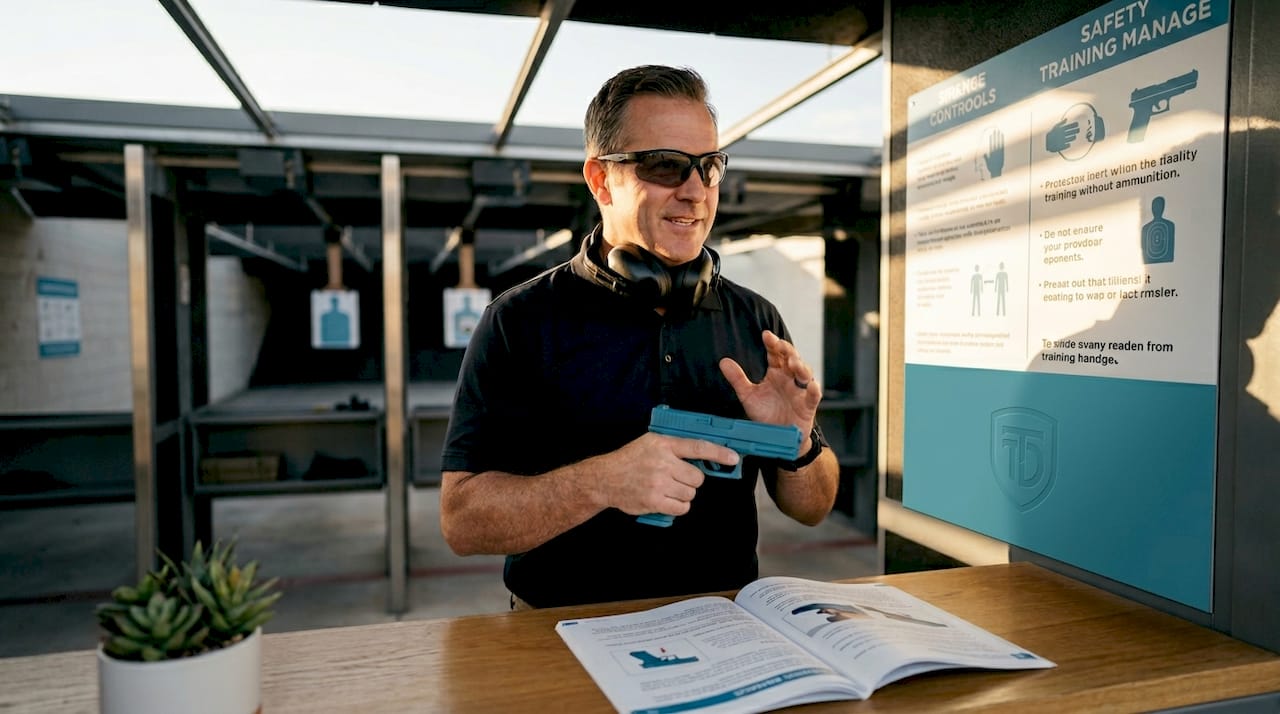
Pro Tip: Take at least two full practice tests using California’s official DOJ study guide or CPW’s published materials before your exam date. Most people who fail do so on the legal and storage questions, not the handling basics.
Test locations are more accessible than most people realize. In California, any licensed dealer can administer the FSC exam, which means you can often complete the test the same day you intend to purchase a firearm. Colorado’s exam is administered through CPW-approved instructors, which requires advance scheduling.
What training courses and practical demonstrations does certification involve?
Training requirements represent the biggest difference between states and the area most likely to catch first-time applicants off guard.
| Feature | California (Current FSC) | Colorado (CPW Program) |
|---|---|---|
| Course length | No mandatory course; written test only | 4 hours (with hunter ed) or 12 hours (without) |
| Live-fire requirement | None currently | Yes, mandatory practical exam |
| Passing score | 75% written | 90% written and practical |
| Administered by | Licensed firearm dealers | CPW-verified instructors |
| Certificate validity | 5 years | 5-year eligibility card |
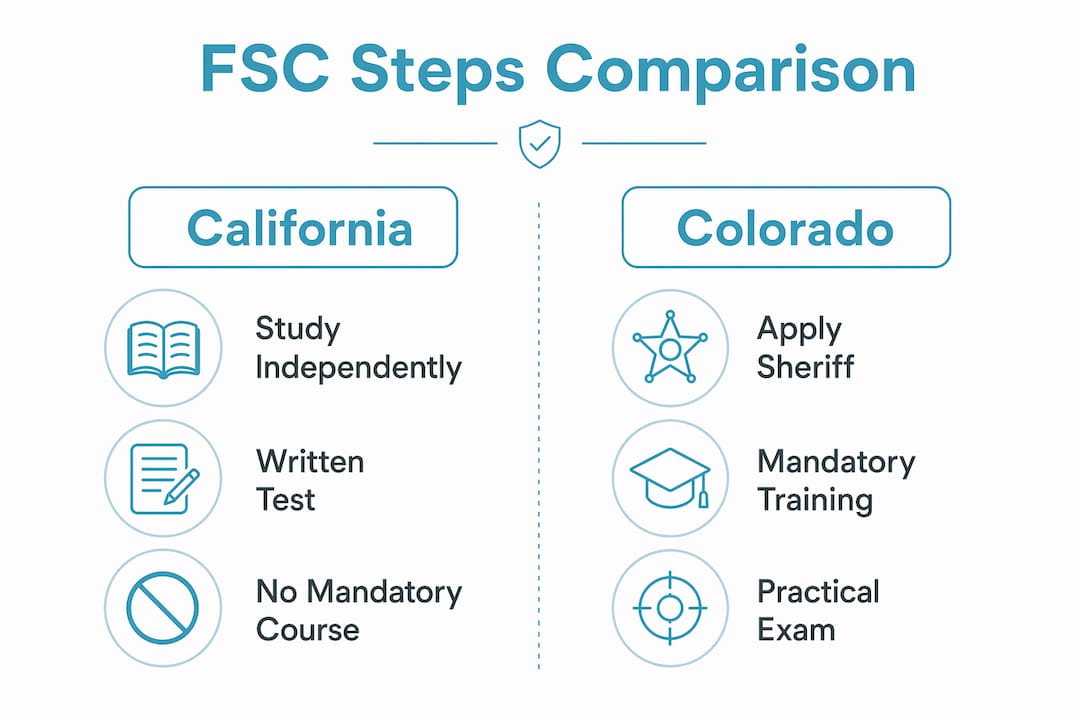
California’s current process is the simpler of the two. No mandatory training course precedes the FSC exam. You study independently, walk into a licensed dealer, pay $25, take the 30-question test, and receive your certificate the same day. That changes under proposed legislation. California SB 948 would require an 8-hour training course including live-fire exercises supervised by DOJ-certified instructors, with implementation targeted for 2028. This represents a significant shift from a self-study model to a structured, instructor-led program.
Colorado’s process is already structured this way. Colorado’s CPW program includes a stepwise process: sheriff reviews your application and issues an eligibility card, then you complete an instructor-led course (4 hours if you have hunter education credentials, 12 hours if you do not), followed by a mandatory 90% passing score on both the final exam and the practical skills demonstration.
Instructor verification is not optional in Colorado. Instructors must be verified by sheriffs and are required to enter student scores into the CPW database within 3 business days of course completion. This data integrity requirement means your certification is officially recorded and verifiable, which matters when you go to purchase a firearm.
Pro Tip: If you are in Virginia or the DMV area and want hands-on training that prepares you for any state’s practical requirements, look for NRA-certified instructors who include live-fire components. This preparation exceeds the minimum standard and builds genuine confidence.
It is worth noting that public safety courses often provide safety education and certificates of attendance but exclude hands-on firearm handling. Attendees at these events are typically required to leave firearms at home. These courses do not substitute for state-mandated certification and should not be confused with the FSC process.
How do California and Colorado firearm safety processes compare?
Understanding the structural differences between these two state models helps you plan your timeline accurately, especially if you have recently moved or are purchasing a firearm in a state where you are not a long-term resident.
| Category | California FSC | Colorado CPW |
|---|---|---|
| First step | Study independently | Apply to county sheriff |
| Eligibility verification | At point of purchase | Sheriff issues eligibility card first |
| Training required | None (changing in 2028) | 4 or 12 hours, instructor-led |
| Practical exam | No | Yes, 90% required |
| Certificate issued by | Licensed dealer (same day) | CPW database after instructor entry |
| Renewal | Retake written test | Retake full process after 5 years |
California’s model prioritizes speed and accessibility. You can walk into a licensed dealer, take the test, and walk out with a certificate in under an hour. The same-day certificate issuance model works because the FSC is specifically tied to the point of purchase, not to a broader training credential.
Colorado’s model separates eligibility, training, and qualification into distinct phases. Colorado’s stepwise program reduces applicant confusion by assigning each phase to a different verified authority: the sheriff handles eligibility, CPW-approved instructors handle training, and the CPW database records qualification. This structure takes longer but produces a more thoroughly verified outcome.
The trend nationally points toward Colorado’s model. California SB 948 signals that longer courses with live-fire training are replacing simple written testing as the standard for firearm safety certification. First-time buyers in 2026 who plan to purchase in California before 2028 should act under the current written-test model while it remains available.
What are the most common mistakes when completing certification steps?
Most certification failures are not about knowledge gaps. They are about timing, documentation, and misunderstanding what the certificate actually authorizes.
The most frequent pitfalls include:
- Starting too late relative to your purchase date. Colorado’s process involves sheriff review, eligibility card issuance, course scheduling, and score entry. This can take weeks. Certification course validity is tied to a 5-year eligibility card, so strategic timing matters from the beginning.
- Confusing the FSC with general safety training. The distinction between a short dealer-administered FSC test and more involved live-fire safety training is critical. Passing the FSC authorizes you to purchase a firearm. It does not certify you as a trained shooter.
- Overlooking expiration dates. Both California and Colorado certificates expire after five years. If you completed training years ago and are now making a new purchase, verify your certificate is still valid before visiting a dealer.
- Failing to keep documentation. Score entry delays can occur in Colorado’s system. Maintaining proof of course completion and communications with your instructor protects you if your eligibility verification is delayed.
- Attending a public safety event expecting it to count. Free community firearm safety events, like those offered in James City County, VA, provide gunlock materials and general education but do not satisfy state FSC requirements.
Pro Tip: Plan backwards from your intended purchase date. If you are in Colorado, add at least three to four weeks to your timeline to account for sheriff processing and course scheduling. In California, the same-day model gives you more flexibility, but study first.
Key takeaways
Completing firearm safety certificate steps requires matching your state’s specific process to your timeline, documentation, and training requirements before your purchase date.
| Point | Details |
|---|---|
| Know your state’s model | California uses a same-day written test; Colorado requires a multi-phase sheriff and CPW process. |
| Check exemptions first | Peace officers, military, and CCW holders may qualify for FSC exemptions in California. |
| Plan your timeline early | Colorado’s process can take weeks; plan backwards from your intended firearm purchase date. |
| Keep all documentation | Score entry delays happen; retain proof of completion and instructor communications. |
| Watch for legislative changes | California SB 948 will require 8-hour live-fire courses starting in 2028, replacing the current written test. |
What I’ve learned from watching people navigate this process
I have seen the same pattern repeat itself more times than I can count. Someone decides they want to purchase a firearm, walks into a dealer, and discovers they need a certificate they did not know existed. They scramble, they rush, and they either fail the test because they did not prepare or they miss their purchase window because the process took longer than expected.
The certification process is not the obstacle. Lack of preparation is. California’s FSC exam is genuinely straightforward if you spend two hours with the official study guide. Colorado’s process is more involved, but it is also clearly documented on the CPW website. The information is there. Most people just do not look for it until they are standing at the counter.
What I find more interesting is the gap between getting certified and actually being safe. Passing a 30-question written test tells you the rules. It does not build the muscle memory, the situational awareness, or the confidence that comes from structured, hands-on instruction. California SB 948 is a legislative acknowledgment of exactly this gap. Moving toward 8-hour live-fire courses supervised by DOJ-certified instructors is the right direction, even if the 2028 timeline feels distant.
My advice: treat the certification as the floor, not the ceiling. Get certified, yes. Then find a qualified instructor and take a real training course. The certificate gets you legal. The training keeps you and everyone around you safe.
— Dee
Get certified with confidence through professional firearm training
Whether you are completing steps for firearm certification for the first time or refreshing your skills before a renewal, professional instruction makes the difference between passing a test and genuinely understanding safe firearm handling.
Trouble Defense LLC, a veteran-owned firearms training academy in Fairfax, VA, offers NRA-certified instruction designed for first-time gun owners, legal requirement attendees, and experienced shooters alike. With over 300 five-star Google reviews and specialized programs including adaptive training and women’s firearm courses, Trouble Defense builds real confidence alongside legal compliance. Browse the upcoming training classes to find a course that fits your schedule and certification needs. You can also explore the full range of firearm training services to find the right fit for your experience level and goals.
FAQ
What is a firearm safety certificate?
A Firearm Safety Certificate (FSC) is a state-issued credential that demonstrates you have passed a required test or training program covering safe firearm handling, storage, and applicable laws. In California, it is required before purchasing most firearms from a licensed dealer.
How long does it take to get a firearm safety certificate?
In California, the FSC can be obtained the same day at a licensed dealer after passing a 30-question written test. Colorado’s CPW process involves sheriff review, course completion, and score entry, which typically takes several weeks from start to finish.
What score do you need to pass the firearm safety certificate test?
California requires a 75% passing score, meaning 23 correct answers out of 30 questions. Colorado’s CPW program requires a 90% passing score on both the written exam and the practical skills assessment.
Who is exempt from the firearm safety certificate requirement in California?
Active and retired peace officers, active military personnel, federally licensed dealers, and valid concealed carry permit holders are exempt from California’s FSC requirement at the point of purchase.
Will firearm safety certificate requirements change in the future?
Yes. California SB 948 proposes replacing the current written test with an 8-hour training course including live-fire exercises supervised by DOJ-certified instructors, with implementation targeted for 2028. This reflects a broader trend toward more rigorous hands-on certification standards.